

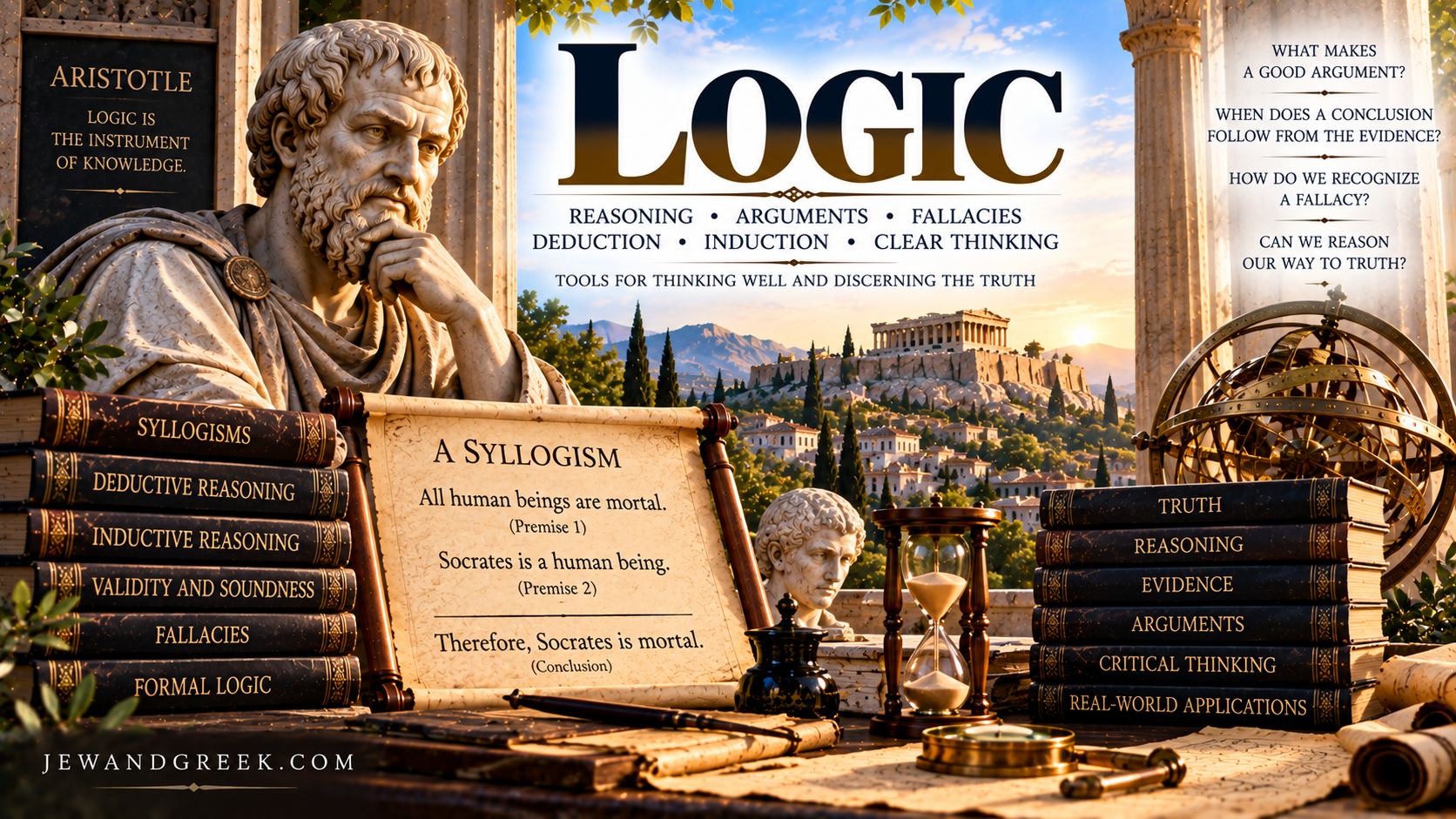
Logic is the branch of philosophy concerned with correct reasoning. It examines the principles that distinguish good arguments from bad ones, conclusions that genuinely follow from their premises from conclusions that merely appear persuasive, and reliable forms of inference from common errors in thought. Whenever someone asks whether a conclusion follows from the evidence, whether an argument contains a contradiction, or whether a claim has actually been demonstrated, that person is already asking a logical question. Logic therefore lies beneath philosophy, mathematics, science, theology, law, historical investigation, and ordinary conversation.
The importance of logic extends far beyond formal academic arguments. Human beings constantly reason from what they believe to conclusions about what they should believe or do. We evaluate political claims, advertisements, sermons, scientific reports, historical arguments, social-media posts, and explanations offered by friends and coworkers. Some arguments persuade because they are logically strong; others persuade because they appeal to fear, loyalty, prejudice, authority, or emotion. Learning logic does not guarantee that a person will reach the truth, but it provides essential tools for recognizing when reasoning supports a conclusion and when it does not.
What Is an Argument?
In logic, an argument is not necessarily a disagreement or quarrel. It is a collection of statements in which one or more statements, called premises, are offered as reasons for accepting another statement, called the conclusion. Consider the classic example: all human beings are mortal; Socrates is a human being; therefore, Socrates is mortal. The first two statements are premises, while the final statement is the conclusion they are intended to support.
Arguments can be extremely simple or extraordinarily complicated. A philosophical book may contain hundreds of pages of reasoning supporting several major conclusions, while an ordinary conversation may contain an argument expressed in a single sentence. Sometimes premises remain unstated because the speaker assumes the audience already accepts them. Learning to identify arguments therefore requires asking what conclusion a person is attempting to establish and what reasons are being offered in support of it. Much confusion disappears once premises and conclusions are made explicit.
Deductive Reasoning
Deductive reasoning attempts to establish conclusions that necessarily follow from the premises. If a deductive argument is correctly structured, it is impossible for all its premises to be true while its conclusion is false. The Socrates argument illustrates this form perfectly. If all human beings are mortal and Socrates is a human being, then Socrates must be mortal.
Deduction is especially important in mathematics and formal logic, but it also appears throughout philosophy and ordinary reasoning. Its strength lies in necessity: a valid deductive argument does not merely make its conclusion probable. However, deduction cannot guarantee that the premises themselves are true. An argument may be perfectly valid while beginning from false assumptions, which is why logic distinguishes carefully between the structure of an argument and the truth of its starting points.
Validity
A deductive argument is valid when its conclusion follows necessarily from its premises. Validity concerns the relationship between premises and conclusion rather than whether the premises happen to be true. Consider the argument: all birds can speak English; Plato is a bird; therefore, Plato can speak English. The argument is logically valid even though its premises are obviously false.
This distinction initially seems strange because people commonly use valid to mean something like “correct.” Formal logic uses the term more narrowly. Validity asks whether the conclusion would have to be true if the premises were true. This allows philosophers to examine the structure of reasoning separately from disputes about factual claims and makes it possible to identify precisely where an argument fails.
Soundness
A sound argument is a valid deductive argument whose premises are actually true. Soundness therefore combines correct logical structure with accurate starting information. If an argument is sound, its conclusion must be true.
This distinction is crucial because demonstrating validity alone does not establish a conclusion. Someone defending an argument must also provide adequate reasons for accepting its premises. Many philosophical disagreements occur precisely at this level. Two people may agree completely that a conclusion follows from certain premises while disagreeing strongly about whether those premises should be accepted. Careful argument therefore requires examining both logical form and evidential support.
Syllogisms
Aristotle developed the first extensive formal system of logic in Western philosophy through his analysis of syllogisms. A syllogism contains premises involving categories and produces a conclusion from the relationships among those categories. The famous argument about Socrates is an example of categorical reasoning: all humans belong to the category of mortal things; Socrates belongs to the category of humans; therefore, Socrates belongs to the category of mortal things.
Aristotle systematically identified patterns of syllogistic reasoning that produce valid conclusions and distinguished them from invalid forms. His logical writings became enormously influential and were studied for centuries in Christian, Jewish, and Islamic intellectual traditions. Medieval universities made logic a foundational part of education because students were expected to reason carefully before moving into advanced study of philosophy or theology. Although modern logic has expanded far beyond Aristotelian syllogisms, Aristotle’s basic insight remains central: arguments can be studied according to their form.
Inductive Reasoning
Not every good argument produces certainty. Inductive reasoning moves from observations or particular cases toward broader conclusions that are probable rather than logically necessary. If thousands of carefully observed ravens have been black, we acquire reason to expect other ravens to be black, but the conclusion does not follow with deductive certainty. One previously unknown white raven would be enough to overturn the universal claim.
Science relies extensively upon inductive reasoning. Experiments involve limited observations, yet scientists attempt to discover patterns and laws extending beyond the specific cases already examined. Ordinary life depends upon induction as well. We expect food to nourish us, buildings to remain standing, and familiar people to behave with some continuity because past experience provides evidence about what is likely to occur. Inductive arguments are therefore evaluated primarily by the strength of their evidence rather than by deductive validity.
The Problem of Induction
David Hume famously raised a profound difficulty concerning induction. Why should past experience provide reliable information about the future? We expect the sun to rise tomorrow because it has always done so within human experience, but claiming that the future will resemble the past appears itself to rely upon an inductive assumption.
Hume’s challenge does not make ordinary or scientific reasoning useless. Human beings cannot realistically function without expecting some continuity in nature. The philosophical problem concerns how that expectation can be justified without reasoning in a circle. Later philosophers have developed numerous responses involving probability, inference, scientific method, natural regularities, and rational expectation, but the problem remains one of the most important issues at the intersection of logic, epistemology, and philosophy of science.
Abductive Reasoning
Abductive reasoning, commonly called inference to the best explanation, begins with evidence and asks which available explanation best accounts for it. A physician observes symptoms and attempts to determine the most likely diagnosis. A detective examines evidence and reconstructs an event. A historian compares documents and asks which account best explains what occurred. Scientists likewise compare theories according to how successfully they explain observed phenomena.
Abduction does not provide deductive certainty because multiple explanations can sometimes fit the same evidence. Strong abductive reasoning therefore considers factors such as explanatory power, explanatory scope, simplicity, consistency with established knowledge, and the degree to which an explanation avoids unnecessary assumptions. This form of reasoning becomes particularly important when investigating unique historical events that cannot be reproduced experimentally. It also appears frequently in philosophy of religion, where arguments may compare the explanatory power of competing worldviews.
Necessary and Sufficient Conditions
Logic often distinguishes between necessary and sufficient conditions. A necessary condition is something that must be present for another condition to occur. Oxygen, for example, is necessary for ordinary human survival, though oxygen by itself is not sufficient to keep a person alive. A sufficient condition guarantees another result even if it is not the only way that result could occur.
Confusing these relationships can produce significant reasoning errors. Saying that something is necessary does not mean it is sufficient, and saying that something is sufficient does not mean it is necessary. Philosophical and theological arguments frequently turn on precisely these distinctions. Clear thinking requires asking whether a proposed condition is required, enough by itself, both, or neither.
Contradictions
The law of noncontradiction is one of the most fundamental principles of classical logic. In its traditional form, it states that something cannot both be and not be in the same respect at the same time. A proposition and its direct negation cannot both be true under identical conditions.
This does not mean that reality cannot be complex or that statements that initially appear contradictory always are. A door can be open at one time and closed at another without contradiction, and something can be hot relative to one comparison while cool relative to another. Apparent contradictions often disappear when terms and conditions are clarified. Genuine contradictions, however, present serious problems because accepting both a proposition and its negation undermines rational distinction between truth and falsehood.
The Law of Identity
The law of identity is traditionally expressed as A is A. Something is what it is, and reasoning requires terms to retain sufficiently stable meanings throughout an argument. If the meaning of an important word changes unnoticed halfway through an argument, a conclusion may appear to follow even though the reasoning has shifted subjects.
This problem appears frequently in ordinary debates. Words such as faith, science, freedom, religion, evidence, and truth can possess several meanings. An argument may begin by using one meaning and conclude using another, producing an equivocation. Careful definition is therefore not merely academic fussiness; it prevents arguments from succeeding through ambiguity rather than reasoning.
The Law of Excluded Middle
Classical logic also includes the law of excluded middle, according to which a proposition is either true or its negation is true. Either Socrates is mortal or Socrates is not mortal. There is no third option between a proposition and its exact negation.
This principle should not be confused with the claim that every complicated question has only two simplistic answers. Many situations contain numerous possibilities because the alternatives being proposed are not genuine logical negations. “Either you agree with my proposal or you hate progress” presents a false choice because many other positions are possible. The law of excluded middle applies to propositions and their direct negations, not to every pair of alternatives someone happens to present.
Formal Logic
Formal logic studies reasoning by representing arguments through symbols and precisely defined rules. By replacing ordinary statements with variables and logical operators, philosophers and mathematicians can analyze argument structures without being distracted by their subject matter. Propositional logic examines relationships among entire propositions, while predicate logic analyzes the internal structure of propositions involving objects, properties, and quantification.
Modern formal logic developed dramatically during the nineteenth and twentieth centuries through thinkers such as George Boole, Gottlob Frege, Bertrand Russell, and Alfred North Whitehead. These developments transformed mathematics and philosophy and eventually contributed to theoretical foundations important for computer science. Digital computation itself depends heavily upon logical operations, demonstrating that a discipline originating in ancient philosophical debates now helps underlie modern technological civilization.
Conditional Reasoning
Many arguments involve conditional statements of the form “If P, then Q.” One valid form is called modus ponens: if P then Q; P; therefore Q. Another is modus tollens: if P then Q; not Q; therefore not P. These patterns are simple but enormously important because they appear constantly in scientific reasoning, mathematics, philosophy, and everyday decisions.
Conditional reasoning also produces common mistakes. Affirming the consequent reasons: if P then Q; Q; therefore P. This is invalid because Q may have another cause. Denying the antecedent reasons: if P then Q; not P; therefore not Q, which is likewise invalid because Q might occur for another reason. Recognizing these patterns helps expose arguments that sound persuasive merely because they resemble valid reasoning.
What Is a Fallacy?
A fallacy is an error in reasoning that weakens an argument. Some fallacies are formal, meaning that the argument’s logical structure is invalid. Others are informal and arise through ambiguity, irrelevant appeals, unsupported assumptions, distorted representations of opposing views, or other failures of reasoning.
Learning fallacies can be useful, but simply attaching a fallacy label to an opponent’s argument does not automatically refute it. People sometimes turn fallacy terminology into rhetorical weapons rather than tools for analysis. A responsible critic should explain precisely how the reasoning fails and why that failure matters to the conclusion. Logic should improve discussion rather than provide a more sophisticated vocabulary for dismissing people.
Ad Hominem
An ad hominem fallacy occurs when someone attempts to dismiss an argument by attacking the person presenting it rather than addressing the relevant reasoning. If a scientist presents evidence about climate, for example, insulting the scientist’s personality does nothing to evaluate the evidence. Likewise, demonstrating that a philosopher possesses unpleasant character traits does not automatically refute the philosopher’s arguments.
Not every discussion of a person’s character is fallacious. Credibility can legitimately matter when testimony is itself the evidence under consideration. A witness with a demonstrated history of dishonesty may reasonably be regarded differently from one with a strong record of reliability. The fallacy occurs when irrelevant personal information is substituted for engagement with the actual argument.
Straw Man
A straw man argument misrepresents an opponent’s position so that it becomes easier to attack. Instead of addressing the strongest reasonable version of what another person actually believes, the critic substitutes an exaggerated, oversimplified, or distorted version and then refutes it.
This fallacy is particularly destructive in discussions of religion, philosophy, and politics because complex positions can easily be reduced to slogans. Christians may caricature atheism, atheists may caricature Christianity, Protestants may caricature Catholicism, and members of almost any intellectual community can misrepresent outsiders. A more responsible approach is sometimes called the principle of charity: interpret an opponent’s argument in its strongest reasonable form before criticizing it. Defeating a weak caricature proves very little; addressing the strongest argument advances understanding.
False Dilemma
A false dilemma presents two alternatives as though they exhaust all possibilities when additional options exist. “Either science explains everything or religion explains everything” creates a false choice if scientific and theological explanations address different dimensions of the same reality. Likewise, “Either you accept my interpretation of this passage or you reject the Bible” ignores the possibility that someone accepts biblical authority while interpreting the passage differently.
Real dilemmas do exist. Sometimes there genuinely are only two logical possibilities, particularly when one proposition is the direct negation of another. The task is therefore not to reject every either-or argument but to determine whether the proposed alternatives truly exhaust the possibilities. Identifying hidden alternatives is often one of the most effective ways to clarify a debate.
Begging the Question
Begging the question occurs when an argument assumes in its premises what it is supposed to prove. This form of circular reasoning can sometimes be obvious: “This book is trustworthy because it says it is trustworthy.” More sophisticated circular arguments can hide their assumptions within definitions or premises that initially appear independent.
All reasoning eventually depends upon some starting assumptions, so the problem is not simply that arguments possess premises. The problem occurs when the support offered for a disputed conclusion depends upon accepting essentially the same disputed claim in advance. Recognizing circularity is especially important when discussing foundational beliefs, worldviews, and religious authority, where disagreements can involve the standards by which evidence itself is evaluated.
Appeal to Authority
An appeal to authority is not automatically fallacious. Human knowledge depends heavily upon expertise, and no individual can personally verify every conclusion in medicine, engineering, physics, history, or other specialized disciplines. It is rational to give appropriate weight to qualified experts working within their areas of competence.
The reasoning becomes weak when the cited authority lacks relevant expertise, when experts in the field are deeply divided and that disagreement is concealed, or when authority is treated as a substitute for evidence where evidence can reasonably be examined. Famous actors, athletes, religious leaders, or scientists do not automatically become authorities on subjects outside their expertise. A healthy appeal to expertise considers qualifications, relevant evidence, professional consensus, potential conflicts of interest, and the quality of the reasoning offered.
Appeal to Emotion
Emotions are not inherently irrational. Compassion, fear, anger, love, and moral outrage can alert us to genuinely important features of a situation. The appeal to emotion becomes fallacious when emotional reaction is substituted for relevant evidence or reasoning.
A moving story may illustrate a problem without establishing how frequently that problem occurs. Fear can make a possibility feel probable even when the statistical risk is small. Anger toward a person can make accusations against that person seem more believable without providing evidence. Logical reasoning does not require becoming emotionally indifferent; it requires distinguishing how strongly we feel from how strongly the evidence supports a conclusion.
Hasty Generalization
A hasty generalization draws a broad conclusion from an inadequate sample. Meeting two dishonest members of a group does not establish that the entire group is dishonest. Reading several extreme comments online does not establish that those comments represent millions of people.
Modern communication makes this fallacy particularly tempting because unusual examples attract attention. Viral stories can create the impression that rare events are common, while algorithms may repeatedly expose users to the most provocative members of an opposing group. Sound reasoning asks whether evidence is representative, whether the sample is large enough, and whether alternative explanations have been considered before drawing general conclusions.
Post Hoc Reasoning
The phrase post hoc ergo propter hoc means roughly “after this, therefore because of this.” The fallacy occurs when someone assumes that because one event followed another, the first event caused the second. Temporal sequence can provide evidence relevant to causation, but it is not sufficient by itself.
Suppose someone takes a particular remedy and feels better the following day. The improvement might have resulted from the remedy, but it might also have resulted from natural recovery, another treatment, expectation, or coincidence. Establishing causation generally requires stronger evidence than sequence alone. This is one reason controlled experiments and statistical methods are so important in science and medicine.
The Genetic Fallacy
The genetic fallacy evaluates a belief primarily according to its origin rather than the evidence for or against it. Someone might dismiss Christianity because a person learned it from Christian parents, or dismiss atheism because someone adopted it after a negative religious experience. Neither explanation determines whether Christianity or atheism is true.
Origins can sometimes be relevant. Understanding how a belief developed may expose bias, manipulation, or unreliable information. Nevertheless, explaining why someone believes something is logically distinct from determining whether the belief itself is true. This distinction is particularly important in discussions of religion, where psychological or sociological explanations are sometimes mistakenly treated as refutations of theological claims.
Logic and Science
Scientific reasoning depends heavily upon logic. Researchers formulate hypotheses, derive predictions, compare those predictions with observations, analyze alternative explanations, and determine what conclusions the evidence supports. Statistical reasoning allows scientists to estimate probabilities and distinguish meaningful patterns from random variation.
Science also demonstrates why logic alone is insufficient for discovering empirical facts. No amount of pure reasoning can determine the boiling point of an unknown substance without information about the physical world. Logic tells us how conclusions relate to premises; observation provides many of the premises science needs. Rational inquiry therefore depends upon cooperation between logical reasoning and empirical evidence.
Logic and Mathematics
The relationship between logic and mathematics became one of the great philosophical projects of the nineteenth and twentieth centuries. Gottlob Frege attempted to place arithmetic upon logical foundations, while Bertrand Russell and Alfred North Whitehead pursued an ambitious related project in Principia Mathematica. Their work helped produce major developments in symbolic logic even though the attempt to reduce all mathematics straightforwardly to logic encountered serious difficulties.
Kurt Gödel later demonstrated famous incompleteness results showing limitations within sufficiently powerful formal mathematical systems. These discoveries transformed understanding of proof, formal systems, and mathematical truth. Logic therefore became not merely a tool used by mathematicians but an object of mathematical investigation itself. Modern computer science, programming languages, automated theorem proving, and digital circuits all reflect aspects of this remarkable intellectual development.
Logic and Theology
Christian theology has a long history of engagement with logic. Early Christian thinkers reasoned carefully about the identity of Christ, the Trinity, creation, resurrection, and the interpretation of Scripture. Medieval theologians developed extraordinarily sophisticated logical arguments, with thinkers such as Anselm and Thomas Aquinas attempting to clarify theological claims through philosophical analysis.
Logic cannot by itself establish every Christian doctrine because many doctrines depend upon claims of divine revelation and historical events. Nevertheless, if Christian claims are true, they should not require genuine logical contradictions. When two theological statements appear contradictory, careful analysis may reveal different meanings, qualifications, or categories that resolve the apparent conflict. Logic therefore serves theology by clarifying concepts, identifying hidden assumptions, testing arguments, and helping Christians distinguish mysteries that exceed complete human comprehension from statements that are simply incoherent.
Logic and Biblical Interpretation
Biblical interpretation also requires logical discipline. Readers make inferences about what a passage means, how one text relates to another, whether a command is universal or addressed to a particular situation, and whether theological conclusions actually follow from the text. Two interpreters can agree completely about biblical authority while disagreeing because they reason differently from the available evidence.
Logical analysis can help identify assumptions being imported into a passage. It can also expose false dilemmas, equivocations, circular arguments, or conclusions that extend beyond what the text establishes. Yet logic does not replace historical, grammatical, literary, and theological interpretation. It helps ensure that conclusions genuinely follow from the evidence produced by those methods.
Jesus and Reasoning
The teachings of Jesus frequently employ recognizable forms of argument. He reasons from lesser cases to greater ones, exposes inconsistencies in the positions of opponents, asks questions that reveal hidden assumptions, and draws conclusions from Scripture. His debates concerning the resurrection, Sabbath, commandments, and identity of the Messiah demonstrate active engagement with arguments rather than rejection of rational thought.
The apostle Paul likewise reasons extensively in his letters and public preaching. Romans contains sustained theological arguments, while Acts portrays Paul reasoning in synagogues and public settings. Christianity’s emphasis upon faith therefore does not require abandoning rational argument. The New Testament regularly presents truth claims accompanied by appeals to Scripture, testimony, historical events, and logical inference.
Logic and Worldviews
Arguments do not occur in complete isolation. People bring background beliefs about reality, knowledge, morality, human nature, and evidence into their reasoning. A naturalist, Christian, Buddhist, and philosophical skeptic may interpret the same argument differently because they disagree about foundational assumptions.
Logic provides common tools for examining whether conclusions follow from premises, but it cannot always determine which foundational premises should be accepted. At that point, philosophical discussion must examine evidence, explanatory power, coherence, and the consequences of competing worldviews. One valuable question is whether a worldview can consistently account for the reasoning processes it uses to defend itself. The relationship between logic and worldview therefore connects this subject directly with epistemology, metaphysics, and philosophy of religion.
Logic in the Information Age
Logical reasoning has become increasingly important in an environment saturated with information. Social media rewards speed, emotional intensity, and simplified messages, while careful reasoning often requires time and qualification. Headlines can omit essential context, statistics can be presented selectively, images can provoke emotional reactions, and algorithms can reinforce beliefs by repeatedly presenting users with material they already prefer.
Artificial intelligence adds another dimension because persuasive language can now be produced automatically at enormous scale. A statement can sound authoritative, contain sophisticated terminology, and still be false or logically defective. The ability to ask basic logical questions—What is the conclusion? What evidence supports it? Are the premises true? Does the conclusion actually follow? What assumptions are being made?—has therefore become an essential form of intellectual self-defense.
Intellectual Charity
Logic is most valuable when combined with intellectual charity. The goal of reasoning should not merely be to defeat opponents but to discover what is true. That requires representing opposing positions accurately, distinguishing strong arguments from weak ones, and acknowledging legitimate points even when they come from people with whom we substantially disagree.
A useful discipline is to formulate an opponent’s argument in a way that the opponent would recognize as fair before attempting to criticize it. This practice reduces straw-man arguments and often reveals that disagreements are more precise than they initially appeared. It also makes criticism stronger because refuting the best version of an argument matters far more than defeating its weakest expression. Intellectual charity does not require pretending that every argument is equally good; it requires criticizing the argument that was actually made.
Why Logic Matters
Logic matters because truth and persuasion are not the same thing. A false argument can be emotionally compelling, rhetorically powerful, socially popular, and confidently presented. A sound argument can be unpopular, complicated, or uncomfortable. Without some ability to distinguish reasoning from rhetoric, people become vulnerable to manipulation by anyone skilled at producing confidence, fear, outrage, or tribal loyalty.
The study of logic trains us to slow down and ask whether our conclusions are warranted. It teaches us to distinguish validity from truth, correlation from causation, evidence from assertion, expertise from celebrity, and genuine contradiction from apparent tension. It also reminds us that the same standards must be applied to arguments we like and arguments we dislike. Logic becomes most valuable when it is used not merely to find mistakes in other people’s reasoning but to discover weaknesses in our own.
The Search for Reason
From Aristotle’s syllogisms to modern symbolic logic, philosophers have spent more than two thousand years examining the structure of rational thought. The methods have become increasingly sophisticated, but the central purpose remains remarkably consistent: to understand when conclusions genuinely follow from reasons and when they do not. Logic provides no automatic guarantee that human beings will agree, because disagreements can involve evidence, premises, definitions, values, and fundamental assumptions as well as logical form.
Nevertheless, meaningful intellectual discussion becomes almost impossible without it. To ask whether Christianity is true, whether a scientific theory is supported by evidence, whether a philosophical argument succeeds, or whether an interpretation of Scripture is justified is already to assume that reasons can be distinguished from non-reasons and better arguments from worse ones. Logic provides the tools for making those distinctions. At its deepest level, it serves one of philosophy’s oldest purposes: not merely learning how to argue, but learning how to think well in the pursuit of truth.