

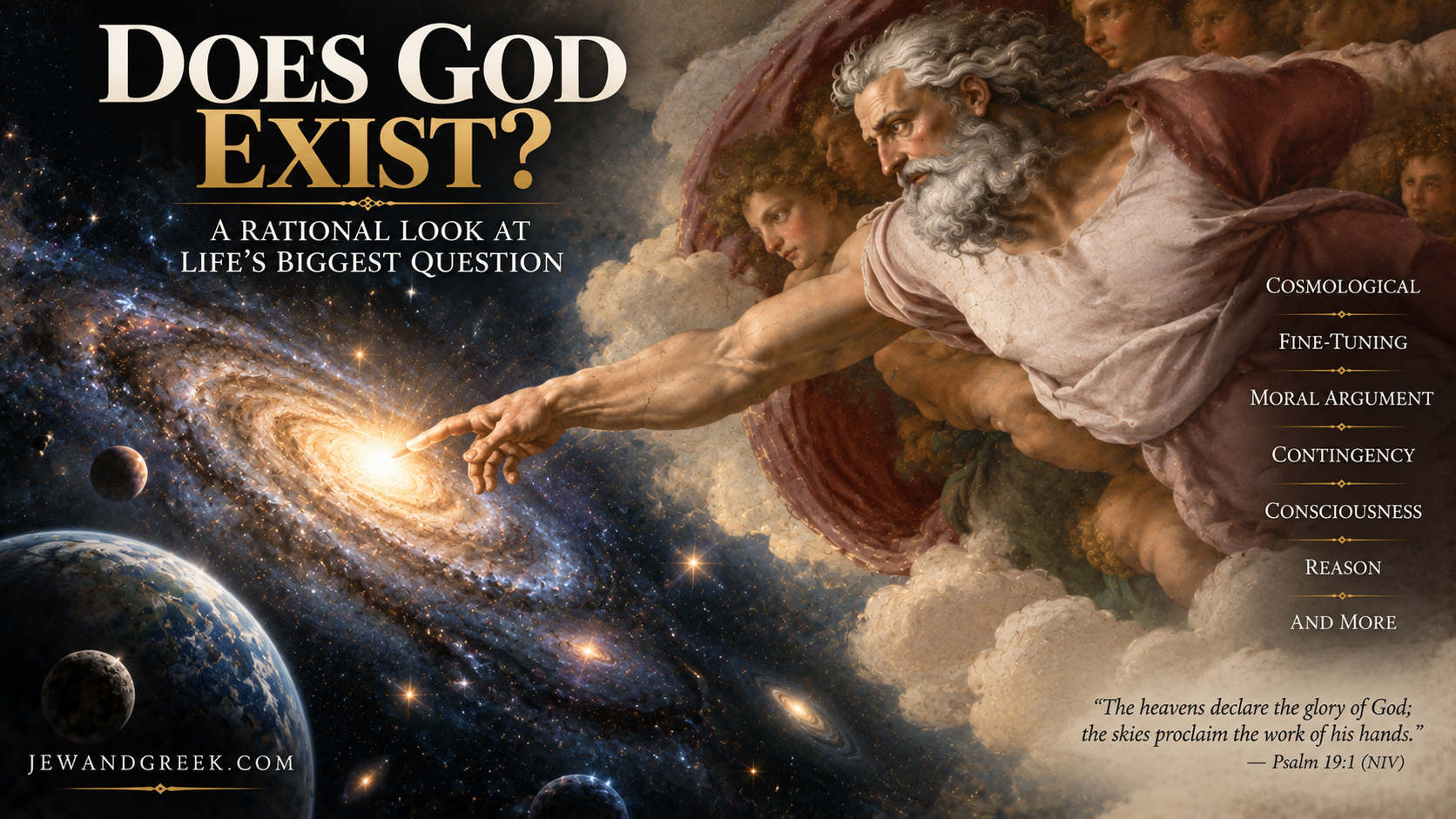
The question of whether God exists is one of the most important questions human beings can ask because the answer affects nearly every other area of thought. If God exists, then the universe is not self-explanatory, human life may possess an objective purpose, moral obligations may be grounded in something beyond human preference, consciousness may belong within a reality larger than matter alone, and religious claims about revelation and miracles become possible in principle. If God does not exist, then reality must ultimately be explained without reference to a transcendent Creator, and human beings must understand meaning, morality, consciousness, and existence within that framework.
Christian apologetics does not begin by pretending that God’s existence can be demonstrated with the same kind of certainty as a mathematical equation. Philosophical arguments for God are not laboratory experiments, and serious thinkers disagree about how persuasive they are. The better approach is cumulative. Rather than asking whether one argument forces every rational person to believe in God, we can ask whether several features of reality—existence, contingency, order, rationality, morality, consciousness, and religious experience—fit more naturally within theism than within competing explanations.
What Do We Mean by God?
Before discussing arguments for God, it is important to clarify what kind of being Christian theism is actually proposing. God is not understood as an invisible object somewhere inside the universe, one more item alongside planets, stars, atoms, and living creatures. Classical Christianity describes God as the Creator of the universe and the ultimate source upon which all contingent reality depends.
This distinction matters because many objections assume a picture of God that Christianity does not teach. Asking, “Who created God?” makes sense only if God is being proposed as another contingent thing requiring the same kind of explanation as the universe. Classical theism instead describes God as necessary rather than contingent, uncreated rather than created, and the ultimate explanation of realities that do not contain the reason for their existence within themselves. Whether such a being actually exists is the question, but the argument should begin with an accurate definition.
Why Is There Something Rather Than Nothing?
One of philosophy’s deepest questions is remarkably simple: Why is there anything at all? There could seemingly have been no galaxies, no matter, no energy, no physical laws, no human beings, and no universe. Yet something exists.
One possible answer is that reality simply exists without further explanation. The universe, or whatever physical reality ultimately underlies it, may simply be a brute fact. Another possibility is that contingent reality requires an explanation beyond itself. Theism proposes that the existence of the universe is grounded in a necessary reality that does not depend upon something else in the same way.
This question lies behind several forms of the cosmological argument. The issue is not merely what happened at the beginning of the universe but why contingent reality exists at all.
The Cosmological Argument
Cosmological arguments reason from features of the universe toward an ultimate cause or explanation. They appear in different forms in Aristotle, Islamic philosophy, Jewish philosophy, medieval Christianity, and modern thought. Because the arguments differ, criticizing one version does not automatically refute every cosmological argument.
A basic form begins with the observation that things within the universe appear dependent. People depend upon biological processes and prior causes, planets depend upon physical conditions, and physical systems operate within broader structures. The argument asks whether a total collection of dependent things can ultimately explain itself or whether explanation must terminate in something that does not exist dependently.
The theistic conclusion is that contingent reality ultimately depends upon a necessary being. Critics object that perhaps the universe itself is necessary or that explanation does not need to continue beyond the physical cosmos. The debate therefore turns on deeper questions about contingency, causation, and explanation.
The Argument from Contingency
The argument from contingency focuses on the distinction between things that exist but could have failed to exist and something that exists necessarily. Individual human beings are clearly contingent. Each of us might never have existed. The same appears true of particular planets, stars, and perhaps the physical universe as a whole.
If every reality were contingent, philosophers ask whether there would be any sufficient explanation for why anything exists at all. Gottfried Wilhelm Leibniz formulated the issue through the Principle of Sufficient Reason, the idea that there should be an adequate reason why something exists rather than not.
The argument concludes that contingent existence ultimately rests upon a necessary reality. The central disagreement is whether such a necessary foundation is required. Critics may reject the Principle of Sufficient Reason or argue that the cosmos needs no deeper explanation. Defenders answer that treating the entire universe as unexplained does not solve the problem but simply stops asking the question.
The Kalam Cosmological Argument
The Kalam cosmological argument is one of the most familiar contemporary arguments for God. In simplified form it states:
- Whatever begins to exist has a cause.
- The universe began to exist.
- Therefore the universe has a cause.
The first premise appeals to the ordinary principle that things do not simply begin existing without explanation. The second premise has been defended philosophically and through interpretations of modern cosmology. If both premises are true, the conclusion follows logically.
The debate, however, does not end there. Scientists and philosophers disagree about what cosmological models establish concerning an absolute beginning. Questions concerning quantum cosmology also complicate popular descriptions of causation. Even if the argument establishes a cause of the universe, additional reasoning is required to identify that cause as timeless, spaceless, immaterial, powerful, personal, or identical with the God of Christianity.
The Kalam argument should therefore be treated as one component of a larger case rather than as a shortcut directly from cosmology to Christianity.
Aquinas and the First Cause
Thomas Aquinas developed several arguments commonly known as the Five Ways. His reasoning is sometimes summarized inaccurately as “everything has a cause, therefore God caused everything.” Aquinas did not argue that everything requires a cause. He distinguished between dependent realities and the kind of ultimate reality that would not require a prior cause in the same sense.
His argument from change begins with Aristotle’s distinction between actuality and potentiality. Something undergoing change moves from potential to actual, and Aquinas reasons that chains of actualization ultimately depend upon something that is not itself being actualized by another. This leads to his concept of a first unmoved source of change.
Whether Aquinas succeeds depends upon accepting parts of his Aristotelian metaphysics, but his reasoning is considerably more sophisticated than the popular caricature that simply asks what caused the first cause.
Can the Universe Cause Itself?
Sometimes the universe is proposed as its own explanation. Yet self-causation appears difficult to understand because something would seemingly need to exist in order to cause itself to exist. A thing cannot ordinarily bring itself into existence before it exists.
A different possibility is that the universe has always existed and therefore never required a beginning cause. Even if that were established, however, the argument from contingency would remain. Something can be eternal in duration while still being dependent in its mode of existence. The question “What caused the universe to begin?” and the question “Why does the universe exist at all?” are therefore related but not identical.
The Fine-Tuning Argument
Modern physics has revealed that the universe depends upon fundamental constants and initial conditions that appear to fall within ranges compatible with complex structures and life. If certain values were significantly different, stars, stable chemistry, or long-lived complex systems might not exist. This has generated the discussion known as fine-tuning.
The argument does not claim merely that the universe is complicated. It asks why the fundamental conditions of the universe fall within ranges that permit complex life. Several broad explanations are commonly discussed: physical necessity, chance, some form of multiverse, or intelligent design.
Theists argue that a life-permitting universe is not surprising if a rational Creator intended a universe containing conscious beings. Critics answer that selection effects matter—we obviously observe a universe compatible with observers—and that multiverse models may provide a natural explanation for apparently improbable conditions. The debate concerns which explanation provides the best overall account of the evidence.
Does Fine-Tuning Prove God?
Fine-tuning does not establish Christianity by itself. Even if design were the best explanation, the argument would not tell us that Jesus rose from the dead or that the Bible is inspired. It would at most contribute evidence toward some form of intelligent causation behind the universe.
This limitation should be acknowledged rather than hidden. Apologetic arguments become stronger when their conclusions are stated modestly. The fine-tuning argument is most useful as part of a cumulative case in which multiple features of reality are considered together.
The Intelligibility of Nature
Another striking feature of reality is that the universe is intelligible. Human beings can describe the physical world through mathematics, discover stable laws, construct theories capable of making accurate predictions, and understand processes occurring billions of light-years away.
Why should the universe possess an order that rational minds can comprehend? The fact that mathematical structures developed through abstract reasoning describe physical reality with extraordinary success has fascinated scientists and philosophers alike.
Theism offers one explanation: the universe originates from a rational Creator, and human rationality reflects that Creator sufficiently to understand aspects of creation. Naturalists can respond that minds capable of survival must develop some reliable understanding of their environment and that the success of mathematics results from human conceptual adaptation. The issue does not prove either worldview by itself, but it contributes to broader questions about whether reason is at home in the universe or an accidental byproduct of nonrational processes.
The Moral Argument
Human beings regularly make moral judgments as though some actions are genuinely right or wrong. We do not usually mean merely that we dislike genocide, slavery, torture, or cruelty. We speak as though such things ought not occur even if individuals or societies approve of them.
The moral argument asks what ultimately grounds objective moral values and duties. If moral obligations are real in a way that transcends individual preference and cultural agreement, theists argue that they fit naturally within a reality grounded in a morally perfect personal God.
The argument can be expressed in simplified form:
- If objective moral values and duties exist, they require an adequate foundation.
- Objective moral values and duties do exist.
- God provides the best foundation for them.
Each premise can be challenged. Some atheistic philosophers defend objective morality without God, while others understand morality through human flourishing, rationality, evolution, social cooperation, or other accounts.
Can Atheists Be Moral?
The moral argument should never be confused with the claim that atheists cannot live moral lives. Clearly they can. Many nonbelievers display compassion, courage, integrity, sacrifice, and concern for justice, while religious believers can behave terribly.
The philosophical issue concerns the grounding of morality, not who behaves better. Atheists and Christians may agree that an action is wrong while disagreeing about what makes its wrongness objectively true. Apologetics becomes confused when questions of moral behavior, moral knowledge, and moral foundations are treated as though they were the same issue.
The Argument from Consciousness
Human consciousness presents another challenge. Physical brains clearly play an essential role in mental life, but subjective experience remains difficult to explain. Why should physical processes produce awareness? Why should there be something it feels like to see red, experience pain, remember childhood, or contemplate existence?
Some philosophers argue that consciousness fits more naturally within a worldview in which mind is fundamental rather than accidental. If ultimate reality is grounded in a supreme mind, conscious beings are not metaphysically surprising.
Physicalists respond that consciousness may emerge from sufficiently complex biological systems and that neuroscience continues to make progress in explaining mental processes. The key disagreement concerns whether a complete physical account could ever explain first-person experience or whether consciousness points toward a deeper structure of reality.
The Argument from Reason
Closely related is the argument from reason. Human beings trust logical inference, mathematical reasoning, and the ability of the mind to discover truth. But if human cognition is entirely the product of processes selected primarily for survival rather than truth, why should we trust our reasoning?
Christian thinkers such as C. S. Lewis raised versions of this challenge, while contemporary philosophers have developed more sophisticated forms. Naturalists answer that generally reliable cognition has obvious survival value and that evolution can favor organisms capable of accurately navigating their environment.
The discussion becomes especially interesting when abstract reasoning extends far beyond immediate survival needs into mathematics, metaphysics, or cosmology. The question is whether rationality is best understood as a fortunate product of nonrational processes or as something expected within a universe grounded in reason.
Beauty and Order
Human beings encounter beauty in nature, mathematics, music, art, and relationships. Beauty alone cannot function as a formal proof of God, but it has long contributed to religious reflection. Why should the universe contain structures that minds experience not merely as functional but as elegant, harmonious, or beautiful?
Theistic interpretations see beauty as reflecting the character and creativity of God. Naturalistic accounts explain aesthetic responses through evolutionary history, psychology, culture, and pattern recognition. These explanations need not be mutually exclusive if God exists, but they operate at different levels. Apologetically, beauty is usually better treated as part of a cumulative existential case rather than as a standalone demonstration.
Religious Experience
Across cultures and throughout history, people have reported experiences they interpret as encounters with God or transcendent reality. These experiences include dramatic visions, answered prayer, a sense of divine presence, conviction, guidance, awe, and profound transformation.
Religious experience is difficult to evaluate because people from different religions interpret experiences differently. Psychological and neurological explanations can also account for aspects of religious experience. Yet explaining the mechanisms accompanying an experience does not automatically establish that the experience has no external object.
The philosophical question is whether religious experience should count as evidence and, if so, how much weight it deserves. As with testimony generally, credibility depends upon context, coherence, competing explanations, and the broader worldview within which the experience is interpreted.
The Ontological Argument
The ontological argument differs sharply from arguments based upon the physical universe. Associated especially with Anselm, it begins with the concept of God as the greatest conceivable being and reasons toward God’s necessary existence.
Modern versions often use modal logic. A simplified modal version reasons that if a maximally great being is genuinely possible, then such a being would exist necessarily; and if it exists necessarily, it exists in the actual world.
Many philosophers find the argument fascinating but controversial. Critics challenge whether necessary existence can legitimately be built into a concept or whether the initial possibility premise simply assumes too much. The ontological argument therefore remains one of philosophy’s most technically interesting arguments rather than the easiest introduction to the case for God.
Does Science Make God Unnecessary?
One common objection says that God was once used to explain natural phenomena that science now explains without divine intervention. Lightning, disease, planetary motion, biological diversity, and many other phenomena once surrounded by religious explanations now possess natural explanations.
This criticism is powerful against a God-of-the-gaps approach that inserts divine action wherever current scientific knowledge is incomplete. Christian theism, however, does not ultimately propose God as a competing explanation for particular mechanisms. A scientific explanation of how gravity operates does not answer why there is a universe containing gravity, laws, matter, and intelligibility in the first place.
Science explains many processes within the universe. The philosophical question of God asks why such a universe exists and whether natural reality is metaphysically self-sufficient. These are not identical questions.
Who Created God?
The question “Who created God?” is understandable because ordinary things appear to have causes. But the cosmological argument does not claim that everything has a cause. It claims that contingent or beginning realities require explanation.
If God were created, dependent, or contingent, then that being would not be the ultimate God classical theism proposes. God is defined philosophically as the necessary reality upon which contingent existence depends.
A critic may reasonably respond that such a necessary being does not exist or that the concept is incoherent. But simply asking who created God does not defeat the argument because it changes the definition of the entity under discussion.
Isn’t God Just an Explanation We Invented?
Another objection suggests that human beings invented God because they fear death, desire meaning, need social order, or want someone to control the universe. Psychological explanations for religious belief deserve serious consideration. Human beings certainly can believe things because they find them comforting.
Yet explaining why someone believes a proposition does not establish whether the proposition is false. A person may believe that food exists because hunger motivates the search for it, but the psychological motivation does not show that food is imaginary. This error is known as a version of the genetic fallacy, judging a belief’s truth primarily by explaining its origin.
The same principle must also be applied to unbelief. Psychological explanations for atheism do not prove God exists either. The question remains whether the evidence supports the belief.
Isn’t Religion Just Cultural?
People often adopt the religion dominant in their family or culture. Someone born in Saudi Arabia is more likely to become Muslim, while someone born in parts of India may be more likely to become Hindu. This raises a legitimate epistemological concern about inherited belief.
Yet cultural influence affects nearly every human conviction, including political beliefs, moral assumptions, philosophical commitments, and attitudes toward religion itself. The appropriate response is not to conclude that all inherited beliefs are false but to examine them critically.
Christian apologetics should therefore welcome the challenge. If Christianity is true, Christians should be willing to ask whether they believe it merely because of upbringing or because its claims withstand serious investigation.
The Problem of Evil
The existence of suffering represents the strongest objection many people raise against belief in God. If God is all-powerful, all-knowing, and perfectly good, why does the world contain cruelty, disease, natural disasters, abuse, and apparently pointless suffering?
The problem can be formulated logically or evidentially. The logical version argues that God and evil cannot coexist. The evidential version argues that the amount and distribution of suffering make God’s existence less likely.
Christian philosophers have offered responses involving human freedom, stable natural laws, the possibility of moral development, limited human knowledge, the consequences of sin, and eventual divine justice and restoration. None of these answers removes the emotional weight of suffering, and apologetics should never treat personal tragedy as merely an argument to be solved.
Divine Hiddenness
A related objection asks why God is not more obvious. If God loves people and desires relationship with them, why do sincere seekers sometimes remain unconvinced that God exists?
This problem of divine hiddenness has become increasingly important in contemporary philosophy of religion. Theists propose several responses, including the possibility that overwhelming divine manifestation might alter the character of human response, that God provides sufficient but noncoercive evidence, or that relationship with God develops within conditions involving freedom and moral formation.
Critics argue that these explanations do not fully account for sincere nonbelief. The issue therefore remains a serious challenge deserving careful treatment rather than dismissal.
The Multiverse
The multiverse is sometimes presented as an alternative explanation of fine-tuning. If an enormous number of universes exist with varying physical constants, it becomes less surprising that at least one universe possesses conditions permitting observers.
A multiverse may weaken certain probabilistic versions of the fine-tuning argument, but it does not necessarily eliminate the philosophical question of ultimate explanation. One can still ask why a universe-generating mechanism exists, why it possesses the laws necessary to produce universes, or why reality contains such a structure.
The multiverse and theism are also not logically incompatible. The existence of many universes, if established, would describe the scope of creation rather than automatically settle whether creation has an ultimate cause.
Can God Be Proven?
The word proof can mislead discussions about God because people may expect mathematical certainty. Philosophical reasoning rarely works that way. Arguments concerning the external world, other minds, morality, history, and scientific theories often involve inference to the best explanation rather than strict demonstration.
A more useful question is whether belief in God is rationally justified and whether theism explains reality better than its major alternatives. Different arguments contribute different pieces to that assessment. Cosmological arguments address existence and contingency. Fine-tuning addresses the structure of the universe. Moral arguments address objective value. Arguments from consciousness and reason address mental life and rationality.
The strength of the case may lie less in one decisive argument than in the way these arguments reinforce one another.
A Cumulative Case
Imagine a courtroom where no single piece of evidence proves the entire case. A witness contributes one fact, physical evidence another, motive another, and chronology another. Together the pieces may form an explanation stronger than any one piece considered alone.
The case for God can be approached similarly. Why is there something rather than nothing? Why does contingent reality exist? Why is the universe ordered and mathematically intelligible? Why does it permit complex conscious life? Why do objective moral obligations seem real? Why do rational minds exist at all? Why are human beings persistently drawn toward transcendence?
A naturalistic worldview offers answers to many of these questions. Christian theism offers another unified explanation: reality originates from an eternal, rational, moral, personal Creator. The apologetic question is not whether alternatives can be imagined, but which worldview provides the most coherent overall account.
From Theism to Christianity
Even if philosophical arguments make belief in God reasonable, they do not establish Christianity by themselves. A cosmological argument cannot tell us that Jesus of Nazareth is the Messiah. Fine-tuning cannot establish the resurrection. Moral realism cannot prove that the New Testament is reliable.
This distinction is crucial. The argument for Christianity proceeds in stages. General philosophical reasoning can make theism plausible. Historical investigation can then examine claims concerning Jesus, Scripture, miracles, and resurrection. Theology asks what follows if those claims are true.
Christian apologetics becomes much clearer when it does not ask one argument to accomplish more than it can.
The God of Philosophy and the God of the Bible
Critics sometimes argue that the abstract God of philosophical arguments is very different from the personal God described in Scripture. There is truth in this observation if philosophical reasoning is expected to produce the entire Christian doctrine of God.
Natural theology may lead toward concepts such as necessary existence, transcendence, intelligence, power, and moral perfection. Scripture goes much further. It describes God as Creator, covenant maker, judge, redeemer, Father, Son, and Holy Spirit, and claims that God has acted within history.
Christianity therefore does not ask people merely to believe in a first cause. It claims that the ultimate ground of reality has revealed himself personally.
Intellectual Humility
Arguments for God should be presented with confidence proportional to their actual strength. Christians do not strengthen apologetics by pretending disputed philosophical arguments are universally accepted proofs. Intellectual honesty requires acknowledging objections, alternative explanations, and areas where philosophers disagree.
This does not require agnosticism about everything. A person can conclude that the cumulative evidence strongly favors theism while admitting that no argument removes every possibility of doubt. Most important beliefs in life operate without absolute certainty.
Christian confidence should therefore be compatible with the willingness to say, “That is a serious objection,” “I don’t know,” or “This argument gets us only this far.”
Why the Question Matters
The question of God is not intellectually trivial because its answer changes the larger picture of reality. If God exists, then the universe possesses an ultimate source beyond itself. Human reason may reflect a deeper rational order. Moral truth may be grounded in objective reality. Conscious persons may possess significance that extends beyond biological survival. Death may not represent the final horizon of human existence.
If God does not exist, humanity must understand those same questions differently. Meaning, morality, consciousness, and purpose may still be defended, but their explanations must remain entirely within a reality lacking a transcendent Creator.
Either conclusion deserves serious thought.
The Search for God
Christian apologetics ultimately argues that belief in God is not an escape from reason but a conclusion that can be investigated through reason. The existence of the universe, its contingency, its order, the emergence of conscious rational beings, the reality of moral experience, and the persistent human search for transcendence together raise questions that material descriptions alone may not completely answer.
None of this allows Christians to leap immediately from “the universe has a cause” to every doctrine of Christianity. The next step requires examining whether this God has revealed himself and whether the historical claims surrounding Jesus Christ deserve belief.
That is where general theism becomes Christian apologetics.
The first question is:
Does God exist?
The next is:
If God exists, has He made Himself known?