
A Sermon
(No. 7-8)
Delivered on Sabbath Morning, February 11, 1855, by the
REV. C.H. SPURGEON
At Exeter Hall, Strand.
"But we preach Christ crucified, unto the Jews a stumblingblock, and
unto the Greeks foolishness; but unto them which are called, both Jews
and Greeks, Christ the power of God, and the wisdom of God."–1
Corinthians 1:23-24.
What contempt hath God poured upon the wisdom of this world! How hath
he brought it to nought, and made it appear as nothing. He has allowed
it to word out its own conclusions, and prove its own folly. Men
boasted that they were wise; they said that they could find out God to
perfection; and in order that their folly might be refuted once and
forever, God gave them the opportunity of so doing. He said, "Worldly
wisdom, I will try thee. Thou sayest that thou art mighty, that thine
intellect is vast and comprehensive, that thine eye is keen, and thou
canst find all secrets; now, behold, I try thee; I give thee one great
problem to solve. Here is the universe; stars make its canopy, fields
and flowers adorn it, and the floods roll o'er its surface; my name is
written therein; the invisible things of God may be clearly seen in the
things which are made. Philosophy, I give thee this problem–find me
out. Here are my works–find me out. Discover in the wondrous world
which I have made, the way to worship me acceptably. I give thee space
enough to do it–there are data enough. Behold the clouds, the earth,
and the stars. I give thee time enough; I will give thee four thousand
years, and I will not interfere; but thou shalt do as thou wilt with
thine own world. I will give thee men enough; for I will make great
minds and vast, whom thou shalt call lords of earth; thou shalt have
orators, thou shalt have philosophers. Find me out, O reason; find me
out, O wisdom; find me out, if thou canst; find me out unto perfection;
and if thou canst not, then shut thy mouth forever, and then will I
teach thee that the wisdom of God is wiser than the wisdom of man; yea,
that the foolishness of God is wiser than men." And how did the wisdom
of man work out the problem? How did wisdom perform her feat? Look upon
the heathen nations; there you see the result of wisdom's researches.
In the time of Jesus Christ, you might have beheld the earth covered
with the slime of pollution, a Sodom on a large scale–corrupt, filthy,
depraved; indulging in vices which we dare not mention; revelling in
lust too abominable even for our imagination to dwell upon for a
moment. We find the men prostrating themselves before blocks of wood
and stone, adoring ten thousand gods more vicious than themselves. We
find, in fact, that reason wrote out her lines with a finger covered
with blood and filth, and that she forever cut herself out from all her
glory by the vile deeds she did. She would not worship God. She would
not bow down to him who is "clearly seen," but she worshipped any
creature–the reptile that crawled, the viper– everything might be a
god; but not, forsooth, the God of heaven. Vice might be made into a
ceremony, the greatest crime might be exalted into a religion; but true
worship she knew nothing of. Poor reason! poor wisdom! how art thou
fallen from heaven; like Lucifer–thou son of the morning–thou art
lost; thou hast written out thy conclusion, but a conclusion of
consummate folly. "After that in the wisdom of God, the world by wisdom
knew not God, it pleased God by the foolishness of preaching to save
them that believe."
Wisdom had had its time, and time enough; it had done its all, and that
was little enough; it had made the world worse than it was before it
stepped upon it, and "now," says God, "Foolishness shall overcome
wisdom; now ignorance, as ye call it, shall sweep away science; now,
humble, child-like faith shall crumble to the dust all the colossal
systems your hands have piled." He calls his armies. Christ puts his
trumpet to his mouth, and up come the warriors, clad in fishermen's
garb, with the brogue of the lake of Galilee–poor humble mariners.
Here are the warriors, O wisdom, that are to confound thee; these are
the heroes who shall overcome thy proud philosophers; these men are to
plant their standard upon thy ruined walls, and bid them to fall
forever; these men and their successors are to exalt a gospel in the
world which ye may laugh at as absurd, which ye may sneer at as folly,
but which shall be exalted above the hills, and shall be glorious even
to the highest heavens. Since that day, God has always raised up
successors of the apostles; not by any lineal descent, but because I
have the same roll and charter as any apostle, and am as much called to
preach the gospel as Paul himself; if not as much owned by the
conversion of sinners, yet, in a measure, blessed of God; and,
therefore, here I stand, foolish as Paul might be, foolish as Peter, or
any of those fishermen; but still with the might of God I grasp the
sword of truth, coming here to "preach Christ and him crucified, unto
the Jews a stumblingblock, and unto the Greeks foolishness; but unto
them which are called, both Jews and Greeks, Christ the power of God,
and the wisdom of God."
Before I enter upon our text, let me very briefly tell you what I
believe preaching Christ and him crucified is. My friends, I do not
believe it is preaching Christ and him crucified, to give people a
batch of philosophy every Sunday morning and evening, and neglect the
truths of this Holy Book. I do not believe it is preaching Christ and
him crucified, to leave out the main cardinal doctrines of the Word of
God, and preach a religion which is all a mist and a haze, without any
definite truths whatever. I take it that man does not preach Christ and
him crucified, who can get through a sermon without mentioning Christ's
name once; nor does that man preach Christ and him crucified, who
leaves out the Holy Spirit's work, who never says a word about the Holy
Ghost, so that indeed the hearers might say, "We do not so much as know
whether there be a Holy Ghost." And I have my own private opinion, that
there is no such thing as preaching Christ and him crucified, unless
you preach what now-a-days is called Calvinism. I have my own ideas,
and those I always state boldly. It is a nickname to call it Calvinism.
Calvinism is the gospel, and nothing else. I do not believe we can
preach the gospel, if we do not preach justification by faith without
works; not unless we preach the sovereignty of God in his dispensation
of grace; nor unless we exalt the electing, unchangeable, eternal,
immutable, conquering love of Jehovah; nor, I think, can we preach the
gospel, unless we base it upon the peculiar redemption which Christ
made for his elect and chosen people; nor can I comprehend a gospel
which lets saints fall away after they are called, and suffers the
children of God to be burned in the fires of damnation, after having
believed. Such a gospel I abhor. The gospel of the Bible is not such a
gospel as that. We preach Christ and him crucified in a different
fashion, and to all gainsayers we reply, "We have not so learned
Christ."
There are three things in the text: first, a gospel rejected, "Christ
crucified, to the Jews a stumblingblock, and to the Greeks
foolishness"; secondly, a gospel triumphant, "unto those who are
called, both Jews and Greeks"; and thirdly, a gospel admired; it is to
them who are called "the power of God and the wisdom of God."
I. First, we have here A GOSPEL REJECTED. One would have imagined that,
when God sent his gospel to men, all men would meekly listen, and
humbly receive its truths. We should have thought that God's ministers
had but to proclaim that life is brought to light by the gospel, and
that Christ is come to save sinners, and every ear would be attentive,
every eye would be fixed, and every heart would be wide open to receive
the truth. We should have said, judging favorably of our
fellow-creatures, that there would not exist in the world a monster so
vile, so depraved, so polluted, as to put so much as a stone in the way
of the progress of truth; we could not have conceived such a thing; yet
that conception is the truth. When the gospel was preached, instead of
being accepted and admired, one universal hiss went up to heaven; men
could not bear it; its first preacher they dragged to the brow of the
hill, and would have sent him down headlong; yea, they did more–they
nailed him to the cross, and there they let him languish out his dying
life in agony such as no man hath borne since. All his chosen ministers
have been hated and abhorred by worldlings; instead of being listened
to they have been scoffed at; treated as if they were the offscouring
of all things, and the very scum of mankind. Look at the holy men in
the old times, how they were driven from city to city, persecuted,
afflicted, tormented, stoned to death, wherever the enemy had power to
do so. Those friends of men, those real philanthropists, who came with
hearts big with love, and hands full of mercy, and lips pregnant with
celestial fire, and souls that burned with holy influence; those men
were treated as if they were spies in the camp, as if they were
deserters from the common cause of mankind; as if they were enemies,
and not, as they truly were, the best of friends. Do not suppose, my
friends, that men like the gospel any better now than they did then.
There is an idea that you are growing better. I do not believe it. You
are growing worse. In many respects men may be better–outwardly
better; the heart within is still the same. The human heart of today
dissected, would be like the human heart a thousand years ago; the gall
of bitterness within that breast of yours, is just as bitter as the
gall of bitterness in that of Simon of old. We have in our hearts the
same latent opposition to the truth of God; and hence we find men, even
as of old, who scorn the gospel.
I shall, in speaking of the gospel rejected, endeavour to point out the
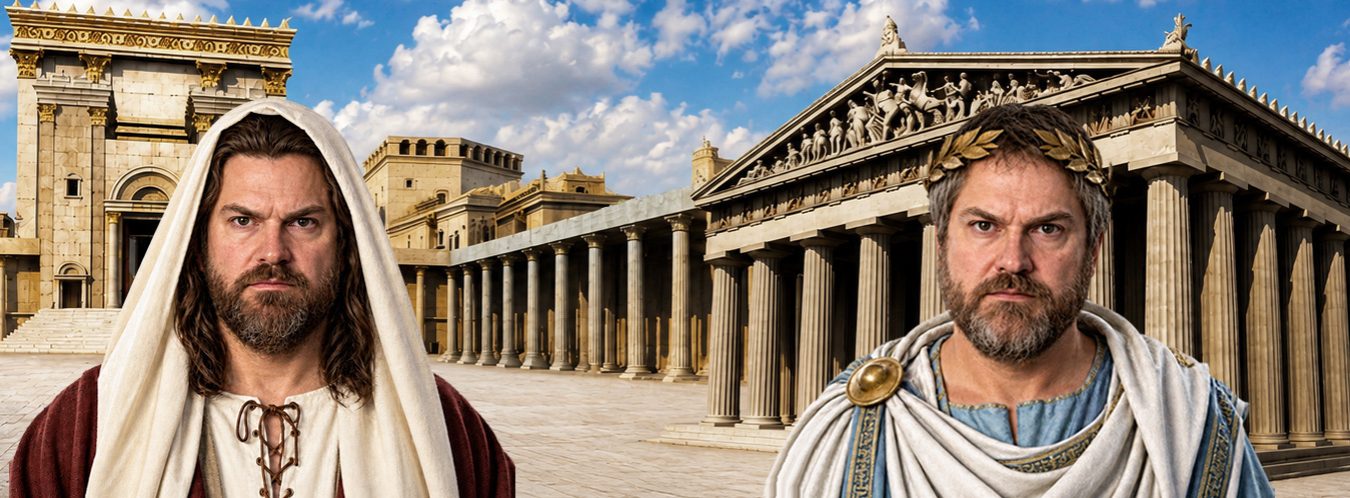
two classes of persons who equally despise truth. The Jews make it a
stumblingblock, and the Greeks account it foolishness. Now these two
very respectable gentlemen–the Jew and the Greek–I am not going to
make these ancient individuals the object of my condemnation, but I
look upon them as members of a great parliament, representatives of a
great constituency, and I shall attempt to show that, if all the race
of Jews were cut off, there would be still a great number in the world
who would answer to the name of Jews, to whom Christ is a
stumblingblock; and that if Greece were swallowed up by some
earthquake, and ceased to be a nation, there would still be the Greek
unto whom the gospel would be foolishness. I shall simply introduce the
Jew and the Greek, and let them speak a moment to you, in order that
you may see the gentlemen who represent you; the representative men;
the persons who stand for many of you, who as yet are not called by
divine grace.
The first is a Jew; to him the gospel is a stumblingblock. A
respectable man the Jew was in his day; all formal religion was
concentrated in his person; he went up to the temple very devoutly; he
tithed all he had, even to the mint and the cummin. You would see him
fast twice in the week, with a face all marked with sadness and sorrow.
If you looked at him, he had the law between his eyes; there was the
phylactery, and the borders of his garments of amazing width, that he
might never be supposed to be a Gentile dog; that no one might ever
conceive that he was not an Hebrew of pure descent. He had a holy
ancestry; he came of a pious family; a right good man was he. He could
not like those Sadducees at all, who had no religion. He was thoroughly
a religious man; he stood up for his synagogue; he would not have that
temple on Mount Gerizim; he could not bear the Samaritans, he had no
dealings with them; he was a religionist of the first order, a man of
the very finest kind; a specimen of a man who is a moralist, and who
loves the ceremonies of the law. Accordingly, when he heard about
Christ, he asked who Christ was. "The Son of a Carpenter." Ah! "The son
of a carpenter, and his mothers's name was Mary, and his father's name
was Joseph." "That of itself is presumption enough," said he; "positive
proof, in fact, that he cannot be the Messiah." And what does he say?
Why, he says, "Woe unto you, Scribes and Pharisees, hypocrites." "That
won't do." Moreover, he says, "It is not by the works of the flesh that
any man can enter into the kingdom of heaven." The Jew tied a double
knot in his phylactery at once; he thought he would have the borders of
his garment made twice as broad. He bow to the Nazarene! No, no; and if
so much as a disciple crossed the street, he thought the place
polluted, and would not tread in his steps. Do you think he would give
up his old father's religion, the religion which came from Mount Sinai,
that old religion that lay in the ark and the overshadowing cherubim?
He give that up! not he. A vile imposter–that is all Christ was in his
eyes. He thought so. "A stumblingblock to me; I cannot hear about it; I
will not listen to it." Accordingly, he turned a deaf ear to all the
preacher's eloquence, and listened not at all. Farewell, old Jew! Thou
sleepest with thy fathers, and thy generation is a wandering race,
still walking the earth. Farewell! I have done with thee. Alas! poor
wretch, that Christ, who was thy stumbling-block, shall be thy judge,
and on thy head shall be that loud curse. "His blood be on us and on
our children." But I am going to find out Mr. Jew here in Exeter
Hall–persons who answer to his description–to whom Jesus Christ is a
stumblingblock. Let me introduce you to yourselves, some of you. You
were of a pious family too, were you not? Yes. And you have a religion
which you love; you love it so far as the chrysalis of it goes, the
outside, the covering, the husk. You would not have one rubric altered,
nor one of those dear old arches taken down, nor the stained glass
removed, for all the world; and any man who should say a word against
such things, you would set down as a heretic at once. Or, perhaps, you
do not go to such a place of worship, but you love some plain old
meeting-house, where your forefathers worshipped, called a dissenting
chapel. Ah! it is a beautiful plain place; you love it, you love its
ordinances, you love its exterior; and if any one spoke against the
place, how vexed you would feel. You think that what they do there,
they ought to do everywhere; in fact, your church is a model one; the
place where you go is exactly the sort of place for everybody; and if I
were to ask you why you hope to go to heaven, you would perhaps say,
"Because I am a Baptist," or, "Because I am an Episcopalian," or
whatever other sect you belong to. There is yourself; I know Jesus
Christ will be to you a stumblingblock. If I come and tell you, that
all your going to the house of God is good for nothing; if I tell you
that all those many times you have been singing and praying, all pass
for nothing in the sight of God, because you are a hypocrite and a
formalist. If I tell you that your heart is not right with God, and
that unless it is so, all the external is good for nothing, I know what
you will say,–"I shan't hear that young man again." It is a
stumblingblock. If you had stepped in anywhere where you had heard
formalism exalted: if you had been told "this must you do, and this
other must you do, and then you will be saved," you would highly
approve of it. But how many are there externally religious, with whose
characters you could find no fault, but who have never had the
regenerating influence of the Holy Ghost; who never were made to lie
prostrate on their face before Calvary's cross; who never turned a
wistful eye to yonder Saviour crucified; who never put their trust in
him that was slain for the sons of men. They love a superficial
religion, but when a man talks deeper than that, they set it down for
cant. You may love all that is external about religion, just as you may
love a man for his clothes–caring nothing for the man himself. If so,
I know you are one of those who reject the gospel. You will hear me
preach; and while I speak about the externals, you will hear me with
attention; whilst I plead for morality, and argue against drunkenness,
or show the heinousness of Sabbath-breaking, but if once I say, "Except
ye be converted, and become as little children, ye can in no wise enter
into the kingdom of God"; if once I tell you that you must be elected
of God: that you must be purchased with the Saviour's blood–that you
must be converted by the Holy Ghost–you say, "He is a fanatic! Away
with him, away with him! We do not want to hear that any more." Christ
crucified, is to the Jew–the ceremonialist–a stumblingblock.
But there is another specimen of this Jew to be found. He is thoroughly
orthodox in his sentiments. As for forms and ceremonies, he thinks
nothing about them. He goes to a place of worship where he learns sound
doctrine. He will hear nothing but what is true. He likes that we
should have good works and morality. He is a good man, and no one can
find fault with him. Here he is, regular in his Sunday pew. In the
market he walks before men in all honesty–so you would imagine. Ask
him about any doctrine, and he can give you a disquisition upon it. In
fact, he could write a treatise upon anything in the Bible, and a great
many things besides. He knows almost everything: and here, up in this
dark attic of the head, his religion has taken up its abode; he has a
best parlor down in his heart, but his religion never goes there–that
is shut against it. He has money in there–Mammon, worldliness; or he
has something else–self-love, pride. Perhaps he loves to hear
experimental preaching; he admires it all; in fact, he loves anything
that is sound. But then, he has not any sound in himself; or rather, it
is all sound and there is no substance. He likes to hear true doctrine;
but it never penetrates his inner man. You never see him weep. Preach
to him about Christ crucified, a glorious subject, and you never see a
tear roll down his cheek; tell him of the mighty influence of the Holy
Ghost–he admires you for it, but he never had the hand of the Holy
Spirit on his soul; tell him about communion with God, plunging in
Godhead's deepest sea, and being lost in its immensity–the man loves
to hear, but he never experiences, he has never communed with Christ;
and accordingly, when you once begin to strike home; when you lay him
on the table, take out your dissecting knife, begin to cut him up, and
show him his own heart, let him see what it is by nature, and what it
must become by grace–the man starts, he cannot stand that; he wants
none of that–Christ received in the heart, and accepted. Albeit that
he loves it enough in the head, tis to him a stumblingblock, and he
casts it away. Do you see yourselves here, my friends? See yourselves
as God sees you? For so it is, here be many to whom Christ is as much a
stumblingblock now as ever he was. O ye formalists! I speak to you; O
ye who have the nutshell, but abhor the kernel; O ye who like the
trappings and the dress, but care not for that fair virgin who is
clothed therewith; O ye who like the paint and the tinsel, but abhor
the solid gold, I speak to you; I ask you, does your religion give you
solid comfort? Can you stare death in the face with it, and say, "I
know that my Redeemer liveth?" Can you close your eyes at night,
singing as your vesper song–
"I to the end must endure
As sure as the earnest is given"?
Can you bless God for affliction? Can you plunge in, accounted as ye
are, and swim through all the floods of trial? Can you march triumphant
through the lion's den, laugh at affliction, and bid defiance to hell?
Can you? No! Your gospel is an effeminate thing–a thing of words and
sounds, and not of power. Cast it from you, I beseech you; it is not
worth your keeping; and when you come before the throne of God, you
will find it will fail you, and fail you so that you shall never find
another; for lost, ruined, destroyed, ye shall find that Christ, who is
now "a stumblingblock," will be your Judge.
I have found out the Jew, and I have now to discover the Greek. He is a
person of quite a different exterior to the Jew. As to the phylactery,
to him it is all rubbish; and as to the broad hemmed garment, he
despises it. He does not care for the forms of religion; he has an
intense aversion, in fact, to broad-brimmed hats, or to everything
which looks like outward show. He likes eloquence; he admires a smart
saying; he loves a quaint expression; he likes to read the last new
book; he is a Greek, and to him the gospel is foolishness. The Greek is
a gentleman found everywhere, now-a-days; manufactured sometimes in
colleges, constantly made in schools, produced everywhere. He is on the
exchange, in the market; he keeps a shop, rides in a carriage; he is
noble, a gentleman; he is everywhere, even in court. He is thoroughly
wise. Ask him anything, and he knows it. Ask for a quotation from any
of the old poets, or any one else, and he can give it you. If you are a
Mohammedan, and plead the claims of your religion, he will hear you
very patiently. But if you are a Christian, and talk to him of Jesus
Christ, "Stop your cant," he says, "I don't want to hear anything about
that." This Grecian gentleman believes all philosophy except the true
one; he studies all wisdom except the wisdom of God; he likes all
learning except spiritual learning; he loves everything except that
which God approves; he likes everything which man makes, and nothing
which comes from God; it is foolishness to him, confounded foolishness.
You have only to discourse about one doctrine in the Bible, and he
shuts his ears; he wishes no longer for your company–it is
foolishness. I have met this gentleman a great many times. Once, when I
saw him, he told me he did not believe in any religion at all; and when
I said I did, and had a hope that when I died I should go to heaven, he
said he dared say it was very comfortable, but he did not believe in
religion, and that he was sure it was best to live as nature dictated.
Another time he spoke well of all religions, and believed they were
very good in their place, and all true; and he had no doubt that, if a
man were sincere in any kind of religion, he would be alright at last.
I told him I did not think so, and that I believed there was but one
religion revealed of God–the religion of God's elect, the religion
which is the gift of Jesus. He then said I was a begot, and wished me
good morning. It was to him foolishness. He had nothing to do with me
at all. He either liked no religion, or every religion. Another time I
held him by the coat button, and I discussed with him a little about
faith. He said, "It is all very well, I believe that is true Protestant
doctrine." But presently I said something about election, and he said,
"I don't like that; many people have preached that and turned it to bad
account." I then hinted something about free grace; but that he could
not endure, it was to him foolishness. He was a polished Greek, and
thought that if he were not chosen, he ought to be. He never liked that
passage, "God hath chosen the foolish things of this world to confound
the wise, and the things which are not, to bring to nought things that
are." He thought it was very discreditable to the Bible and when the
book was revised, he had no doubt it would be cut out. To such a
man–for he is here this morning, very likely come to hear this reed
shaken of the wind–I have to say this: Ah! thou wise man, full of
worldly wisdom; thy wisdom will stand thee here, but what wilt thou do
in the swellings of Jordan? Philosophy may do well for thee to learn
upon whilst thou walkest through this world; but the river is deep, and
thou wilt want something more than that. If thou hast not the arm of
the Most High to hold thee up in the flood and cheer thee with
promises, thou wilt sink, man; with all thy philosophy, thou wilt sink;
with all thy learning, thou shalt sink, and be washed into that awful
ocean of eternal torment, where thou shalt be forever. Ah! Greeks, it
may be foolishness to you, but ye shall see the man your judge, and
then shall ye rue the day that e'er ye said that God's gospel was
foolishness.
II. Having spoken thus far upon the gospel rejected, I shall now
briefly speak upon the GOSPEL TRIUMPHANT. "Unto us who are called, both
Jews and Greeks, it is the power of God, and the wisdom of God." Yonder
man rejects the gospel, despises grace, and laughs at it as a delusion.
Here is another man who laughed at it, too; but God will fetch him down
upon his knees. Christ shall not die for nothing. The Holy Ghost shall
not strive in vain. God hath said, "My word shall not return unto me
void, but it shall accomplish that which I please, and it shall prosper
in the thing whereto I sent it." "He shall see of the travail of his
soul, and shall be abundantly satisfied." If one sinner is not saved,
another shall be. The Jew and the Greek shall never depopulate heaven.
The choirs of glory shall not lose a single songster by all the
opposition of Jews and Greeks; for God hath said it; some shall be
called; some shall be saved; some shall be rescued.
"Perish the virtue, as it ought, abhorred,
And the fool with it, who insults his Lord.
The atonement a Redeemer's love has wrought
Is not for you–the righteous need it not.
See'st thou yon harlot wooing all she meets,
The worn-out nuisance of the public streets
Herself from morn till night, from night to morn,
Her own abhorrence, and as much your scorn:
The gracious shower, unlimited and free,
Shall fall on her, when heaven denies it thee.
Of all that wisdom dictates, this the drift,
That man is dead in sin, and life a gift."
If the righteous and good are not saved, if they reject the gospel,
there are others who are to be called, others who shall be rescued; for
Christ will not lose the merits of his agonies, or the purchase of his
blood.
"Unto us who are called." I received a note this week asking me to
explain that word "called"; because in one passage it says, "Many are
called but few are chosen," while in another it appears that all who
are called must be chosen. Now, let me observe that there are two
calls. As my old friend, John Bunyan, says, the hen has two calls, the
common cluck, which she gives daily and hourly, and the special one,
which she means for her little chickens. So there is a general call, a
call made to every man; every man hears it. Many are called by it; all
you are called this morning in that sense, but very few are chosen. The
other is a special call, the children's call. You know how the bell
sounds over the workshop, to call the men to work–that is a general
call. A father goes to the door and calls out, "John, it is dinner
time"–that is the special call. Many are called with the general call,
but they are not chosen; the special call is for the children only, and
that is what is meant in the text, "Unto us who are called, both Jews
and Greeks, the power of God and the wisdom of God." That call is
always a special one. While I stand here and call men, nobody comes;
while I preach to sinners universally, no good is done; it is like the
sheet lightning you sometimes see on the summer's evening, beautiful,
grand; but whoever heard of anything being struck by it? But the
special call is the forked flash from heaven; it strikes somewhere; it
is the arrow sent in between the joints of the harness. The call which
saves is like that of Jesus, when he said "Mary," and she said unto him
"Rabonni." Do you know anything about that special call, my beloved?
Did Jesus ever call you by name? Canst thou recollect the hour when he
whispered thy name in thine ear, when he said, "Come to me"? If so, you
will grant the truth of what I am going to say next about it–that it
is an effectual call; there is no resisting it. When God calls with his
special call, there is no standing out. Ah! I know I laughed at
religion; I despised, I abhorred it; but that call! Oh, I would not
come. But God said, "Thou shalt come. All that the Father giveth to me
shall come." "Lord, I will not." "But thou shalt," said God. And I have
gone up to God's house sometimes almost with a resolution that I would
not listen, but listen I must. Oh, how the word came into my soul! Was
there a power of resistance? No; I was thrown down; each bone seemed to
be broken; I was saved by effectual grace. I appeal to your experience,
my friends. When God took you in hand, could you withstand him? You
stood against your minister times enough. Sickness did not break you
down; disease did not bring you to God's feet; eloquence did not
convince you; but when God puts his hand to the work, ah! then what a
change. Like Saul, with his horses going to Damascus, that voice from
heaven said, "I am Jesus whom thou persecutest." "Saul, Saul, why
persecutest thou me?" There was no going further then. That was an
effectual call. Like that, again, which Jesus gave to Zaccheus, when he
was up in the tree; stepping under the tree, he said, "Zaccheus, come
down, today I must abide in thy house." Zaccheus was taken in the net;
he heard his own name; the call sank into his soul; he could not stop
up in the tree, for an almighty impulse drew him down. And I could tell
you some singular instances of persons going to the house of God and
having their characters described, limned out to perfection, so that
they have said, "He is painting me, he is painting me." Just as I might
say to that young man here, who stole his master's gloves yesterday,
that Jesus calls him to repentance. It may be that there is such a
person here; and when the call comes to a peculiar character, it
generally comes with a special power. God gives his ministers a brush,
and shows them how to use it in painting life-like portraits, and thus
the sinner hears the special call. I cannot give the special call; God
alone can give it, and I leave it with him. Some must be called. Jew
and Greek may laugh, but still there are some who are called, both Jews
and Greeks.
Then, to close up this second point, it is a great mercy that many a
Jew has been made to drop his self righteousness; many a legalist has
been made to drop his legalism, and come to Christ; and many a Greek
has bowed his genius at the throne of God's gospel. We have a few such.
As Cowper says:
"We boast some rich ones whom the gospel sways,
And one who wears a coronet, and prays;
Like gleanings of an olive tree they show,
Here and there one upon the topmost bough."
III. Now we come to our third point, A GOSPEL ADMIRED; unto us who are
called of God, it is the power of God, and the wisdom of God. Now,
beloved, this must be a matter of pure experience between your souls
and God. If you are called of God this morning, you will know it. I
know there are times when a Christian has to say,
"Tis a point I long to know,
Oft it causes anxious thought;
Do I love the Lord or no?
Am I his, or am I not?"
But if a man never in his life knew himself to be a Christian, he never
was a Christian. If he never had a moment of confidence, when he could
say, "Now I know in whom I have believed," I think I do not utter a
harsh thing when I say, that that man could not have been born again;
for I do not understand how a man can be killed and then made alive
again, and not know it; how a man can pass from death unto life, and
not know it; how a man can be brought out of darkness into marvellous
liberty without knowing it. I am sure I know it when I shout out my old
verse,
"Now free from sin, I walk at large,
My Saviour's blood's my full discharge;
At his dear feet content I lay,
A sinner saved, and homage pay."
There are moments when the eyes glisten with joy and we can say, "We
are persuaded, confident, certain." I do not wish to distress any one
who is under doubt. Often gloomy doubts will prevail; there are seasons
when you fear you have not been called, when you doubt your interest in
Christ. Ah! what a mercy it is that it is not your hold of Christ that
saves you, but his hold of you! What a sweet fact that it is not how
you grasp his hand, but his grasp of yours, that saves you. Yet I think
you ought to know, sometime or other, whether you are called of God. If
so, you will follow me in the next part of my discourse, which is a
matter of pure experience; unto us who are saved, it is "Christ the
power of God, and the wisdom of God."
The gospel is to the true believer a thing of power. It is Christ the
power of God. Ay, there is a power in God's gospel beyond all
description. Once, I, like Mazeppa, bound on the wild horse of my lust,
bound hand and foot, incapable of resistance, was galloping on with
hell's wolves behind me, howling for my body and my soul, as their just
and lawful prey. There came a mighty hand which stopped that wild
horse, cut my bands, set me down, and brought me into liberty. Is there
power, sir? Ay, there is power, and he who has felt it must acknowledge
it. There was a time when I lived in the strong old castle of my sins,
and rested in my works. There came a trumpeter to the door, and bade me
open it. I with anger chide him from the porch, and said he ne'er
should enter. There came a goodly personage, with loving countenance;
his hands were marked with scars, where nails were driven, and his feet
had nail-prints too; he lifted up his cross, using it as a hammer; at
the first blow the gate of my prejudice shook; at the second it
trembled more; at the third down it fell, and in he came; and he said,
"Arise, and stand upon thy feet, for I have loved thee with an
everlasting love." A thing of power! Ah! it is a thing of power. I have
felt it here, in this heart; I have the witness of the Spirit within,
and know it is a thing of might, because it has conquered me; it has
bowed me down.
"His free grace alone, from the first to the last,
Hath won my affection, and held my soul fast."
The gospel to the Christian is a thing of power. What is it that makes
the young man devote himself as a missionary to the cause of God, to
leave father and mother, and go into distant lands? It is a thing of
power that does it–it is the gospel. What is it that constrains yonder
minister, in the midst of the cholera, to climb up that creaking
staircase, and stand by the bed of some dying creature who has that
dire disease? It must be a thing of power which leads him to venture
his life; it is love of the cross of Christ which bids him do it. What
is that which enables one man to stand up before a multitude of his
fellows, all unprepared it may be, but determined that he will speak
nothing but Christ and him crucified? What is it that enables him to
cry, like the war-horse of Job in battle, Aha! and move glorious in
might? It is a thing of power that does it–it is Christ crucified. And
what emboldens that timid female to walk down that dark lane in the wet
evening, that she may go and sit beside the victim of a contagious
fever? What strengthens her to go through that den of thieves, and pass
by the profligate and profane? What influences her to enter into that
charnel-house of death, and there sit down and whisper words of
comfort? Does gold make her do it? They are too poor to give her gold.
Does fame make her do it? She shall never be known, nor written among
the mighty women of this earth. What makes her do it? Is it love of
merit? No; she knows she has no desert before high heaven. What impels
her to it? It is the power of the gospel on her heart; it is the cross
of Christ; she loves it, and she therefore says–
"Were the whole realm of nature mine.
That were a present far too small;
Love so amazing, so divine,
Demands my soul, my life, my all."
But I behold another scene. A martyr is going to the stake; the halberd
men are around him; the crowds are mocking, but he is marching steadily
on. See, they bind him, with a chain around his middle, to the stake;
they heap faggots all about him; the flame is lighted up; listen to his
words: "Bless the Lord, O my soul, and all that is within me, bless his
holy name." The flames are kindling round his legs; the fire is burning
him even to the bone; see him lift up his hands and say, "I know that
my Redeemer liveth, and though the fire devour this body, yet in my
flesh shall I see the Lord." Behold him clutch the stake and kiss it,
as if he loved it, and hear him say, "For every chain of iron that man
girdeth me with, God shall give me a chain of gold; for all these
faggots, and this ignominy and shame, he shall increase the weight of
my eternal glory." See all the under parts of his body are consumed;
still he lives in the torture; at last he bows himself, and the upper
part of his body falls over; and as he falls you hear him say, "Into
thy hands I commend my Spirit." What wondrous magic was on him, sirs?
What made that man strong? What helped him to bear that cruelty? What
made him stand unmoved in the flames? It was the thing of power; it was
the cross of Jesus crucified. For "unto us who are saved it is the
power of God."
But behold another scene far different. There is no crowd there; it is
a silent room. There is a poor pallet, a lonely bed: a physician
standing by. There is a young girl: her face is blanched by
consumption; long hath the worm eaten her cheek, and though sometimes
the flush came, it was the death flush of the deceitful consumption.
There she lieth, weak, pale, wan, worn, dying, yet behold a smile upon
her face, as if she had seen an angel. She speaketh, and there is music
in her voice. Joan of Arc of old was not half so mighty as that girl.
She is wrestling with dragons on her death-bed; but see her composure,
and hear her dying sonnet:
"Jesus, lover of my soul,
Let me to thy bosom fly,
While the nearer waters roll,
While the tempest still is high!
Hide me, O my Saviour, hide,
Till the storm of life is past,
Safe into the haven guide,
O receive my soul at last!"
And with a smile she shuts her eye on earth, and opens it in heaven.
What enables her to die like that? It is the thing of power; it is the
cross; it is Jesus crucified.
I have little time to discourse upon the other point, and it be far
from me to weary you by a lengthened and prosy sermon, but we must
glance at the other statement: Christ is, to the called ones, the
wisdom of God as well as the power of God. To a believer, the gospel is
the perfection of wisdom, and if it appear not so to the ungodly, it is
because of the perversion of judgement consequent on their depravity.
An idea has long possessed the public mind, that a religious man can
scarcely be a wise man. It has been the custom to talk of infidels,
atheists, and deists, as men of deep thought and comprehensive
intellect; and to tremble for the Christian controversialist, as if he
must surely fall by the hand of his enemy. But this is purely a
mistake; for the gospel is the sum of wisdom; an epitome of knowledge;
a treasure-house of truth; and a revelation of mysterious secrets. In
it we see how justice and mercy may be married; here we behold
inexorable law entirely satisfied, and sovereign love bearing away the
sinner in triumph. Our meditation upon it enlarges the mind; and as it
opens to our soul in successive flashes of glory, we stand astonished
at the profound wisdom manifest in it. Ah, dear friends! if ye seek
wisdom, ye shall see it displayed in all its greatness; not in the
balancing of the clouds, nor the firmness of earth's foundations; not
in the measured march of the armies of the sky, nor in the perpetual
motions of the waves of the sea; not in vegetation with all its fairy
forms of beauty; nor in the animal with its marvellous tissue of nerve,
and vein, and sinew: nor even in man, that last and loftiest work of
the Creator. But turn aside and see this great sight!–an incarnate God
upon the cross; a substitute atoning for mortal guilt; a sacrifice
satisfying the vengeance of Heaven, and delivering the rebellious
sinner. Here is essential wisdom; enthroned, crowned, glorified.
Admire, ye men of earth, if ye be not blind; and ye who glory in your
learning bend your heads in reverence, and own that all your skill
could not have devised a gospel at once so just to God, so safe to man.
Remember, my friends, that while the gospel is in itself wisdom, it
also confers wisdom on its students; she teaches young men wisdom and
discretion, and gives understanding to the simple. A man who is a
believing admirer and a hearty lover of the truth as it is in Jesus, is
in a right place to follow with advantage any other branch of science.
I confess I have a shelf in my head for everything now. Whatever I read
I know where to put it; whatever I learn I know where to stow it away.
Once when I read books, I put all my knowledge together in glorious
confusion; but ever since I have known Christ, I have put Christ in the
centre as my sun, and each science revolves round it like a planet,
while minor sciences are satellites to these planets. Christ is to me
the wisdom of God. I can learn everything now. The science of Christ
crucified is the most excellent of sciences, she is to me the wisdom of
God. O, young man, build thy studio on Calvary! there raise thine
observatory, and scan by faith the lofty things of nature. Take thee a
hermit's cell in the garden of Gethsemane, and lave thy brow with the
waters of Silo. Let the Bible be thy standard classic–thy last appeal
in matters of contention. Let its light be thine illumination, and thou
shalt become more wise than Plato, more truly learned than the seven
sages of antiquity.
And now, my dear friends, solemnly and earnestly, as in the sight of
God, I appeal to you. You are gathered here this morning, I know, from
different motives; some of you have come from curiosity; others of you
are my regular hearers; some have come from one place and some from
another. What have you heard me say this morning? I have told you of
two classes of persons who reject Christ; the religionist, who has a
religion of form and nothing else; and the man of the world, who calls
our gospel foolishness. Now, put your hand upon your heart, and ask
yourself this morning, "Am I one of these?" If you are, then walk the
earth in all your pride; then go as you came in: but know that for all
this the Lord shall bring thee unto judgement; know thou that thy joys
and delights shall vanish like a dream, "and, like the baseless fabric
of a vision," be swept away forever. Know thou this, moreover, O man,
that one day in the halls of Satan, down in hell, I perhaps may see
thee amongst those myriad spirits who revolve forever in a perpetual
circle with their hands upon their hearts. If thine hand be
transparent, and thy flesh transparent, I shall look through thy hand
and flesh, and see thy heart within. And how shall I see it? Set in a
case of fire–in a case of fire! And there thou shalt revolve forever
with the worm gnawing within thy heart, which ne'er shall die–a case
of fire around thy never-dying, ever-tortured heart. Good God! let not
these men still reject and despise Christ; but let this be the time
when they shall be called.
To the rest of you who are called, I need say nothing. The longer you
live, the more powerful will you find the gospel to be; the more deeply
Christ-taught you are, the more you live under the constant influence
of the Holy Spirit, the more you will know the gospel to be a thing of
power, and the more also will you understand it to be a thing of
wisdom. May every blessing rest upon you; and may God come up with us
in the evening!
"Let men or angels dig the mines
Where nature's golden treasure shines;
Brought near the doctrine of the cross,
All nature's gold appears but dross.
Should vile blasphemers with disdain
Pronounce the truths of Jesus vain,
We'll meet the scandal and the shame,
And sing and triumph in his name."