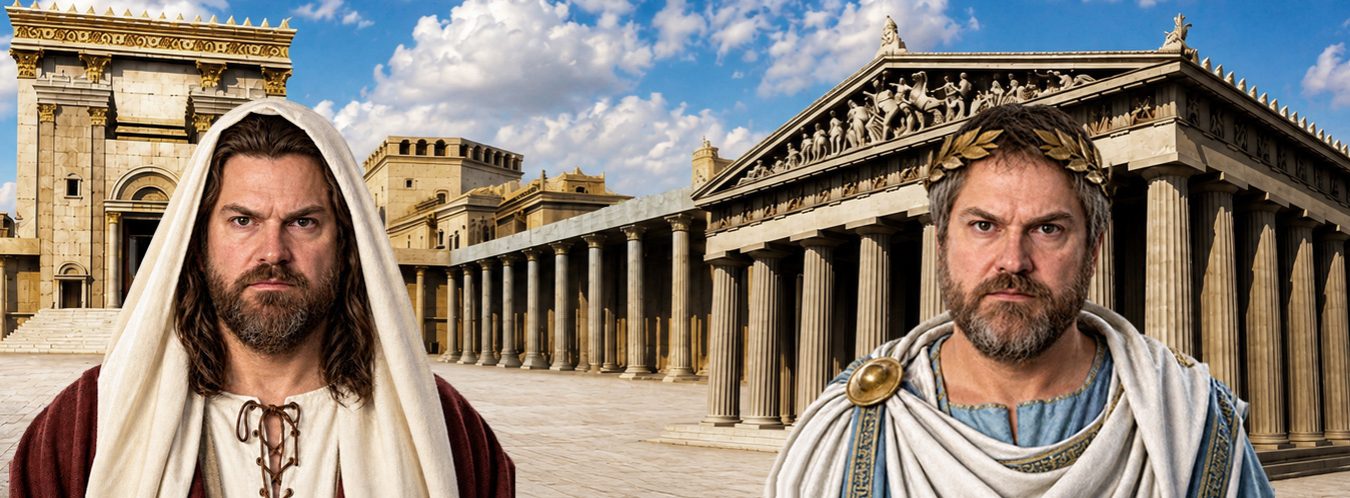

Elijah's Appeal to the Undecided
A Sermon
(No. 134)
Delivered on Sabbath Morning, May 31, 1857, by the
REV. C.H. SPURGEON
at the Music Hall, Royal Surrey Gardens.
"How long halt ye between two opinions? If the Lord be God, follow him;
if Baal, then follow him."–1 Kings 18:21.
IT WAS A DAY to be remembered, when the multitudes of Israel were
assembled at the foot of Carmel and when the solitary prophet of the
Lord came forth to defy the four hundred and fifty priests of the false
god. We might look upon that scene with the eye of historical
curiosity, and we should find it rich with interest. Instead of doing
so, however, we shall look upon it with the eye of attentive
consideration, and see whether we can not improve by its teachings. We
have upon that hill of Carmel, and along the plain, three kinds of
persons. We have first the devoted servant of Jehovah, a solitary
prophet; we have, on the other hand, the decided servants of the evil
one, the four hundred and fifty prophets of Baal; but the vast mass of
that day belonged to a third class–they were those who had not fully
determined whether fully to worship Jehovah, the God of their fathers,
or Baal, the god of Jezebel. On the one hand, their ancient traditions
led them to fear Jehovah, and on the other hand, their interest at
court led them to bow before Baal. Many of them therefore, were secret
and half-hearted followers of Jehovah, while they were the public
worshipers of Baal. The whole of them at this juncture were halting
between two opinions. Elijah does not address his sermon to the priests
of Baal; he will have something to say to them by-and-by, he will
preach them horrible sermons in deeds of blood. Nor has he aught to say
to those who are the thorough servants of Jehovah, for they are not
there; but his discourse is alone directed to those who are halting
between two opinions.
Now, we have these three classes here this morning. We have, I hope, a
very large number who are on Jehovah's side, who fear God and serve
him; we have a number who are on the side of the evil one, who make no
profession of religion, and do not observe even the outward symptoms of
it; because they are both inwardly and outwardly the servants of the
evil one. But the great mass of my hearers belong to the third
class–the waverers. Like empty clouds they are driven hither and
thither by the wind; like painted beauties, they lack the freshness of
life; they have a name to live and are dead. Procrastinators,
double-minded men, undecided persons, to you I speak this morning–"How
long halt ye between two opinions?" May the question be answered by
God's Spirit in your hearts, and may you be led to say, "No longer,
Lord, do I halt; but this day I decide for thee, and am thy servant for
ever!"
Let us proceed at once to the text. Instead of giving the divisions at
the commencement, I will mention them one by one as I proceed.
I. First, you will note that the prophet insisted upon the distinction
which existed between the worship Baal and the worship of Jehovah. Most
of the people who were before him thought that Jehovah was God, and
that Baal was God too; and that for this reason the worship of both was
quite consistent. The great mass of them did not reject the God of
their fathers wholly, nor did they bow before Baal wholly; but as
polytheists, believing in many gods, they thought both Gods might be
worshiped, and each of them have a share in their hearts. "No," said
the prophet when he began, "this will not do, these are two opinions;
you can never make them one, they are two contradictory things which
can not be combined. I tell you that instead of combining the two,
which is impossible, you are halting between the two, which makes a
vast difference." "I will build in my house," said one of them, "an
altar for Jehovah here, and an altar for Baal there. I am of one
opinion; I believe them both to be God." "No, no," said Elijah, "it can
not be so; they are two, and must be two. These things are not one
opinion, but two opinions No, you can not unite them." Have I not many
here who say, "I am worldly, but I am religious too; I can go to the
Music Hall to worship God on Sunday; I went to the Derby races the
other day: I go, on the one hand, to the place where I can serve my
lusts; I am to be met with in every dancing room of every description,
and yet at the same time I say my prayers most devoutly. May I not be a
good churchman, or a right good dissenter, and a man of the world too?
May I not, after all, hold with the hounds as well as run with the
hare? May I not love God and serve the devil too–take the pleasure of
each of them, and give my heart to neither? We answer–Not so, they are
two opinions; you can not do it, they are distinct and separate. Mark
Anthony yoked two lions to his chariot; but there are two lions no man
ever yoked together yet–the Lion of the tribe of Judah and the lion of
the pit. These can never go together. Two opinions you may hold in
politics, perhaps, but then you will be despised by every body, unless
you are of one opinion or the other, and act as an independent man. But
two opinions in the matter of soul-religion you can not bold. If God be
God, serve him, and do it thoroughly; but if this world be God, serve
it, and make no profession of religion. If you are a worldling, and
think the things of the world the best, serve them; devote yourself to
them, do not be kept back by conscience; spite your conscience, and run
into sin. But remember, if the Lord be your God, you can not have Baal
too; you must have one thing or else the other. "No man can serve two
masters." If God be served, he will be a master; and if the devil be
served he will not be long before he will be a master; and "ye can not
serve two masters." O! be wise, and think not that the two can be
mingled together. How many a respectable deacon thinks that he can be
covetous, and grasping in business, and grind the faces of the poor,
and yet be a saint! O! liar to God and to man! He is no saint; he is
the very chief of sinners! How many a very excellent woman, who is
received into church fellowship among the people of God, and thinks
herself one of the elect, is to be found full of wrath and bitterness,
a slave of mischief and of sin, a tattler, a slanderer, a busybody;
entering into other people's houses, and turning every thing like
comfort out of the minds of those with whom she comes in contact–and
yet she is the servant of God and of the devil too! Nay, my lady this
will never answer; the two never can be served thoroughly. Serve your
master, whoever he be. If you do profess to be religious, be so
thoroughly; if you make any profession to be a Christian, be one; but
if you are no Christian, do not pretend to be. If you love the world,
then love it; but cast off the mask, and do not be a hypocrite. The
double-minded man is of all men the most despicable; the follower of
Janus, who wears two faces, and who can look with one eye upon the
(so-called) Christian world with great delight, and give his
subscription to the Tract Society, the Bible Society, and the
Missionary Society, but who has another eye over there, with which he
looks at the Casino, the Coal-hole, and other pleasures, which I do not
care to mention, but which some of you may know more of than I wish to
know. Such a man, I say, is worse than the most reprobate of men, in
the opinion of any one who knows how to judge. Not worse in his open
character, but worse really, because he is not honest enough to go
through with that he professes. And how many such are there in London,
in England; everywhere else! They try to serve both masters; but it can
not be; the two things can not be reconciled; God and Mammon, Christ
and Belial, these never can meet; there never can be an agreement
between them, they never can be brought into unity, and why should you
seek to do it? "Two opinions," said the prophet. He would not allow any
of his hearers to profess to worship both. "No," said he, "these are
two opinions, and you are halting between the two."
II. In the second place, the prophet calls these waverers to an account
for the amount of time which they had consumed in making their choice.
Some of them might have replied, "We have not had yet an opportunity of
judging between God and Baal; we have not yet had time enough to make
up our minds;" but the prophet puts away that objection, and he says,
"How long halt ye between two opinions ? How long? For three years and
a half not a drop of rain has fallen at the command of Jehovah; is not
that proof enough? Ye have been all this time, three years and a half
expecting, till I should come, Jehovah's servant, and give you rain;
and yet, though you yourselves are starving, your cattle dead, your
fields parched, and your meadows covered with dust, like the very
deserts, yet all this time of judgment, and trial and affliction, has
not been enough for you to make up your minds. "How long then," said
he, "halt ye between two opinions?"
I speak not, this morning, to the thoroughly worldly; with them I have
now nothing to do; another time I may address them. But I am now
speaking to you who are seeking to serve God and to serve Satan; you
who are trying to be Christian worldlings, trying to be members of that
extraordinary corporation, called the "religious world," which is a
thing that never had an existence except in title. You are endeavoring,
if you can, to make up your mind which it shall be; you know you can
not serve both, and you are coming now to the period when yon are
saying, "Which shall it be? Shall I go thoroughly into sin, and revel
in the pleasures of the earth, or become a servant of God ?" Now, I say
to you this morning, as the prophet did, "How long halt ye?" Some of
you have been halting until your hair has grown gray; the sixtieth year
of some of you is drawing nigh. Is not sixty years long enough to make
up your choice? "How long halt ye ?" Perhaps one of you may have
tottered into this place, leaning on his staff, and you have been
undecided up till now. Your eightieth year has come; you have been a
religious character outwardly, but a worldling truly; you are still up
to this date halting, saying, "I know not on which side to be." How
long, sirs, in the name of reason, in the name of mortality, in the
name of death, in the name of eternity, "How long halt ye between two
opinions?" Ye middle-aged men, ye said when ye were youths, "When we
are out of our apprenticeship we will become religious; let us sow our
wild oats in our youth, and let us then begin to be diligent servants
of the Lord." Lo! ye have come to middle age, and are waiting till that
quiet villa shall be built, and ye shall retire from business, and then
ye think ye will serve God. Sirs, ye said that same when ye came of
age, and when your business began to increase. I therefore solemnly
demand of you, "How long halt ye between two opinions?" How much time
do you want? O! young man, thou saidst in thine early childhood, when a
mother's prayer followed thee, "I will seek God when I come to
manhood;" and thou hast passed that day; thou art a man, and more than
that, and yet thou art halting still. "How long halt ye between two
opinions?" How many of you have been churchgoers and chapel-goers for
years! Ye have been impressed, too, many a time, but ye have wiped the
tears from your eyes, and have said, "I will seek God and turn to him
with full purpose of heart;" and you are now just where you were. How
many sermons do you want? How many more Sundays must roll away wasted ?
How many warnings, how many sicknesses, how many tollings of the bell
to warn you that you must die? How many graves must be dug for your
family before you will be impressed? How many plagues and pestilences
must ravage this city before you will turn to God in truth? "How long
halt ye between two opinions?" Would God ye could answer this question,
and not allow the sands of life to drop, drop, drop from the glass
saying, "When the next goes I will repent," and yet that next one
findeth you impenitent. You say, "When the glass is just so low, I will
turn to God." No, sir, no; it will not answer for you to talk so; for
thou mayest find thy glass empty before thou tboughtest it bad begun to
run low, and thou mayest find thyself in eternity when thou didst but
think of repenting and turning to God. How long, ye gray heads, how
long, ye men of ripe years, how long, ye youths and maidens, how long
will ye be in this undecided, unhappy state? "How long halt ye between
two opinions?"
Thus we have brought you so far. We have noted that there are two
opinions, and we have asked the question, How long time you want to
decide? One would think the question would require very little time, if
time were all; if the will were not biassed to evil and contrary to
good, it would require no more time than the decision of a man who has
to choose a halter or life, wealth or poverty; and if we were wise, it
would take no time at all; if we understood the things of God, we
should not hesitate, but say at once, "Now God is my God, and that for
ever."
III. But the prophet charges these people with the absurdity of their
position. Some of them said, "What! prophet, may we not continue to
halt between two opinions? We are not desperately irreligious, so we
are better than the profane, certainly we are not thoroughly pious;
but, at any rate, a little piety is better than none, and the mere
profession of it keeps us decent, let us try both!" "Now," says the
prophet, "how long halt ye?" or, if you like to read it so, "how long
limp ye between two opinions?" (How long wriggle ye between two
opinions? would be a good word, if I might employ it.) He represents
them as like a man whose legs are entirely out of joint; he first goes
on one side, and then on the other, and can not go far either way. I
could not describe it without putting myself into a most ludicrous
posture. "How long limp ye between two opinions?" The prophet laughs at
them, as it were. And is it not true, that a man who is neither one
thing or another is in a most absurd position? Let him go among the
worldlings; they laugh under their sleeve, and say, "This is one of the
Exeter Hall saints," or, "That is one of the elect." Let him go among
the Christian people, those that are saints, and they say, "How a man
can be so inconsistent, how he can come into our midst one day, and the
next be found in such and such society, we can not tell." Methinks even
the devil himself must laugh at such a man in scorn. "There," says he,
"I am every thing that is bad; I do sometimes pretend to be an angel of
light, and put on that garb; but you do really excell me in every
respect, for I do it to get something by it, but you do not get any
thing by it. You do not have the pleasures of this world, and you do
not have the pleasures of religion either; you have the fears of
religion without its hopes; you are afraid to do wrong, and yet you
have no hope of heaven; you have the duties of religion without the
joys; you have to do just as religious people do, and yet there is no
heart in the matter; you have to sit down, and see the table all spread
before you, and then you have not power to eat a single morsel of the
precious dainties of the gospel." It is just the same with the world;
you dare not go into this or that mischief that brings joy to the
wicked man's heart; you think of what society would say. We do not know
what to make of you. I might describe you, if I might speak as the
Americans do but I will not. Ye are half one thing, and half the other.
You come into the society of the saints, and try to talk as they talk;
but you are like a man who has been taught French in some day-school in
England; he makes a queer sort of Frenchified English, and Englishized
French, and every one laughs at him. The English laugh at him for
trying to do it, and the French laugh at him for failing in it. If you
spoke your own language, if you just spoke out as a sinner, if you
professed to be what you are, you would at least get the respect of one
side; but now you are rejected by one class, and equally rejected by
the other. You come into our midst, we can not receive you; you go
amongst worldlings, they reject you too; you are too good for them, and
too bad for us. Where are you to be put? If there were a purgatory,
that would be the place for you; where you might be tossed on the one
side into ice, and on the other into the burning fire, and that for
ever. But as there is no such place as purgatory, and as you really are
a servant of Satan, and not a child of God, take heed, take heed, how
long you stay in a position so absurdly ridiculous. At the day of
judgment, wavering men will be the scoff and the laughter even of hell.
The angels will look down in scorn upon the man who was ashamed to own
his Master thoroughly, while hell itself will ring with laughter. When
that grand hypocrite shall come there–that undecided man, they will
say, "Aha! we have to drink the dregs, but above them there were
sweets; you have only the dregs. You dare not go into the riotous and
boisterous mirth of our youthful days, and now you have come here with
us to drink the same dregs; you have the punishment without the
pleasure." O! how foolish will even the damned call you, to think that
you halted between two opinions! "How long limp ye, wriggle ye, walk ye
in an absurd manner, between two opinions?" In adopting either opinion,
you would at least be consistent; but in trying to hold both, to seek
to be both one and the other, and not knowing which to decide upon, you
are limping between two opinions. I think a good translation is a very
different one from that of the authorized version–"How long hop ye
upon two sprays?" So the Hebrew has it. Like a bird, which perpetually
flies from bough to bough, and is never still. If it keeps on doing
this, it will never have a nest. And so with you: you keep leaping
between two boughs, from one opinion to the other; and so between the
two, you get no rest for the sole of your foot, no peace, no joy, no
comfort, but are just a poor miserable thing all your life long.
IV. We have brought you thus far, then; we have shown you the absurdity
of this halting. Now, very briefly, the next point in my text is this.
The multitude who had worshiped Jehovah and Baal, and who were now
undecided, might reply, "But how do you know that we do not believe
that Jehovah is God? How do you know we are not decided in opinion?"
The prophet meets this objection by saying, "I know you are not decided
in opinion, because you are not decided in practice. If God be God,
follow him; if Baal, follow him. You are not decided in practice."
Men's opinions are not such things as we imagine. It is generally said
now-a-days, that all opinions are right, and if a man shall honestly
hold his convictions, he is, without doubt, right. Not so; truth is not
changed by our opinions; a thing is either true or false of itself, and
it is neither made true nor false by our views of it. It is for us,
therefore, to judge carefully, and not to think that any opinion will
do. Besides, opinions have influence upon the conduct, and if a man
have a wrong opinion, he will, most likely, in some way or other, have
wrong conduct, for the two usually go together. "Now," said Elijah,
"that you are not the servants of God, is quite evident, for you do not
follow him; that you are not thoroughly servants of Baal either, is
quite evident, for you do not follow him." Now I address myself to you
again. Many of you are not the servants of God; you do not follow him;
you follow him a certain distance in the form, but not in the spirit;
you follow him on Sundays; but what do you do on Mondays? You follow
him in religious company, in evangelical drawing-rooms, and so on; but
what do you do in other society? You do not follow him. And, on the
other hand, you do not follow Baal; you go a little way with the world,
but there is a place to which you dare not go; you are too respectable
to sin as others sin or to go the whole way of the world. Ye dare not
go to the utmost lengths of evil. "Now," says the prophet, twitting
them upon this–"if the Lord be God, follow him. Let your conduct be
consistent with your opinions; if you believe the Lord to be God, carry
it out in your daily life; be holy, be prayerful, trust in Christ, be
faithful, be upright, be loving; give your heart to God, and follow
him. If Baal be God, then follow him; but do not pretend to follow the
other." Let your conduct back up your opinion; if you really think that
the follies of this world are the best, and believe that a fine
fashionable life, a life of frivolity and gayety, flying from flower to
flower, getting honey from none, is the most desirable, carry it out.
If you think the life of the debauchee is so very desirable, if you
think his end is to be much wished for, if you think his pleasures are
right, follow them. Go the whole way with them. If you believe that to
cheat in business is right, put it up over your door–"I sell trickery
goods here;" or if you do not say it to the public, tell your
conscience so; but do not deceive the public; do not call the people to
prayers when you are opening a "British Bank." If you mean to be
religious, follow out your determination thoroughly; but if you mean to
be worldly, go the whole way with the world. Let your conduct follow
out your opinions. Make your life tally with your profession. Carry out
your opinions whatever they be. But you dare not; you are too cowardly
to sin as others do, honestly before God's sun; your conscience will
not let you do it–and yet you are just so fond of Satan, that you dare
not leave him wholly and become thoroughly the servants of God. O do
not let your character be like your profession; either keep up your
profession, or give it up: do be one thing or the other.
V. And now the prophet cries, "If the Lord be God, follow him; if Baal,
then follow him," and in so doing, he states the ground of his
practical claim. Let your conduct be consistent with your opinions.
There is another objection raised by the crowd. "Prophet," says one,
"then comest to demand a practical proof of our affection; then sayest,
Follow God. Now, if I believe God to be God, and that is my opinion,
yet I do not see what claim he has to my opinions." Now, mark how the
prophet puts it: he says, "If God be God, follow him." The reason why I
claim that you should follow out your opinion concerning God is, that
God is God; God has a claim upon you, as creatures, for your devout
obedience. One person replies, "What profit should I have, if I served
God thoroughly? Should I be more happy? Should I get on better in this
world? Should I have more peace of mind?" Nay, nay, that is a secondary
consideration. The only question for you is, "If God be God follow
him." Not if it be more advantageous to you; but, "if God be God,
follow him." The secularist would plead for religion on the ground that
religion might be the best for this world, and best for the world to
come. Not so with the prophet; he says, "I do not put it on that
ground, I insist that it is your bounden duty, if you believe in God,
simply because he is God, to serve him and obey him. I do not tell you
it is for your advantage–it may be, I believe it is–but that I put
aside from the question; I demand of you that you follow God, if you
believe him to be God. If you do not think he is God; if you really
think that the devil is God, then follow him; his pretended godhead
shall be your plea, and you shall be consistent; but if God be God, if
he made you, I demand that you serve him; if it is he who puts the
breath into your nostrils, I demand that you obey him. If God be really
worthy of your worship, and you really think so, I demand that you
either follow him, or else deny that he is God at all." Now, professor,
if thou sayest that Christ's gospel is the gospel, if thou believest in
the divinity of the gospel, and puttest thy trust in Christ, I demand
of thee to follow out the gospel, not merely because it will be to thy
advantage, but because the gospel is divine. If thou makest a
profession of being a child of God, if thou art a believer, and
thinkest and believest religion is the best, the service of God the
most desirable, I do not come to plead with thee because of any
advantage thou wouldst get by being holy; it is on this ground that I
put it, that the Lord is God; and if he be God, it is thy business to
serve him. If his gospel be true, and thou believest it to be true, it
is thy duty to carry it out. If thou sayest Christ is not the Son of
God, carry out thy Jewish or thy infidel convictions, and see whether
it will end well. If thou dost not believe Christ to be the Son of God,
if thou art a Mohammedan, be consistent, carry out thy Mohammedan
convictions, and see whether it will end well. But, take heed, take
heed! If, however, thou sayest God is God, and Christ the Saviour, and
the gospel true; I demand of thee, only on this account, that thou
carry it out. What a strong plea some would think the prophet might
have had, if he had said, "God is your fathers, God, therefore follow
him!" But no, he did not come down to that; he said, "If God be God–I
do not care whether he be your fathers' God or not–follow him." "Why
do you go to chapel?" says one, "and not to church?" "Because my father
and grandfather were dissenters." Ask a churchman, very often, why he
attends the establishment. "Well, our family were always brought up to
it; that is why I go." Now, I do think that the worst of all reasons
for a particular religion, is that of our being brought up to it. I
never could see that at all. I have attended the house of God with my
father and my grandfather; but I thought, when I read the Scriptures,
that it was my business to judge for myself. I knew that my father and
my grandfather took little children in their arms, and put drops of
water on their faces, and they were baptized. I took up my Bible, and I
could not see any thing about babes being baptized. I picked up a
little Greek; and I could not discover that the word "baptized" meant
to sprinkle; so I said to myself, "Suppose they are good men, they may
be wrong; and though I love and revere them, yet it is no reason why I
should imitate them." And therefore I left them, and became what I am
to-day, a Baptist minister, so called, but I hope a great deal more a
Christian than a Baptist. It is seldom I mention it; I only do so by
way of illustration here. Many a one will go to chapel, because his
grandmother did. Well, she was a good old soul, but I do not see that
she ought to influence your judgment. "That does not signify," says
one, "I do not like to leave the church of my fathers." No more do I; I
would rather belong to the same denomination with my father; I would
not willfully differ from any of my friends, or leave their sect and
denomination, but let God be above our parents; though our parents are
at the very top of our hearts, and we love them and reverence them, and
in all other matters pay them strict obedience, yet, with regard to
religion, to our own Master we stand or fall, and we claim to have the
right of judging for ourselves as men, and then we think it our duty,
having judged, to carry out our convictions. Now I am not going to Say,
"If God be your mother's God, serve him;" though that would be a very
good argument with some of you; but with you waverers, the only plea I
use is, "If God be God, serve him;" if the gospel be right, believe it;
if a religious life be right, carry it out; if not, give it up. I only
put my argument on Elijah's plea–"If God be God, follow him; but if
Baal, then follow him." VI. And now I make my appeal to the halters and
waverers, with some questions, which I pray the Lord to apply. Now I
will put this question to them: "How long halt ye?" I will tell them;
ye will halt between two opinions, all of you who are undecided, until
God shall answer by fire. Fire was not what these poor people wanted
that were assembled there. When Elijah says, that "the God that
answereth by fire let him be God," I fancy I hear some of them saying,
"No; the God that answereth by water let him be God; we want rain badly
enough." "No," said Elijah," if rain should come, you would say that it
was the common course of providence; and that would not decide you." I
tell you, all the providences that befall you undecided ones will not
decide you. God may surround you with providences; he may surround you
with frequent warnings from the death-bed of your fellows; but
providences will never decide you. It is not the God of rain, but the
God of fire that will do it. There are two ways in which you undecided
ones will be decided by-and-by. You that are decided for God will want
no decision; you that are decided for Satan will want no decision; you
are on Satan's side, and must dwell for ever in eternal burning. But
these undecided ones want something to decide them, and will have
either one of the two things; they will either have the fire of God's
Spirit to decide them, or else the fire of eternal judgment, and that
will decide them. I may preach to you, my hearers; and all the
ministers in the world may preach to you that are wavering, but you
will never decide for God through the force of your own will. None of
you, if left to your natural judgment, to the use of your own reason,
will ever decide for God. You may decide for him merely as an outward
form, but not as an inward spiritual thing, which should possess your
heart as a Christian, as a believer in the doctrine of effectual grace.
I know that none of you will ever decide for God's gospel, unless God
decide you; and I tell you that you must either be decided by the
descent of the fire of his Spirit into your hearts now, or else in the
day of judgment. O! which shall it be? O! that the prayer might be put
up by the thousand lips that are here: "Lord, decide me now by the fire
of thy Spirit; O! let thy Spirit descend into my heart, to burn up the
bullock, that I may be a whole burnt offering to God; to burn up the
wood and the stones of my sin; to burn up the very dust of worldliness;
ah, and to lick up the water of my impiety, which now lieth in the
trenches, and my cold indifference, that seek to put out the
sacrifice."
"O make this heart rejoice or ache!
Decide this doubt for me;
And if it be not broken, break,
And heal it, if it be."
"O sovereign grace, my heart subdue;
I would be led in triumph too,
A willing captive to my Lord,
To sing the triumphs of his word."
And it may be, that whilst I speak, the mighty fire, unseen by men, and
unfelt by the vast majority of you, shall descend into some heart which
has of old been dedicated to God by his divine election, which is now
like an altar broken down, but which God, by his free grace, will this
day build up. O! I pray that that influence may enter into some hearts,
that there may be some go out of this place, saying,
"Tis done, the great transaction's done,
I am my Lord's, and he is mine;
He drew me, and I followed on,
Glad to obey the voice divine."
Now rest my undivided heart, fixed on this stable center, rest." O!
that many may say that! But remember, if it be not so, the day is
coming–dies irae, the day of wrath and anger–when ye shall be decided
of God; when the firmament shall be lit up with lightnings, when the
earth shall roll with drunken terror, when the pillars of the universe
shall shake, and God shall sit, in the person of his Son, to judge the
world in righteousness. You will not be undecided then, when, "Depart
ye cursed," or "Come, ye blessed," shall be your doom. There will be no
indecision then, when you shall meet him with joy or else with
terror–when, "rocks hide me, mountains on me fall," shall be your
doleful shriek; or else your joyful song shall be, "The Lord is come."
In that day you will be decided; but till then, unless the living fire
of the Holy Spirit decide you, you will go on halting between two
opinions. May God grant you his Holy Spirit that you may turn unto him
and be saved!