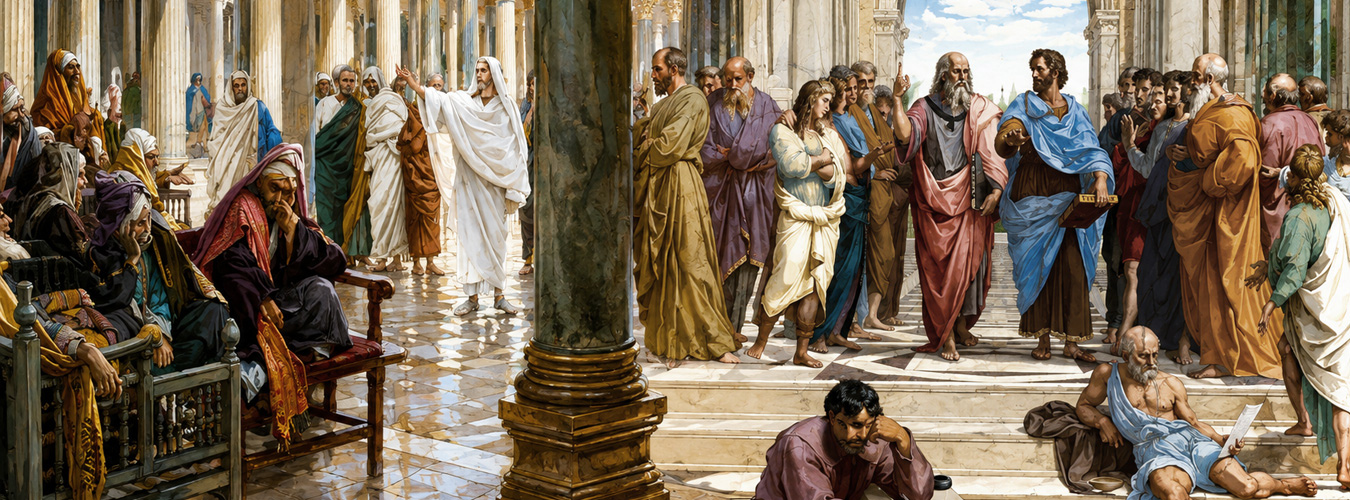

Jesus Meeting His Warriors
DELIVERED ON LORD'S DAY MORNING, SEPTEMBER 11, 1864, BY C. H. SPURGEON,
AT THE METROPOLITAN TABERNACLE, NEWINGTON.
"And Melchizedek king of Salem brought forth bread and wine: and he was
the priest of the Most High God. And he blessed him and said, Blessed
be Abram of the Most High God, possessor of Heaven and earth: and
blessed be the Most High God, which has delivered your enemies into
your hand. And he ga ve him tithes of all." Genesis 14:18-20.
What a splendid type is Abram, in the narrative before us, of our Lord
Jesus Christ! Let us read this story of Abram in connection with our
Savior and see how full of meaning it is. Our Lord Jesus Christ, in the
abundance of His love, had taken us to be His brothers. But we, through
our sin, had gone into the land of Sodom and Jesus Christ dwelt alone
in His safety and His happiness, enjoying the Presence of God. The
hosts of our enemies, with terrible force and cruel fury, carried us
away captives. We were violently borne away, with all the goods which
we possessed, into a land of forgetful-ness and captivity forever.
Christ, who had lost nothing by this, nevertheless being a "brother
born for adversity," pursued our haughty foes. He overtook them. He
struck them with His mighty hand–He took their spoil and returned with
crimsoned vesture, leading captivity captive. He restored that which He
took not away. I think, as I see Abram returning from the slaughter of
the four kings, I see in him a picture of a greater than Abram,
returning "from Edom, with dyed garments from Boz-rah, traveling in the
greatness of His strength" who answers to my inquiry of who is he? "I
that speak in righteousness, mighty to save." Abram was that righteous
man raised in the East, to whom God gave his enemies as driven stubble
to his bow.
And so the Lord Jesus has driven our enemies like chaff over to the
wind, for they fled at the Presence of Jehovah Jesus, and by the valor
of the atoning Lamb they have been utterly broken in pieces forever.
Let that thought dwell with you–it may furnish you with matter for
meditation at your leisure. We shall this morning rather consider Abram
as the type and picture of all the faithful. He was the father of the
faithful. And in his history you have condensed–as I think– history
of all faithful men. You will scarcely find a trial which will befall
you which has not in some respect happened to Abraham.
I will not say that he was tempted in all points like as we are, but he
was tempted in so many points that he well deserves to be called the
father of the faithful–being partaker of flesh and blood even as all
the children are who belong to his faithful family. Observe then, in
handling our subject in this manner, that Believers are frequently
engaged in warfare. Notice, secondly, that when they are thus engaged
they may expect to be met by their Lord, the great Melchizedek! And
remember, thirdly, that when they are favored with an interview with
Him and are refreshed by Him as with bread and wine, then, like Abram,
they consecrate themselves anew and as Abram gave tithes of all, even
so do they.
I. We mention, then, what you must all know right well by
experience–you who are God's people–that the Believer is often
engaged in warfare. This warfare will be both within and
without–within with the innumerable natural corruptions which
remain–with the temptations of Satan, with the suggestions of his own
wicked heart. And without he will frequently be engaged in warfare,
wrestling "not against flesh and blood, but against principalities,
against powers, against the rulers of the darkness of this world,
against spiritual wickedness in high places."
The peculiar case of Abram leads me to remark that sometimes the
Believer will be engaged in warfare, not so much on his own account as
on the account of erring Brethren who, having gone into ill company,
are by-and-by carried away captive. It was no quarrel of Abram's–it
was Lot's matter. Lot had gone to Sodom. Instead of standing in the
separated path of the true Believer he had joined himself to the world.
And when evil days came Lot was carried away captive with the rest.
Abram cared little enough for the king of Sodom–I do not suppose he
would have taken his sword from the sheath for all the men who dwelt in
Admah or Zeboim. But for Lot's sake, seeing him in ill company and in
danger, he draws the sword. And sometimes, Brethren, when we see those
who are God's servants putting themselves into alliance with evil
systems, we find them carried away captive and taken where we believe
their hearts would never go. And so we feel compelled to come out and
draw the sword against the common enemy of Christ and of all His
people. And though they may heartily wish that we would let them alone
in their sin and let them be quiet in their evil union, we see into
what spiritual capacity it leads them and we cannot be silent. We must
draw the sword when conscience and when God demand it and never sheath
it until God's work is done.
However, this rarely occurs. For the most part the Christian spends his
sword's edge upon his own spiritual foes– and truly we have enough of
these. What with pride, sloth, lust–what with the arch enemy of souls
and his insinuations and blasphemies–the lust of the eyes, the
pleasures of this world and the pride of life–what with enemies who
come upon us even from Providence in the shape of temptations arising
out of our trials and our vocations, we ought to carry our sword always
drawn! And, above all, we should ever carry the shield of faith and
take the weapon of all-prayer.
The Christian is never to feel himself at ease so long as he is on this
side of Jordan. This is an enemy's land. Expect a foe behind every
bush. Look to hear the shot come whistling by and each night adore
almighty Grace that you have not fallen prey to your cruel and
remorseless foes. The Christian is engaged throughout his whole life as
a soldier–he is so called in Scripture–"A good soldier of Jesus
Christ." And if any of you take the trouble to write out the passages
of Scripture in which the Christian is described as a soldier and
provision is made for his being armed and directions given for his
warfare, you will be surprised to find there are more of this character
than concerning any other metaphor by which the Christian is described
in the Word of God!
His chief and main business seems to be, like his Master, to bear
witness for the Truth of God. "For this purpose was I born and sent
into the world." And though in himself a man of peace, yet he can say
with his Master, "I came not to send peace but a sword." Wherever he
goes he finds that his presence is the signal for war–war within him
and war outside him–he is a man of peace and yet a man of war because
a man of peace. The Christian is engaged in warfare with sin, Satan,
error and falsehood and sometimes he is called to fight for erring
friends.
Observe that this war is one against powerful odds. The four kings
mentioned in this chapter were all great sovereigns. From what little
we can glean from profane history, they appear to have been very mighty
monarchs and they must have been assisted by very valiant armies to
have struck the giants whose names are mentioned in the opening verses.
They appear to have carried away the five kings of the plain with the
greatest possible ease. Yet here is Abram, who has little more than
three hundred of his own armed servants at his call–and yet he
ventures against the embattled thousands of the kings of nations!
Such is the warfare of the Christian–he has to contend against foes
far too many for him–he is like the worm that is to arise and thrash
the mountain. He is little and despised and if he measures his own
strength he will find it to be perfect weakness. And yet, for all this,
he anticipates a victory and like Abram hastens to the holy war.
Carefully notice that as it is a battle of fearful odds, it is one
which is carried on in faith. Abram did not venture to this fight with
confidence in his own strength, or reliance upon his own bow. He went
in the name of the Lord of Hosts. Faith was Abram's continual comfort.
Sometimes his faith failed, as it will in the best, but still, the
spirit of the man's life was a simple confidence upon God–whom he had
not seen–but whose voice he cheerfully obeyed.
The Christian is to carry on his warfare in faith. You will be
vanquished, indeed, if you attempt it by any other method! Brethren,
there is not a sin in your heart which will not master you if you seek
to fight it by resolutions of your own. Faith in the precious blood of
Christ must win you the victory and the world will laugh you to scorn
if you assail it with any other weapons than such as Calvary will
furnish you. "This is the victory which overcomes the world, even our
faith." And if you ask Faith what weapon she uses, her reply is, "They
overcame through the blood of the Lamb." Live near to Jesus Christ.
Rest upon the power of His Atonement and the prevalence of His
plea–and then go forward against every enemy without and every foe
within–and you shall be more than a conqueror!
In this great battle, carried on by faith, Abram had a right given him
from God and the promise of God's Presence virtually in that right.
What business had Chedorlaomer to come to Canaan? Had not Jehovah said
to Abram, "All this land will I give unto you"? Therefore he and his
confederate monarchs were neither more nor less than intruders. For
thirteen years they might have exercised sovereignty over the cities of
the plain, but those cities and everything around them belonged
virtually to Abram. It is true they would have laughed at the very idea
of Abram's claiming the whole land of Canaan, but that claim was
nevertheless valid in the court of Heaven and the Patriarch, by Divine
right, was heir of all the land.
Christian, you are, by virtue of a Covenant made with you to drive out
every sin as an intruder. "Sin shall not have dominion over you: for
you are not under the Law, but under Grace." You are to drive out every
error, for you are a servant of the Truth of God and the Truth alone
has a right to live and a right to exist. And in fighting this lawful
warfare you may expect that the right arm of the Most High God–the
Possessor of Heaven and earth–will be bared that He may show Himself
strong on behalf of all those who are valiant for His Truth and for His
name. Fear not! The battle is not yours, but God's. You go not to a
warfare at your own charges. And though Hell may roar, as it will, and
earth be all in arms–and your own heart may fail you and your flesh,
when you take counsel with it, makes you feel a coward– yet say, "In
the name of God will I destroy them," and go forward and conquer! "They
compass me about like bees," said David, "yes, like bees they compass
me about: but in the name of God will I destroy them." And what David
did you shall do through David's God!
Yet more–the Christian is engaged in a conflict in which he walks by
faith and leans upon God. But yet it is a conflict in which he uses all
means, calls in all lawful assistance and exerts himself with all vigor
and speed. Abram did not sit still and say, "Well, God will deliver
Lot. He has promised to keep His servants as the apple of His eye." Oh,
no, that is not faith–that is foolish presumption! Abram did not take
his time about it and go marching leisurely after the foe, nor did he
go without the assistance of his friends, Aner and Eshcol and Mamre. So
the Christian, if he sees any method by which he may be assisted in
overcoming sin or promoting the Truth of God, uses it with wisdom and
discretion. He trusts in God as though he did nothing himself and yet
he does everything as if all depended upon himself. He knows that good
works cannot save him and he equally knows that he is not saved unless
there are some fruits of good works.
He understands that the means of Grace cannot of themselves convey
Grace to him and yet at the same time he never despises them but looks
to find a blessing in the use of them. He understands that the ministry
and private prayer and the searching of the Scriptures cannot save
him–but he also understands that thus using them helps which God has
given him and diligently pressing forward and setting a bold face
before the foe–he is in the path of God's ordinances and may expect to
have God's help. And do observe, dear Friends, yet again, that Abram
marching on thus with activity and using discretion–by attacking his
enemies at night rather than by day–did not cease until he had gained
a complete victory over them.
It was not enough to strike them at one corner of their host, nor
merely to deliver Lot. Now that he is come out against them he will win
a sure and decisive victory. O Beloved, you and I are never to sit
still and say, "It is enough." Have I struck my drunkenness? Have I
overcome by blaspheming habits? Am I delivered from Sabbath-breaking?
Have I become honest and chaste? Yet this is not where I should stop.
Have I sought to bring down my self-conceit, my pride, my sloth? It is
well and good but let me never be satisfied with any attainment short
of absolute perfection. We do not believe we shall be perfect in this
life, but we will never be satisfied until we are. "Onward," is the
Christian's motto! As long as there is one sin which is not removed we
will fight and cry and groan and go to the Cross concerning it.
As long as there is one soul in this world unsaved, we will wrestle
with the Mighty One of Jacob to stretch out His hand to save it! So
long as there remains one error upon earth–so long as we have a tongue
to speak and God gives us Grace–we will bear our witness against it.
In this battle there is no keeping back our hand till the victory is
wholly won. We must bring back the goods and the men and the women and
Lot and the whole company–the victory must be complete. More than
conquerors must we be through Him who has loved us. Let us anticipate
the time when it shall be so.
O Brethren, I think I see the victors ascending the starry steeps in
triumphal state! Christ at their head rides gloriously! He who loved
them leads the van. The gates open to Him as the great Conqueror who
has led their captivity captive. I think I see the glad faces of all
those soldiers of the Cross as they enter the portals of eternal
peace–
"I ask them where their victory came.
They with united breath,
Ascribe their conquest to the Lamb,
Their triumph to His death."
See, then, Beloved, you are this morning soldiers! You are to fight by
faith in God. However tremendous the power of your adversaries, you are
not to fear since God is with you. You are to fight using discretion as
your armor-bearer, but you are also to couple this with perseverance,
continuing faithful to the end, for only those who overcome shall sit
upon the Throne of God forever!
We have thus, perhaps, said enough concerning this first point and now
may the Holy Spirit bedew with His holy influences while we talk of the
second, for otherwise it will be only talk.
II. While engaged in such earnest spiritual contention the Believer may
expect to see his Lord. When Shadrach, Me-shach and Abednego were
fighting Christ's battles in the fiery furnace, then the Son of Man
appeared to them. As in the building of Jerusalem in troublous times
they had the sword in one hand and the trowel in the other, so our Lord
Jesus Christ, while He teaches us to use the sword, takes care to edify
and build us up in the faith at the same time! He understands that
warriors require strengthening meat and that especially when they are
under stern conflict they need extraordinary comforts that their souls
may be stayed and refreshed.
Why does Jesus Christ, as set forth here under the type of Melchizedek,
appear unto His children in times of conflict? Answer–He comes to
them, first, because they are weary. In every conflict which the child
of God has to wage, it is not the private person who goes to the
warfare–it virtually is Christ fighting–Christ contending. It is a
member of Christ's body laboring against Christ's enemy for the glory
of the Head. Christ the Head has an intense feeling of sympathy with
every member, no matter how humble. Since there is a vital union
between Christ and every member, there is also an undying sympathy. And
whenever, Brothers and Sisters, you contend for the faith till you grow
weary, Jesus Christ will be sure to give you some proof of His close
communion with you.
The martyrs proclaim that they never had such communion with God
anywhere as among the caverns of the hills, or the swamps of the woods
to which they were exiled for Christ. And even on the rack, in
extremity of torture, or even upon the gridiron in the heat of the
fire–even there the sweet Presence of Christ has been overpoweringly
delightful to them so that they almost lost the sense of pain! You,
Lord, do send a plenteous rain whereby You refresh Your heritage when
it is weary! Spend your strength for God, Brothers and Sisters, for
when fainting seems inevitable, then shall come such a sweet renewing
of your strength that, like an eagle, you shall stretch your wings and
mount aloft to commune with God in solitary joys! Christ, your
Melchizedek, will meet you in your conflicts if He never did before!
The King of Peace met the returning warrior for another reason. Abram
was probably flushed with victory and this is a very dangerous feeling
for any child of God. When the seventy disciples returned to Christ
they said, with evident exultation, "Lord, even the devils are subject
unto us." But Jesus Christ sweetly and gently rebuked them by saying,
"Nevertheless, rejoice not in this, but rather rejoice because your
names are written in Heaven." The true secret of a Christian's joy is
not to be his conquest over sin or over error, but the Person of his
Lord Jesus Christ! The Lord knows that His people, if they are
successful even in spiritual warfare–when they have used the best of
means and felt the best of motives–are, nevertheless, very liable to
the intoxication of pride. And therefore He either sends "a thorn in
the flesh," or else, what is better still, He comes Himself!
I am persuaded, Beloved, that the best cure for pride is a sight of
Christ. Oh, when your eyes see Him, then your own loathsomeness,
blackness and deformity are clearly revealed. I am fair until I see the
sun–then–then am I black, indeed! I think myself pure until I see Him
whiter than any fuller could make Him and then I fall down and cry,
"Unclean, unclean, unclean!" "Now my eye sees You," said Job, "why I
abhor myself, and repent in dust and ashes." Down go your flaunting
banners and your lofty plumes when you have a sight of Christ! No
humbler man than George Herbert–no humbler man than Samuel
Rutherford–and these were men who lived close to Christ. Christ's
Presence is a cure-all.
When Melchizedek comes every spiritual disease flies before Him. The
Church at Laodicean was very far gone and how did the Master propose to
cure it? Here it is–"Behold, I stand at the door and knock: if any man
hears My voice and opens the door, I will come into him and will sup
with him." What? Lord, is this Your delightful treatment of Your sick
Church? "Yes, My communion with you, poor lukewarm Laodicean, will
revive you." Truly that is a most suggestive figure by which John
describes the countenance of Christ–he says, "His countenance was as
the sun shining in his strength." So, Lord, it does not matter how dark
I am, the moment You show Your face, all must be light! This, I think,
was the reason why the King of Righteousness met Abram–to turn away
his thoughts from the tempting joys of victory to his sure portion in
the Most High God, possessor of Heaven and earth.
Yet again, was not this visit bestowed because Abram was about to be
tried in a yet more subtle manner than he had been before? It is easier
to fight Chedorlaomer than to resist the King of Sodom. Joshua down in
the plain never grew weary when he was fighting the Amalekites, but
Moses on the mountain felt his hands grow heavy. Why? Because the more
spiritual the exercise, the more apt are we to grow weary in it. And so
the more spiritual the temptation the more likelihood of our becoming a
prey to it and the more strength do we need to overcome it. That was a
very subtle temptation to Lot, by the King of Sodom. Why it looked so
right–perfectly right. Abram has brought back these captives– he has
a right to the spoil–he ought, therefore, to take it. If he had done
so, no one would blame him on ordinary rules. But there is a higher
rule for Believers than for other men!
Brethren, I contend that the common rules of morality are binding upon
all–but that a supernaturally high rule of morality should regulate
the Christian! The Christian is not allowed to wink at an evil because
he has educated his conscience not to think it so–but he shall so act
that there shall not be any wrong in the action upon the common
judgment of any unbiased spectator. He who is of the King's Council
must walk very daintily lest he offend his Master. I tell you, from
experience, that the nearer you come to Christ and the more you have of
communion with Him, the more jealous you must be of yourself, or else,
if other men escape the rod you will not–you will have to smart for it
behind the door where another may not see nor understand your grief.
Beloved, it is well to have communion with Christ to prepare us against
subtle temptations, for to feed us upon Mel-chizedek's bread and wine
is to make us more than a match for the King of Sodom. O Jesus! When I
have seen Your face, my soul beholds not the dazzling beauties of
earthly excellence. Brothers and Sisters, if ever you have seen
Christ's face, that painted harlot, the world, will never win your love
again! Did you ever eat the pure white bread of Heaven? Then the brown
gritty bread of earth will never suit you but will break your teeth
with gravel stones. You will never care to drink earth's sour and
watery wine if you have once been made to drink of the wines on the
lees well refined–the spiced wine of Christ's pomegranate. If you want
to be strengthened against the most subtle worldly temptations, cry,
"Let Him kiss me with the kisses of His mouth: for Your love is better
than wine." And you may go forth to conflicts of every kind more than a
conqueror, through Him that has loved you!
Thus we have spoken upon the fact that Melchizedek met Abram and the
reasons. Now, let us look a little more closely at what he did. In what
character did he meet Abram? The reply is easy–he met him as one
possessed of a royal priesthood. Christ meets us, Brethren, as a Priest
and a King in all our battles. What a mercy it is that Christ visits us
as a Priest, for we never fight against sin without being in some
measure partakers of it. I do not believe there ever was a controversy
for the Truth of God upon which any gracious man, though engaged upon
the right side, could look back without some regrets and some tears.
I much believe that even Martin Luther or John Knox, when upon their
dying beds, though never regretting that they contended earnestly for
the faith yet felt that while they were in the flesh something of flesh
mingled with all that they did. Thus it will be to the end and even
when contending against our own sins and lusts. Yet, Beloved, our very
repentance has something in it to be repented of and our very flying to
the Cross has something in it of a lingering from the Cross and
therefore something of evil. Jesus, all hail! How much I need to meet
You as a priest! And you, Beloved, do you not feel that you need Him,
too? Do you not, as you look upon Calvary and the flowing blood,
confess that you need, in all spiritual conflicts, to meet Christ?
But Melchizedek was also a king and truly thus we want to view our Lord
whenever we are fighting His battles. "The Lord reigns," is perhaps one
of the most comforting texts in the compass of God's Word to the
contending Christian. "Ah," says the poor soul, "I am trod under foot
of Satan, but rejoice not over me, O my enemy–though I fall, yet shall
I rise again, for the Lord reigns!" Oh, that is our consolation when at
any time we think we are routed! When we see our Church dismayed and
our banner trailed in the mire–we then remember Jesus, for Him has God
the Father exalted, "and given Him a name which is above every name:
that at the name of Jesus every knee should bow, of things in Heaven
and things in earth and things under the earth."
Hail, King of Righteousness and Peace, much do we need to meet You!
Come, mount Your glorious chariot, ride forth conquering and to conquer
drawn by Your three white horses, Meekness, Truth and Righteousness!
Heaven adores
You, earth obeys You, Hell trembles at Your Presence! Gates of brass
must burst at Your touch and bars of iron snap at Your Word! O King
Immortal, ride gloriously and let Your people behold You and rejoice in
You. But we must see Christ, see Him, by close communion with Him. You
cannot see Him by my description. Melchizedek met Abram and Jesus
Christ must meet you. He must stop you all of a sudden, when you least
expect it, and reveal Himself to you as He does not unto the world.
Jacob, before wrestling, was met by hosts of angels at Mahanaim–but
what are these when compared with the Lord Himself? There is a high
blessing in being met by angels–do not mistake me there–but oh, to be
met by the Angel of the Covenant, the Michael the Archangel, to be met
by Him! Ah, what comfort is here! And will He meet me? Will He meet
you? Yes, we can answer, He will–for we have met with Him. "My eyes
have seen the King in His beauty." Many of us can say that and our
souls are exceedingly comforted and full of holy joy because we have
beheld Him as Priest and King.
The next inquiry is what did he do for him? He brought him bread and
wine, precisely setting forth what Jesus does, who brings us His flesh
and His blood. Carnal people say in order to understand Christ's words,
that when you eat bread and drink wine at the Lord's Table, there is
His flesh in the bread, or that the bread is transubstantiated into
flesh and the same with the wine. But the spiritual mind understands
that these emblems awaken the spiritual powers and that the spiritual
powers–not the lips and the stomach, but the spiritual powers–do
really and spiritually feed upon the flesh and blood of Jesus Christ
and so the Word is fulfilled–"Except you eat My flesh and drink My
blood, there is no life in you."
I do not know that Christian people feed altogether on doctrine. I know
that the Truth of God is food, but Believers get richer nourishment
than even this affords. When I am very gloomy I like to take down some
work upon the high doctrines–God's Sovereignty, election,
perseverance–and I get comforted. But there are other times when I am
brought very low and that kind of food will not suit me. I am obliged
then to turn to my Lord Himself. There is, I believe, in times of
conflict, no food which can be the stay of an immortal soul except the
Master Himself–communion with Him–a putting of the fingers into the
print of the nails and a thrusting of the hand into the side. This is
the sovereign remedy for unbelief and the best food for faith. His
manifest Presence is our noblest nutriment.
When Christ reveals Himself, all grows calm and peaceful. But until we
can get Him we still abide in darkness and we see no light. The
worshiper who came up to the temple could not live upon the brazen
laver, nor the golden snuffers, nor even upon the cherubic emblems–he
must partake with the priests of the lamb offered in sacrifice! And so
the true food of the child of God is Jesus Christ Himself–not so much
ordinances and doctrines, which are only the utensils and the
vestments–but Christ Himself! The very Christ, made flesh for us,
received with joy into our soul and fed upon, until, like Abram, we go
on our way rejoicing. That is what the royal priest did for the
Patriarch.
Bear with me patiently while I remark what Melchizedek said to him.
First he blessed him and then he blessed God and that is just what we
need our Lord to do for us. We want our Lord Jesus Christ first to
bless us. "Blessed be Abram of the Most High God, possessor of Heaven
and earth." We need a blessing upon our own persons and especially upon
our own works. What are our works when we have done them all but futile
vanity until God comes to strengthen us? Beloved, you and I may contend
for Christ until we are dumb but not a soul will see the light or know
the Truth of God by our witness of itself! We may go with tender hearts
and seek to bring sinners to the Cross of Christ, but we shall never
bring a sinner unless God's own arm is revealed.
We shall come back like the Prophet, saying, "Who has believed our
report?" And feeling that the arm of God has not been revealed unto
men. But when, on the other hand, the Possessor of Heaven and earth has
blessed us, then our earthly substance is blessed and our earthly words
are blessed and then we get a heavenly blessing! Heaven's rest and
peace–Heaven's Omnipotence rest upon us and in the glory of a
Heaven-given strength we go forth confident of victory. We want a
blessing from Christ. Ask for it now, Beloved! Ask for it now, you who
are weary with last week's fighting, you who can scarcely endure any
longer by reason of your trials and troubles! Say to Him now,
"Melchizedek, bless me! O Jesus, bless me now!"
Possessor of Heaven and earth, forget not one of us, Your beloved ones,
but give us a blessing! Beloved Brethren, Melchizedek did not stop
there, but he fulfilled another part of his priestly office–he blessed
God. Whenever we are singing here, when I am in right order, my soul
takes wing and wants to fly to Heaven! When we all sing with power and
force there is a sweetness and grandeur about the song which we do not
often meet. Yet I am always conscious that we cannot praise God as He
deserves to be and herein I bless the great Melchizedek that though we
cannot bless God as He should be blessed, yet He can! Jesus Christ
presents the praises of His saints before God as well as their prayers.
He is the Intercessor and while He has the vials full of odors sweet to
present, He also presents the music of our harps. Both our offerings
come up accepted in the Beloved.
Now what do you say, Brethren? Have you done anything this week that is
of good repute? Has God given you any success? Dear Sister, have you
won any souls for Christ? I know you have! Dear Brother, has God
blessed you in any witness-bearing? Have you felt that God has been
with you? Well now, come and lay your honors down at His feet, whatever
they may be! Put them there and pray the great Melchizedek to take out
of your heart every particle of self-glory and every atom of
self-exaltation and ask Him to say for you in a higher sense than ever
you can say it, "Blessed be the Most High God, possessor of Heaven and
earth who has delivered my enemies into my hand." Thus you shall be
glad that the great Melchizedek has met you!
I have talked thus, but truly one word from the lips of Christ will be
worth ten thousand of mine! And if you ever have seen Him, you will
think me a very dauber when I try to paint Him. If you get this day so
much as ten minutes real fellowship with Jesus, you will wonder how it
is, that I, if I know anything about Him, could talk in this cold way!
Go your way, Brethren, and pray Melchizedek will meet you!
III. Lastly, and very briefly, indeed, since our time is gone–when a
wrestling Believer is favored with a sight of the great
Melchizedek–voluntarily and yet necessarily he makes a new dedication
of himself to God. You see Abram does not appear to delay a moment but
he gives to Melchizedek a tithe of all, by which he seemed to say, "I
own the authority of my superior liege lord, to all that I am and all
that I have." There is one of our hymns which says–
"Hail, Melchizedek Divine! You, great High Priest, shall be mine. All
my powers before You fall Take not tithe, but take them all." And truly
our holy faith deserves that we should give all to Christ!
I would that some Christians, however, practiced the rule of giving a
tenth of their substance to the Lord's cause. The Lord's Church need
never lack if you had a bag in which you stored up for Christ–when you
gave anything, you would not feel it was giving of your own–your left
hand would not know what your right hand did, for you would be taking
out of the Lord's stock which you had already consecrated to the Lord's
cause. Not less than one-tenth should be the Lord's portion, especially
with those who have.
And more than this, I think, should be expected of those who have
wealth. But there is no rule binding with iron force upon you for we
are not under Law in Christ's Church, but under Grace and Grace will
prompt you to do more than Law might suggest. But certainly the
Christian should reckon himself to be not his own and that he has
nothing to retain for his own private account. I pray God if I have a
drop of blood in my body which is not His, to let it bleed away! And if
there is one hair in my head which is not consecrated to Him, I would
have it plucked out–for it must be the devil's drop of blood and the
devil's hair. It belongs to either one or the other–if not to God,
then to Satan. No, we must, Brethren, have no division of ourselves–no
living unto this world and unto God, too.
Mark Anthony yoked two lions together and drove them through the
streets of Rome–they do strange things at Rome and there are many
people who can yoke two lions together and drive towards Rome. But you
will never be able to yoke the lion of the tribe of Judah and the lion
of Hell together–they are at deadly antagonism and Christ will not
have you for His servants if you seek to serve two masters. I know that
any talk of mine here will be in vain, but if, Beloved, you should see
Christ and have communion with Him, your consecration to Him will be a
matter of course. I will suppose that this afternoon one of you should
sit down in your arm chair and, as you are sitting there, you will be
thinking, "How little I have been giving of late to the cause of
Christ! How seldom I have opened my mouth for Him!"
Perhaps you will think, "I have got on in the world, too, but I really
cannot afford it! My expenses are so great!" Suppose the Lord Jesus
Christ should come into the room with those pierced hands and bleeding
feet–suppose He were to remind you of what He has done for you–how He
visited you in your low estate when your heart was breaking under a
sense of sin? You would not tell Him you could not afford to give to
His cause! Suppose our Lord Jesus Christ should look you in the face
and say to you, "I have done all this for you. What will you do for
Me?" What would be your answer? Why, you would say, "Take it all, my
Master, take it all, all that I am and all that I have shall be forever
Yours."
Or, if you felt niggardly–supposing He should say to you, "If you will
never ask anything of Me, I will never take anything from you." Would
you agree to that? No! Because you still will have immense demands to
make upon His liberality cease not to give your whole spirit, soul and
body as a whole burnt-offering unto God. As Abram did before
Mel-chizedek so you do in the Presence of Christ. Admit that you are
His and give yourself to Him. My dear Brethren, I pray God that this
may stir you up to seek a high grade of piety and to live in daily
communion with a living Savior and He will bless and keep you.
But there are some of you who are not like Abram. You need not hope,
yet, to see Melchizedek. There are some of you strangers, far off. Ah,
I may rather compare you to the men of Sodom! Christ has done something
for you as Abram did for Sodom. You know it was only for the sake of
Lot that He brought them back, but He did bring them all back and for
the sake of Lot gave a respite to them all–although a few years after
they had grown so wicked that they were all destroyed. My Master has
given a respite to free you all. While His great work was the salvation
of His own chosen, yet He has spared you all in the land of the living.
Take heed lest you do as did the men of Sodom, for then a hail more
fiery, a destruction more terrible must come upon you, seeing that you
turn not aside from your evil ways, nor seek His face.
Trust Christ and you are saved! Believe in Him and your sins are
forgiven. But if you refuse, beware lest that come upon you which is
written in the Prophets, "Behold, you despisers and wonder and perish!"
The Master now send us away with His benediction. Amen.