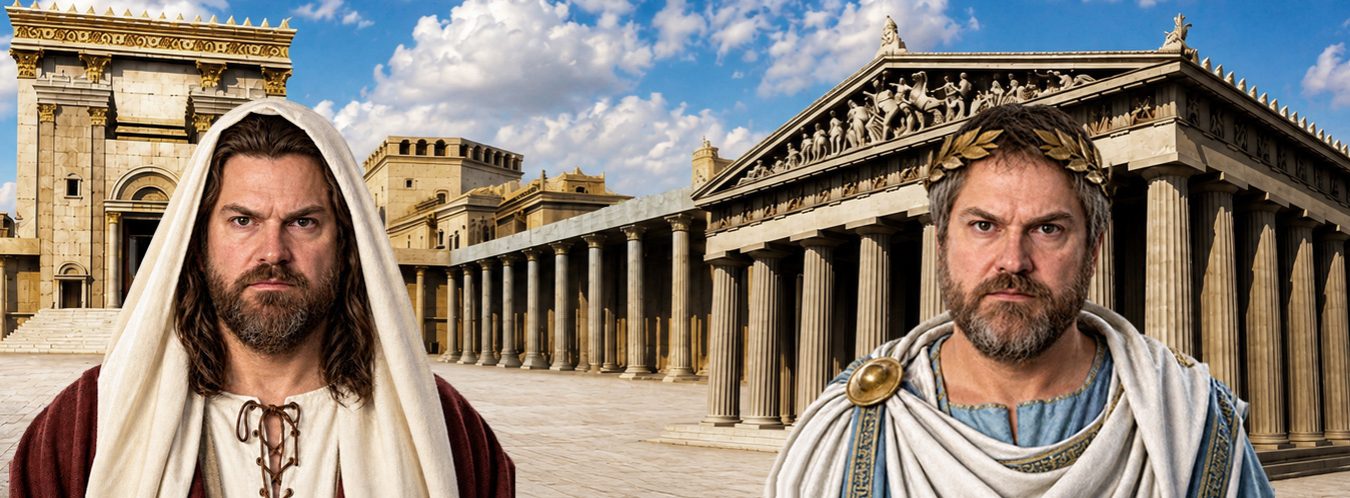

An Awful Contrast
(No. 2473)
A SERMON INTENDED FOR READING ON LORD'S-DAY, JULY 12, 1896.
DELIVERED BY C. H. SPURGEON,
AT THE METROPOLITAN TABERNACLE, NEWINGTON, ON LORD'S-DAY EVENING, JULY
11, 1886.
"Then they spat in His face." Matthew 26:67.
"And I saw a great white throne, and Him that sat on it, from whose
face the earth and the Hea ven fled away." Revelation 20:11.
GUIDED by our text in Matthew's Gospel, let us first go in thought to
the palace of Caiaphas, the High Priest, and there let us, in deepest
sorrow, realize the meaning of these terrible words–"Then they spat in
His face." There is more of deep and awful thunder in them than in the
bolt that bursts overhead. There is more of vivid terror in them than
in the sharpest lightning flash–"Then they spat in His face."
Observe that these men, the priests, scribes, elders and their
servitors did this shameful deed after they had heard our Lord say,
"Hereafter shall you see the Son of Man sitting on the right hand of
power, and coming in the clouds of Heaven." It was in contempt of this
claim, in derision of this honor which He foretold for Himself that,
"then they spat in His face," as if they could bear it no longer, that
He, who stood to be judged of them, should claim to be their
Judge–that He whom they had brought at dead of night from the Garden
of Gethsemane as their captive, should talk of coming in the clouds of
Heaven–"Then they spat in His face."
Nor may I fail to add that they thus assaulted our Lord after the High
Priest had torn his clothes. My Brothers and Sisters, do not forget
that the High Priest was supposed to be the representative of
everything that was good and venerable among the Jews! The High Priest
was the earthly head of their religion. He it was who, alone of mortal
men, might enter within the mysterious veil–yet it was he who
condemned the Lord of Glory as he tore his clothes and said, "He has
spoken blasphemy; what further need have we of witnesses? Behold, now
you have heard His blasphemy." It makes me tremble as I think of how
eminent we may be in the service of God and yet how awfully we may be
enemies of the Christ of God! Let none of us think that though we
clamber up to the highest places in the Church we are, therefore,
saved. We may be High Priests and wear the Urim and the Thummim. We may
put on the breastplate with all its wondrous mystic stones and bind
around us the curious girdle of the ephod, and yet, for all that, we
may be ringleaders in expressing contempt of God and of His Christ!
It was when Caiaphas, the High Priest, had pronounced the word of
condemnation against Christ that, "then they spat in His face." God
grant that we may never take upon ourselves any office in the Church of
God and then, girt about with the authority and influence which such an
office might lend to us, be the first to pour derision and contempt
upon the Christ of God! Yet I do not hesitate to say that when men look
to the earthly priesthood instead of looking to Christ, the Great High
Priest. When men are taught to trust in the "mass" instead of trusting
in Christ's one Sacrifice for sin upon the Cross, it is then that the
very priests lead the way in spitting in His face! Antichrist never
more surely dwells anywhere than in the place where Christ is thus
dishonored–and none do Him such dire disgrace as those who ought to
bow at His feet and lift Him high among the sons of men–yet who reject
Him and refuse His rightful claims.
"Then they spat in His face," after He had proclaimed His Godhead as
King and Judge of all, and after the man who ought to have been His
principal earthly servant had turned arch-traitor and led the way in
contempt of Him by accusing Him of blaspheming! "Then they spat in His
face."
There are two or three thoughts that come to my mind when I think that
these wicked men actually spat in Christ's face–in that face which is
the light of Heaven, the joy of angels, the bliss of saints and the
very brightness of the Father's Glory! This spitting shows us, first,
how far sin will go. If we need proof of the depravity of the heart of
man, I will not point you to the stews of Sodom and Gomorrah, nor will
I take you to the places where blood is shed in streams by wretches
like Herod and men of that sort. No, the clearest proof that man is
utterly fallen and that the natural heart is enmity against God is seen
in the fact that they spat in Christ's face, did falsely accuse Him,
condemn Him, lead Him out as a malefactor and hang Him up as a felon
that He might die upon the Cross! Why, what evil had He done? What was
there in His whole life that should give them occasion to spit in His
face? Even at that moment, did His face flash with indignation against
them? Did He look with contempt upon them? Not He, for He was all
gentleness and tenderness even towards these, His enemies, and their
hearts must have been hard and brutal, indeed, that, "then they spat in
His face."
He had healed their sick. He had fed their hungry. He had been among
them a very fountain of blessing up and down Judea and Samaria, and
yet, "then they spat in His face." I say again, relate not to me the
crimes of ancient nations, nor the horrible evils committed by
uncivilized men, nor the more elaborate iniquities of our great cities!
Tell me not of the abominations of Greece or Rome–this, this, in the
sight of the angels of God and in the eyes of the God of the angels, is
the masterpiece of all iniquity–"Then they spat in His face." To enter
into the King's own palace and draw near to His only-begotten Son–and
to spit in His face–this is the crime of crimes which reveals the
infamous wickedness of men! Humanity stands condemned of the blackest
iniquity now that it has gone as far as to spit in Christ's face!
My meditation also turns towards the Well-Beloved into whose face they
spat. And my thought concerning Him is this–how deep was the
humiliation He had to endure! When He was made sin for us, though He,
Himself, knew no sin, when our Lord Jesus Christ took upon Himself the
iniquities of His people and was burdened with the tremendous weight of
their guilt–it became incumbent upon the justice of God to treat Him
as if He were actually a sinner. He was no sinner and He could not be
one–He was perfect Man and perfect God–yet He stood in the place of
sinners and the Lord caused to meet upon Him the iniquity of all His
people! Therefore, in the time of humiliation He must not be treated as
the Son of God, neither must He be held in honor as a righteous Man! He
must first be given up to shame and to contempt–and then to suffering
and to death and, consequently, He was not spared this last and most
brutal of in-sults–"Then they spat in His face." O my Lord, to what
terrible degradation are You brought! Into what depths are You dragged
through my sin and the sin of all the multitudes whose iniquities were
made to meet upon You! O my Brothers, let us hate sin! O my Sisters,
let us loathe sin, not only because it pierced those blessed hands and
feet of our dear Redeemer, but because it dared even to spit in His
face! No one can ever know all the shame the Lord of Glory suffered
when they spat in His face.
These words glide over my tongue all too smoothly–perhaps I do not
feel them as they ought to be felt–though I would do so if I could.
But could I feel as I ought to feel in sympathy with the terrible shame
of Christ and then could I interpret those feelings by any language
known to mortal man, surely you would bow your heads and blush! And you
would feel rising within your spirits a burning indignation against the
sin that dared to put the Christ of God to such shame as this! I want
to kiss His feet when I think that they spat in His face.
Then, once more, my thoughts run to Him, again, in this way–I think of
the tender Omnipotence of His love. How could He bear this spitting
when, with one glance of His eyes, had He been but angry, the flame
might have slain them and withered them all up? Yet He stood still even
when they spit in His face! And they were not the only ones who thus
insulted Him, for, afterwards, when He was taken by the soldiers into
Pilate's hall, they also spat upon Him in cruel contempt and scorn–
"See how the patient Jesus stands,
Insulted in His lowest case!
Sinners ha ve bound the Almighty hands,
And spit in their Creator's face." How could He bear it? Friends, He
could not have borne it if He had not been Omnipotent. That very
Omnipotence which would have enabled Him to destroy them was
Omnipotence of love, as well as Omnipotence of force. It was this that
made Him–if I may so say–"restrain Himself," for there is no
Omnipotence like that which restrains Omnipotence. Yet so it was that
He could endure this spitting from men! Can you think of this marvelous
condescension without feeling your hearts all on fire with love for
Him, so that you long to do some special act of homage to Him by which
you may show that you would gladly pay Him for this shame if you could?
I will not say more about that point, for the shameful fact stands
indelibly recorded in the Scripture–"Then they spat in His face"–but
I want to bring the Truth of God home, Brothers and Sisters, and show
you how we may have done to Christ what these wicked men did. "Oh,"
says one, "I was not there! I did not spit in His face." Listen!
Perhaps you have spat in His face. Perhaps even you have spat in His
face. You remember that touching hymn that we sometimes sing–
"My Jesus! Say what wretch has dared Your sacred hands to bind? And who
has dared to buffet so Your face so meek and kind? My Jesus! Whose the
hands that wove That cruel thorny crown? Who made that hard and hea vy
Cross That weighs Your shoulders down? My Jesus! Who with spittle vile
Profaned Your sacred brow? Or whose unpitying scourge has made Your
precious blood to flow? 'Tis I have thus ungrateful been, Yet, Jesus,
pity take! Oh, spare and pardon me, my Lord, For Your sweet mercy's
sake!" There are still some who spit in Christ's face by denying His
Godhead. They say, "He is a mere man–a good man, it is true, but only
a man." How they dare say that, I cannot make out, for he would be no
good man who claimed to be God if he were not God! Jesus of Nazareth
was the basest of impostors who ever lived if He permitted His
disciples to worship Him and if He left behind Him a life which compels
us to worship Him! If He were not really and truly God, then of all
those who declare that He is not God–and there is a very great company
of them even among the nominally religious people of the present day,
we must sorrowfully, but truthfully say, "Then they spat in His face."
They also do the same who rail at His Gospel. There are many, in these
days, who seem as if they cannot be happy unless they are tearing the
Gospel to pieces. Especially is that Divine mystery of the
Substitutionary Sacrifice of Christ the mark for the arrows of these
wise men, I mean those who are wise according to the wisdom of this
world. We delight to know that our Lord Jesus Christ suffered in the
place of His people–
"He bore that we might never bear His Father's righteous ire."
Yet I have read some horrible things which have been written against
that blessed doctrine and, as I read them, I could only say to myself,
"Then they spat in His face." If there is anything that is beyond all
else, the Glory of Christ, it is His atoning Sacrifice! And if ever you
thrust your finger into the very apple of His eye and touch His honor
in the most tender possible point, it is when you have anything to say
against His offering of Himself a Sacrifice to God, without blemish and
without spot, that He might put away the iniquities of His people!
Therefore judge yourselves in this matter and if you have ever denied
Christ's Deity, or if you have ever assailed His atoning Sacrifice, it
might truly have been said of you–"Then they spat in His face."
Further, this evil is also done when men prefer their own righteousness
to the righteousness of Christ. There are some who say, "We do not need
pardon, we do not need to be justified by faith in Christ–we are
already good enough." Or, "We are working out our own salvation–we
mean to save ourselves." O Sirs, if you can save yourselves, why did
Jesus bleed upon the Cross? It was a superfluity, indeed, that the Son
of God should die in human form if there is a possibility of salvation
by your own merits! And if you prefer your merits to His, it must be
said of you, also, "Then they spat in His face." Your righteousnesses
are only filthy rags! And if you prefer these to the fair white linen
which is the righteousness of saints. If you think to wash yourselves
in your tears and so despise that precious blood apart from which there
is no purging of our sin–to you does our text apply–"then they spat
in His face," when they preferred their own righteousness to Christ's.
I have often spoken to you about the parable of the prodigal son, but,
possibly, your case is more like that of the elder brother in the
parable. You have your portion of goods and it is all your own, and you
are keeping it. You are rich, and increased in goods and have need of
nothing. You are self-righteous. You think that you can do very well
without God and without Christ–and you half suspect that God can
hardly do without you. You are doing so very well in the observance of
rites and ceremonies, and the performance of charity and devotions,
that if you go into the far country, you will cut a very respectable
figure! You will be one of those excellent citizens of that country who
will, in due time, send some poor prodigal into your fields to feed
your swine. I am inclined to believe that your case is even more sad
and hopeless than that of the prodigal, himself! You, too, have gone
far away from God. You are living without Him. He is not in all your
thoughts. You could almost wish that there were no God, for then there
would be no dark cloud hovering in the distance to spoil your summer's
day, no fear of storms to come to mar the joy of the hour. Just as
truly as of the avowed infidel who openly rejects Christ, it must be
said of you, "Then they spat in His face."
The same thing is oh so sadly true when anyone forsakes the profession
of being a follower of Christ's. There are some, alas, who, for a time,
have appeared to stand well in the Church of God–I will not judge
them–but there have been some who, after making a profession of
religion, have deliberately gone back to the world. After seeming for a
while to be very zealous, they have become worldly and, perhaps, even
lascivious and vile. They break the Sabbath, they neglect the Word of
God, they forsake the Mercy Seat–and their last end is worse than
their first. When a man forsakes Christ for a harlot, when he gives up
Heaven for gold, when he resigns the joys he professed to have had in
Christ in order that he may find mirth in the company of the ungodly,
it is another instance of the truth of these words, "Then they spat in
His face." To prefer any of these things to Christ is infamous–and the
mere act of spitting from the mouth seems little compared with this sin
of spitting with the very heart and soul–and pouring contempt upon
Christ by choosing some sin in preference to Him. Yet, alas, how many
are thus still spitting in Christ's face! Perhaps some now present are
doing it.
If, dear Friends, our conscience in any measure accuses us of this sin,
let us at once confess it. Let us humble ourselves before the Lord and
with the very mouth that spat upon Him, let us kiss the Son lest He be
angry and we perish from the way, when His wrath is kindled but a
little!
And when we have confessed the sin, let us believe that He is able and
willing to forgive us. I know that it requires a great act of faith,
when sin is consciously felt, to believe in the splendor of Divine
Mercy. But, dear Friends, believe it! Do the Lord Jesus the great honor
of saying to Him, "Gracious Lord, wash me in Your precious blood.
Though I did spit in Your face, wash me in that cleansing Fountain and
I shall be whiter than snow." And according to your faith, so shall it
be done to you. You shall have the forgiveness, even, of this great sin
if you confess it and believe that Christ is both able and willing to
forgive it!
And when you have done that, then let your whole life be spent in
trying to magnify and glorify Him whom you and others have defamed and
dishonored! Oh, I think that if I had ever denied Christ's Deity, I
would want to stand in this pulpit night and day to revoke what I had
said–and to declare Him to be the Son of God with power! I think that
if I had ever set up anything in opposition to Him, I should want, day
and night, to be setting Him up above everything else, as, indeed, I
long to do! Come, Christian Brothers and Sisters, let us do something
unusual in Christ's honor! Let us find out something or invent
something fresh, either in the company of others or all by ourselves,
by which we may further glorify His blessed name!
Yet once more, if ever anybody should despise us for Christ's sake, let
us not count it hard, but let us be willing to bear scorn and contempt
for Him. Let us say to ourselves, "'Then they spat in His face.' What,
then, if they also spit in mine? If they do, I will 'hail reproach and
welcome shame,' since it comes upon me for His dear sake!" Look, that
wretch is about to spit in Christ's face! Put your cheek forward, that
you may catch that spittle upon your face, that it fall not upon Him,
again, for as He was put to such terrible shame, everyone who has been
redeemed with His precious blood ought to count it an honor to be a
partaker of the shame, if by any means we may screen Him from being
further despised and rejected of men!
There, dear Friends, I have not preached, I have just talked very, very
feebly and not at all as I wished and hoped I might be able to about
this wonderful text–"Then they spat in His face."
Now try to follow me, just for a few minutes, while I let you see that
same face in a very different light. Our second text is in the 20th
Chapter of the Revelation, at the 11th verse–"And I saw a great white
throne, and Him that sat on it, from whose face the earth and Heaven
fled away; and there was found no place for them."
This passage needs no words of mine to explain it. Notice how the
Apostle begins–"I saw." Oh, I wish I had the power to make you see
this great sight! Sometimes, to vividly realize a Truth even once is
far better than to have merely heard it stated ten thousand times. I
remember the story of a soldier who was employed in connection with one
of the surveys of Palestine. He was with some others of the company in
the valley of Jehoshaphat and, without thinking seriously of his words,
he said to his comrades, "Some people say that when Christ shall come a
second time to judge the world, the judgment will take place in the
valley of Jehoshaphat, in this very place where we now are." Then he
added, "When the Great White Throne shall be set, I wonder whereabouts
I shall be." It is said that he carelessly exclaimed, "I shall sit here
upon this big stone." And he sat down, but in an instant he was struck
with horror and fainted because, in the act of sitting down, he had
begun to realize somewhat of the grandeur and the terror of that
tremendous scene!
I wish I knew how to do or say anything by which I could make you
realize this scene that John saw in his vision. The Lord Jesus Christ
went up to Heaven from the top of Olivet in His own proper body–and He
shall so come in like manner as He was taken up into Heaven–but He
shall come, not the lowly Man of Sorrows, but as Judge of All, seated
upon a great white throne! And John says, "I saw it." As we sang, a few
minutes ago–
"The Lord shall come! But not the same As once in lowliness He came– A
silent lamb before His foes, A weary Man, and full of woes. The Lord
shall come! A dreadful form, With rainbow wreath and robes of storm. On
cherub wings, and wings of wind, Appointed Judge of all mankind."
I wish, dear Friends, that even in your dreams you might see this
sight, for, though I have no trust in dreams by themselves, yet any
realization of this great Truth of God will be better than the mere
hearing of it.
"I saw," said John, "a great white throne." He saw a throne, for Christ
now reigns! He is King of Kings and Lord of Lords–and when He comes
again, He will come in the power of universal sovereignty as the
appointed Judge of all mankind! He will come upon a throne!
That throne is said to be white. What other throne can be so described?
The thrones of mere mortals are often stained with injustice, or
bespattered with the blood of cruel wars. But Christ's Throne is white,
for He does justice and righteousness and His name is Truth.
It will also be a great white throne–a throne so great that all the
thrones of former kings and princes shall be as nothing in comparison
with it. The thrones of Assyria, and Babylon, and Persia, and Greece,
and Rome shall all seem only like tiny drops of dew to be exhaled in a
moment! But this Great White Throne shall be the recognized seat of the
King of Kings, the Sovereign over all sovereignties–"I saw a great
white throne."
John not only saw the Great White Throne, but also, "HIM that sat upon
it." What a wondrous sight that was! John saw Him, whose eyes are "as a
flame of fire, and His feet like fine brass, as if they burned in a
furnace." John saw Him whose Divine Majesty shall shine resplendent
even through the nail-prints which He shall still wear when seated on
the Great White Throne. What a sight it was to John, who had leaned His
head upon Christ's breast, to behold that same Master, whom He had seen
die upon the Cross, now sitting upon the throne of universal judgement!
"I saw a great white throne, and Him that sat upon it."
Now notice what happened–"from whose face the earth and the Heaven
fled away." As soon as ever this Great White Throne appeared, Heaven
and earth began to roll away like a wave receding from the shore! What
must HE be, before whose face Heaven and earth shall retreat as in
dismay?
Observe, first, Christ's power. He does not drive away the Heaven and
the earth. He does not even speak to them. The sight of His face is all
that is needed–and the old Heaven, and the old sin-stained earth shall
begin to flee away–"the elements shall melt with fervent heat, the
earth, also, and the works that are therein shall be burned up." And
all that by the mere showing of Christ's face! He does not have to lift
His arm, He has not to seize a javelin and to hurl it at the condemned
earth–at the sight of His face, Heaven and earth shall flee away!
Behold the terror of Christ's majesty. And what will you do in that
day–you who spit in His face, you who despised Him? What will you do
in that day? Suppose the Great Judgment Day had already come! Suppose
that the Great White Throne was just over yonder and that when this
service was over, you must appear with all the risen dead before your
Judge. One would have to say, "I have refused Him! How shall I dare
look in His face?" Another would cry, "He drew me, once. I felt the
tugging of His love, the drawings of His Spirit, but I resisted and
would not yield. How can I meet Him now? How can I look Him in the
face?" Another will have to say, "I had to strive hard to escape from
the grasp of His hand of mercy. I stifled conscience and I went back
into the world." You will all have to look into that face, and that
face will look at all of you! One will have to say, "I gave up Christ
for the world." "I gave Him up for the theater," another must say. "I
gave Him up for the dancing saloon," another will say. "I gave Him up
for the love of women," another will say. "I gave Him up that I might
carry on my business as I could not carry it on if I was a true
Christian–I gave up Christ for what I could get." You will have to say
all this–and that very soon. As surely as you see me upon this
platform, you will see the King upon the Great White Throne–that King
who was once despised and rejected of men!
O Sirs, I would that you would think of all this! It is not one
hundredth part so much my concern as it is yours! I am not afraid to
see Christ's face, for He has looked on me in love and blotted out all
my sin–and I love Him and long to be with Him forever and ever. But if
you have never had that look of love. If you have never been reconciled
to Him, I ask you, by the love you bear yourselves, to begin to think
about this matter! Begin to prepare to meet this King of Men, this Lord
of Love, who, as surely as He is the Lord of Love, will be the King of
Wrath, for there is no anger like the anger of love! There is no
indignation like "the wrath of the Lamb," of which we read a few
minutes ago. Divine Love, when it has become righteous indignation,
burns like coals of juniper and is quenchless as Hell! Therefore–
"You sinners, seek His Grace, Whose wrath you cannot bear! Fly to the
shelter of His Cross And find salvation there"
and before Heaven and earth begin to flee away from the face of Him who
sits upon the Throne, and before you, yourselves, begin to cry to the
rocks to cover you and the mountains to hide you from that face–seek
His face with humble penitence and faith that you may be prepared to
meet Him with joy in that last tremendous day!
If what I have been saying is all a dream, dismiss it and go your ways
to your sins. But if these things are the very Truth of God–and verily
they are–act as sane men should and think them over, and prepare to
meet your Judge! God help you to do so, for Christ's sake! Amen.
EXPOSITION BY C. H. SPURGEON: MATTHEW26:57-68;. REVELATION 6:12-17;
19:11-16; 20:11-15; 21:1.
We shall read two or three short portions of God's Word in order to
bring before you the wonderful contrast to which I am about to direct
your thoughts.
Matthew 26:57. And they that had laid hold on Jesus led Him away to
Caiaphas the High Priest, where the scribes and the elders were
assembled. It was night, but these wicked men could sit up for this
gruel deed, to judge the Lord of Glory, and to put the Innocent One to
shame! They "led Him away to Caiaphas the High Priest, where the
scribes and the elders were assembled."
58. But Peter followed Him afar off to the High Priest's palace, and
went in, and sat with the servants, to see the end. I have heard Peter
represented as if he did wrong to follow Christ "afar off." I think he
was the bravest of all the Apostles, for scarcely one of them followed
Christ at all, at that time. Afterwards, John came to his senses and
went into the Judgment Hall. Peter kept at a distance from his Lord,
but he did follow Him and he did go into the High Priest's palace. He
"went in, and sat with the servants, to see the end." Peter was right
enough in following Christ–it was afterward, when the temptation came,
that he fell so grievously.
59, 60. Now the chief priests, and elders, and all the council sought
false witness against Jesus, to put Him to death; but found none.
Because they did not agree, they would not hold together. This is the
weakness of falsehood–that it contradicts itself. These men felt that
they must have some show of truth-likeness, even in condemning Christ,
and this they could not get, at first, even from their false witnesses!
60, 61. Yes, though many false witnesses came, yet found they none. At
the last came two false witnesses and said, This Fellow said, I am able
to destroy the Temple of God, and to build it in three days. Brothers
and Sisters, observe that this was a little twisting of Christ's words,
but that slight wresting made them as different as possible from what
Christ had really said. I suppose that if you want to know how this
twisting or wresting is done, any one of our general elections will
give you the most wonderful examples of how everything that any man may
say can be twisted to mean the very reverse of what he said! If there
is one thing in which English people are expert beyond all others, it
is in the art of misquoting, misstating and misrepresenting. As our
Lord was wronged in this fashion, nobody need be surprised if the same
should happen to him. "This Fellow said, I am able to destroy the
Temple of God, and to build it in three days."
62. And the High Priest arose, and said to Him, Answer You nothing?
What is it which these witness against You? What was the good of
answering? What is ever the good of answering when the only evidence
brought against one is palpable and willful misrepresentation? So the
Savior was silent. And thus He not only proved His wisdom, but He also
fulfilled that marvelous prophecy of Isaiah, "He was oppressed, and He
was afflicted, yet He opened not His mouth: He was brought as a lamb to
the slaughter, and as a sheep before her shearers is dumb, so He opened
not His mouth."
63. But Jesus held His peace. And the High Priest answered and said to
Him, I adjure You by the living God, that You tell us whether You are
the Christ, the Son of God. Now came the answer! The good confession
that our Lord witnessed before His cruel adversaries.
64. Jesus said to Him, You have said: nevertheless I say to you,
Hereafter shall you see the Son of Man sitting on the right hand of
power, and coming in the clouds of Heaven. How that sentence must have
come with the vividness of a lightning flash before their faces! What a
declaration of power from One who stood there, bound before His
enemies, apparently helpless and about to die!
65-68. Then the High Priest tore his clothes, saying, He has spoken
blasphemy! What further need have we of witnesses? Behold, now you have
heard His blasphemy. What do you think? They answered and said, He is
guilty of death. Then they spat in His face, and buffeted Him; and
others struck Him with the palms of their hands, saying, Prophesy to
us, You Christ, Who is he that struck You? Our Lord had told these
mockers that they should one day see Him coming in the clouds of
Heaven. Let us read in the Book of the Revelation concerning that great
event.
Revelation 6:12-16. And I beheld when He had opened the sixth seal and,
lo, there was a great earthquake, and the sun became black as sackcloth
of hair, and the moon became as blood, and the stars of Heaven fell to
the earth, even as a fig tree casts its late figs, when it is shaken by
a mighty wind. And the Heaven departed as a scroll when it is rolled
together; and every mountain and island were moved out of their places.
And the kings of the earth, and the great men and the rich men, and the
chief captains, and the mighty men, and every slave, and every free man
hid themselves in the dens and in the rocks of the mountains and said
to the mountains and rocks, Fall on us, and hide us from the face of
Him that sits on the Throne, and from the wrath of the Lamb! Think of
the contrast between this awful cry and the sentence we read just
now–"Then they spat in His face." "Mountains and rocks, fall on us,
and hide us from the face of Him that sits on the Throne." Think, too,
of the contrast of which we were reminded in our opening hymn–
"While sinners in despair shall call,
'Rocks hide us; mountains, on us fall!'
The saints, ascending from the tomb,
Shall joyfully sing, 'The Lord is come!'" 17. For the great day of His
wrath is come; and who shall be able to stand? Let us read further on
in the same Book. Revelation 19:11, 12. And I saw Heaven opened, and
behold a white horse, and He that sat upon Him was called Faithful and
True, and in righteousness He does judge and make war. His eyes were as
a flame offire, and on His head were many crowns–
"Bright with all His crowns of glory See the royal Victor's brow."
Again, note the contrast–"Then they spat in His face." "And on His
head were many crowns"– 12-16. And He had a name written, that no man
knew, but He Himself. And He was clothed with a vesture dipped in
blood: and His name is called The Word of God. And the armies which
were in Heaven followed Him upon white horses,
clothed in fine linen, white and clean. And out of His mouth goes a
sharp sword, that with it He should strike the nations: and He shall
rule them with a rod of iron: and He treads the winepress of the
fierceness and wrath of Almighty God. And He has on His vesture and on
His thigh a name written, KING OF KINGS AND LORD OF LORDS. And this is
He in whose face His enemies did spit!
Now turn to the next chapter.
Revelation 20:11 And I saw a great white throne, and Him that sat on
it, from whose face the earth and the Heaven fled away; and there was
found no place for them. Driven, like chaff before the wind, from the
face of Him who sat upon the Throne!
12-15. And I saw the dead, small and great, stand before God; and the
books were opened: and another book was opened, which is the Book of
Life: and the dead were judged out of those things which were written
in the books, according to their works. And the sea gave up the dead
which were in it; and death and Hell delivered up the dead which were
in them: and they were judged, every man according to their works. And
death and Hell were cast into the Lake of Fire. This is the second
death. And whoever was not found written in the Book of Life was cast
into the Lake of Fire.
Revelation 21:1. And I saw a new Heaven and a new earth: for the first
Heaven and the first earth were passed away; and there was no more sea.