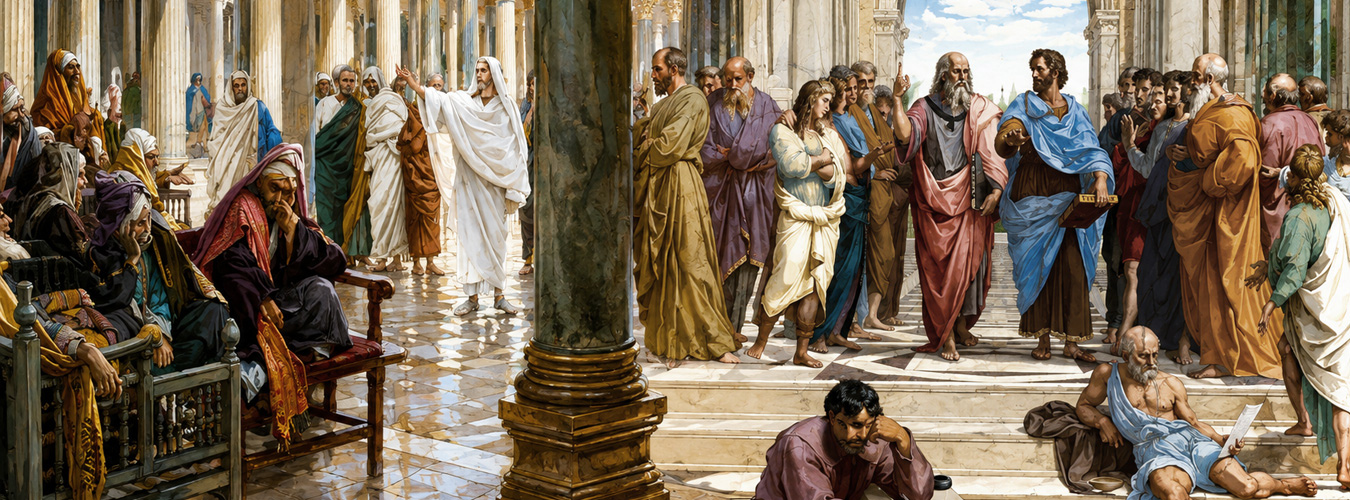

Jesus and His Brethren
(No. 2516)
INTENDED FOR READING ON LORD'S-DAY, MAY 9 1897.
DELIVERED BY C. H. SPURGEON,
AT THE METROPOLITAN TABERNACLE, NEWINGTON, ON LORD'S-DAY EVENING,
OCTTOBER 4, 1885.
"Then Joseph could not refrain himself before all them that stood by
him, and he cried, Cause every man to go out from me. And there stood
no man with him, while Joseph made himself known unto his brethren. And
he wept aloud: and the Egyptians and the house ofPharaoh heard. And
Joseph said unto his brethren, I am Joseph; does my father yet live?
And his brethren could not answer him; for they were troubled at his
presence. And Joseph said unto his brethren, Come near to me, I pray
you. And they came near. And he said, I am Joseph your brother, whom
you sold into Egypt. Now therefore be not grieved, nor angry with
yourselves, that you sold me here: for God did send me before you to
preserve life." Genesis 45:1-5.
I NEED not say to you, Beloved, who are conversant with Scripture, that
there is scarcely any personal type in the Old Testament which is more
clearly and fully a portrait of our Lord Jesus Christ than is the type
of Joseph. You may run the parallel between Joseph and Jesus in very
many directions, yet you need never strain the narrative so even much
as once. I am not about to attempt that task on the present occasion,
but I am going to take this memorable portion of the biography of
Joseph and show you how, in making himself known to his brethren, he
was a type of our Lord revealing himself to us.
It seems that, at last, Joseph could bear the suspense no longer. He
knew who his brethren were, he knew which was Benjamin and which was
Reuben, Simeon, Levi, Judah and the rest, and he remembered all the
story of their early days together. But they did not know him. They
thought him some mysterious potentate, some great ruler of the land of
Egypt–as indeed he was–but they did not know so much about him as he
knew about them. Consequently, there was a distance between him and
them and his loving heart ached to bridge that gulf by manifesting
himself to them. It is the way of love to desire to make itself known.
Now, in a still higher sense, the Lord Jesus Christ knows all about
those in this place whom He has redeemed with His precious blood. The
Father gave them to Him from before the foundation of the world and He
took them into Covenant relationship with Himself before the earth was.
Often has He thought of these as His beloved ones. His delights have
been with the sons of men and He has looked forward and foreseen all
that would happen to them. Ever since these redeemed and chosen ones
have been born into the world, He has watched them so carefully that He
has counted the very hairs on their heads! They are so precious to Him,
as the purchase of His heart's blood, that they have never taken a
single wandering step that His eyes have tracked the mazes of their
lives. He knows them altogether–knows their sins, knows their sorrows,
knows their ignorance of Him, knows how, sometimes, that ignorance has
been willful and they have continued in the dark when they might have
walked in the Light of God–and now, at this moment, speaking after the
manner of men, the heart of Christ aches to manifest Himself to some of
them! He wants to be known. He thirsts to be known. He can only be
loved as He is known and He pines for love and so He pines to manifest
Himself to His loved ones!
Yes, and there are some of them who know Him already, in a measure, but
their measure is a very little one. It is but as a drop compared with
the great deep sea. I have been praying and am still praying, and I am
not alone in the prayer, that this very hour the Lord Jesus may be
pleased to manifest Himself to His own blood-bought ones! To all who
have been already called by His Grace and to many not yet called to
Him, may He come in the fullness of His own glorious revelation and
make Himself known! For know you not this–that the revelation of
Christ in the Word will not save you unless Christ is revealed in you
and to you personally. No, more than that–the Christ born at Bethlehem
will not save you unless that Christ is formed in you the hope of
Glory–He must Himself come to you and make Himself known to you. It
will not suffice you to read about His healing the sick. He must touch
you with His hand or you must touch the hem of His garment with your
hand. Somehow there must be personal contract between yourself and the
Lord Jesus Christ, or else all that He did will mean nothing to you.
Let this be our prayer now–that to each man and woman and child here
the Lord may graciously make Himself known.
I. Notice, first, that THE LORD JESUS CHRIST, LIKE JOSEPH, REVEALS
HIMSELF IN PRIVATE FOR THE MOST PART.
Joseph cried, "Cause every man to go out from me. And there stood no
man with him while Joseph made himself known unto his brethren." It
would not have been seemly for this great ruler to lose all command of
himself in the presence of the Egyptians. His heart was carried away
with love to his brothers and the cry that he lifted up was so loud
that the people in other parts of the palace could hear that something
strange was going on! But he could not bear that they should all stand
around and gaze with curious eyes upon their ruler as he revealed
himself to his brothers. They would not have understood it. They might
have misrepresented it. At any rate, he could not bear that the scene
of affection which was now to be enacted should be witnessed by
strangers, so he cried, "Cause every man to go out from me."
My dear Friends, do you really want to see and know the Lord Jesus
Christ savingly? Have you ever beheld Him by the eye of faith? Then,
permit be to exhort you to be literally much alone–searching the
Scriptures–and much alone in private, secret prayer. That gracious
revelation of Himself to you as bearing your sins and putting away your
guilt, will nor be likely to come to you until you get a little time in
private, where you can quietly meditate upon your Lord and His great
atoning work. The mischief of this busy London is that we are fretted
and worn with incessant occupations–we would, all of us, be much
stronger and better if we saw less of the faces of men and more of the
face of God. But for a penitent sinner who desires to behold his pardon
written in the smiling Countenance of Christ, there must be solitude.
You must rise earlier in the morning and get a half-hour to yourself,
then, or you must sit up later at night, or you must steal out of bed
at the dead of night, or you must even resolve that you will not go to
your business until the first business of finding Christ is ended once
and for all! I feel persuaded that with some of you, at least, there
will be no peace to your heart and no comfortable sight of Christ until
you have gone upstairs and said, "Here, alone, with every man put out
and every wandering thought excluded, will I bow the knee and cry, and
look, and hope, and believe until I can say, 'I have seen the Lord! I
have looked to Him whom I have pierced and I have seen my sin put away
by His death upon the Cross.'"
Further, I want you to notice not only the excellence of solitude in
general, but the benefit of a kind of mental solitude. Brothers and
Sisters, if in the House of God, in the midst of the assembly, the Lord
Jesus Christ is ever to manifest Himself personally to us, it must be
in a kind of mental and spiritual solitude. I believe that the preacher
will never succeed in winning a soul if he tries to make himself
prominent in his own preaching. An old man who was accustomed to
catching trout in a certain stream, was asked by one who had been
fishing in vain, "Have you caught any fish today?" "Yes, Sir," he said,
"I have a little basketful." "Oh," said the other, "I have been fishing
all day long and I have taken none." "No," said the man, "but there are
three rules about catching trout, which, perhaps, you have not
observed. The first is–Get quite out of sight. And the second is–Get
still more out of sight. And the third is–Get still more out of sight
than that–and you will catch them."
And I believe that it is just so in preaching. If the preacher can get
quite out of sight, still more out of sight and yet still more out of
sight, then he will be the means of bringing souls to Christ. And you,
dear Friends, will only see Him well in any kind of preaching when you
try to forget the man. I mean that remark to apply in two ways. Perhaps
the preacher is one whom you dearly love and you expect much from him.
Well then, forget him! Expect nothingfrom him and look away from him to
your Lord! Or, perhaps, the preacher's voice has no particular charm
for you. The man is not very bright in his utterances. Well, forget him
and try to see his Master! Forget the preacher for good and for bad,
for better and for worse–and get to the Lord, Himself.
There is a story told of Mr. Erskine having preached on one occasion
before the communion and a good woman, a child of God, heard him with
such delight and was so much fed and satisfied, that she left her own
pastor and went some miles on the next Lord's Day to go and hear Mr.
Erskine again. That morning he was dreadfully dry and barren, or at
least she thought that he was. There was no food for her whatever and,
being not a very wise woman, she went in to tell him so. She said, "Oh,
Mr. Erskine, I heard you at the communion with such delight! You seemed
to take me to the very gates of Heaven and I was fed with the finest of
the wheat. So I have come this morning on purpose to hear you and I
confess that I have got nothing out of you!" So he said, "My good
woman, what did you go for last Lord's Day?" "I went to the communion,
Sir." "Yes, you went to the communion. That was to have communion with
the Lord?" "Yes," she said, "I did." "Well," said Mr. Erskine, "that is
what you went for and you got it–and the Lord blessed my word to you,
and you had communion with Him. Now, what did you come here for this
morning?" "I came to hear you, Sir." "And you have got what you came
for, there is nothing in me."
Think of this story when you are remembering the Lord's servants and
forgetting their Master, Himself. I believe that as you are sitting
here, you whose eyes have already been opened by the Spirit of God, if
you will but say, "Cause every man to go out from me. Shut the door, I
have entered into my closet even while in the pew. I am alone, now, and
I desire to see no man but Jesus, only." You shall see Him, for He
manifests Himself to His people all alone! Oh, that each one here would
say, "There is nothing but Christ that I desire to see, there is
nothing else I wish to remember, I would think only of my Lord Jesus.
May He be pleased to reveal Himself to me!"
II. The second remark I have to make is this–when the Lord Jesus
Christ reveals Himself to any man for the first time, it is usually in
the midst of terror. And THAT FIRST REVELATION OFTEN CREATES MUCH
SADNESS.
When Joseph made himself known to his brethren and said to them, "I am
Joseph," "they were troubled in his presence." Judah had made a very
plaintive speech when it was threatened that Benjamin should be
detained in Egypt and all the brothers were in deep trouble, so that
when the great ruler said to them, "I am Joseph," they were not filled
with joy by his words. So we read, "His brethren could not answer him,
for they were troubled at his presence." He was Joseph, their brother,
and he loved every one of them–yet, "they were troubled at his
presence." It was the best thing that could have happened to them, to
be in the presence of him who was sent of God to save their lives with
a great deliverance. Yet, "they were troubled at his presence."
And you and I recollect, perhaps, when, under a deep sense of sin and
sorrow when we had our first perception of Christ's salvation–instead
of being glad at it, we were "troubled at His Presence." "Why," we said
to ourselves, "this Christ is He whom we have despised, rejected and
crucified." There did not seem, at first, much comfort for us in the
manifestation of Christ. One said, in order to cheer us, "He died for
sinners." "But," we answered, "surely not for such sinners as we are."
Even the very sound of that blessed word, "salvation," grated on our
ears because we thought we should be like the fabled Tantalus–up to
our necks in water which we could not drink, or surrounded by fruit
which we could not pluck. "He may have died for others," we seem to
say, "but scarcely for us." "We were troubled at His Presence." Even
the House of God, to which we continued to go, was a place of terror to
us and we cried, like Jacob did at Bethel, "How dreadful is this
place!" In the worst sense of that word, it really was "dreadful" to
us–full of dread although we believed it to be "none other but the
House of God, and the gate of Heaven."
We said, "What right have we to be in the House of God? How can we
expect to enter Heaven even though its gate is so near to us?" We heard
that Jesus of Nazareth was passing by, but we sorrowfully exclaimed,
"Ah, that is only too true! He will pass by but He will never stop to
look at us." We heard that precious text, "God so loved the world, that
He gave His only begotten Son, that whoever believes in Him shall not
perish, but have everlasting life," but we said, "What is it to believe
in Him? How can we believe in Him?" The Light of God seemed shifting
all around us, but our eyes were blind to it! The music of Heaven was
sounding in all its sweetness, but our ears were closed to its melody!
Everlasting love was coming near to us, yet our hearts did not open to
receive it and, therefore, we could not answer Christ, for we "were
troubled at His Presence."
Dear Friends, if any of you are in this sad state, do not, therefore,
be driven away from our Jesus, our greater Joseph but stand still in
His presence, even though you are troubled at it, for that experience,
though it is bitter, is a bitter sweet! There may be trouble in
Christ's Presence, but there is a far greater trouble in being driven
from His Presence, and from the glory of His power. So keep standing
just where you are, even though you stand trembling, for, by-and-by,
and perhaps this very hour, He will graciously reveal Himself to you
and you shall no longer tremble at His Presence, but, on the contrary,
you shall rejoice with unspeakable joy and full of glory, as you
perceive that this Joseph, this Jesus, is your Brother, your Savior,
your Friend, your All in All!
II. Now, thirdly, though the first appearance of Jesus, like that of
Joseph, may cause sadness, THE FURTHER
REVELATION OF THE LORD JESUS CHRIST TO HIS BRETHREN BRINGS THEM THE
GREATEST POSSIBLE
JOY.
If you look at this passage when you are at home, you will perhaps say
to yourself, "The second time that Joseph spoke to his brethren, he had
not much more to say than he said the first time. For then he said, 'I
am Joseph; does my father yet live?' And the second time there was as
much the same burden in his language, "I am Joseph, your brother, whom
you sold into Egypt." So, when Christ reveals Himself in Grace to any
poor heart, the revelation, for substance, is much the same as at the
first, yet there is a great difference. When, for the first time, I
heard the Gospel to my soul's salvation, I thought that I had never
really heard the Gospel before and I began to think that the preachers
to whom I had listened had not truly preached it. But, on looking back,
I am inclined to believe that I had heard the Gospel fully preached
many hundredsof times, before, but that thiswas the difference–I then
heard it as though I heard it not–and when I didhear it, the message
may not have been any more clear in itself than it had been at former
times, but the power of the Holy Spirit was present to open my ears and
to guide the message to my heart!
O dear Friend, if you have heard me preach Christ crucified and you
have not yet seen Christ to your soul's salvation, I pray that you may
do so now! I do not suppose that there will be any difference in the
sermon, or in the Truths of God proclaimed. The difference will be that
in the one case it has not reached your heart and in the other case it
will. O blessed Master, speak comfortably to the hearts of sinners and
to the hearts of Your people, too! Make the old, old Gospel be new to
us by clothing it with a new power within our hearts and consciences,
and throughout our lives!
Yet, there were some differences in the words which Joseph uttered to
his brethren. If you turn again to the narrative, you will see that he
began his second speech by saying to them, "Come near to me, I pray
you." There was a longing for nearness to those he loved and that is
the point of my sermon at this time. I want you who do not believe in
the Lord Jesus Christ, but who are, nevertheless, His elect, His
redeemed ones, to come near to Him, now, by an act of faith and trust
Him with yourselves, your souls, your sins and everything else! Stand
not back through shame or fear, you chief of sinners, for He says,
"Come near to Me, I pray you. 'Come unto Me, all you that labor and are
heavy laden, and I will give you rest.'" As for you who are already His
Brothers and Sisters, come near to Him, for to you, also, He says,
"Come near to Me, I pray you."
Oh, if our Lord were actually here in bodily Presence–and I can almost
picture Him in the loveliness and glory of Divine Majesty–if He were
to stand here and say to us, "Come near to Me, I pray you," we would,
with solemn reverence, bow before Him and we would, with joyful
obedience, come near to Him and try to hold Him by the feet and worship
Him! Would not each one of you press forward to come near to Him? I am
sure that you would! Well, that is what you have to do in a spiritual
fashion. We know not Christ after the flesh, but we do know Him after
the Spirit. So, come near to Him, dear Brothers and Sisters in Christ!
Believe in Him, again, as you did at the first! Look to Him again as if
you had never looked before! Worship Him as your Lord and your
Redeemer. Prostrate yourselves before Him and adore Him as the Son of
God revealed in our midst–come near to Him!
Then talk to Him. Tell Him all that is in your inmost heart. Unburden
to Him your cares and your doubts. Yes, and come near to Him with your
fondest affection and say to Him, now, in the silence of your spirit,
"Lord, You know all things. You know that I love You." Come near to
Christ with all your tears of penitence. Come near with your alabaster
box of gratitude. Come near with the kisses of your lips of love. Come
near with your whole heart's purest affection and come now, for that is
what He invites you to do! It is a part of His manifestation of Himself
to you that you should endeavor to come near to Him. Cry, "Stand back,
O self! Stand back, O devil! Stand back, all care for the world! Stand
back, even care for the Church just now! My heart must come near unto
her Lord and sit like a dove on His finger and be satisfied to look
with her gentle eyes at the beauties of His Countenance." God help us
to do so in response to our Lord's gracious invitation, "Come near to
Me, I pray you."
Then, as if to help us to come near, our Lord, in this revelation,
declares His relationship to us. The speaker in the type says, "I am
Joseph your brother" and the Lord Jesus Christ, though He is Head over
all things to His Church and King and Lord of death and Hell, yet says
to everyone who believes in Him, "I am your Brother; I am your kith and
kin; Head of the family, but still of the family and touched with the
feeling of your infirmities, for I was in all points tempted like as
you are." Do not imagine, concerning the Lord Jesus, that there is only
a fanciful or sentimental brotherhood between Him and you. It is a
realbrotherhood–there is no such brotherhood under Heaven so complete
and true as that which exists between Christ and every blood-washed
soul, for it is not a brotherhood according to the flesh, but an
everlasting, spiritualbrotherhood. An eternal union of the closest and
most vital kind is established between Christ and everyone who believes
in Him.
We do not reckon it hard, do we, to win a brother's heart? If we have
been a little cold towards a brother, his heart soon warms to us again
and, as for our Lord, if we have not seen Him of late, if any of us
have not loved Him as we should, if we are saying, "We are troubled at
His Presence. We hardly dare come to His table," may He say to us,
"Come near to Me, I pray you. I am your Brother. Come near, come
nearer, nearer still. I am pleased when you are near." Come with your
sin and your lukewarmness. Come just as you are, as you came to Him at
the first, and He will receive you, and will manifest Himself unto you
as He does not unto the world.
In addition to revealing his relationship, which was a great motive for
Joseph inviting his brothers to come near, he also told them a secret.
He said, "I am Joseph your brother, whom you sold into Egypt." I think
he mentioned that to show them that he must be Joseph their brother,
for who else in all the world knew of that shameful action on their
part? I do not suppose that the Midianite merchants who bought Joseph
knew that he was sold by his own brothers, or if they did know, there
were none of them in Pharaohs palace, for they were Ishmaelites and
they had gone their way to traffic somewhere else. All who knew of that
wicked transaction were Joseph and his brothers, so by this password he
lets them know that there was a sort of freemasonry between them. This
was the sign, "I am Joseph your brother, whom you sold into Egypt." It
made them blush, I dare say, and it must have made them mourn. But it
also made them feel, "Yes, that is our brother. Nobody but Joseph would
know that we sold him into slavery."
And, dear Friends, have you ever seen your Well-Beloved as He reads
your heart? I have known Him read mine from the first thought in it to
the last and I have thanked Him as He has read it, for I have said,
"Lord, You have read that book right through, and now You know all
things, You know that I love you. Alas, I did sell you into Egypt!
There was a day when I chose Egypt and its pleasures rather than You
and there have been days since when I have sold You again into Egypt by
treating You with lukewarmness, and giving myself up to other lovers.
Yes, Lord, I have sold You to the Ishmaelites by doubting You and
mistrusting You. And by my sins I have stripped You of Your
many-colored garment. And by my own folly I have let You go away from
Your Father's house and from the chamber of her that bore You. You know
all this, my Lord, but I know You, too, because You know me so well."
Then notice that when Joseph thus revealed himself to his brethren, he
did not say more till he had sweetly put away all their offenses
against him. They had been troubled because they knew that they had
sold him into Egypt, but he said to them, "Now, therefore, be not
grieved, nor angry with yourselves, that you sold me here." So Jesus
says to His loved ones who have grieved Him by their evil deeds, "Be
not grieved, for I have blotted out, as a thick cloud, your
transgressions and, as a cloud, your sins.' Be not angry with
yourselves, for I will receive you graciously and love you freely. Be
not angry with yourselves, for your sins, which are many, are all
forgiven. Go and sin no more. For My name's sake will I defer My anger.
Therefore, 'Come now, and let us reason together: though your sins are
as scarlet, they shall be as white as snow; though they are red like
crimson they shall be as wool.'"
Many of you know the way our Savior talks. I pray that He may just now
make every Believer sure that there is not a sin against him in God's
Book of Remembrance. May you, dear Friends, be clear in your conscience
from all dead works! May you have the peace of God which passes all
understanding to keep your hearts and minds through Christ Jesus and in
the clear white light of your Savior's glorious Presence. May you see
the wounds He endured when suffering for your sins! Then will you sing
with the disciple whom Jesus loved, "Unto Him that loved us and washed
us from our sins in His own blood, and has made us kings and priests
unto God and His Father, to Him be glory and dominion forever and ever.
Amen."
Last of all, Joseph was not satisfied with thus revealing himself to
his brethren, and assuming them of his forgiveness, but he promised
them rich supplies for the future. To my mind this was the next best
news to his message of forgiveness. He said to them, in effect, "You
have had two years of famine. It is only through me that you have been
preserved alive. You have come down to Egypt with your donkeys and your
sacks, and you have taken home provender to my father and to your
households. But there are yet five more years in which there will be no
plowing and no harvest. What will become of you? What little you had in
store is already all consumed. God has sent me here that through those
five years I may nourish you. You shall come down and live in Goshen,
on the fat of the land of Egypt, and you shall never have any need, for
all the treasures of the land of Egypt are mine and I will take care of
you. You shall never know any need."
In like manner, Beloved, your Lord stands and says to you, "You will
have many more troubles." Some of my dear Brothers and Sisters in
Christ who are here will be in Heaven before five more years have
expired. They have good reason to be very grateful to God. But to some
of us who are younger, it may be that God has appointed many a year to
abide here. But our Savior lives!–
"He is at the Father's side, The Man of Love, the Crucified"
and the arrangements of Providence are in His hands and all that
Providence shall be overruled for us. "No good thing will he withhold
from them that walk uprightly." You will be in Egypt for a while
longer, dear Friend, but you will be in the Goshen of Egypt and the
good of all the land is yours! Oh, what a blessing it is to think that
we have a Brother who reveals Himself to us as the Universal Provider
who will not let us have a need, but will take care that, before our
need comes, the supply shall be ready and we shall have nothing to do
but to rejoice in Him who cares for us!
Let not that sweet thought take away from your minds what I want to be
the center of all the meditation, namely, that you should come near to
your Lord. We never use a crucifix–we would think it sinful to do so.
Neither do I want to have an imaginary crucifix, by trying to set
Christ before you so that you should picture Him mentally! But I want
your faith to do much more than imagination can. The Lord Jesus Christ
is spirituallyhere in the midst of us, according to His gracious
promise, "Lo, I am with you always, even unto the end of the world."
And He hears me speaking these words at this moment–I am as sure of it
as if I saw that mystic Presence with my natural eyes. If I did see
Him, I know that I would fall at His feet as dead, and the rest of this
service would have to be spent in awe-struck silence by everyone that
did behold Him!
But, O Son of God and Son of Mary, Jesus Christ our Savior, we trust
You wholly and alone to save us and we love You with all our heart,
mind, soul and strength. And as we live byYou, we pray You to help us
to live forYou, to live to You, to live like You and, by-and-by, to
live with You! We could almost wish that we might now fall down and
kiss Your dear feet, but You are not here in visible Presence, for You
have gone up into Glory. But You are here spiritually and we come to
You and say, "Lord, You are ours, and we are Yours. We will hold You
and will not let You go."–
"Sun of my Soul, Savior dear, It is not night if You are near." Come,
stay with me while yet the evening shade shall linger, till death's
dark night comes on and then, instead of night, let the morning break
upon my gladdened eyes because it is You that has come, the Life, the
Resurrection, and not death at all!
Come, Beloved, can you not get nearer to your Lord? Can you not speak
familiarly with Him? Can you not whisper into His ear the story of your
love?–
"Come, Holy Spirit, heavenly Dove" and help us now to come near to
Jesus! Amen and Amen!
EXPOSITIONS BY C. H. SPURGEON: GENESIS 45:1-13; SONG OFSOLOMON 1:1-7;
3:1-5.
Genesis 45:1, 2. Then Joseph could not refrain himself before all them
that stood by him: and he cried, Cause every man to go out from me. And
there stood no man with him, while Joseph made himself known unto his
brethren. And he wept aloud. Emotion long pent up grows intense and
when, at last, it bursts forth, it cannot be restrained. "He wept
aloud."
2, 3. And the Egyptians and the house of Pharaoh heard. And Joseph said
unto his brethren, I am Joseph; does my father yet live? And his
brethren could not answer him for they were troubled at his presence.
What a rush of thoughts must have passed through their minds when they
remembered all their unkind behavior toward him! There is no wonder
that "they were troubled at his presence."
4. And Joseph said unto his brethren, Come near to me, I pray you. He
pleads with them. He who was far greater than they–a prince among
peasants–now prays to them! And is it not amazing that the Lord Jesus,
our infinitely-greater Brother, at times pleads with us, even as He
said to the woman at the well, "Give Me to drink"? Joseph said unto his
brethren, "Come near to me, I pray you."
4, 5, And they came near Andhe said, Iam Joseph your brother, whom you
soldinto Egypt Now therefore be not grieved, nor angry with yourselves,
that you sold me here: for God did send me before you to preserve life.
"You did very wrong, but I say nothing about that, for I want you to
notice how God has overruled your action, how your sin has been made to
be the means of your preservation and the preservation of many besides.
'God did send me before you to preserve life.'"
6. For these two years has the famine been in the land: and yet there
are five years in which there shall neither be eating nor harvest There
were to be five more dreary years of utter desolation and need.
7. And God sent me before you to preserve you a posterity in the earth,
and to save your lives by a great deliverance. How wonderfully those
two things meet in practical harmony–the free will of man and the
predestination of God! Man acts just as freely and just as guiltily as
if there were no predestination whatever. And God ordains, arranges,
supervises, and overrules just as accurately as if there were no free
will in the universe! There are some purblind people who only believe
one or other of these two Truths of God, yet they are both true and the
one is as true as the other. I believe that much of the theology which
is tinged with free will is true and I know that the teaching which
fully proclaims electing love and Sovereign Grace is also true–and you
may find much of both of these Truths in the Scriptures. The fault lies
in trying to compress all Truth of God under either of those two heads.
These men were verily guilty for selling their brother, yet God was
verily wise in permitting him to be sold. The inference which Joseph
draws from their misconduct is, of course, an inference of love. Love
may not be always logical, but it is sweetly consoling, as it must have
been in this case.
8. So now it was not you that sent me here, but God: and He has made me
a father to Pharaoh, and lord of all his house, and a ruler throughout
all the land ofEgypt. See how Joseph traces God's hand in his whole
career?
9. Hasten you, and go up to my father, and say unto him, Thus says your
son Joseph, God has made me lord of all Egypt: come down unto me, tarry
not See how love attracts? Joseph must have his brothers near him. Now
he wants to have his father, also, near. "Go up to my father, and say
unto him, 'Come down unto me.'" See how great love turns pleader again?
He who said to his brothers, "Come near to me," sends to his father the
message, "Come down unto me."
10. And you shall dwell in the land of Goshen, and you shall be near
unto me, you, and your children, and your children's children, and your
flocks, and your herds, and all that you have. Our common saying, "Love
me, love my dog," is very true! Love me, love even my flocks and my
herds. So the blessing of God extends to all His chosen people
have–not only to their children, but to all that they possess.
11-13. And there will I nourish you; for yet there are five years of
famine; lest you and your household, and all that you have, come to
poverty. And, behold, your eyes see, and the eyes of my brother
Benjamin, that it is my mouth that speaks unto you. And you shall tell
my father of all my glory in Egypt, and of all that you have seen; and
you shall hasten and bring down my father here. Love is impatient to
have the object of its affection brought near. Now we will read two
short portions out of the Song of Solomon from which you will see how
love evermore craves for nearness to the loved one. The Song opens
thus:–
Song of Solomon 1:1-4. The song of songs, which is Solomon's. Let Him
kiss me with the kisses of His mouth: for
Your love is better than wine. Because of the savor of Your good
ointments Your name is as ointment poured forth, therefore do the
virgins love You. Draw me, we will run after You. Still is love
pleading, you see, but here it is the other side pleading for nearness,
the lowly one crying for help to get nearer to the Heavenly Bridegroom.
"Draw me, we will run after You."
4, 5. The King has brought me into His chambers: we will be glad and
rejoice in You, we will remember Your love more than wine: the upright
love You. I am black, but comely, O you daughters of Jerusalem, as the
tents of Kedar, as the curtains of Solomon. The spouse was black in
herself; sunburned through her toil and hard suffering; yet lovely in
the sight of her Beloved, and comely to look upon "as the curtains of
Solomon."
6, 7. Look not upon me, because Iam black, because the sun has looked
upon me: my mother's children were angry with me; they made me the
keeper of the vineyards, but my own vineyard have I not kept Tell me, O
You whom my soul loves, where You feed.–Still is there that same
craving for nearness to the Beloved. Since we love Christ, we desire to
be with Him. We cannot bear His absence. "Tell me, O You whom my soul
loves, where You feed."
7. Where You make Your flock to rest at noon: for why should I be as
one that turns aside by the flocks of Your companions?See, dear
Friends, how this same seeking after the Beloved comes out in another
shape in the third chapter of the Song.
Song of Solomon 3:1. By night on my bed Isought Him whom my soul loves:
I sought Him, but I foundHim not. Sometimes, the most eager search does
not at once obtain its end. For wise reasons, Christ sometimes hides
Himself from His seeking people.
2-5. I willrise now and go about the city in the streets, and in the
broad ways I will seek Him whom my soul loves: I sought Him, but I
found Him not. The watchmen that go about the city found me: to whom I
said, Saw you Him whom my soul loves? It was but a little while that
Ipassed from them, but I found Him whom my soul loves: I held Him and
would not let Him go until Ihad brought Him into my mother's house, and
into the chamber of her that conceivedme. I charge you, O you daughters
of Jerusalem, by the roes, and by the hinds of the field–"By
everything that is timid, and delicate, and pure, and full of love, I
charge you, O you daughters of Jerusalem."–
5. That you stir not up, nor awake my love, till He pleases. "I have
found my Beloved, and I would not lose Him again. He has come to me, so
I will not grieve Him and drive Him away." That is the one strain of
our reading– "Come near to me, I pray You; and when You come near me,
stay by me still."