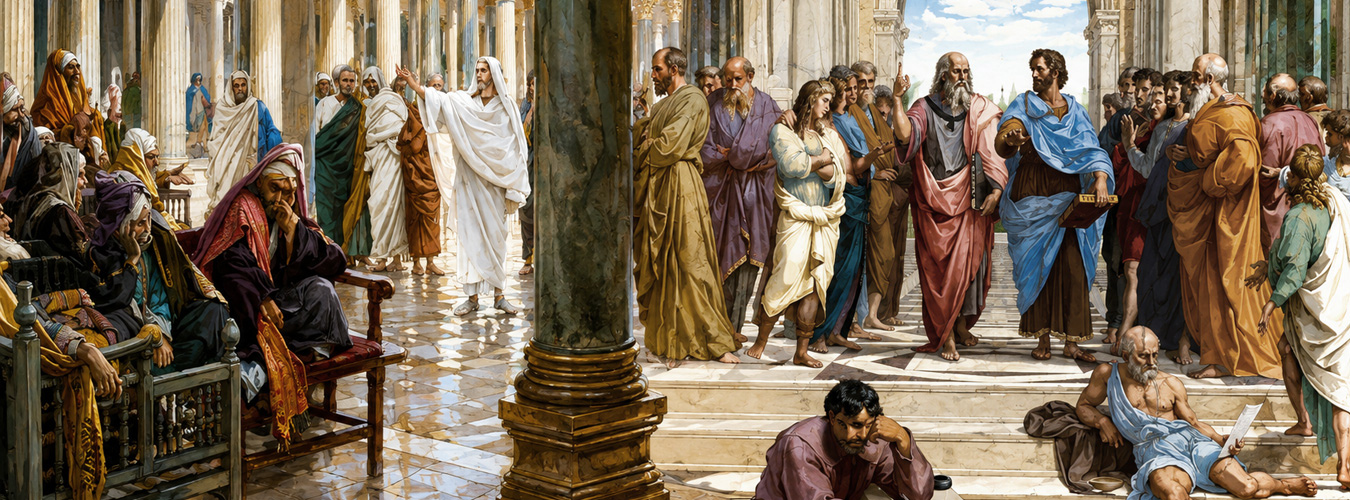

Christ Before Annas
(No. 2820)
A SERMON INTENDED FOR READING ON LORD'S DAY, MARCH 1, 1903.
DELIVERED BY C. H. SPURGEON,
AT THE METROPOLITAN TABERNACLE, NEWINGTON, ON THURSDAY EVENING, OCTOBER
26, 1882.
"Then the band and the captain and officers of the Jews took Jesus and
bound Him and led Him away to Annas first: for he was father-in-law to
Caiaphas, who was the high priest that same year…The high priest then
asked Jesus of His disciples and of His doctrine. Jesus answered him, I
spoke openly to the world; I taught in the synagogue, and in the
temple, where the Jews always resort; and in secret have I said
nothing. Why do you ask Me? Ask them who heard Me, what I have said
unto them: behold, they know what I said. And when He had thus spoken,
one of the officers which stood by struck Jesus with the palm of his
hand, saying, Answer You the high priest so? Jesus answered him, if I
have spoken evil, bear witness of the evil: but if well, why do you
strike Me?" John 18:12,13,19-23.
NOTE the words in verse 13–"and led him away to Annas first." This
man, Annas, has not become so infamous as Pontius Pilate because his
name did not happen to be mentioned in the Creed, but, in some
respects, he was even more guilty than the Roman governor. He was one
of those who handed over our Lord to Pilate and he is included in the
judgment, "he that delivered Me unto you has the greater sin." It must
not be forgotten that he was first in trying the Savior–let him have
the full benefit of it–"hey led him away to Annas first."
Who was this man to whose palace the Lord Jesus was first conducted? He
was a man who had been high priest actually for a time and had, for
some 50 years, been regarded as high priest by the Jews, while members
of his family, one after another, had in turns nominally held the
office. The high-priesthood had been degraded from its permanence to
become little more than an annual office and hence the Evangelist
significantly says of Caiaphas that, "he was the high priest that same
year." But Annas would seem to have been secretly regarded by the Jews
as the real high priest and respect to him in that capacity was the
more easily offered because, according to Josephus, five of his sons
and his son-in-law, Caiaphas, had succeeded him in the sacred office.
To him, then, it was due that the victim of the priests should be first
taken. He shall have this mark of distinction–"they led him away to
Annas first." The Sacrifice of God, the Lamb of His Passover, the
Scapegoat of the Lord's Atonement shall be brought before the priest
before He is slain.
The house of Annas was united to that of Caiaphas and it was proposed
to detain the prisoner there till the Sanhedrim could be hastily
convened for His trial. If He should be brought into the palace of
Annas, the old man would be gratified by a sight of Jesus and by
conducting a preliminary examination, acting as deputy for his
son-in-law. Without leaving his own house, he could thus indulge his
malice and have a finger in the business. Priestly hate is always deep
and unrelenting. Today none are such enemies of Christ's holy Gospel as
those who delight in priestcraft–and it is not without prophetic
meaning that our Lord must be led as a prisoner, first to a priest's
house–"they led him away to Annas first." Not in the soldiers'
barracks, nor in the governor's hall, but in the high priest's palace
must Jesus meet with His first captivity! There it is that Christ in
bonds seems not altogether out of place–
"See how the patient Jesus stands,
Insulted in His lowest case!
Sinners have bound the Almighty hands,
And spit in their Creator's face."
Annas bore a very promising name, for it signifies clement or merciful,
yet he was the man to begin the work of ensnaring the Lord Jesus in His
speech, if He could be ensnared. He examined Him first in a
semi-private manner, that, by cunning questions, he might extract from
Him some ground of accusation. Under pretence of mercy, he turned
inquisitor and put his Victim to the question. This priest, whose name
was clemency, showed the usual tender mercies of the wicked, which are
proverbially cruel. When Jesus is to be ill-treated by His servants,
there is usually a pretence of pity and compassion. Persecutors are
grieved to feel forced to be harsh–their tender spirits are wounded by
being compelled to say a word against the Lord's people! Gladly would
they love them if they would not be so obstinate! With sweet language
they inflict bitter wounds–their words are softer than butter–but
inwardly they are drawn swords.
If I read aright the character of this man, Annas, he was one of the
Savior's bitterest enemies. He was a Sadducee. Is not this the
"liberal" side? Do we not reckon Pharisees to be the straitest sect of
the Jews? Why he should have been so bitter against the Savior is
pretty clear, since, if Pharisees, in their multiplication of
ceremonies and self-righteousness, hate the Christ, so also do the
Sadducees in their unbelief and rejection of the great Truths of
Revelation. Here, Ritualism and Rationalism go hand in hand and the
free-thinker, with all his profession of liberality, usually displays
none of it toward the followers of the Truth of God. The Broad Church
is usually narrow enough when the Doctrine of the Cross is under
discussion! Whether this Sadducee had an interest in the sales that
were effected in the temple and whether, as some suppose, he was
greatly irritated and touched in a very tender point, namely, in his
pocket, when Jesus overthrew the tables of the money-changers and the
seats of them that sold doves, I cannot tell. But, certainly, for some
reason or other, Annas was among the first of our Lord's persecutors,
not only in order of time, but also in point of malice. The wealthy
latitudinarian has a fierce enmity to the Gospel of Christ Jesus and
will be found second to none in hunting down the adherents of Christ.
Did the military tribune and his cohort stop at the house of Annas
because he had been at the bottom of the business and Pilate had
ordered them, for the time, to do the will of the high priest and his
father-in-law? Was this long-headed old gentleman the counselor of the
conspirators? Did the force of character which kept him to the front
for half a century, make him a leader at this juncture? Is it possible
that they called at the house of Annas to hand over their Victim that
Judas might receive the blood money? At all events we hear no more of
the traitor as being in the company of those who had seized upon his
Lord.
At any rate, the Lord is led to Annas, first, and we feel sure that
there was a motive for that act. Annas, in some sense, had a priority
in the peerage of enmity to Jesus–he was malignant, cruel and
unscrupulous enough to be premier in the ministry of persecutors. In
all matters, there are first, as well as last, and this man leads the
van among the unjust judges of our Lord. He was a favorite of the first
and most detestable of the Herods and a friend of Pilate, the governor,
and so, a fit ringleader in procuring the judicial murder of the
Innocent. All hope ofjustice was gone when the Holy One and the Just
was delivered into those cruel and unrighteous hands! He was as
determined as he was cold-blooded–and a lamb might as well look for
favor from a wolf as Jesus expect candor from the old deputy high
priest. For many a long years he had held his own by flattering Herod,
the Roman and the Jew–and he set about the work of mastering the
Na-zarene with cool determination and deep subtlety, hoping to pave the
way for the men of the Sanhedrim who were even then being mustered to
do the deed of blood on which their hearts were set.
In the house of this man, then, who is very properly called the high
priest, having quite as good a right to the title as Caiaphas had, we
see these two things. First, we see our Lord under examination. And,
secondly, we see our Lord wrongfully struck.
I. First, let us, tenderly, lovingly, adoringly, look at OUR DIVINE
MASTER UNDER EXAMINATION.
My first remark is that this examination was informal and
extrajudicial. Jesus was not yet accused of anything, so far. No judge
had taken his place upon the judgment seat, neither were any witnesses
called to give evidence against the Prisoner. It was a sort of private
examination, held with the view of extorting something from the Captive
which might afterwards be used against Him. You know how strongly and
how properly our law forbids anything of the kind and, though it may
not have been contrary to Jewish law, it was certainly contrary to the
eternal laws of right and wrong! A prisoner should not thus be
questioned with the object of entangling him in his speech and making
him incriminate himself. If there is no charge formulated against him,
let him go his way. If the entries on the charge sheet are not
completed, let him be remanded, but let him not be set before one of
his most cruel foes to be questioned to his own detriment!
This is what was done in our Savior's case when He was brought before
Annas. And I think that I know many who treat Him, at this time, quite
as badly. They ask questions about Him and make enquiries concerning
Him, but they do not do it honestly and sincerely, or according to the
rules of justice. You know how captious unbelievers often are, how they
pick up any misquoted text, or half a text torn from its context, and
say that they are enquiring about Christ, when they are not doing it
either judicially or as they would wish to be questioned were they
themselves under examination! I fear that the bulk of those who quibble
at the faith of Christ, do it not as honest men, nor as they would wish
to have their own characters investigated. The last book which some of
them think of reading is the New Testament–and the last thing that
they try to understand is Christ's true Character. And one of the last
things that they will ever listen to is a full and fair statement of
what His Gospel really is. Still, to this day, the representatives of
Annas are here and there, and almost everywhere, questioning the
followers of Christ with the design of finding out something to jeer
at, something which may be hawked about as a discrepancy, or held up as
obsolete and inconsistent with the spirit of this wonderful century of
which I hear so often that I am utterly sick of it–and long for the
time when the 19th Century shall go down to its ignoble grave!
Next, this questioning of Christ was one-sided.''The high priest then
asked Jesus of His disciples and of His doctrine." Why did he not ask
Him about Himself–who and what He was–and enquire especially
concerning His miracles and His whole course of life? Why did not Annas
enquire, "Did You raise the dead? Did You open blind eyes? Did You heal
the lepers? Did You go about doing good?" Oh, no, there were no
questions about any such things–they were all passed over as of no
importance!
The questions began with the weakest point of all, or that which men
have often regarded as the weakest–he "asked Jesus of His disciples."
Can a leader help the follies and weaknesses of his followers? I
suppose Annas put his question thus, "Where are Your disciples? "Ah,
there was Peter down there in the hall, but Christ could not call him
up to witness for Him. John was probably somewhere in the background,
but the rest had forsaken their Lord and fled. Annas, no doubt asked,
"Who are these disciples of Yours? Where did You pick them up?" I dare
say he knew that they were men of Galilee, mostly plain fishermen, and
he meant to cast a slur upon Christ on that account. If he had known
more about those disciples, he might have put a great many questions
which would have reflected but little honor upon the religion of Jesus.
This is just as men do now–they ask concerning Christ's disciples. I
do not deny that it is quite fair to enquire what is the influence of
Christianity upon the men who believe it, but, oftentimes, that one
point is thrust so prominently into the front that the wonders which
Christ, Himself, worked, are thrown into the background–and the
investigation thus becomes one-sided. We are quite willing that Christ,
Himself, and His work–all that has been, all that is to be, all His
designs and purposes–should be examined. But, for the most part, men
search for that which they think to be the weakest point of assault and
they say, "Look at So-and-So, one of Christ's disciples. And look at
So-and-So, one of His ministers! See what divisions there are in the
churches," and so forth. Yes, but surely, if Christ is examined at all,
He deserves to have a full and fair examination–it should not be upon
only one point. Blessed be His name, it matters not upon what point He
is examined! He always has His answer ready, and a glorious one it is!
If men were really willing to know the Truth of God, they would take an
all-round view of Him and look at Him from this point and from
that–and then judge Him.
Further, this examination was very disorderly, for the high priest
asked Christ "of His disciples and of His doctrine." Now, logically,
the enquiry should have been, first, concerning His doctrine and then
with respect to His disciples–first as to His teaching and then as to
the people influenced by it. But men like Annas put their questions
anyway–upside down, the first last and the last first–so that they
may secure some accusation against Christ. Now, if any man will sit
down quietly and really study the life, Character and teaching of Jesus
of Nazareth, we shall be delighted to hear what he has to say about it,
but let him study it in due order. Let him not pick out this, and leave
out that, and put everything out of gear, so as to make a monster of
Him. Let Him be looked at after the same manner as one would look at
any other religious teacher, or as we might examine the character of
any man brought before a court of law. I ask those, if there are any
such now present, who have spoken harshly of our blessed Lord and
Master, to do themselves the justice and to do Christ the justice, to
adopt another course and to examine Him as they would wish to be
examined themselves, if their character and their designs were called
in question.
Annas did not so, for his examination of Christ was concerning His
disciples and His doctrine. With regard to His disciples, our Master
said nothing. He had been saying much about them to His Father and, in
His almighty love and wisdom, He could have said much, then and there,
concerning His disciples if He had chosen to do so, but He did not and
therein He proved His wisdom. All through the Scriptures we find
comparatively little said concerning God's people. The record is mostly
of their faults and their failings. The reason for that is that this is
not the day of their manifestation. That day comes on apace and, "when
He shall appear, we shall be like Him; for we shall see Him as He is."
"Then shall the righteous shine forth as the sun in the Kingdom of
their Father." Annas thought that Christ's followers were a set of
fanatics–ignorant, unskilled, worthless people–the lower orders. The
catacombs tell us, as we read the rude inscriptions there, how few of
those godly folk, of whom the world was not worthy, were men of
education–the most of them were evidently plain, humble, common
people. Our Lord Jesus Christ has no great reverence for earthly rank
or grandeur–He loves the man, but cares little for the garb he
wears–and of the poorest saints it is true that "He is not ashamed to
call them brethren."
It is a mercy for us, who are on Christ's side, and who have been
despised in consequence, that, in the Resurrection, there will also be
a resurrection of reputations as well as of bodies. There will be a
bestowal of honor that has been denied here and of credit that has been
refused on earth. God has said it, so it must be true, "Light is sown
for the righteous," and their glad harvest time shall surely come! And
then the glory will forever blot out the shame and derision which may
have been poured upon the faithful for the sake of Jesus Christ their
Lord and Master. As yet, we will not ask Him concerning His disciples,
but that is the point that the adversary harps upon. Therefore, O you
disciples of Jesus, watch and pray, and seek to be like your Master!
Pray to be kept from the evil which is in the world and, as for the
rest, if men despise you, count that as part of the bargain upon which
you have entered–a bargain which shall, in due season, fill you with
eternal bliss!
Annas also asked Christ concerning His doctrine–what it was that He
taught those who listened to Him. I will not go into that matter, for I
want to speak at some length upon the answer which Christ gave to
Annas. He first protested that it was not fair for Him to be thus
questioned in private as to what He had said in public. The proper
thing was to ask those who had heard Him, "for," He said, "'I spoke
openly to the world. I always taught in the synagogue, and in the
temple.' I chose the most public places for My teaching. I had no
hole-and-corner gatherings, no little conventicle in which I urged My
followers to sedition. No, 'I spoke openly.' The heavens heard Me. On
the side of the hills, I proclaimed My message. By the seashore, I
spoke to all who gathered around Me. Multitudes were often present at
My services–they know what I said, and they could bear witness
concerning it if they were asked to do so."
There was great openness about Christ. There was an utter absence of
anything like the Jesuitical plan of saying one thing and meaning
another, or using expressions that had double meaning in them. It is
true that our Lord did not explain to the great mass of the people all
that He said to them, for they were so stupid that they would not
receive it. But, at the same time, there was nothing that His hearers
really needed to know that He concealed from them. He carried His heart
where all might read it and even in His common teaching to the
multitude, there was, if they had but had eyes to see it, all that He
taught to His disciples in the most private place. There was no wish,
on His part, to keep back any Truth of God that ought to be made known
to those who gathered to hear Him.
I have heard it said that there are certain Truths in God's Word which
it is better for us not to preach. It is admitted that they are true,
but it is alleged that they are not edifying. I will not agree to any
such plan! This is just going back to old Rome's method. Whatever it
has seemed good to God's wisdom to reveal, it is wise for God's
servants to proclaim. Who are we that we are to judge between this
Truth of God and that and to say that this we are to preach, and that
we are to withhold? This system would make us to be, after all, the
judges of what Christ's Gospel is to be! It must not be so among us,
Beloved–that would be assuming a responsibility which we are quite
unable to bear. I believe that it is because the Doctrines of Grace
have been too much kept from the pulpit, that the pews are getting so
empty. Leave the Doctrines of Grace out of the preaching and you have
left the marrow and fatness out of it! What is there to make the people
rush to your houses of prayer and crowd them, if there is no preaching
of the Election of Grace–no declaration of Particular Redemption and
Effectual Calling, no proclamation of the blessed Final Perseverance of
the Saints? If you leave these glorious Truths out of your preaching,
you have put on the table nothing but the horseradish and the
parsley–the roast is conspicuous by its absence!
Some people say that these things are to be talked of among the saints,
but must not be preached to sinners. Oh, say not so! Every Doctrine of
God's Word is good! Every Truth in the Bible is precious! The omission
of any one part of it, willfully, and with design, may so impair the
whole of our testimony that, instead of being like Hermon, "wet with
dew," our ministry will be like the accursed Gilboa, upon which no dew
descended. Whatever the Lord has taught you by His Spirit, my Brother,
tell to others! According as you have opportunity, reveal to them what
God has revealed to you. Remember how Christ Himself charged His
disciples, "What I tell you in darkness, that speak in light; what you
hear in the ear, that preach upon the housetops." And, today, the
sublime and majestic Truths of God which cluster around the Sovereignty
of God are as much to be proclaimed as the softer, most tender and
apparently more winsome words which tell of infinite mercy to the chief
of sinners! All truths are to be preached in due proportion–there is a
time for this, and a time for that–and none must be omitted. There is
a particular stone which is to be the key of the arch, and another
which is to go on this side, another lower down and yet another still
lower down–and the omitting of any one stone, because it does not
happen to be of what we reckon to the orthodox shape for usefulness,
may spoil the whole bridge and it may come down with a crash! Oh, that
we may so build in our teaching that our building will last throughout
eternity! At the end of our ministry, may we be able to say, "I have
kept back nothing; all that Christ taught me, I have taught to others
and so I have made full proof of my ministry." Christ was able to
appeal to those who had heard Him and who could tell what His testimony
had been. May God give us Grace to imitate Him in this respect!
Our blessed Lord answered Annas by referring him to His public life and
teaching. There was no need for any other defense. We cannot imagine
anything more convincing. No eloquence of speech or forcibleness of
argument could have completely put the wily adversary out of the field.
The inquisitor, himself, was so ashamed and, for the moment, so
confounded, that a zealous official struck Jesus with his open hand.
The innocent, unabashed face of the persecuted Nazarene was thus
slapped because His simple defense had silenced His cruel opponent!
What a wonderful answer it was! How it commends His whole Character to
us and makes Him seem to be even more truly majestic than ever!
I am sure there is not one of us who would dare to say of our lives, at
least not so unreservedly, what Jesus could truly say of His. Our
Lord's life was emphatically lived among men. He was no recluse. From
early morning to the last thing at night, He was associated with men
and, therefore, all that He did was done before the eyes of men. That
"fierce light that beats about a throne" always beat about Him. He was
constantly being watched–every word that He uttered was remembered.
Again and again, His enemies endeavored to catch Him in His speech. He
could scarcely be allowed a moment's leisure when He might relax, like
one at his own fireside. He was always before the Argus-eyes of the
ungodly world who would see faults where there were none, and who, if
there had been the least speck of blame, would have magnified it and
published it to the ends of the earth!
Moreover, our Lord was by no means a silent Man. He spoke and spoke
often. Witness the Books that we have by way of record of that quiet
life of His–and the things that He said and did were far more than
those that are recorded, for John says, "And there are also many other
things which Jesus did, the which, if they should be written, everyone,
I suppose that even the world itself could not contain the books that
should be written." Yet there was never any act or word of Christ's in
which friend or foe could find a single speck of sin at all. He could
even challenge Satan, himself, to find a flaw in His life–"The prince
of this world comes, and has nothing on Me."
His speech, too, was not only very frequent, but it was also very
plain. He spoke so simply that even little children could understand
Him. I should think there was never one person in His audience who
could truthfully say that he could not comprehend what the Preacher
meant. And yet, though they could all tell what His meaning was, they
could not honestly find fault with that meaning.
Another thing that is worthy of observation is that He spoke frequently
under great provocation. Yet He never lost His temper, nor spoke
unadvisedly with His lips. You and I know that if we ever lose our
temper, we are apt to say all manner of unwise, foolish and wicked
words–but our blessed Savior never sinned in that way, however great
was the provocation to which He was subjected. He was also often
misrepresented and our tendency is, when men speak falsely of us, to go
beyond the bounds of truth or prudence in replying to them. Our Lord
Jesus never did that. The pendulum of the great clock of His wonderful
life never swung too far either one way or the other. You have not to
correct any one saying of the Savior by what He said at some other
time–all His utterances are the absolute Truth of God, whether tak-
en separately, or taken together. Even the false witnesses who were
bribed to bring accusations against Him, altogether failed to find
anything that could be laid to His charge!
It must not be forgotten, also, that our blessed Master frequently
spoke in the midst of turmoil. He did not always have such a quiet,
orderly assembly as we have when we gather for public worship–He had
to speak, often, amidst the clamor of the angry mob and the opposition
and even the maledictions of those who hated Him. Yet, even under these
trying circumstances, He spoke so that He could fearlessly challenge
them all to find fault with anything that He had said in their hearing.
Our Lord had spoken to all sorts of characters–bad, good and
indifferent–and there was especially one who betrayed Him, who had
head many of His most secret speeches. Judas had been with Him in His
retirement and had listened to His words when only the favored few had
been present, yet there was no single sentence or syllable that even he
could plead in extenuation of his great crime in betraying his Lord.
II. I have spoken at such length upon this first part of my subject
that I have very little time left for the second portion, namely, OUR
LORD JESUS WRONGFULLY STRUCK–"When He had thus spoken, one of the
officers which stood by, struck Jesus with the palm of his hand,
saying, Answer You the high priest so?"
His answer was a very simple one and a very proper one in all respects,
yet, at the same time, it must have been a very stinging one if Annas
was the kind of man that I think he was, for our Savior seemed to say,
(you may read it between the lines), "Iam not plotting in secret
against another man's life. Ihave not talked with another man with the
object of entangling him in his speech. Ihave not been a conspirator,
but I have spoken publicly in the synagogues and taught in the temple,
in the very center of the place of concourse–but in secret I have said
nothing." This must have been a very sharp rebuke to Annas, if any
conscience was left in the wretched man! So one of the lackeys that
stood around the hierarch struck Christ and said, "Answer You the high
priest so?"
Now, in the first instance, Christ met with the opposition of a
so-called enquiry. But here He had the vulgar opposition of
persecution. Alas, there are still many who never enquire about Christ
at all, but they decide against Him and then they begin to persecute
wife, child, friend, neighbor, or whoever it may be that is on Christ's
side! And, often, they strike him as this officer struck our Lord. This
was a most cowardly act, for Christ was bound and helpless. Yet we have
the same sort of conduct in our own day. It does seem to me a wretched
thing that if some people choose to go through the streets singing
hymns, they are pelted with stones and mud while their own hands are
bound. They cannot turn round and fight their assailants, for their
Christianity has tied their hands–and the cruel mobs know it. If these
men want to fight, why do they not find some fellows like themselves,
walking through the streets, and attack them and then see what will
come of it? They are afraid to do that, for, to this day, persecution
is always against men whose hands are bound. If our religion taught us
to answer sharply and to give cuff for cuff, and kick for kick, it
would be all fair–but when we are commanded not to resist evil and our
very faithfulness to Christ prevents our replying to the foul language
that is used against us, it is brutally cruel that we should be thus
persecuted. Read all history through and see whether some have not
degraded themselves utterly beneath contempt by burning men who would
not have touched a hair of their heads–and putting to death poor men
and women who could not have done them any injury and who never wished
to do so. That is the story of Christ and His followers all the way
through–first, to be questioned by people who do not want to know the
Truth and, next, to be persecuted by people who really have not
anything to say against them.
To the man who thus wrongfully struck Him, our Savior said, "If I have
spoken evil, bear witness of the evil: but if well, why do you strike
Me?" We also may say to those who wantonly strike Christ's followers.
"Why do you do it? Has Christianity done any harm to manhood in
general, or to you in particular?" What has been the force that has
broken the power of tyrants? At the bottom, in many countries, it has
been the Word of God that has made men free. In our own times, what
ended the slave trade and set the Negro free? What is it that, today,
is the most potent force against the drunkenness of our land? Surely,
nothing but the Gospel of Jesus Christ! Have we, as Christians, any
aim, in all the world, of which anyone can accuse us? Are we doing
mischief to our fellow men? Do we teach drunkenness, or lust, or
oppression? Do you hear from us anything about robbing you of your
birthright, or injuring you in any way whatever? No, you know that it
is not so! Our war is for peace. Every blow that we strike is against
blows. If we have to denounce anything, we do most of all denounce
denunciation–and if we are bitter at all, most of all are we bitter
against bitterness, envy, malice and all uncharitableness!
Oh, that we could always give to our persecutors such an answer as our
blessed Master gave to the officer who struck Him, "If I have spoken
evil, bear witness of the evil: but if well, why do you strike me?"
There are times when we dare not say that, but we would rather say, "If
I have spoken evil, do not remember it, do not bring it to my
recollection. If I have spoken evil, try to forget it, or, at least, if
you remember it, repeat it not to another, for I am afraid that I may
have said much that might stain my profession and grieve my God." I
think that if we had our choice as to whether we would be slapped on
the face, or have our own words brought up as witnesses against us, we
would, each one, say, "If I have spoken evil, do not bear witness of
the evil, but much rather slap me than bear witness against me."
Yet it is not always so. There are times when, in conscious integrity,
or concerning certain words or acts of ours, we can challenge any man
to find fault with us. But, taking the whole range of our lives, in
public and in private, most of us would be loath to ask for such a test
as that. When our adversaries persecute us, we might say to them, "Ah,
if you really knew all that we have been, you would not so much
persecute us for our goodness, but punish us for our badness." When I
have been slandered, I have often said to myself, "Ah, they have spoken
a lie against me, but if they had known me better, they might have said
quite as bad a thing as that and yet have only spoken what was true."
There is not one man living, who is in his right mind, who would like
to have all his thoughts written down, or all his words and acts
recorded. We have often wished that half our words could be blotted out
with our tears–and then the other half would have to be washed with
that precious blood of Jesus before we could, ourselves, endure it.
Now, I think that all this of which I have been speaking to you, ought
very much to endear the Master to us and it will do so if we remember
and believe that God "has made Him to be sin for us, who knew no sin,
that we might be made the righteousness of God in Him." Here is a Lamb
that is fit for sacrifice. The high priest and all his officers may
examine it as much as they please–they will find that it is perfect.
There is not a blemish in it. There is no redundancy and there is no
omission. There is neither speck nor spot of sin in Christ–we cannot
find any fault in Him. Whether we look at Him within or without, in His
youth, or in His childhood, or in His Manhood–in His life or in His
death–in His speech or in His silence, in His feelings, or in His
thoughts, or in His acts–He is good, and only good–and blessed be His
holy name forever and ever! Amen.