

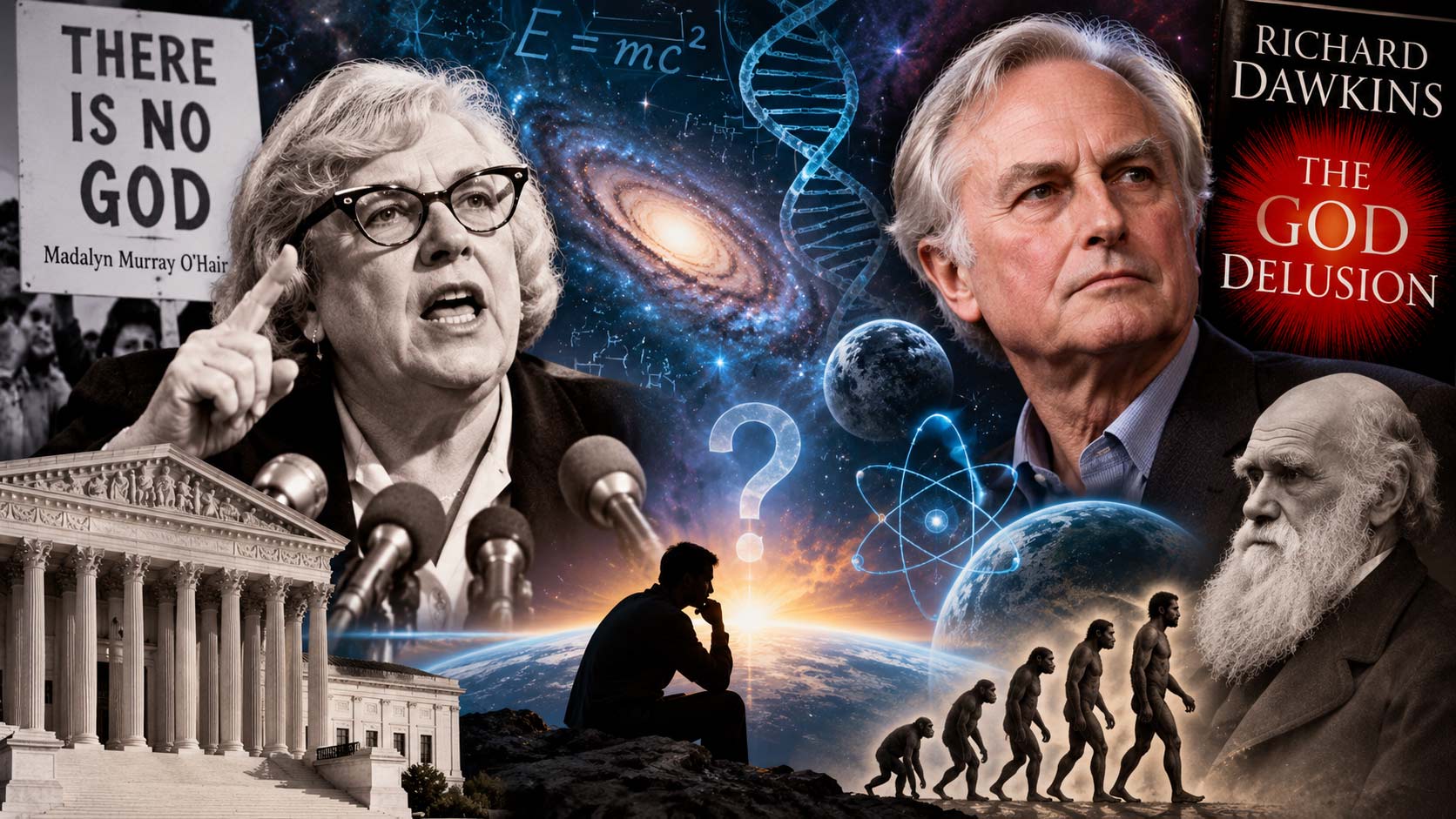
Atheism is sometimes described simply as the belief that God does not exist, although many atheists today prefer to define it as the absence of belief in God. That distinction can matter when discussing who bears the burden of proof, but it does not settle the larger philosophical questions involved. Whether someone says, “There is no God” or simply, “I see no reason to believe there is a God,” we are still left with questions about the nature of reality, the origin of the universe, human consciousness, morality, reason, and why anything exists at all. Christianity and atheism offer very different ways of understanding those things, and deciding between them involves considerably more than asking whether religion can prove the existence of God.
Atheism is also frequently associated with naturalism, although the two should not be confused. An atheist does not necessarily have to be a philosophical naturalist, and technically a naturalist need not make atheism the starting point of his worldview. Naturalism generally holds that the natural world is all that exists and that reality should ultimately be explained in terms of natural causes rather than supernatural ones. If naturalism is true, God, angels, spirits, miracles, divine revelation, and life after death either do not exist or must be reinterpreted in entirely natural terms. The disagreement between Christianity and naturalism, therefore, involves much more than the existence of God. It concerns the fundamental nature of reality itself.
Does God Exist?
Arguments about God’s existence are almost as old as philosophy. Christians have offered cosmological arguments based upon the existence and origin of the universe, teleological arguments based upon order and apparent design, moral arguments based upon objective moral values, and arguments based upon contingency, consciousness, reason, religious experience, and other features of reality. None of these arguments should be treated as a magic formula that forces every reasonable person to become a Christian. Philosophical arguments rarely work that way. Their value is cumulative: they ask whether particular features of the world are better explained if God exists than if He does not.
Atheists have responses to each of these arguments, and those responses deserve serious consideration. Some contend that the universe may not require a cause of the kind Christians propose. Others argue that apparent design can be explained through natural processes, particularly biological evolution. Moral realists may believe objective morality can exist without God, while other atheists understand morality primarily in evolutionary, social, or subjective terms. Christian apologetics should engage the strongest versions of these arguments rather than pretending that atheism survives only because atheists have never heard the cosmological argument.
Why Is There Something Rather Than Nothing?
One of the oldest philosophical questions is also one of the simplest to ask: Why does anything exist?
The universe exists, but it is not obvious that it had to exist. Things within the universe continually come into existence and pass out of existence, and contemporary cosmology indicates that the universe as we know it has a finite history. Even if some physical reality preceded the observable universe, however, the philosophical question remains. Why is there a physical reality at all? Saying that the universe arose from a quantum state, vacuum, multiverse, or some other physical condition may move the question backward, but it does not necessarily answer why there is something capable of producing universes in the first place.
Christianity answers that question by grounding the existence of everything else in a necessary and eternal God whose existence does not depend upon anything outside Himself. The atheist is certainly free to reject that explanation, but rejecting God does not eliminate the question. It requires some alternative account of why reality exists or an acknowledgment that reality may ultimately have no further explanation.
Reason and the Human Mind
Naturalism also raises interesting questions about the human capacity for reason. If our brains are entirely the products of unguided physical and biological processes, our cognitive abilities developed because they contributed to survival and reproduction. That does not mean our reasoning must therefore be unreliable. An organism that consistently misunderstands its environment is unlikely to survive very long. Nevertheless, survival and truth are not identical, and the relationship between evolutionary usefulness and our ability to discover abstract truths about mathematics, logic, philosophy, and the universe deserves consideration.
Christianity approaches reason from a different direction. If human beings were created by a rational God and made in His image, it is not surprising that the human mind is capable of understanding something about the rational order of creation. Christians should not overstate this argument; believers make reasoning errors as readily as anyone else, and the success of science demonstrates that naturalists are obviously capable of excellent reasoning. The question is not whether atheists can reason. Clearly they can. The philosophical question is which worldview provides the better explanation for the existence of rational minds capable of discovering truths far beyond those immediately necessary for survival.
Morality Without God
Christians sometimes make the unfortunate argument that atheists cannot be moral people. That claim is plainly false. Atheists can be compassionate, honest, generous, courageous, and deeply concerned about justice, just as religious people can be selfish, dishonest, cruel, and hypocritical. The moral argument for God’s existence has nothing to do with claiming that Christians behave better than atheists.
The real question concerns the foundation of morality. If some things are objectively right or wrong regardless of what individuals or societies happen to believe, what makes them objectively so? Naturalistic explanations can tell us a great deal about how moral behavior may have developed. Cooperation, empathy, reciprocal behavior, and concern for members of one’s group can clearly provide evolutionary and social advantages. But explaining why human beings developed moral beliefs is not necessarily the same thing as explaining whether those beliefs correspond to genuine moral obligations. Christianity grounds objective morality in the character of God. Naturalists have proposed several alternative accounts, and those should be evaluated on their merits rather than dismissed merely because they do not invoke God.
Science and Naturalism
Science is sometimes presented as though it naturally leads to atheism, but science and philosophical naturalism are not the same thing. Science ordinarily investigates natural phenomena by looking for natural explanations. A scientist studying an infection looks for bacteria, viruses, immune responses, and other physical causes rather than inserting supernatural intervention whenever something remains unexplained. This approach, sometimes called methodological naturalism, has been extraordinarily successful and is used by Christian and atheist scientists alike.
Philosophical naturalism goes further by concluding that nature is all that exists. That conclusion is philosophical rather than scientific because science itself studies the natural world. A method designed to investigate natural causes cannot by itself demonstrate that nothing beyond nature exists. Christians therefore do not need to choose between science and belief in God. The more fundamental question is whether the natural world studied by science is the whole of reality or part of a larger reality that includes its Creator.
The Problem of Evil
Any serious discussion of atheism must also acknowledge what many people consider the strongest argument against belief in God: the existence of evil and suffering. If God is all-powerful and perfectly good, why is there so much suffering in the world? Why do children die? Why do natural disasters kill thousands of people? Why does God apparently remain hidden while terrible things happen?
Christians have offered a variety of responses involving human freedom, the regularity of natural laws, the consequences of living in a fallen world, character formation, divine providence, and the limitations of human knowledge. Those responses deserve careful examination, but suffering should never be treated merely as an intellectual puzzle. For someone who has just lost a child, a clever philosophical answer may be the last thing he needs. The problem of evil has both an intellectual and an intensely personal dimension, and Christian apologetics should recognize both.
Christianity also makes a claim about suffering that should not be overlooked. Its answer is not that suffering is imaginary or unimportant. At the center of Christianity is a crucified Messiah. Christians believe that God entered human history, experienced suffering and death, defeated death through the resurrection, and promises a final restoration in which evil will not have the last word. That does not answer every question about why particular tragedies occur, but it places suffering within a larger Christian understanding of creation, fall, redemption, and restoration.
Is Atheism the Default Position?
Some contemporary atheists argue that atheism requires no defense because it simply represents the absence of belief. A person who has not been given sufficient evidence for God is no more obligated to disprove God than someone who does not believe in fairies is obligated to disprove fairies. There is an important point here: Christians making claims about God do bear responsibility for providing reasons for those claims.
But once the discussion expands into a worldview, nobody occupies a completely neutral position. Christians, atheists, naturalists, agnostics, and everyone else interpret the same universe and attempt to make sense of it. If someone maintains that physical reality is all that exists, that is a claim about reality and can be examined like other philosophical claims. The question is not simply which side carries a burden of proof. The more useful question is which explanation makes the best sense of the world we actually experience.
Following the Evidence
Christian apologetics should not begin by assuming that every atheist secretly knows Christianity is true or that unbelief can always be reduced to rebellion against God. People reject Christianity for many reasons. Some have encountered weak arguments from Christians. Some have experienced hypocrisy or abuse in religious settings. Others have studied the issues carefully and concluded that the evidence does not persuade them. We can disagree with that conclusion without questioning their intelligence or sincerity.
The Christian claim is that reality ultimately makes better sense if God exists than if He does not, and that the case does not end with abstract philosophy. Christianity makes historical claims about Jesus of Nazareth, His crucifixion, and His resurrection that can themselves be investigated. The purpose of apologetics is not to protect Christianity from difficult questions but to ask those questions honestly and follow the evidence wherever it leads. If Christianity is true, Christians should have nothing to fear from serious investigation.