

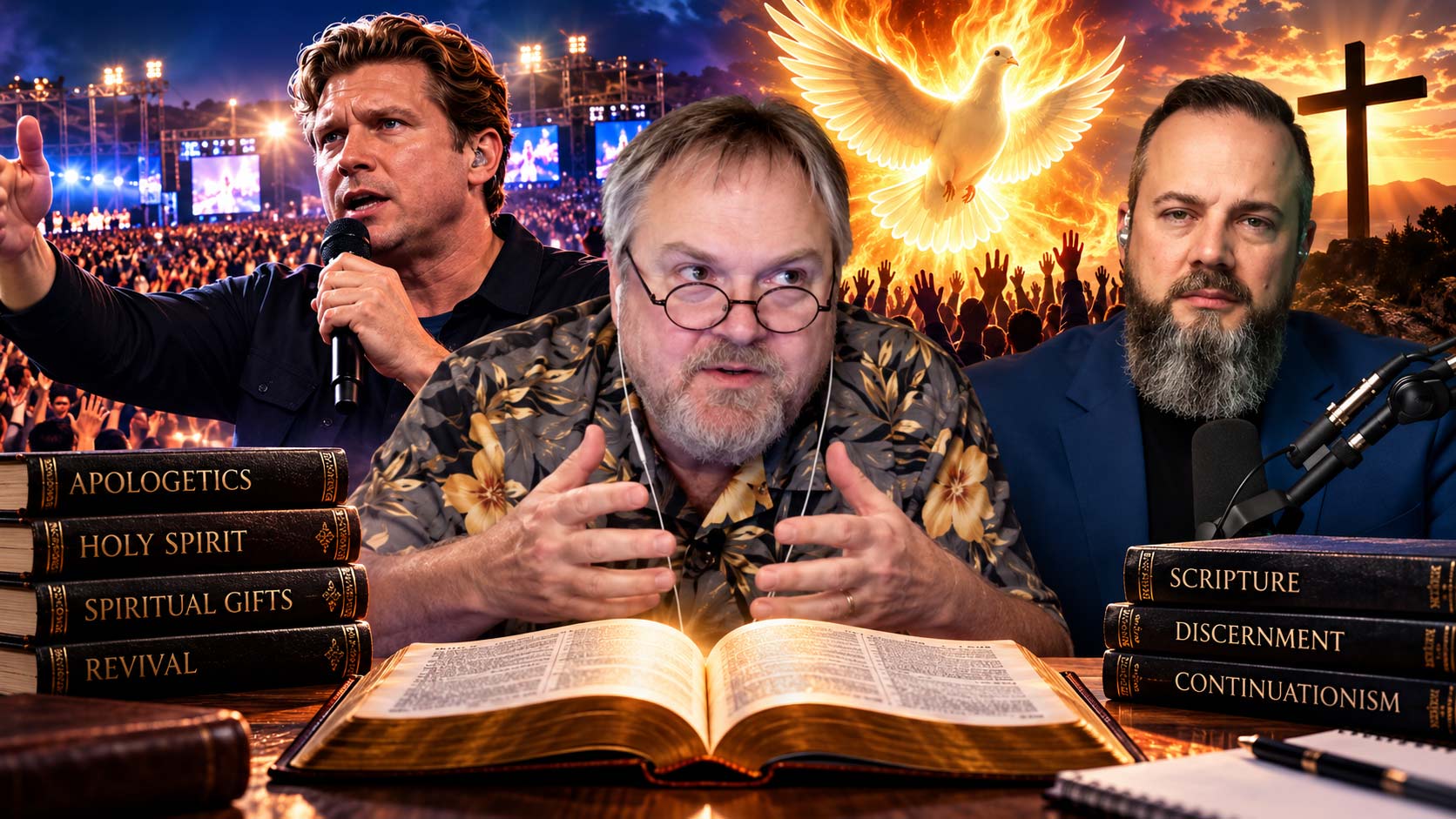
I have been part of the Pentecostal and charismatic world for most of my Christian life, which means I have seen both the good and the bad. I have seen people genuinely helped through prayer, experienced the presence of God in ways that were difficult to describe, and watched spiritual gifts operate in ways that strengthened people’s faith. I have also seen exaggeration, questionable prophecies, emotional manipulation, strange doctrines, and things attributed to the Holy Spirit that I found difficult to reconcile with Scripture. One of the unfortunate tendencies within charismatic Christianity is to assume that questioning something supernatural demonstrates a lack of faith. I believe precisely the opposite. If we believe the Holy Spirit is genuinely at work today, we should have no reason to fear examining claims made in His name.
Charismatic apologetics therefore has two responsibilities. The first is to defend the biblical case for the continuing work and gifts of the Holy Spirit. The second is to evaluate claims made within charismatic Christianity itself. Those responsibilities belong together. It is inconsistent to demand careful biblical examination from cessationists while excusing questionable teaching or practices simply because they occur in charismatic circles. Paul told the Thessalonians, “Do not quench the Spirit. Do not despise prophecies,” but he didn’t stop there. He immediately added, “Test everything; hold fast what is good” (1 Thessalonians 5:19–21). That combination provides an excellent framework for charismatic apologetics: don’t reject something merely because it claims to be supernatural, and don’t accept it merely because it claims to be supernatural.
Are the Gifts for Today?
The fundamental disagreement between continuationists and cessationists concerns whether the supernatural gifts described in the New Testament were intended to continue throughout the life of the church. Cessationists generally believe that at least some gifts, particularly prophecy, tongues, and certain kinds of miraculous gifts, belonged primarily to the apostolic period and ceased once their foundational purpose had been fulfilled. Continuationists believe there is no adequate biblical basis for concluding that these gifts disappeared, but that the Holy Spirit continues to distribute them according to His will.
I find the continuationist case considerably more persuasive. The New Testament presents spiritual gifts as part of the ordinary life of the church, and I do not find a passage teaching that they would cease with the death of the apostles or the completion of the New Testament canon. First Corinthians 12–14 contains extensive instructions governing spiritual gifts, but Paul never suggests that those instructions would soon become irrelevant. Instead, he tells believers to desire spiritual gifts while insisting that they operate in an orderly manner and for the edification of the church. The burden of proof, it seems to me, belongs to anyone arguing that something the New Testament instructs the church to practice subsequently disappeared without the New Testament clearly telling us that it would.
That does not mean every argument offered for continuationism is convincing. Nor does it mean every modern charismatic practice can simply be projected back into the book of Acts. If we claim biblical support for contemporary practices, we should be willing to demonstrate that connection carefully rather than merely assuming it.
Pentecost and the Baptism in the Holy Spirit
Pentecostals have historically emphasized the baptism in the Holy Spirit as an experience of empowerment distinct from conversion. Acts 1:5–8 connects the promised baptism in the Spirit with receiving power to become witnesses, and Acts subsequently records occasions in which believers experience the Spirit in ways that are identifiable and sometimes accompanied by tongues or prophecy. Pentecostals understand these passages as establishing a pattern in which believers who already belong to Christ can receive a subsequent empowering work of the Spirit.
Other Christians interpret these passages differently. Some understand Pentecost primarily as a unique event in salvation history rather than a pattern for subsequent believers. Others believe every Christian receives the baptism of the Holy Spirit at conversion and that later experiences should be described as fillings of the Spirit rather than Spirit baptism. These are legitimate exegetical questions and deserve more than denominational slogans. Pentecostals should be able to explain why they interpret Acts as they do, while recognizing that terminology can sometimes obscure substantial areas of agreement. Christians on both sides affirm the necessity of the Holy Spirit and His empowering presence in Christian life.
What About Tongues?
Few subjects identify Pentecostal and charismatic Christianity more readily than speaking in tongues. Unfortunately, few have generated more misunderstanding. Paul describes the person speaking in a tongue as speaking “not to men but to God,” because no one understands him unless interpretation occurs (1 Corinthians 14:2). He also distinguishes between uninterpreted tongues, which can edify the individual believer, and interpreted tongues that can function within the gathered church. Whatever position one takes on contemporary tongues, Paul’s discussion makes clear that the practice was real, that it was regulated, and that the person exercising the gift retained control over his participation.
That last point matters. Paul says that “the spirits of prophets are subject to prophets” and repeatedly instructs people when to speak and when to remain silent. The Holy Spirit does not require believers to surrender self-control. Claims that someone “couldn’t help himself” because the Spirit took control should therefore be treated cautiously. Spiritual manifestations in the New Testament occur within a framework of order, discernment, and responsibility.
The events of Pentecost in Acts 2 also demonstrate that tongues can involve languages understood by listeners, although that does not necessarily establish that every biblical occurrence of tongues must be a naturally identifiable human language. First Corinthians 14 presents circumstances in which those present do not understand what is being spoken unless interpretation is provided. Christians can disagree about precisely how these passages relate without dismissing the biblical phenomenon itself.
Prophecy and Testing Prophecy
Modern prophecy presents one of the most difficult issues for charismatic apologetics because extravagant claims have sometimes been made in the name of God. The New Testament clearly contains prophecy after Pentecost, including prophetic ministry by people who were not apostles. At the same time, Scripture repeatedly insists that prophetic claims be evaluated. Paul tells believers to weigh what prophets say (1 Corinthians 14:29), and John instructs Christians not to believe every spirit but to test the spirits (1 John 4:1).
I believe New Testament prophecy continues, but I am uncomfortable with the casual use of “Thus saith the Lord” to give someone’s impressions an authority approaching Scripture. Prophecy today does not add to the biblical canon and should never become the primary means by which Christians make important decisions. The Holy Spirit leads believers, but that is not the same thing as allowing someone else’s prophetic word to govern our lives. A genuine prophetic ministry should point people toward Christ and strengthen the church rather than create dependence upon the prophet.
Predictive prophecy also creates accountability. If someone repeatedly makes specific predictions in God’s name that do not occur, Christians should not continually redefine those predictions until they become impossible to falsify. Grace and humility are appropriate when people make mistakes, but accountability is also appropriate. Testing prophecy means that some claims will fail the test.
Healing and Miracles
Divine healing has always occupied an important place in Pentecostal and charismatic Christianity. I believe Christians should pray for the sick and expect God to heal. The New Testament instructs elders to pray for the sick (James 5:14–16), describes gifts of healings in the church, and repeatedly portrays healing as part of Jesus’ ministry and the ministry of His followers. I see no biblical reason to conclude that God stopped healing when the apostolic age ended.
At the same time, belief in divine healing does not require hostility toward medicine. God can work through physicians, medication, surgery, natural recovery, or direct supernatural intervention. Christians should not be made to feel that receiving medical treatment demonstrates deficient faith. Nor should someone who remains sick be automatically blamed for failing to believe strongly enough. The New Testament itself does not reduce every instance of sickness to a simple formula involving the amount of faith possessed by the sick person.
Claims of miraculous healing should also be reported honestly. If someone claims that a medically documented disease disappeared following prayer, that claim can potentially be investigated. If someone reports feeling temporarily better during a meeting, we should not immediately describe it as medical proof of a miracle. Exaggerating healings may generate excitement in the short term, but it ultimately damages the credibility of genuine testimony.
Discernment Without Cynicism
One reaction to charismatic excess is to become suspicious of virtually everything supernatural. That is understandable, particularly for people who have witnessed manipulation or been harmed by irresponsible ministry, but cynicism is not the same thing as discernment. Biblical discernment does not begin with the assumption that everything is false. It asks whether something is true.
The opposite error is equally dangerous. Some charismatics appear willing to accept almost anything provided it occurs in an exciting meeting and is attributed to the Holy Spirit. Unusual behavior becomes evidence of revival precisely because it is unusual. That is not a reliable biblical standard. The fact that something cannot be explained immediately does not prove that God caused it, and the fact that a preacher uses biblical language does not establish that his teaching is biblical.
Discernment requires Scripture, wisdom, observation, and sometimes simply time. Jesus said that trees are known by their fruit. Ministries that continually produce manipulation, fear, financial exploitation, sexual misconduct, failed predictions, or dependence upon charismatic personalities deserve serious examination regardless of how impressive their meetings appear.
The Word of Faith Movement
The Word of Faith movement deserves particular attention because it is frequently presented by critics as representative of charismatic Christianity generally. I have personal experience with the movement and disagree with several teachings that have circulated within it, but I also believe critics sometimes paint with a brush so broad that important distinctions disappear. Not every Pentecostal is Word of Faith, not everyone associated with Word of Faith believes everything attributed to the movement, and questionable statements by one preacher should not automatically be assigned to everyone else.
Teachings concerning faith, confession, healing, prosperity, the nature of humanity, and the work of Christ should be examined individually and biblically. Some criticisms are justified. Others depend upon quotations removed from context, extreme representatives, or definitions that adherents themselves would reject. The proper apologetic response is neither to defend everything associated with the movement nor to condemn everything associated with it. It is to determine what is actually being taught and compare it with Scripture.
That principle should apply to every charismatic movement. Bethel Church, the New Apostolic Reformation, prosperity ministries, healing evangelists, prophetic ministries, and independent charismatic networks should not be evaluated primarily through labels. Specific teachings and practices should be examined on their own merits.
Experience and Scripture
Pentecostalism has always placed considerable emphasis upon experience, and I do not believe that is inherently a weakness. Christianity itself involves experience. Conversion is experienced. Prayer is experienced. Worship is experienced. The presence and activity of the Holy Spirit are not merely theological propositions to be affirmed intellectually. The danger arises when experience becomes self-authenticating; when something is assumed to be from God because it felt powerful.
Experience needs interpretation, and Scripture provides the primary standard by which Christian spiritual experience is interpreted. At the same time, Scripture should not be used to construct a Christianity in which God did remarkable things throughout biblical history but is assumed to have become practically inactive once the final page of the New Testament was written. The biblical picture is neither uncontrolled supernaturalism nor functional naturalism. It is a church dependent upon the Holy Spirit while remaining accountable to the Word of God.
A Charismatic Faith Worth Defending
Charismatic apologetics should therefore be willing to face criticism from both directions. To the cessationist, we should be prepared to explain why we believe the gifts of the Spirit continue and why experiences described throughout the New Testament should not automatically be confined to the first century. To the charismatic, we should be equally prepared to say that claiming the activity of the Holy Spirit does not place a teaching, prophecy, healing claim, or ministry beyond examination.
We do not honor the Holy Spirit by believing everything attributed to Him. Neither do we honor Him by refusing to believe He still acts. The New Testament gives us a better approach: welcome the work of the Spirit, test what is claimed in His name, reject what is false, and hold firmly to what is good. A mature charismatic Christianity should have room for expectation without gullibility, discernment without cynicism, supernatural experience without abandoning Scripture, and faith without fear of honest questions.
That is the kind of charismatic faith worth defending.