

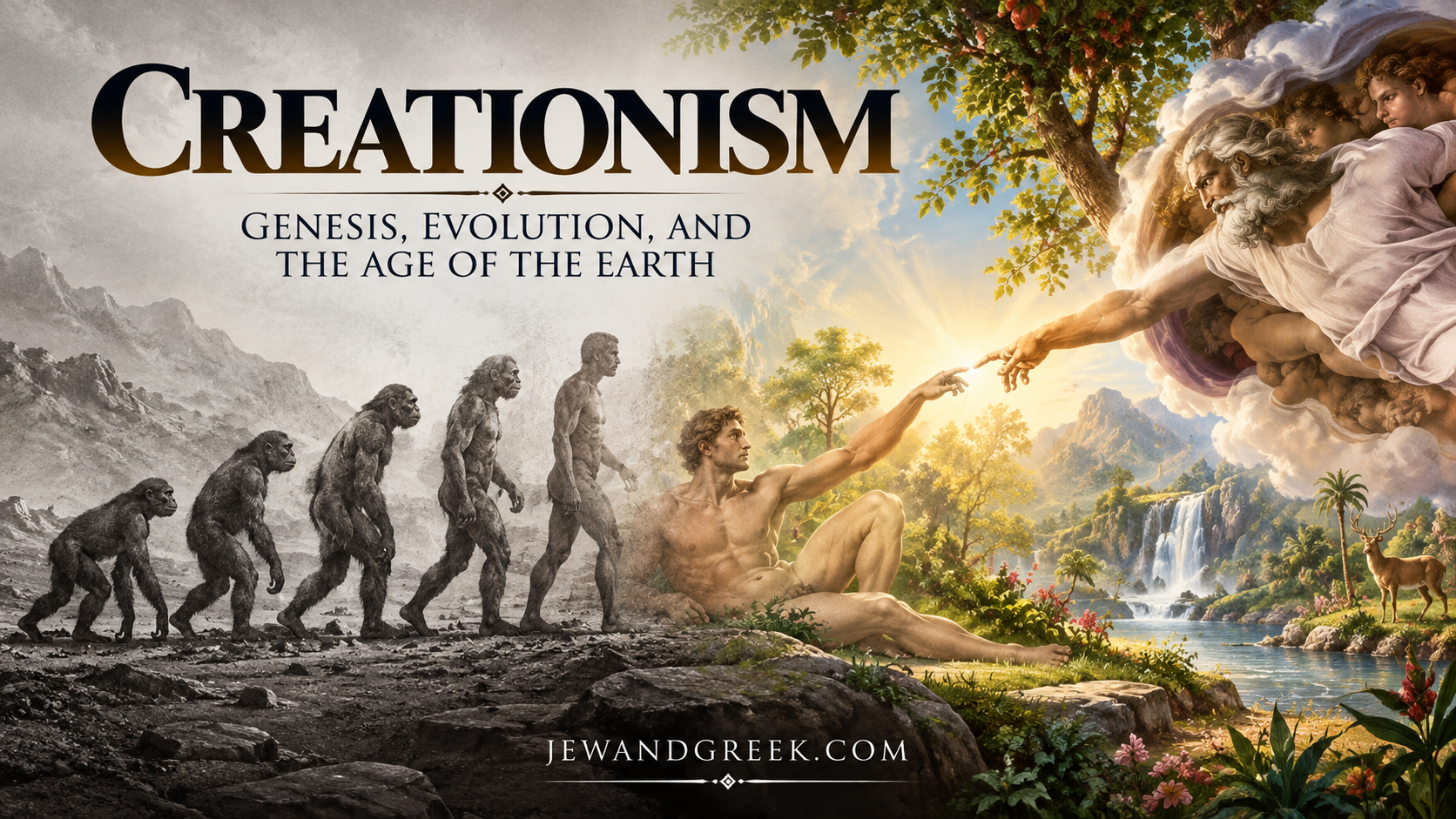
“In the beginning God created the heavens and the earth.” That’s where Christianity starts. Before Abraham, before Israel, before Moses, before the Law, and before Jesus came into the world, there is God—and there is everything else because God created it. For Christians, that fundamental claim shouldn’t be controversial. What becomes controversial is almost everything we start asking after it: Did God create the universe in six ordinary twenty-four-hour days? Is the earth thousands or billions of years old? Did dinosaurs live alongside human beings? Does the fossil record demonstrate common ancestry? Were Adam and Eve specially created? Was Noah’s flood global? Does Genesis describe creation chronologically, or are we sometimes asking questions of the text that its original author wasn’t trying to answer?
Somewhere along the way, what should have been a fascinating discussion about Scripture and the natural world turned into a battle in which everybody was expected to pick a team. I don’t think we need to do that. If God created the universe, Christians shouldn’t be afraid to study it. We’re not going to dig up a fossil that catches God by surprise, and we’re not going to discover a law of physics He didn’t know about. At the same time, Christians shouldn’t automatically reinterpret Scripture every time a new scientific theory becomes popular, because scientific theories can be wrong. So can our interpretations of Scripture. That means we’re going to have to do something more difficult than picking a side: we’re going to have to look honestly at both the text and the evidence.
What Does the Bible Actually Say?
Before we start arguing about Darwin, fossils, radiometric dating, or the Big Bang, we should probably ask the most basic question: What does Genesis actually say? That sounds obvious, but creation debates have a habit of beginning somewhere else. One person starts with modern geology and tries to fit Genesis around it, while another starts with a particular creation model and assumes that model is what Genesis says. Before long, we’re defending systems rather than reading the text. Genesis 1 presents God deliberately bringing order to creation: God speaks, light appears, waters are divided, land emerges, vegetation grows, the heavenly lights mark times and seasons, living creatures fill the seas, sky, and land, and finally humanity is created in God’s image. Whatever else we conclude about the chapter, God is the actor throughout the story.
The chapter also has an unmistakable structure and rhythm. God speaks, something happens, God evaluates it, and evening and morning follow; the first three days establish realms while the next three populate or govern those realms, followed by God’s rest on the seventh day. Recognizing that literary structure doesn’t settle the creation debate, because a historical account can be carefully structured and literary artistry doesn’t make an event fictional. But neither should we ignore the structure simply because we’re afraid someone will use it to argue against six ordinary days. The real question isn’t whether Genesis is “literal” or “figurative”—two words that often create more confusion than clarity—but what kind of literature Genesis 1 is and what its author intended his readers to understand about what actually happened.
How Long Is a Day?
Sooner or later, every discussion of Genesis 1 arrives at the Hebrew word yom, normally translated “day.” Young-earth creationists correctly point out that the creation days are numbered and repeatedly associated with “evening and morning,” which certainly sounds like ordinary days. Exodus 20:11 strengthens that case by connecting Israel’s six-day workweek and seventh-day Sabbath with God’s six days of creation and seventh-day rest. Those are real exegetical arguments, and Christians who accept an old earth shouldn’t simply brush them aside because modern geology makes an ancient earth easier to accommodate.
But the argument sometimes gets exaggerated into the claim that yom can only mean a twenty-four-hour day, and that’s simply not true. Like the English word day, the Hebrew word has a range of meanings determined by context. So saying “yom means day” doesn’t settle the question any more than pointing out that it can refer to a longer period settles it in the opposite direction. We still have to determine what it means here. Young-earth creationists have a serious contextual argument; old-earth and literary interpreters have arguments concerning the unusual nature and structure of the creation account. We should deal with those arguments rather than pretending that one side can’t read Hebrew.
Young-Earth Creationism
Young-earth creationism generally holds that God created the world during six ordinary days within the last several thousand years, that Adam and Eve were specially created as the first human beings, and that Noah’s flood was a worldwide catastrophe responsible for much of the geological record. There are obvious reasons Christians find this position attractive. It appears to follow the chronological sequence of Genesis naturally, takes the repeated evenings and mornings seriously, and provides a straightforward relationship between the creation week and the Sabbath command. It also offers a simple understanding of Adam, the fall, and the entrance of death into the world. You don’t have to work very hard to understand why Christians reading Genesis without any knowledge of modern geology might come away with something resembling a young-earth interpretation.
But young-earth creationism carries an enormous scientific burden, and we shouldn’t pretend otherwise. If the earth is only several thousand years old, then major portions of modern astronomy, geology, physics, paleontology, genetics, archaeology, and geochronology have been interpreted incorrectly. That’s possible; scientific consensus isn’t infallible. But saying “scientists have been wrong before” isn’t enough. If you’re proposing a radically different history of the earth, you have to explain the evidence better. Finding a weakness in one dating method or an anomaly in one geological formation doesn’t automatically compress billions of years of conventional history into a few thousand.
An Old Earth
Current scientific estimates place the universe at approximately 13.8 billion years old and the earth at about 4.54 billion years old. Those numbers aren’t the result of one scientist using one technique and everybody else simply repeating the answer. They emerge from multiple lines of evidence involving radioactive decay, meteorites, lunar material, stellar evolution, geological formations, and observations of the expanding universe. That doesn’t make the numbers inspired or incapable of revision, but it does mean that the case for an ancient earth is much stronger than popular presentations sometimes suggest.
I’ve heard radiometric dating dismissed simply because “it makes assumptions.” Of course it makes assumptions. Every reconstruction of the past makes assumptions. The relevant questions are whether those assumptions are justified, whether they can be tested, whether known sources of error can be identified, and whether independent methods converge upon similar results. If we’re going to challenge billions of years of earth history, we need to engage the strongest evidence for it rather than the weakest version we can find in a Sunday school illustration. Christians shouldn’t be intimidated by scientific consensus, but neither should we act as though consensus means nothing when it rests upon substantial evidence.
Old-Earth Creationism
Old-earth creationists accept an ancient universe and earth while maintaining that God intentionally created the world and, in many versions, intervened directly at significant stages in the history of life. Some interpret the Genesis days as long periods, while others understand them analogically or emphasize the literary structure of the creation week. Old-earth creationism therefore isn’t one model so much as a family of attempts to take both Scripture and conventional scientific chronology seriously. Its obvious advantage is that it doesn’t require Christians to overturn enormous portions of contemporary astronomy and geology merely to preserve belief in creation.
But old-earth creationists have homework too. If Genesis naturally describes ordinary days, then we shouldn’t turn those days into geological ages simply because billions of years make our scientific problems disappear. Exodus 20 still has to be explained. So does the repeated evening-and-morning formula. And if animals were suffering, killing one another, developing diseases, and going extinct for hundreds of millions of years before Adam sinned, Christians have to think carefully about the relationship between death and the fall. Saying “science says the earth is old” doesn’t answer those theological questions. It merely tells us why we need to ask them.
The Day-Age and Framework Views
The day-age interpretation understands the creation days as long periods rather than ordinary solar days. That has obvious appeal because it seems to provide room for an ancient earth while preserving a sequential reading of Genesis. The problem is that attempts to correlate individual creation days with geological ages can become strained rather quickly. Genesis doesn’t line up neatly with the conventional scientific sequence in every detail, and once we start rearranging events to make the correlation work, we have to ask whether the text itself is really driving the interpretation.
The framework interpretation takes a different approach by emphasizing the literary arrangement of Genesis 1. Days one through three establish realms, while days four through six populate or govern corresponding realms, followed by the seventh day of divine rest. That structure is genuinely present in the chapter and deserves attention, but literary structure doesn’t automatically eliminate historical sequence. A writer can arrange real events deliberately. The framework view therefore raises a legitimate question rather than providing an automatic solution: Is the creation week primarily giving us a chronological sequence, a literary framework, or some combination of the two? That’s a question we have to answer from the text rather than from what would make our preferred creation model easier.
The Big Bang
The Big Bang is frequently misunderstood on both sides of the creation debate. It doesn’t describe matter exploding outward from a point into preexisting empty space; it describes the universe developing from an extremely hot, dense early state while space itself expands. Interestingly, some Christians originally resisted Big Bang cosmology while others welcomed it because a universe with a finite history sounded much more compatible with creation than the eternal static universe many scientists had previously favored. One of the important early architects of the theory, Georges Lemaître, was both a physicist and a Catholic priest, which at least complicates the popular story that the Big Bang was invented to get rid of God.
But let’s not baptize the Big Bang either. Genesis isn’t secretly teaching twentieth-century cosmology, and Big Bang theory doesn’t prove Genesis 1. Physics can investigate earlier and earlier stages of cosmic history, but even a complete physical description wouldn’t answer the metaphysical question of why a universe exists at all. If tomorrow’s cosmology substantially revised today’s model, Christianity wouldn’t collapse with it. God created is a theological claim about ultimate reality; the Big Bang is a scientific model describing the physical history of that reality.
Evolution
The word evolution causes more confusion than it should because people use it to mean several different things. Biological populations change over generations; we can observe that. Natural selection operates; we can observe that too. Mutations occur, genetic frequencies change, organisms adapt, and populations can become sufficiently separated to produce new species. None of that requires atheism, and creationists don’t strengthen their position by denying processes we can actually watch.
The larger controversy concerns universal common ancestry: whether all living organisms ultimately descend from earlier forms through branching evolutionary history, including the claim that human beings share ancestry with other forms of life. Mainstream biology considers the evidence for common descent strong, drawing from genetics, comparative anatomy, fossils, embryology, and biogeography. Many creationists disagree with that interpretation or accept common ancestry only within limited created groups. That’s where the substantive argument belongs. Asking “Do you believe in evolution?” is often almost meaningless until we establish which evolutionary claim we’re actually talking about.
Evolution Is Not Atheism
This distinction is important enough to state plainly: evolution is not atheism. A person can believe that evolutionary processes occurred and still believe that God created the universe and providentially governs it. Plenty of Christians do exactly that. What you cannot do is demonstrate that God does not exist merely by demonstrating a natural mechanism. If scientists established every major claim of evolutionary biology beyond reasonable dispute tomorrow, they would have told us something extremely important about how life developed. They would not have demonstrated that life has no Creator or purpose.
This is where philosophical assumptions sometimes sneak into scientific discussions without announcing themselves. Science can investigate mutation, selection, genetics, common ancestry, and biological history. It cannot put God in a test tube and determine that He wasn’t involved. “This happened through a natural process” and “therefore God had nothing to do with it” are two entirely different statements. The first may be science. The second is philosophy. Putting the word science in front of a philosophical assumption doesn’t magically turn it into science.
But Creationists Can’t Hide Behind That Either
Creationists can make the opposite mistake. If evolutionary theory currently has an unanswered question, we don’t get to write GOD in the blank and declare victory. That’s the familiar God-of-the-gaps problem: “Science can’t explain this, therefore God must have done it directly.” The problem is that scientific gaps have a nasty habit of getting smaller, and Christianity shouldn’t depend upon keeping particular scientific questions unanswered.
God doesn’t disappear when we discover a mechanism. Christians believe God sends rain, but understanding evaporation, condensation, atmospheric pressure, and weather systems doesn’t threaten divine providence. Natural mechanisms and divine action aren’t necessarily competitors. So if scientists eventually provide a convincing natural explanation for something we currently don’t understand, that doesn’t mean God has been pushed out of creation. It means we’ve learned something else about how creation works.
Darwin and Natural Selection
Charles Darwin didn’t invent the idea that living things could change over time. What made his work revolutionary was providing a powerful mechanism—natural selection—capable of explaining how populations become increasingly adapted across generations. Organisms vary, some of those variations are heritable, and organisms produce more offspring than can survive. If certain inherited characteristics improve reproductive success, those characteristics tend to become more common. That’s not atheistic philosophy; it’s an observable biological process.
The larger question is how much natural selection, mutation, genetic drift, gene duplication, developmental processes, environmental pressure, and enormous spans of time can explain. Creationists shouldn’t deny natural selection because Darwin made it famous, and evolutionists shouldn’t assume that demonstrating natural selection automatically establishes every proposed evolutionary transition. The real scientific question is whether known mechanisms adequately explain the diversity and history of life. That’s a much more interesting discussion than arguing over whether Darwin was a hero or a villain.
Microevolution and Macroevolution
Creationists frequently distinguish microevolution from macroevolution, accepting small changes within populations while rejecting large-scale evolutionary transitions. The distinction can be useful descriptively, but it can also become a slogan that hides the actual problem. Evolutionary biologists don’t generally propose one mechanism that produces small changes and another mysterious mechanism that produces large ones. Macroevolution involves ordinary evolutionary processes operating across longer timescales together with speciation, extinction, developmental constraints, and other population-level phenomena.
So if creationists believe there is a biological boundary beyond which evolutionary change cannot proceed, that’s a perfectly legitimate hypothesis—but we need to identify the boundary. Where is it? What produces it? What evidence demonstrates it? Saying “dogs always produce dogs” doesn’t get us very far because nobody expects a dog to suddenly give birth to something from a different biological lineage. Evolutionary theory itself predicts gradual population-level change, not cartoon transformations between unrelated modern species. If we’re going to criticize evolution, let’s criticize what evolutionary biology actually claims.
The Fossil Record
I wouldn’t use the old apologetic claim that there are no transitional fossils. There are fossils possessing combinations of characteristics that paleontologists reasonably interpret as transitional between major groups. We can debate precisely where particular fossils belong, whether the proposed evolutionary relationships are correct, how complete the record is, and whether known mechanisms adequately explain the transitions. Those are legitimate questions. Simply saying transitional fossils don’t exist gives somebody an easy opportunity to show that our argument is wrong.
The more interesting question concerns the fossil record as a whole. Conventional geology interprets its broad sequence as the history of organisms appearing, diversifying, and becoming extinct across immense periods. Young-earth creationists interpret much of that same record through catastrophic burial, especially in connection with Noah’s flood. Those are radically different models, and each needs to explain more than a few favorite fossils. Fossil ordering, sedimentary formations, geographic distribution, ecological patterns, radiometric dates, and genetic relationships all have to fit the larger explanation. A model earns credibility by explaining the evidence, not merely by finding difficulties in the other model.
Genetics and Common Ancestry
Darwin knew nothing about DNA, but modern evolutionary biology certainly does, and genetics has provided some of the strongest evidence used to support common ancestry. Organisms share genes and genetic sequences in patterns that often correspond closely with relationships inferred independently from anatomy and fossils. Creationists commonly respond with the concept of common design: an intelligent designer might reuse successful biological structures just as engineers reuse effective designs. That’s a reasonable possibility and shouldn’t simply be dismissed.
But “common design” isn’t a magic phrase that answers every genetic argument. Shared mutations, inactive genetic sequences, chromosomal structures, and other inherited patterns sometimes look more naturally like the consequences of shared ancestry than merely the reuse of useful designs. Creationists who want to challenge genetic evidence need to engage those arguments specifically. This is also an area where apologetics has to remain current, because genetics develops rapidly and arguments that sounded impressive thirty years ago may no longer survive scrutiny. If we’re going to make a scientific case, we need to keep up with the science.
Intelligent Design
The intelligent design movement asks whether certain features of the universe and living organisms are better explained by intelligent causation than by undirected processes. Michael Behe’s concept of irreducible complexity is one of the best-known biological examples. Some molecular systems contain numerous interacting components, and removing critical components causes the system to stop functioning. Behe argues that such systems create serious difficulties for gradual evolutionary explanations because the completed system requires multiple coordinated parts.
Evolutionary biologists have responded with mechanisms such as co-option, where structures originally performing one function become incorporated into another system, along with gene duplication and changes in existing biological components. That’s exactly the kind of exchange we should want. Make the design argument. Present the evidence. Let critics attack it. Refine the argument if necessary, and abandon it if it fails. If intelligent design is correct, it doesn’t need protection from scrutiny. And if a particular design argument fails, that doesn’t establish that God doesn’t exist; it establishes that the particular argument didn’t work.
DNA and Information
DNA looks remarkably information-like, which makes comparisons with language and computer code almost irresistible. From there it’s tempting to make the apologetic argument: “Information always comes from intelligence; DNA contains information; therefore DNA came from intelligence.” There may be a serious argument in that neighborhood, but we shouldn’t move quite that fast. The word information has technical meanings in genetics and information theory that aren’t identical to the everyday sense in which we talk about a book containing information, and evolutionary mechanisms can alter genetic sequences, duplicate genes, rearrange genetic material, and sometimes produce new functions.
That doesn’t settle the design question in favor of evolution. It simply means we need to make the stronger version of the argument. How much biologically functional information can known mechanisms generate? What exactly requires explanation? Are we talking about Shannon information, specified function, sequence complexity, or something else? Saying “DNA is a code, therefore it had a programmer” sounds impressive, but apologetics shouldn’t settle for an argument because it sounds impressive. If there’s a good design argument from biological information—and I think the question is worth exploring—let’s make the good argument.
The Origin of Life
The origin of life and the evolution of life aren’t the same scientific problem. Evolutionary theory primarily addresses what happens once reproducing biological systems already exist, while abiogenesis investigates how the first living or proto-living systems could have arisen from nonliving chemistry. Researchers have made real progress in producing biologically relevant molecules under plausible conditions and exploring possibilities involving RNA, membranes, metabolism, hydrothermal environments, and other early-earth chemistry. But we do not currently possess a complete historical account showing precisely how nonliving chemistry became the first self-replicating life.
Creationists are perfectly justified in pointing that out. Origin-of-life research has major unanswered questions, and those questions shouldn’t be disguised by talking as though “evolution” explains everything from the Big Bang to human consciousness. But we should also resist the temptation to say, “Science doesn’t know how life began, therefore we’ve proved direct divine intervention.” We haven’t. We’ve identified an important unanswered question. There’s a difference between showing that an explanation is incomplete and demonstrating that your preferred explanation is correct.
Adam and Eve
For me, Adam and Eve are where the theological questions become considerably more serious. The age of the earth doesn’t threaten Christianity nearly as much as some Christians assume. If God created the earth 4.5 billion years ago rather than several thousand years ago, He’s still the Creator. Adam is more complicated because Genesis doesn’t merely mention him in passing. Paul builds theological arguments around Adam, particularly when discussing sin, death, condemnation, and Christ in Romans 5 and 1 Corinthians 15.
That doesn’t automatically tell us how Adam relates to genetics or ancient population history, and Christians accepting evolutionary biology have proposed several models. Some understand Adam and Eve as a specially chosen historical pair within a larger population; others explore genealogical ancestry or representative models. Those proposals deserve examination rather than ridicule. But I don’t think we can casually turn Adam into a disposable literary character simply because evolutionary questions become difficult. Any Christian account of human origins has to take seriously what the rest of Scripture does with Adam, and that’s where I would apply much more theological pressure than I would over the age of a rock.
The Image of God
Whatever happened biologically before humanity appeared, Genesis says something extraordinary happened with us: human beings were created in the image of God. Christians have debated exactly what that means, proposing rationality, moral agency, relationship, spiritual capacity, representation of divine rule, vocation, or combinations of these ideas. The doctrine doesn’t require us to settle every biological question before we understand its basic significance. Humanity occupies a distinctive relationship to God and bears a dignity rooted in God’s purpose rather than in our physical capabilities.
That matters far beyond the creation debate. Human dignity isn’t grounded in intelligence, evolutionary uniqueness, health, race, wealth, productivity, or social usefulness. A newborn child, a brilliant scientist, a severely disabled person, an elderly dementia patient, and the poorest person on earth possess human worth for the same fundamental reason. They bear God’s image. If a creation model preserves all the right dates but loses that truth, it has missed something far more important than chronology.
Death Before Adam
Here’s another issue we can’t simply sweep under the rug. If the conventional geological record represents hundreds of millions of years of natural history before human beings appeared, then animals were dying, eating one another, suffering disease, developing cancer, and going extinct long before Adam sinned. Young-earth creationists understandably see a theological problem because Scripture connects sin and death, and they often interpret the pre-fall world as one without animal death. In that model, much of the fossil record must therefore belong after the fall and frequently to the flood.
Old-earth Christians usually respond that Paul’s argument in Romans 5 concerns human death, not necessarily animal mortality. That may be right, but it needs to be demonstrated exegetically rather than simply asserted because geology requires it. Were animals originally immortal? What exactly changed in creation at the fall? How should Romans 8’s description of creation being subjected to futility relate to natural history? These are real theological questions, and I don’t think shouting “Romans 5!” or “dinosaurs!” at each other gets us very far. We need to let the biblical passages say what they actually say.
Noah’s Flood
Noah’s flood becomes especially important for young-earth creationism because a recent earth requires an explanation for enormous geological formations that conventional geology interprets as developing across vast periods. If a worldwide catastrophic flood produced much of the geological record, that event should have left physical evidence, and there’s nothing unspiritual about looking for it. In fact, if the flood happened in the manner proposed by flood geology, we should expect evidence. Creationists have developed models involving rapid sedimentation, catastrophic tectonics, fossil burial, and post-flood geological processes to explain what we observe.
Christians who interpret the flood as regional or geographically limited have homework of their own because Genesis uses sweeping language about the waters, mountains, humanity, and animal life. Ancient writers could use universal language phenomenologically or rhetorically, but that possibility has to be argued from context rather than assumed. Once again, both the biblical text and the physical evidence deserve serious examination. The question shouldn’t be which interpretation makes our existing system easiest to defend; it should be which interpretation best explains both sets of evidence.
Radiometric Dating
Radiometric dating is sometimes described in popular creationist presentations as though scientists put a rock into a machine, type “four billion years” into a computer, and wait for the machine to agree. That’s not how it works. Radioactive isotopes decay at measurable rates, different isotope systems operate over different timescales, and scientists can frequently compare multiple methods. They also know contamination and geological disturbance occur and have developed techniques for detecting many of those problems. None of this means every radiometric date is automatically correct, but the actual methodology deserves better than caricature.
Young-earth creationists raise questions about initial conditions, changing decay rates, contamination, and geological assumptions, and those questions can be investigated. But if you’re arguing that the conventional chronology is wrong by several orders of magnitude, you need a model capable of explaining why multiple methods repeatedly produce ancient ages and often agree with one another. “Dating methods aren’t perfect” doesn’t get you from 4.5 billion years to 6,000. If the young-earth model is correct, it needs to explain why the evidence looks so old.
Dinosaurs
And yes, eventually every creation discussion gets to dinosaurs, because apparently no conversation about Genesis is complete until somebody asks whether Noah put a Tyrannosaurus rex on the ark. Young-earth creationists place dinosaurs within recent creation and generally believe most became extinct during or after the flood. Conventional paleontology places non-avian dinosaurs tens of millions of years before human beings, while understanding birds as surviving members of the dinosaur lineage. Those aren’t minor chronological differences; they represent completely different histories of life.
Some Christians identify the biblical creatures Behemoth and Leviathan with dinosaurs or other extinct reptiles. Maybe. But I wouldn’t build much apologetic weight on it. The passages are highly poetic and don’t give us enough anatomical information to confidently turn them into zoological field guides. Christianity will survive whether Behemoth was a dinosaur, a hippopotamus, a symbolic creature, or something we haven’t identified. There are much stronger issues in the creation debate than trying to find a brontosaurus in Job.
The Second Law of Thermodynamics
Here’s one creationist argument I think we can safely retire: “Evolution violates the second law of thermodynamics.” No, it doesn’t. The second law doesn’t say that complexity or organization can never increase anywhere; it concerns entropy within thermodynamic systems. The earth receives enormous amounts of energy from the sun, and local increases in organization happen constantly while overall entropy still increases. Seeds become trees, fertilized eggs become human beings, and crystals form elaborate structures without overturning thermodynamics.
There may be sophisticated questions about biological organization, information, and the origin of highly ordered systems. Make those arguments. But don’t misuse the second law because somebody put the argument in a creationist book decades ago and we’ve been repeating it ever since. When an argument is bad, drop it. Christianity was true before somebody invented that argument, and if Christianity is true, it will still be true after we stop using it.
Bad Arguments Don’t Help God
That principle goes beyond thermodynamics. Christians sometimes keep using an argument long after it has been shown to be weak because we’re afraid that giving up the argument means giving up the Bible. It doesn’t. Saying there are no transitional fossils doesn’t help us if transitional fossils exist. Misrepresenting evolutionary theory doesn’t help us if any biology student can correct us. Quoting a scientist out of context doesn’t become acceptable because we’re using the quotation in defense of Christianity.
There’s a spiritual issue here as well as an intellectual one. Someone who discovers that a confident apologetic claim was false may begin wondering what else Christians exaggerated. We don’t defend truth by defending bad arguments. If the evidence forces us to abandon an argument, abandon it. God doesn’t need misinformation, and Christians shouldn’t either.
Science Isn’t Infallible Either
Now let’s turn the telescope around, because intellectual humility isn’t something only creationists need. Science is enormously successful, but scientists are human. Scientific conclusions can be revised, paradigms can change, data can be interpreted incorrectly, researchers have biases, funding pressures exist, and consensus has sometimes been wrong. None of that gives Christians permission to dismiss scientific consensus whenever we don’t like its conclusions, especially when that consensus rests upon multiple independent lines of evidence.
But neither does the phrase “scientists agree” end every philosophical or theological discussion. Science is a method of investigating the natural world, not an omniscient institution delivering revelation from Mount Sinai. Scientific evidence can establish powerful conclusions about physical processes and history without answering every metaphysical question. We should respect science, understand how it works, examine its evidence, and keep asking questions. That’s not anti-science. That’s how science is supposed to work.
Science Cannot Disprove God
Suppose someday we understood every physical process from the earliest measurable state of the universe through the formation of galaxies, stars, planets, life, consciousness, and human beings. Would God be gone? No. We would have an extraordinarily detailed description of how creation works. We could still ask why anything exists, why these particular laws exist, why the universe is intelligible, why consciousness exists, why rational minds can understand nature, and whether the entire system ultimately depends upon something beyond itself.
Natural explanations and divine explanations aren’t necessarily competitors because they can answer different kinds of questions. Knowing how an engine works doesn’t tell you whether anyone designed the car. Likewise, explaining the mechanism by which something occurs doesn’t automatically answer why the entire system exists. If somebody argues, “We found a natural explanation, therefore God didn’t do it,” they’ve moved from science into philosophy whether they recognize the move or not.
Genesis and the Ancient World
Genesis wasn’t written in a vacuum. Israel lived among cultures containing their own stories about gods, creation, primordial waters, heavenly bodies, humanity, and the ordering of the cosmos. Those parallels matter because they help us understand the intellectual world in which Genesis was first heard. But the differences are just as striking. Genesis doesn’t portray rival gods fighting one another for control of reality. The sun isn’t a god, the moon isn’t a god, the sea isn’t a god, and humanity isn’t created merely as slave labor to feed needy deities.
Genesis presents one sovereign God who speaks creation into order and then gives humanity an extraordinary status within it. Human beings bear God’s image and are commissioned to exercise stewardship over creation. Whatever else Genesis 1 is doing, it is making enormous theological claims about who God is, what the world is, and who we are. We shouldn’t become so preoccupied with calculating the age of granite that we miss the point the original audience could hardly have missed.
Is Genesis a Science Textbook?
No, Genesis isn’t a modern science textbook. But we need to be careful with that statement because it can become a convenient way of avoiding anything Genesis says that intersects with physical history. Of course Genesis doesn’t discuss atomic theory, stellar nucleosynthesis, genetics, radiometric decay, or plate tectonics. Why would it? Neither does an ancient historical account describe a battle using satellite imagery and modern ballistics, but that doesn’t mean the author isn’t claiming the battle happened.
The question isn’t whether Genesis sounds like a twenty-first-century scientific journal. It obviously doesn’t. The question is what kind of claims the author intended to make about reality. If Genesis intends to say that God created in six ordinary days, that intersects with natural history whether or not the text explains scientific mechanisms. If the days function primarily as a literary framework, then the relationship looks different. Genre doesn’t make truth irrelevant; genre helps us understand what kind of truth a writer intends to communicate.
What Do Christians Actually Have to Believe?
At minimum, historic Christianity teaches that God created. The universe isn’t God, and it doesn’t ultimately explain itself. Human beings bear God’s image. Humanity is fallen. Creation isn’t presently everything God intends it to become. God’s redemptive work in Christ ultimately involves not the abandonment of creation but its restoration. Those affirmations run throughout Scripture and belong to the theological architecture of Christianity.
The precise age of the earth hasn’t historically occupied the same doctrinal category as the existence of the Creator, and Christians were interpreting aspects of Genesis differently long before Darwin appeared. Augustine, for example, didn’t read the creation week exactly the way modern young-earth creationism does, although it would be equally misleading to recruit him as a modern evolutionary creationist. That doesn’t make chronology irrelevant, because interpretations can have consequences. It means we need to keep our doctrines in proportion. A Christian can be wrong about the age of the earth without thereby being wrong about whether God created it.
Can Christians Disagree?
Absolutely, but saying Christians can disagree doesn’t mean every position is equally convincing or that we should stop trying to determine which one is correct. Young-earth creationists have serious exegetical arguments that old-earth Christians shouldn’t dismiss. Old-earth creationists have substantial scientific evidence that young-earth Christians shouldn’t dismiss. Evolutionary creationists have to explain Adam, the fall, death, and human uniqueness. Intelligent design advocates have to show that design inferences actually explain something rather than merely identifying places where current scientific explanations are incomplete.
In other words, everybody has homework. That’s probably healthy. We should be able to examine another Christian’s creation model without questioning his commitment to Christ simply because he reaches a different conclusion about geology. At the same time, Christian fellowship isn’t a reason to pretend difficult questions don’t matter. We can disagree charitably and still argue vigorously about which interpretation best accounts for Scripture and the evidence.
Creationism and Apologetics
Creationism becomes bad apologetics when Christians act as though proving evolution wrong would somehow prove Christianity true. It wouldn’t. Suppose universal common ancestry disappeared from biology tomorrow and every evolutionary textbook had to be rewritten. You’d still have to establish that God exists. Then you’d have to explain why the Creator is the God revealed in Christianity. Then you’d have to deal with Jesus, the resurrection, Scripture, and the rest of the Christian case.
Christianity isn’t true because Darwin might have been wrong. Christianity stands or falls on much bigger claims than that. Creation apologetics has an important role because Scripture makes claims about origins and because naturalism frequently presents itself as though science has eliminated the need for God. But we should know exactly what our arguments establish. Disproving one natural explanation isn’t the same thing as proving Christianity.
Follow the Evidence
Here’s where I land methodologically. Start with Scripture and ask what it actually says. Then look at creation and ask what the evidence actually shows. Don’t manipulate either one to protect your preferred model. If scientific evidence challenges your interpretation of Genesis, investigate it rather than panicking. If somebody takes legitimate scientific evidence and turns it into a philosophical argument for atheism, challenge the philosophical leap. If a creationist argument is bad, abandon it. If an evolutionary argument is stronger than you expected, admit it.
Truth doesn’t need us to protect it from evidence. If Christianity is true and God really created the natural world, then ultimately the book of Scripture and the book of nature have the same Author, even though our interpretations of both can be mistaken. That gives Christians every reason to investigate difficult questions rather than avoid them. We can hold Scripture seriously and examine science seriously at the same time.
In the Beginning
The creation debate can become so consumed with timelines, fossils, dinosaurs, Hebrew words, radioactive isotopes, and evolutionary mechanisms that Christians forget what Genesis is actually announcing. God made this. The universe isn’t an accident in the ultimate sense. Human beings aren’t cosmic debris that somehow learned to think. Creation has meaning because it has a Creator, and our existence belongs within a story larger than biological survival.
Exactly how God created, when He created, and what processes He used are important questions, and Christians should investigate them without fear. We may discover that some interpretations we’ve defended need modification, and we may discover that some confident claims made in the name of science contain philosophical assumptions that deserve challenge. That’s what serious inquiry looks like. But whatever creation model we eventually conclude best fits Scripture and the evidence, the Christian confession remains where the biblical story begins:
“In the beginning God created the heavens and the earth.”