

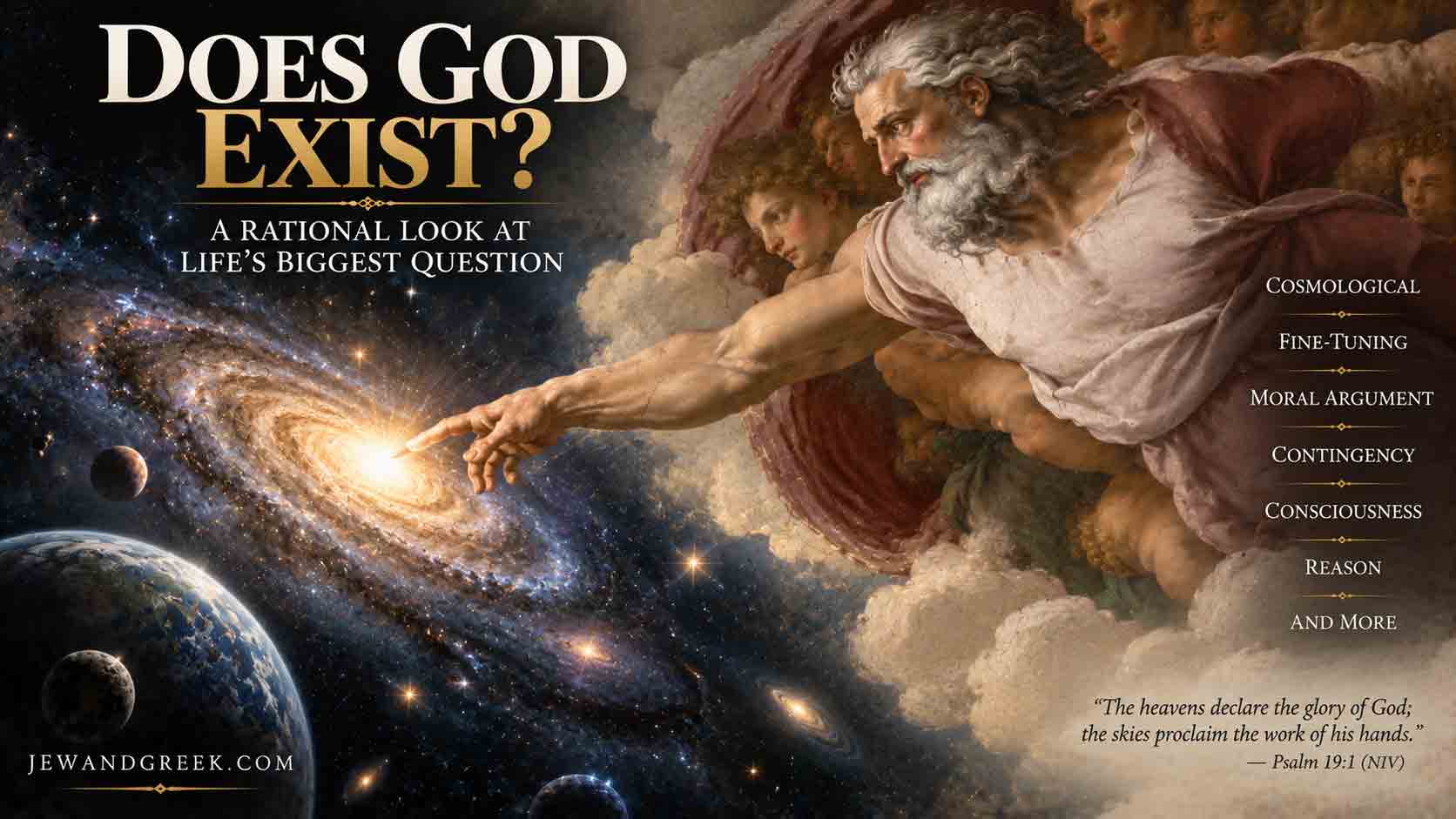
Does God exist? There probably isn’t another question that affects the way we look at life more than this one. If God exists, then the universe isn’t simply a self-contained accident that somehow explains itself. Human life may have an objective purpose, morality may be grounded in something more substantial than personal or cultural preferences, and consciousness may be more than an unusual byproduct of matter. The existence of God would also mean that miracles, revelation, prayer, and life after death can’t simply be dismissed because they’re supernatural. On the other hand, if God doesn’t exist, then we have to explain everything without Him. The universe, life, consciousness, morality, reason, and our desire to find meaning in life all have to be accounted for entirely within the natural world. That doesn’t mean atheists can’t find meaning in their lives or live morally. Of course they can. The question is where those things ultimately come from and what, if anything, they’re grounded in.
I don’t think we can prove the existence of God in the same way we can prove that two plus two equals four, but I don’t think that’s necessary. We believe all kinds of things based on evidence without having mathematical proof of them. A jury doesn’t watch a murder happen, and historians can’t travel back in time to see Julius Caesar cross the Rubicon. We examine the evidence available to us and decide what explanation makes the most sense. I think that’s the best way to approach the existence of God as well. Rather than looking for one knockout argument that no atheist could possibly answer, we should look at the evidence as a whole. Why does anything exist? Why is the universe orderly? Why can our minds understand it? Where do consciousness and reason come from? Are some things really right and wrong regardless of what we think about them? Maybe all of those things can be adequately explained without God, but maybe God explains them better. That’s the question we’re trying to answer.
What Do We Mean by God?
Before discussing whether God exists, we need to make sure we’re talking about the same thing. Christians don’t believe that God is some invisible object located somewhere inside the universe, like one more thing alongside planets, stars, black holes, and galaxies. According to Christianity, God created the universe. Space, time, matter, and energy exist because He created them. God is therefore fundamentally different from the things He created, and that’s important when we’re discussing some of the common objections to His existence.
That’s why the familiar question, “Who created God?” really misses the point. If I argued that everything has to be created and then turned around and said that God wasn’t created, I would obviously be contradicting myself. But that’s not what classical Christianity teaches, and it isn’t what the better cosmological arguments claim. The argument is that things that begin to exist, or things that depend upon something else for their existence, require an explanation. God is proposed as the eternal, necessary reality upon which everything else ultimately depends. You can certainly argue that no such being exists, or even that the concept of a necessary being doesn’t make sense, but asking who created the uncreated Creator changes the definition of the thing we’re discussing. The real question isn’t “Who created God?” but whether there must ultimately be something that wasn’t created.
Why Is There Something Rather Than Nothing?
One of the deepest questions in philosophy is also one of the simplest: Why is there something rather than nothing? There didn’t have to be a Milky Way, stars, planets, atoms, gravity, energy, physical laws, or people sitting around asking philosophical questions about why any of it exists. At least none of those things appear to contain the reason for their own existence within themselves. Nevertheless, something exists, and it seems perfectly reasonable to ask why.
One possible answer is that there simply isn’t any answer. The universe, or whatever physical reality ultimately lies behind it, just exists. At some point we have to stop asking why, and perhaps the universe is where we stop. That’s possible, but I don’t find it particularly satisfying. If everything we encounter within the universe depends upon something else, it’s reasonable to ask whether the universe itself depends upon something. If it does, then eventually we have to arrive at something that doesn’t depend upon anything else. That’s the basic idea behind the cosmological arguments for God. They don’t begin by assuming Christianity is true. They begin by asking whether dependent reality can ultimately explain itself.
The Cosmological Argument
There isn’t just one cosmological argument. Versions of it have appeared in Greek philosophy, Jewish thought, Islamic philosophy, medieval Christianity, and modern philosophy, and they don’t all make exactly the same argument. That’s worth pointing out because sometimes someone answers one version of the cosmological argument and assumes that the entire subject has been settled. It hasn’t. Some versions deal primarily with whether the universe had a beginning, while others are concerned with contingency, change, causation, or the need for an ultimate explanation.
The basic idea, however, isn’t difficult to understand. Everything around us appears to be dependent upon something else. I exist because my parents existed. A tree exists because a seed grew under the right conditions. Planets and stars exist because matter behaved in particular ways under particular physical conditions, and those conditions operate within a larger physical system. The question is where the chain of dependence ultimately ends. Can a collection of dependent things explain its own existence simply because the collection is very large, or does dependent reality ultimately require something that isn’t dependent? The Christian answer is God. Obviously, simply giving the answer doesn’t prove it. Someone can argue that the universe itself is necessary, or that reality doesn’t require any further explanation. That’s where the real philosophical disagreement begins.
The Argument from Contingency
Philosophers use the word contingent to describe something that exists but didn’t have to exist. I’m contingent, and so are you. There was a time when neither of us existed, and the world got along just fine without us. The earth is contingent, our solar system is contingent, and individual stars and galaxies appear to be contingent. They exist, but there’s nothing obviously necessary about their existence. We can easily imagine circumstances in which they never existed at all.
The argument from contingency asks what happens if everything is like that. Gottfried Wilhelm Leibniz argued that there should be a sufficient reason why something exists rather than doesn’t exist. If everything depends upon something else, then eventually there must be something that doesn’t. Otherwise, we haven’t really explained anything; we’ve just kept moving the question backward. Suppose I asked why a chandelier was hanging over my head and you told me it was attached to a chain. I ask what’s holding up the chain, and you tell me it’s attached to another chain. Then another, and another. You can keep adding links for as long as you want, but eventually I’m going to ask what the whole thing is attached to. The argument from contingency says that reality ultimately has to be “attached,” so to speak, to something that exists necessarily rather than contingently. Christians identify that necessary reality as God.
The Kalam Cosmological Argument
The Kalam cosmological argument has become one of the better-known arguments for God’s existence. In its simplest form it says that whatever begins to exist has a cause, the universe began to exist, and therefore the universe has a cause. The logic itself is straightforward. If the first two premises are true, the conclusion follows. Most of the discussion therefore centers on whether those premises are true, particularly whether we can confidently say that the universe had an absolute beginning.
Modern cosmology frequently enters the discussion at this point, and this is one place where Christians need to be careful not to claim more than the science actually establishes. The Big Bang certainly changed the way scientists think about the history of the universe, but there are various cosmological models, including models involving quantum physics, that make the discussion considerably more complicated than saying, “Science proved that the universe had a beginning, therefore God exists.” Even if we conclude that the universe had a cause, we’re still not all the way to Christianity. We would need additional reasoning to determine what kind of cause could produce space, time, matter, and energy, and still more evidence before we could identify that cause with the God revealed in Scripture. The Kalam argument can get us part of the way down the road, but there’s nothing wrong with admitting that it doesn’t get us all the way there.
Aquinas and the First Cause
Thomas Aquinas is sometimes credited with an argument that he didn’t actually make: “Everything has a cause, therefore there must be a first cause, and that’s God.” Someone then responds, “Well, what caused God?” and thinks the argument has been defeated. Aquinas’ actual reasoning was considerably more sophisticated than that. He didn’t say that everything requires a cause. His arguments dealt with dependent realities, change, actuality and potentiality, and whether the things we observe can ultimately account for themselves.
One of Aquinas’ arguments begins with change. Something that changes moves from what it potentially could be to what it actually becomes, and Aquinas reasoned that chains of things being actualized by other things can’t ultimately explain themselves. There has to be an ultimate source that isn’t itself being actualized by something else. You don’t have to accept all of Aquinas’ Aristotelian metaphysics to understand that this is different from saying, “Everything has a cause except God.” Whether Aquinas successfully proves his conclusion is another question, but we should at least argue against the argument he actually made rather than a simplified version that’s much easier to knock down.
Can the Universe Cause Itself?
Sometimes the universe itself is offered as its own explanation, but I have trouble even making sense of the idea that something could cause itself to exist. In order for the universe to cause itself, it would seemingly have to exist before it existed so that it could cause itself to exist. That’s quite a trick. A more serious possibility is that the universe, or some underlying physical reality, has always existed and therefore never needed a beginning cause.
Even if that turned out to be true, however, it wouldn’t necessarily answer the argument from contingency. Something could theoretically exist forever and still be dependent. The question “What caused the universe to begin?” isn’t exactly the same as “Why does the universe exist at all?” An eternal universe might eliminate the need for a cause that brought it into existence at a particular moment, but it wouldn’t automatically explain why that eternal universe exists rather than nothing. These arguments overlap, but they aren’t identical, and confusing them can make the discussion much more difficult than it needs to be.
The Fine-Tuning Argument
Modern physics has discovered that the basic constants and conditions of our universe fall within ranges that permit stars, chemistry, planets, and ultimately complex life to exist. Change some of those values enough and you don’t simply get a slightly different universe. You may get one in which stable matter, long-lived stars, or complex chemistry can’t exist at all. This has led to what is commonly called the fine-tuning argument.
There are several possible explanations. Maybe those values couldn’t have been different. Maybe we simply got incredibly lucky. Maybe there are enormous numbers of universes with different physical conditions, and naturally we find ourselves in one of the universes where observers can exist. Or perhaps the universe was designed. The fact that the universe is fine-tuned for life doesn’t automatically prove the last option, but I think it’s reasonable to include design among the possibilities. If God intended to create conscious beings capable of knowing Him and studying His creation, a universe capable of supporting conscious life isn’t exactly surprising.
Does Fine-Tuning Prove God?
No, and Christians shouldn’t pretend that it does. Even if we concluded that the universe was intelligently designed, fine-tuning wouldn’t tell us that Jesus rose from the dead, that the Bible is inspired, or even necessarily that the Designer is the God of Christianity. At most, the argument would give us evidence that some kind of intelligence lies behind the physical conditions of the universe. That’s significant, but that’s as far as the argument goes.
One of the mistakes Christians sometimes make in apologetics is asking an argument to accomplish more than it can. We don’t make an argument stronger by exaggerating its conclusion. We actually make it easier to attack. I think the fine-tuning argument is much more useful when it’s placed alongside the other evidence. It may not prove God by itself, but it becomes one part of a larger question about what kind of universe we should expect if God exists and what kind we should expect if He doesn’t.