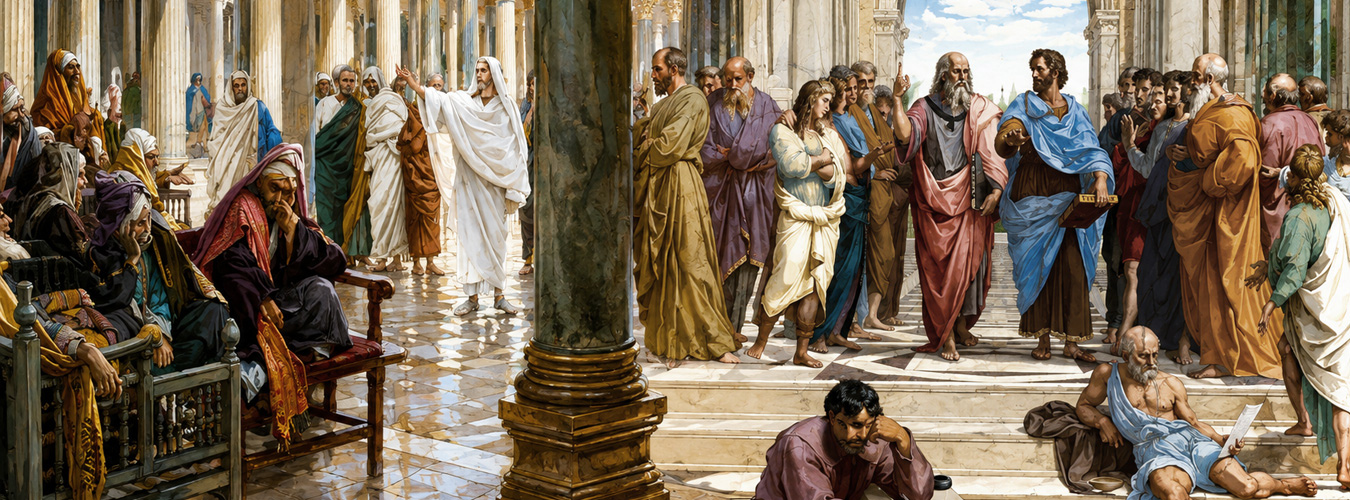

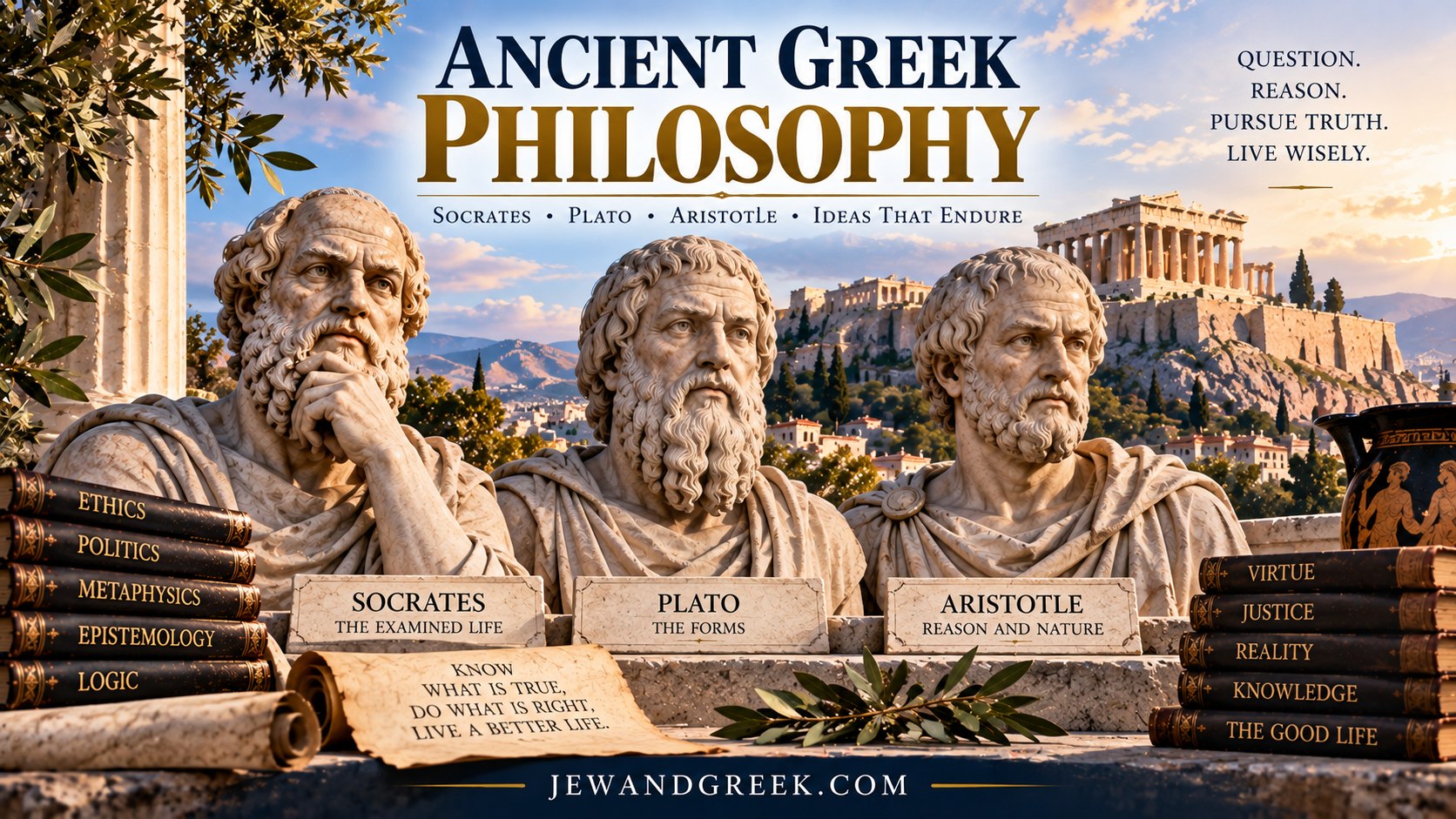
Ancient Greek philosophy marks one of the most influential developments in the history of human thought. Beginning several centuries before Christianity, Greek thinkers increasingly sought rational explanations for the natural world, human knowledge, morality, politics, and the nature of reality itself. Rather than simply accepting traditional stories about the gods and the cosmos, philosophers began asking whether the world could be understood through observation, argument, and reason.
The questions they raised remain remarkably familiar. What is everything ultimately made of? Is reality constantly changing, or is there something permanent beneath change? Can human beings possess genuine knowledge? What makes a person virtuous? What is justice? What kind of government is best? What is the soul? Is there a highest reality or ultimate cause behind the universe?
Greek philosophers offered radically different answers to these questions, but the intellectual traditions they created became foundational for later Western philosophy. Plato and Aristotle profoundly influenced Christian, Jewish, and Islamic thinkers, while Stoic, Epicurean, and skeptical ideas remained important throughout the Roman world in which Christianity emerged. Understanding ancient Greek philosophy therefore provides essential background not only for philosophy but also for understanding the intellectual environment of the New Testament and early Christianity.
From Myth to Philosophical Explanation
Greek culture did not suddenly abandon mythology when philosophy appeared. Traditional religion remained deeply embedded in Greek society, and philosophers themselves sometimes used religious and mythological language. Nevertheless, beginning around the sixth century BC, some Greek thinkers began seeking explanations for nature that depended increasingly upon principles inherent in the cosmos rather than stories about conflicts among the gods.
These early thinkers are conventionally called the Presocratics, although some lived during the lifetime of Socrates. Their surviving writings are fragmentary, and much of what we know about them comes from later authors. Yet their questions were revolutionary. They asked whether the enormous variety of things observed in nature might arise from some more fundamental reality and whether change itself could be explained rationally.
This transition is sometimes described as a movement from mythos to logos—from myth toward rational explanation. That description can be oversimplified, since myth and rational inquiry continued to coexist, but it captures an important development. Nature increasingly became something that could be investigated through reason.
The Presocratics
Thales of Miletus, traditionally regarded as one of the earliest Greek philosophers, proposed that water was in some sense the underlying principle of everything. His particular answer is less important than the kind of question he was asking. Instead of explaining the diversity of nature through separate divine actions, he searched for a fundamental principle capable of explaining the world as a unified whole.
Other philosophers proposed different answers. Anaximander spoke of the apeiron, an indefinite or boundless source from which things arise. Anaximenes identified air as the fundamental reality. These thinkers are associated with the Milesian school and represent some of the earliest surviving attempts to construct natural explanations of the cosmos.
Later Presocratics moved beyond the search for a single physical substance. Pythagoras and his followers emphasized number, mathematical order, and harmony. Their community combined philosophical, mathematical, and religious elements, and Pythagorean thought eventually influenced Plato and later philosophical traditions.
Two particularly important Presocratic thinkers, Heraclitus and Parmenides, approached the problem of change from nearly opposite directions. Heraclitus emphasized continual change and the dynamic character of reality, while also speaking of an underlying logos or rational order. Parmenides argued that genuine being cannot arise from nonbeing and therefore concluded that ultimate reality must be unchanging. The apparent world of change presented by the senses consequently raised profound questions about the relationship between appearance and reality.
These debates created problems that later philosophers, especially Plato and Aristotle, would attempt to resolve.
Socrates and the Examined Life
Socrates, who lived in Athens during the fifth century BC, changed the direction of Greek philosophy. Rather than concentrating primarily on the physical composition of the cosmos, Socrates became associated especially with questions about virtue, knowledge, justice, courage, piety, and the proper way to live.
Socrates left no philosophical writings of his own. Our knowledge of him comes principally from writers such as Plato and Xenophon, with a very different portrayal appearing in the comedy of Aristophanes. This creates what scholars call the “Socratic problem”: determining how much of the Socrates presented in Plato’s dialogues reflects the historical Socrates and how much represents Plato’s own developing philosophy.
In the Platonic dialogues, Socrates frequently questions people who confidently claim to understand concepts such as justice or courage. Through careful questioning, he exposes inconsistencies in their definitions and assumptions. This approach became associated with the Socratic method: pursuing understanding through disciplined questioning rather than merely presenting conclusions.
Socrates also emphasized the moral importance of self-examination. Philosophy was not merely an intellectual exercise but a way of examining one’s beliefs and character. His famous association with the “examined life” captures the conviction that human beings should critically investigate what they believe and how they live.
The Trial and Death of Socrates
Socrates became controversial in Athens and was eventually charged with impiety and corrupting the young. In 399 BC an Athenian jury convicted him, and he was sentenced to death. Plato’s Apology presents Socrates defending his philosophical mission before the jury, while the Crito and Phaedo portray events surrounding his imprisonment and death.
Socrates refused opportunities to abandon his philosophical activity and ultimately drank hemlock as required by his sentence. His death became one of the defining events in the history of philosophy. For Plato especially, the execution of a man devoted to the pursuit of virtue and wisdom raised profound questions about justice, politics, knowledge, and the relationship between the philosopher and society.
Socrates consequently became more than an important thinker. He became an enduring image of intellectual integrity—the philosopher willing to suffer rather than abandon the pursuit of truth.
Plato
Plato, a student of Socrates, became one of the most influential philosophers in history. Born into an aristocratic Athenian family, he lived through a period of political upheaval and was deeply affected by the execution of Socrates. He eventually founded the Academy in Athens, an institution devoted to philosophical and mathematical study that continued in various forms for centuries.
Plato wrote philosophical dialogues rather than systematic textbooks. Socrates appears as the central speaker in many of them, although scholars generally recognize that Plato’s later dialogues increasingly develop philosophical positions that cannot simply be attributed to the historical Socrates.
Plato investigated virtually every major area of philosophy: knowledge, reality, ethics, politics, education, love, beauty, mathematics, language, and the soul. His dialogues include the Republic, Symposium, Phaedo, Meno, Timaeus, and many others.
Plato and the Forms
One of the ideas most strongly associated with Plato is the theory of Forms. The physical world is filled with particular things that change, decay, and imperfectly exemplify qualities such as beauty, justice, equality, or goodness. Plato argued that genuine knowledge ultimately concerns realities that are stable rather than constantly changing.
The Forms are frequently understood as perfect, intelligible realities corresponding to things or qualities encountered imperfectly in the physical world. Particular beautiful things may cease to be beautiful, but Beauty itself does not change. Particular acts may participate imperfectly in justice, while Justice itself provides the standard by which they can be judged.
The precise interpretation of Plato’s Forms remains debated, particularly because his dialogues present the theory in different contexts and sometimes raise objections to it. Nevertheless, the distinction between changing physical appearances and a higher intelligible reality became extraordinarily influential.
At the summit of Plato’s philosophical vision stands the Form of the Good. In the Republic, Plato compares the Good to the sun: just as the sun makes physical sight possible, the Good makes knowledge and intelligibility possible. Later Christian thinkers would interact extensively with Platonic ideas, although Christianity’s doctrine of a personal Creator differs fundamentally from Plato’s metaphysical framework.
Plato’s Allegory of the Cave
One of the most famous passages in Western philosophy appears in Book VII of Plato’s Republic. Plato asks the reader to imagine prisoners who have spent their lives chained inside a cave, able to see only shadows cast upon a wall. Because they have never experienced anything else, they mistake the shadows for reality.
If one prisoner were released and eventually emerged into the sunlight, he would gradually discover that what he had previously considered reality was only an appearance. If he then returned to the cave and attempted to explain the truth to the other prisoners, they might reject or even attack him.
The allegory illustrates several themes in Plato’s philosophy: the difference between appearance and reality, the difficulty of education, the ascent from ignorance toward knowledge, and the philosopher’s responsibility to return to society. It has remained one of philosophy’s most powerful images of intellectual awakening.
Aristotle
Aristotle entered Plato’s Academy as a young man and remained associated with it for approximately twenty years. Although profoundly influenced by Plato, he eventually developed a philosophical system that differed from his teacher’s in important ways. Aristotle later tutored the young Alexander the Great and eventually established his own school in Athens, the Lyceum.
The range of Aristotle’s work is extraordinary. He wrote on logic, metaphysics, ethics, politics, rhetoric, poetry, biology, psychology, physics, and natural science. His works became foundational texts in multiple disciplines, and his philosophical vocabulary deeply influenced later Christian, Jewish, and Islamic thought.
Where Plato frequently emphasized the distinction between the changing physical world and intelligible Forms, Aristotle generally sought to understand form within particular things themselves. Individual substances are composites of matter and form rather than imperfect copies of separately existing Forms. This approach allowed Aristotle to construct an extensive account of change, causation, nature, and living things.
Aristotle’s Four Causes
Aristotle argued that explaining something adequately often requires several different kinds of explanation, traditionally called the four causes. The material cause concerns what something is made from. The formal cause concerns what kind of thing it is or the structure that makes it what it is. The efficient cause concerns the source of its change or production. The final cause concerns its purpose or end.
Consider a statue. The bronze is its material cause, its shape or design contributes to its formal cause, the sculptor functions as an efficient cause, and the purpose for which the statue was created represents its final cause.
Aristotle’s concept of final causation became particularly influential in medieval philosophy and theology. The idea that nature possesses intelligible purposes contributed to later discussions of natural law and arguments concerning divine design.
Aristotle’s Unmoved Mover
Aristotle’s analysis of change and causation eventually led him to argue for a first principle commonly called the Unmoved Mover. Because things undergoing change are actualized through causes, Aristotle reasoned toward an ultimate actuality that does not itself require actualization by something prior.
The Unmoved Mover should not simply be equated with the God of Christianity. Aristotle’s conception arose from his own metaphysical system and differs in significant respects from biblical doctrines of creation, providence, and God’s personal relationship with humanity. Nevertheless, later Jewish, Christian, and Islamic philosophers found Aristotle’s arguments enormously important when developing philosophical accounts of God.
Thomas Aquinas would eventually adapt Aristotelian concepts extensively within Christian theology, particularly in his arguments concerning God’s existence and his analysis of being, causation, and natural law.
Aristotle and the Virtuous Life
In the Nicomachean Ethics, Aristotle asks what constitutes the highest human good. His answer centers on eudaimonia, a Greek term often translated as happiness but more accurately associated with flourishing or living well. Human flourishing is not simply experiencing pleasure. It involves living rationally and developing excellent character.
Virtues such as courage, justice, generosity, and temperance are cultivated through practice. A person becomes courageous by repeatedly acting courageously until the disposition becomes part of one’s character. Aristotle therefore understood morality not merely as obeying rules but as becoming the kind of person capable of living well.
His doctrine of the mean proposes that many virtues lie between destructive extremes. Courage, for example, lies between cowardice and recklessness. The appropriate mean is not a simple mathematical midpoint but the response appropriate to circumstances as judged by practical wisdom.
Virtue ethics declined in influence during some periods of modern philosophy but experienced a major revival in contemporary ethical thought.
Epicureanism
Epicurus founded a philosophical community in Athens known as the Garden. Epicureanism is sometimes misunderstood as the pursuit of extravagant pleasure, but Epicurus advocated a considerably more restrained life. He believed happiness involved freedom from unnecessary desires, bodily distress, and mental anxiety.
Epicurus adopted an atomistic understanding of nature and rejected the fear that the gods constantly intervened in human affairs. He also sought to remove the fear of death, arguing that death should not trouble us because when we exist death is absent, and when death occurs we no longer experience anything.
Friendship, simplicity, moderation, and tranquility were central to the Epicurean way of life. Epicurean philosophy therefore offered both an account of nature and a practical strategy for achieving peace.
The New Testament specifically mentions Epicurean philosophers among those who encountered Paul in Athens in Acts 17.
Stoicism
Stoicism was founded by Zeno of Citium around the beginning of the third century BC and became one of the most influential philosophical traditions of the Hellenistic and Roman worlds. Later Stoics included Seneca, Epictetus, and the Roman emperor Marcus Aurelius.
Stoics believed that the cosmos is governed by rational order and that human flourishing requires living in accordance with nature and reason. Virtue is the genuine good, while external circumstances such as wealth, health, status, and even suffering do not determine whether a person possesses a good life.
Stoicism emphasized distinguishing between what lies within our control and what does not. Human beings cannot control every circumstance, but they can cultivate their judgments, responses, and character. This emphasis on self-government and endurance has contributed to renewed popular interest in Stoicism in the modern world.
Stoic philosophers also spoke of the logos, the rational principle ordering the cosmos. The term logos later appears prominently in the Gospel of John, although John’s identification of the Logos with the preexistent Christ should not simply be treated as an adoption of Stoic philosophy. The shared vocabulary illustrates the intellectual environment in which early Christian claims were communicated.
Skepticism
Ancient skepticism challenged the confidence of philosophers who claimed to possess certain knowledge. Pyrrhonian skeptics emphasized suspending judgment where competing arguments could not decisively establish a conclusion. Rather than constructing another comprehensive theory of reality, skepticism questioned whether human beings could justify the certainty claimed by other philosophical schools.
Academic skepticism developed within Plato’s Academy during later periods and similarly questioned whether certainty was attainable. These traditions forced philosophers to address a problem that remains central to epistemology: what distinguishes knowledge from belief, and how can our beliefs be justified?
The skeptical challenge would reappear powerfully in modern philosophy, particularly in the work of René Descartes and David Hume.
Greek Philosophy and the New Testament World
By the first century, Greek philosophical ideas had spread far beyond Greece. Alexander the Great’s conquests had helped spread Greek language and culture throughout the eastern Mediterranean and Near East, and Greek remained a major language of intellectual and commercial life under Roman rule. The New Testament itself was written in Greek.
This does not mean that the New Testament should be interpreted simply as Greek philosophy expressed in Christian terminology. Its central theological framework is deeply rooted in Israel’s Scriptures and Jewish expectations concerning God, creation, covenant, Messiah, resurrection, and the kingdom of God. Nevertheless, the earliest Christians communicated their message within a world in which Greek philosophical concepts and vocabulary were widely known.
Paul’s encounter at Athens provides the clearest biblical example. Acts 17 specifically identifies Epicurean and Stoic philosophers among his listeners. Paul begins with concepts his audience could understand but redirects the discussion toward the biblical Creator, human accountability, repentance, judgment, and the resurrection of Jesus.
Greek Philosophy and Early Christianity
As Christianity expanded throughout the Greco-Roman world, Christian thinkers increasingly interacted with Greek philosophy. Some regarded philosophical speculation cautiously. Tertullian famously contrasted Athens and Jerusalem in expressing concern about attempts to subordinate Christian revelation to pagan philosophy.
Other Christian thinkers saw philosophy as potentially useful. Justin Martyr believed that truths discovered by philosophers could ultimately point toward the divine Logos. Clement of Alexandria regarded Greek philosophy as having served a preparatory role for Greeks somewhat analogous to the role of the Law among Israel. Origen employed philosophical concepts extensively while developing Christian theology.
The interaction intensified during debates about the Trinity and the person of Christ. Christians employed Greek philosophical vocabulary while attempting to articulate teachings they believed arose from Scripture and apostolic tradition. Terms such as ousia and hypostasis acquired enormous theological importance.
This relationship remained both productive and controversial. Greek philosophy supplied conceptual tools that helped Christian thinkers articulate difficult theological distinctions, but philosophical assumptions could also conflict with central Christian claims.
Plato, Aristotle, and Christian Thought
Of all the Greek philosophers, Plato and Aristotle exerted the greatest long-term influence upon Christian intellectual history. Early Christian and late antique theology frequently interacted with Platonic and Neoplatonic thought. Augustine’s theology, for example, was profoundly shaped by his encounter with Platonist philosophy, although he rejected and transformed major elements of it according to Christian convictions.
Aristotle’s influence became especially prominent in medieval scholasticism. Through a complicated history of preservation, translation, and interpretation involving Greek, Syriac, Islamic, Jewish, and Christian scholars, Aristotle’s works became increasingly available in Western Europe. Thinkers such as Thomas Aquinas made extensive use of Aristotelian philosophy while carefully distinguishing Aristotle’s conclusions from Christian revelation.
The resulting synthesis shaped centuries of Christian discussions concerning God, causation, natural law, virtue, the soul, reason, and the relationship between theology and philosophy.
The Continuing Importance of Ancient Greek Philosophy
Ancient Greek philosophy remains important because many of philosophy’s enduring questions were formulated with extraordinary clarity by Greek thinkers. Contemporary debates about virtue still interact with Aristotle. Discussions of appearance and reality still recall Plato. Questions about change and permanence reach back to Heraclitus and Parmenides. Skepticism continues challenging claims to knowledge, while Stoicism and Epicureanism continue attracting people searching for practical philosophies of life.
For Christians, studying Greek philosophy has an additional value. Christianity developed and expanded in a world where Greek intellectual traditions were already deeply established. Early Christian thinkers sometimes opposed those traditions, sometimes borrowed their vocabulary, and sometimes transformed their concepts. Understanding that interaction helps distinguish biblical claims from philosophical assumptions while also explaining how Christian theology acquired much of its later intellectual vocabulary.
Ancient Greek philosophy therefore represents more than the beginning of a historical survey. It introduces questions about reality, knowledge, morality, reason, God, and human nature that will accompany us throughout the entire study of philosophy.