

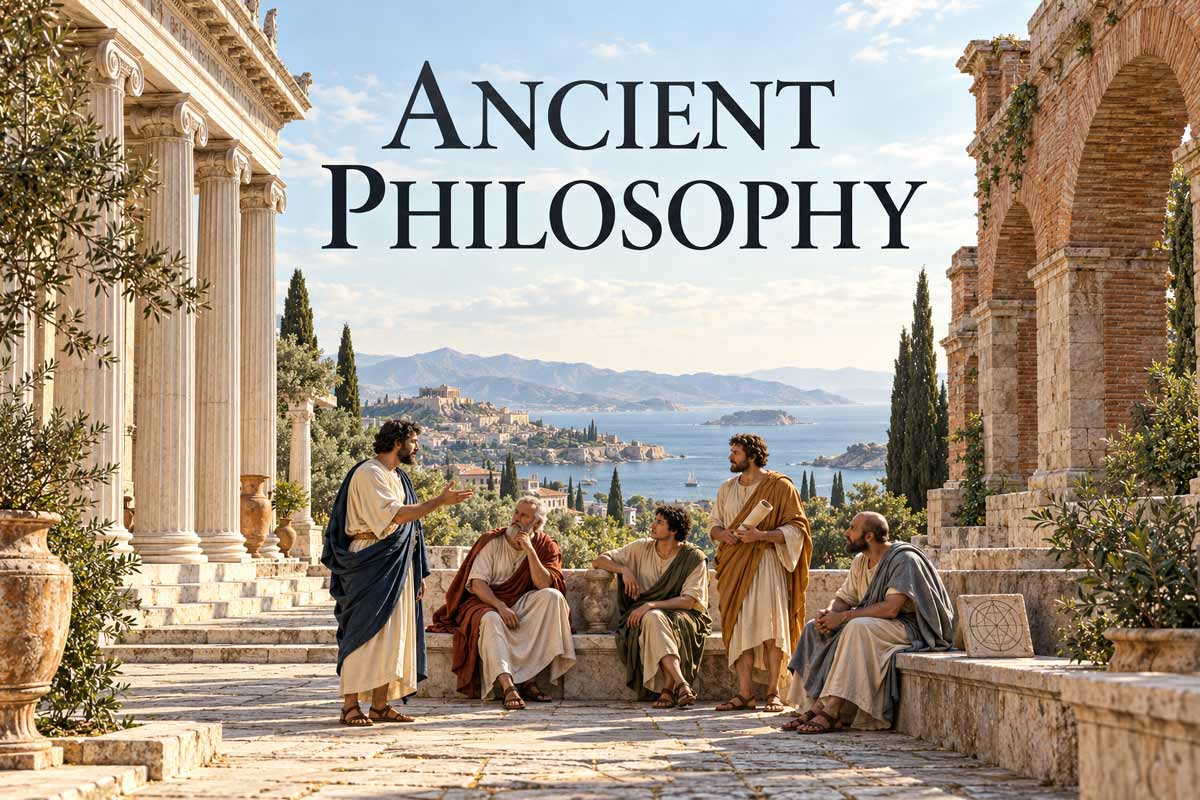
People were arguing about what makes a life worth living long before anyone could turn the argument into a podcast. Ancient philosophers asked where the world came from, whether appearances could be trusted, and what kind of person we ought to become. They disagreed about the answers, sometimes sharply, but they helped establish questions that still shape discussions about truth, morality, religion, and government. Reading them isn’t an exercise in collecting impressive names. It gives us a chance to examine ideas that have continued influencing people who may never have heard of the person who first defended them.
Ancient philosophy includes much more than Socrates, Plato, and Aristotle. Earlier thinkers investigated nature and change, while later schools developed competing accounts of happiness and moral responsibility. Greek philosophy also became part of the Roman world, where writers such as Cicero, Seneca, Epictetus, and Marcus Aurelius carried its debates into new circumstances. Eventually these traditions entered into conversation and conflict with Christianity. Understanding that development helps us recognize both the wisdom Christians have found in ancient philosophy and the convictions that prevent us from treating it as a substitute for the gospel.
What We Mean by Ancient Philosophy
In this part of Jew & Greek, Ancient Philosophy refers primarily to the Greek and Roman philosophical traditions and their development into late antiquity. That includes thinkers writing in Greek throughout the Mediterranean world, rather than only people who lived within the boundaries of modern Greece. It also includes Roman authors who studied, adapted, and argued with Greek ideas. The category allows us to read a Greek teacher and a Roman emperor together when their philosophical commitments connect them. Their nationality alone wouldn’t tell us nearly enough about what they believed.
This focus doesn’t mean that serious reflection began in Greece or was confined to the Mediterranean. Ancient China and India developed extensive philosophical traditions, and Egypt and Mesopotamia had their own histories of learning, moral instruction, and religious thought. Those traditions deserve attention on their own terms. Our immediate purpose here is to introduce the ancient Mediterranean conversation that lies behind many of the authors in our philosophy reader. Keeping that scope clear helps us cover the subject honestly without pretending that one article can contain the intellectual history of the entire ancient world.
The Presocratics and the Search for Order
The thinkers commonly called the Presocratics belong mainly to the sixth and fifth centuries BC. The label means “before Socrates,” although some lived during his lifetime, so it works better as a convenient description than as a strict dividing line. Their questions often concerned the underlying nature of reality and how an ordered world could develop. They wanted explanations that could be examined and debated, rather than merely another retelling of a traditional story about the gods. That doesn’t make all of them atheists or modern scientists, but it does mark an important development in the history of inquiry.
Thales is traditionally associated with the proposal that water is the fundamental principle of things. Other early thinkers offered different accounts, which shows that philosophy began with disagreement almost as soon as it began with an answer. The significance isn’t that we should replace chemistry with Thales’s proposal. It’s that someone was asking whether the variety of things around us could be understood through an underlying explanation. Once that question had been raised, another person could challenge the explanation and offer reasons for a different one.
Heraclitus drew attention to change and to the order within a world of opposing conditions. Parmenides pressed difficult questions about being and whether genuine reality could undergo the changes our senses seem to report. Democritus and the atomist tradition explained the world through atoms moving in empty space. Their atoms weren’t the experimentally studied structures of modern physics, and we shouldn’t give them credit for discoveries they hadn’t made. Still, their disagreement reveals a lasting problem: how to relate the world we experience to the account of reality we think reason requires.
Much of what these philosophers wrote survives in fragments and reports preserved by later authors. That makes interpretation difficult, especially when a later writer is explaining an earlier thinker in order to criticize him. We should be cautious about reducing a complicated position to a sentence on a chart. Even so, the surviving material shows that questions about matter, knowledge, change, and divine reality were already being examined before the more familiar Athenian philosophers appeared. Socrates entered a conversation that had been going on for quite some time.
Socrates and the Examination of Life
Socrates became famous for questioning people’s confidence in their own understanding. If someone claimed to know what courage or justice was, he wanted to find out whether that person could explain it consistently. A definition that sounded persuasive at first might collapse when applied to a difficult example. The process could be uncomfortable because it exposed the difference between using a word and understanding the thing the word describes. Anyone who has watched an argument continue while both sides use different definitions will recognize why this remains useful.
Socrates left no writings of his own, so we know him through other authors, particularly Plato and Xenophon. Their accounts don’t give us an uncontested recording of everything he said, and scholars debate how to distinguish the historical Socrates from the literary portraits. He was tried and executed in Athens in 399 BC. His willingness to continue examining moral questions helped make him a central figure in the philosophical tradition. For Christians, his example can encourage intellectual humility without requiring us to accept every belief attributed to him.
Plato and Aristotle
Plato presented much of his philosophy through dialogues in which people reason together, challenge one another, and sometimes fail to reach a tidy conclusion. His discussions connect ethics and politics with questions about knowledge, the soul, and reality. In many dialogues, he distinguishes the changing things we encounter from stable Forms, such as beauty or justice, that help explain what those things are. We don’t need to agree with his account to see the question driving it. If judgments about justice are more than changing preferences, we need to explain what makes them true.
His Republic connects the character of a political community with the character of the people within it. The discussion asks what justice requires and whether a just life is worth choosing when injustice appears profitable. Its proposals about education and government are influential, but they also invite serious objections about power and freedom. Plato is useful precisely because he makes readers confront the assumptions behind their answers. Admiring his seriousness doesn’t oblige us to approve every society he imagines.
Aristotle studied with Plato but developed his own approach to reality, knowledge, and human life. His investigations ranged across logic, biology, metaphysics, ethics, and politics. He devoted considerable attention to how particular things are constituted and how we explain their development and activity. His work on reasoning also helped give later thinkers tools for distinguishing a valid argument from a persuasive performance. That distinction remains necessary wherever confidence and volume are being mistaken for evidence.
In ethics, Aristotle asks about human flourishing and the habits through which a person becomes virtuous. Courage, for example, involves learning to respond appropriately to danger, rather than simply feeling no fear. His account gives practical importance to education, judgment, and repeated action. Christians can appreciate that attention to the formation of character while examining his assumptions about human purposes and the good life. We should also read him critically where his treatment of slavery and social hierarchy reflects judgments we have good reason to reject.
Philosophy as a Way of Living
The period following Alexander the Great is usually called the Hellenistic age. Philosophical schools developed and competed within a world connected by Greek language and culture, and their influence continued under Roman rule. Many treated philosophy as a discipline that should change how a person lived. They investigated nature and knowledge partly because those beliefs affected fear, desire, and conduct. Their concern with practical living didn’t mean they had stopped asking theoretical questions; it meant that they expected the answers to have consequences.
Stoicism began with Zeno of Citium in Athens. The Stoics taught that virtue is the genuine good and that living well requires bringing our judgments and conduct into agreement with reason and nature. Their account of nature included a rational order pervading the universe, so their ethics rested on more than advice about remaining calm. Wealth, reputation, and bodily comfort couldn’t by themselves make someone morally good. The practical challenge was to act justly even when those advantages were missing or when doing the right thing threatened to cost us something.
Epictetus emphasized the distinction between what depends on us and what doesn’t, while Marcus Aurelius repeatedly applied Stoic convictions to his responsibilities and frustrations. Seneca wrote about subjects such as anger, friendship, and the use of time. These writers can help us examine reactions that we’ve been treating as inevitable. Their philosophy also requires careful evaluation wherever confidence in rational self-government becomes an inadequate account of suffering or human weakness. Learning patience from a Stoic doesn’t settle the Christian questions of grace, salvation, or resurrection.
Epicurus offered a different account of the good life, placing pleasure at its center. That sounds like permission for endless indulgence until we discover how much importance he attached to freedom from bodily pain and mental disturbance. Simple living, friendship, and the careful evaluation of desires could serve that goal better than luxury. He also tried to relieve fears about divine punishment and death through his account of nature. Christians will disagree with important parts of that account, but we should understand it before assuming that “Epicurean” means someone who wants another expensive dinner.
The Cynics challenged social convention through radical simplicity and provocative behavior. Diogenes of Sinope became their most famous representative, although stories about his life require the same caution we bring to other ancient anecdotes. Cynics questioned whether wealth, status, and respectable appearances were preventing people from living virtuously. Their criticism could expose hypocrisy, but rejecting convention doesn’t automatically make every unconventional act wise. Christians can recognize the danger of becoming enslaved to social approval while still asking whether a proposed alternative serves truth and love.
Ancient Skeptics examined the grounds on which philosophers claimed certainty. Academic skepticism developed within Plato’s Academy, while the Pyrrhonian tradition pursued suspension of judgment when opposing arguments prevented a settled answer. These weren’t simply two names for assuming that everything was false. They represented different ways of investigating claims and living with the limits of judgment. Their questions still matter whenever someone moves too quickly from having an opinion to insisting that no reasonable person could dispute it.
Greek Ideas in the Roman World
Roman philosophy wasn’t a completely separate enterprise that replaced Greek philosophy. Roman writers inherited its schools and debates, then addressed them within their own political, social, and literary settings. Cicero made philosophical arguments available to Latin readers and examined questions about duty, law, knowledge, and the gods. He drew on several traditions rather than fitting neatly into the category of a Stoic teacher. Reading him alongside the Stoics helps us see that ancient philosophy contained overlapping conversations as well as distinct schools.
The Roman world also gives us examples of people with very different social positions pursuing philosophical life. Epictetus had been enslaved, Seneca was involved in imperial politics, and Marcus Aurelius was emperor. Their shared interest in Stoicism didn’t erase those differences or guarantee that they always lived consistently with their principles. A philosophical work can offer insight while its author remains morally compromised. We can learn from the arguments without turning admiration for an author into an obligation to defend his entire career.
Late Antiquity and the Christian Encounter
Ancient philosophy continued developing after the familiar Greek and Roman figures had died. Plotinus, who lived in the third century AD, became a major representative of the tradition now called Neoplatonism. He understood reality through a hierarchy originating in the One, with the intellectual and spiritual life directed toward its source. Later Platonists developed complex accounts of the universe and human participation in it. This tradition influenced subsequent Christian, Jewish, and Islamic thought, although influence didn’t mean that all those thinkers accepted the same theology.
Augustine belongs to late antiquity and illustrates the importance of that encounter for Christians. Platonic writings helped him consider immaterial reality and move beyond earlier ways of understanding God. His Christian commitments also required beliefs that those writings didn’t provide, including the incarnation and the saving work of Christ. The relationship involved discernment and revision. An idea could help him ask a better question without supplying the Christian answer to it.
We can already see an encounter between Christianity and philosophical schools in Acts 17, where Paul speaks with Epicurean and Stoic philosophers in Athens. He engages his hearers’ world and refers to language found among their poets. He also challenges their worship and proclaims God’s judgment and the resurrection of Jesus. Some hearers mock the resurrection, while others respond differently. The account gives us a useful example of taking people seriously while remaining clear about the claims of the gospel.
That approach is more demanding than either dismissing pagan philosophy as worthless or treating it as Christianity expressed in different words. Ancient thinkers could identify genuine moral problems and offer penetrating arguments, but they didn’t thereby arrive at the whole Christian message. Their accounts of God, human nature, and death often differ substantially from Scripture. Christians should be willing to recognize an insight without overlooking the disagreement surrounding it. Careful engagement requires us to understand the claim before deciding whether to accept it.
Reading the Ancients With Discernment
The best starting point is usually an author or question that already interests you. Plato’s dialogues can introduce the practice of testing definitions and arguments, while Aristotle offers sustained investigations of character and reasoning. Epictetus and Marcus Aurelius bring readers quickly into questions of responsibility and self-control. Cicero opens discussions about public duty, and Augustine helps connect philosophical inquiry with explicitly Christian concerns. Reading across these authors makes their disagreements clearer than collecting quotations that happen to sound agreeable.
We should also pay attention to the kind of work we’re reading. A dialogue, a philosophical argument, and a set of private reminders don’t communicate in exactly the same way. Some early thinkers survive only through fragments, while later authors may preserve their ideas for purposes of criticism. Recognizing those differences helps us avoid asking a passage to prove more than it can. The aim is to understand an author’s reasoning well enough to evaluate it fairly.
Ancient philosophy remains useful because the questions haven’t become ancient in the same sense as the clothing or architecture. We still need to distinguish truth from persuasion, decide what justice requires, and examine the desires shaping our conduct. These authors can help us notice assumptions we’ve inherited without examining them. Christians bring their faith to that examination, including confidence that the gospel gives us something human inquiry alone cannot supply. We can listen carefully to the ancients while continuing to ask whether their answers are true and what following them would require of us.