
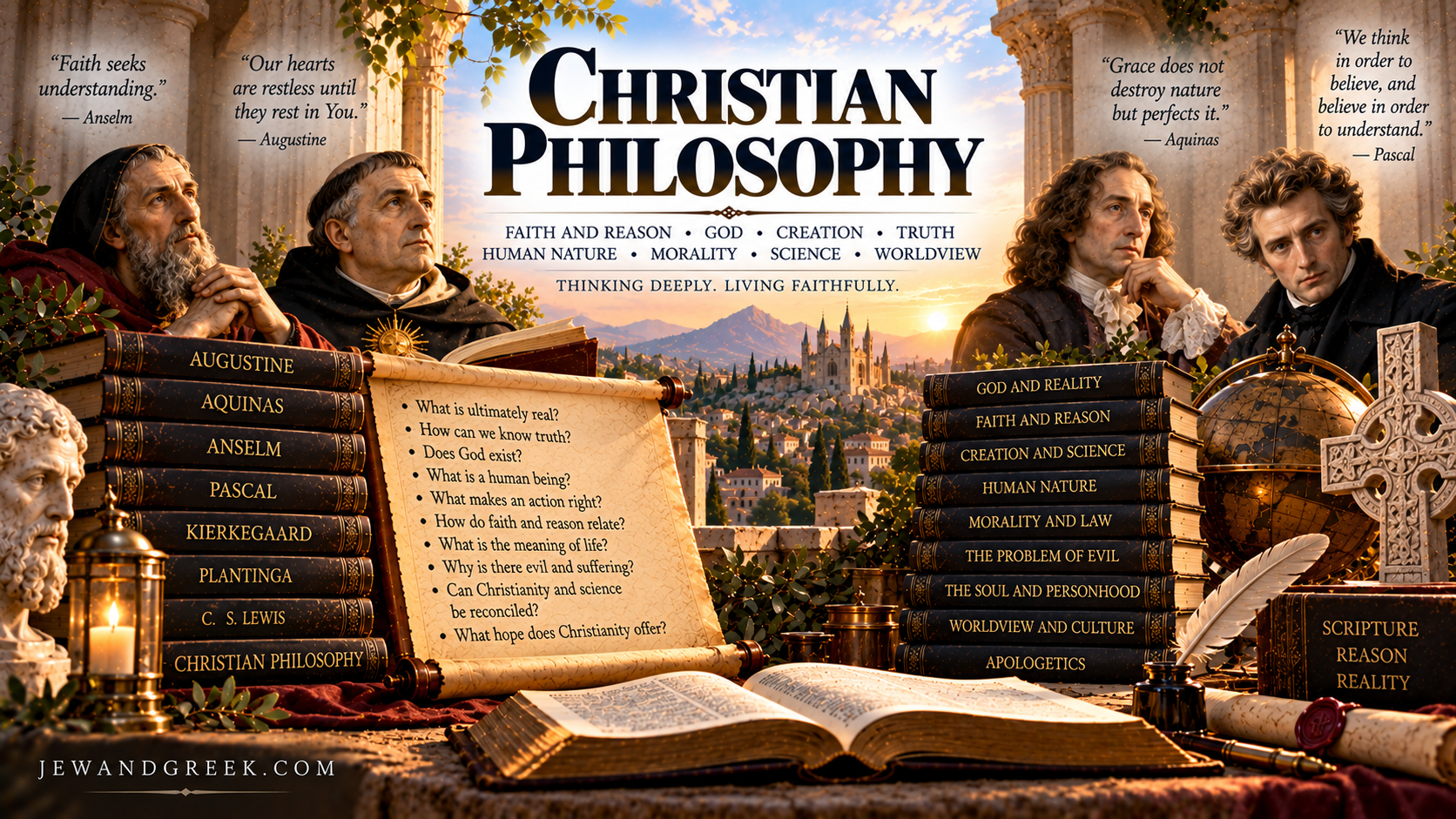
Christian philosophy is the disciplined use of philosophical reasoning within a worldview shaped by Christian belief. It asks many of the same questions that have occupied philosophers throughout history: What is ultimately real? How can human beings know truth? What makes an action morally right or wrong? What is a person? Are human beings genuinely free? Why does anything exist at all? Yet Christian philosophy approaches these questions while taking seriously the central claims of Christianity concerning God, creation, human nature, sin, revelation, Jesus Christ, redemption, and the ultimate restoration of creation.
Christian philosophy is therefore neither philosophy with a few Bible verses attached nor theology conducted without reference to reason. It represents a long intellectual tradition in which Christians have examined philosophical arguments, borrowed useful concepts, criticized ideas they believed incompatible with Christian revelation, and developed philosophical accounts of reality from within a Christian understanding of the world. From Augustine’s engagement with Platonism and Aquinas’s appropriation of Aristotle to contemporary debates over consciousness, morality, science, and religious knowledge, Christians have repeatedly sought to understand how faith and reason belong together.
What Is Christian Philosophy?
The expression Christian philosophy can be understood in more than one way. At its broadest, it refers to philosophical thinking conducted by Christians whose beliefs about God and the world influence the questions they ask and the answers they consider plausible. In a more specific sense, it refers to philosophical arguments and systems that attempt to articulate a coherent Christian understanding of reality, knowledge, morality, human nature, and ultimate purpose.
This does not mean every conclusion reached by a Christian philosopher is automatically Christian or that all Christian philosophers agree. Augustine, Thomas Aquinas, Søren Kierkegaard, Blaise Pascal, Alvin Plantinga, and many others differed significantly in method and emphasis. Christian philosophy is better understood as an intellectual tradition centered upon certain fundamental convictions while allowing substantial disagreement about how those convictions should be philosophically expressed.
Faith and Reason
The relationship between faith and reason lies at the heart of Christian philosophy. Christianity asks people to trust God, yet it also makes claims that can be examined rationally. Christians believe that God exists, that the universe is created, that human beings possess moral significance, that God has acted within history, and that Jesus Christ was raised from the dead. These are not merely descriptions of private emotional experiences; they are claims about reality.
Christian thinkers have therefore generally rejected the idea that faith requires abandoning reason. At the same time, they have resisted the opposite idea that human reason is capable of discovering every important truth independently of revelation. Faith and reason are distinct but potentially complementary. Reason can evaluate arguments and evidence, while revelation may disclose truths that human beings could not discover unaided.
Christianity and Greek Philosophy
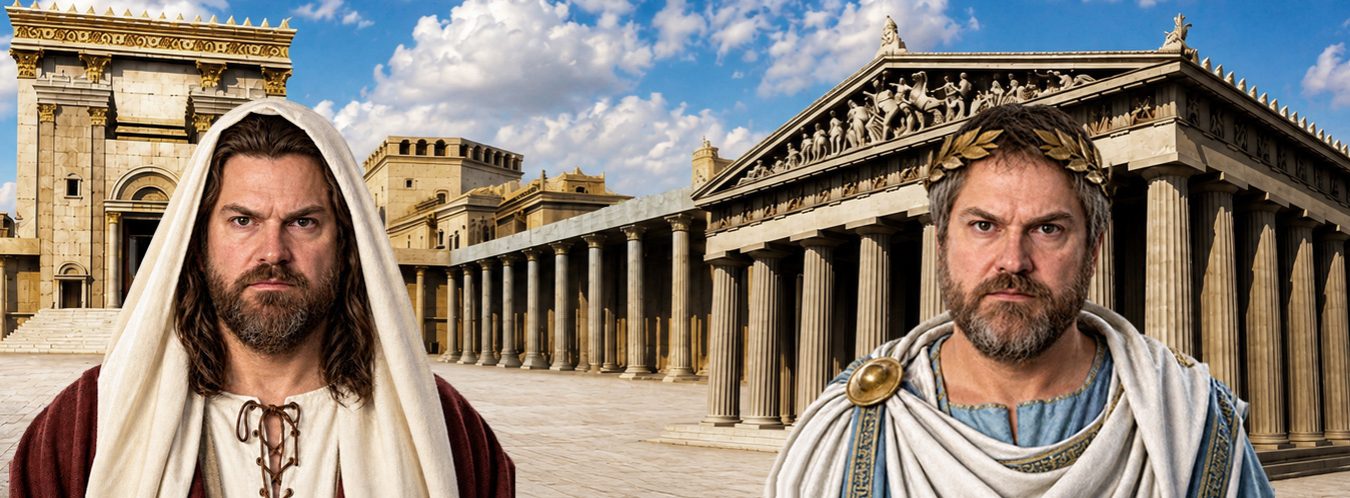
Christianity emerged within a world already shaped by Greek philosophy. Plato, Aristotle, the Stoics, Epicureans, and other philosophical traditions had spent centuries debating God, nature, virtue, knowledge, the soul, and the good life before the first Christian theologians began writing. The New Testament itself reflects this intellectual environment, most visibly when Paul encounters Epicurean and Stoic philosophers in Athens.
Early Christians therefore faced a question that would continue throughout church history: What should Christianity do with philosophy? Some thinkers were suspicious of philosophical speculation, while others believed philosophy could provide useful intellectual tools. The result was neither wholesale acceptance nor complete rejection. Christian thinkers adopted concepts they considered helpful while transforming or rejecting others in light of biblical teaching.
Justin Martyr and the Seeds of Truth
Justin Martyr, a second-century Christian apologist trained in philosophy, regarded Christianity as the fulfillment of humanity’s search for truth. He believed that Greek philosophers had sometimes perceived portions of truth through reason, even though the fullness of divine revelation was found in Christ.
Justin’s approach established an important pattern. Christians did not need to regard every insight outside Christianity as false simply because it originated elsewhere. If all truth ultimately belongs to God, genuine philosophical discoveries can be received wherever they appear. The challenge is discernment: distinguishing useful insight from assumptions that conflict with the Christian understanding of God and creation.
Tertullian and the Limits of Philosophy
Not every early Christian thinker was equally enthusiastic. Tertullian famously asked, “What has Athens to do with Jerusalem?” His question expressed concern about allowing philosophical systems to reshape Christianity rather than allowing Christian revelation to judge philosophical systems.
The tension remains relevant. Philosophy can clarify theological concepts, but philosophical assumptions can also quietly determine conclusions before Scripture is considered. Christian philosophy therefore operates with a continuing tension between openness and caution. It recognizes the value of reason without treating any particular philosophical tradition as an unquestionable authority.
Augustine
Augustine of Hippo became one of the most influential figures in the history of Christian philosophy. Deeply influenced by Platonism and Neoplatonism, Augustine found philosophical concepts that helped him think about God as immaterial, eternal, and transcendent. Yet he substantially transformed those ideas within a Christian framework centered upon creation, sin, grace, Christ, and Scripture.
Augustine’s thought ranges across epistemology, metaphysics, ethics, philosophy of mind, political philosophy, and the philosophy of history. His reflections on time in Confessions remain philosophically significant, while The City of God presents a sweeping interpretation of history and political life. Augustine’s guiding conviction was captured in the idea of faith seeking understanding: belief does not eliminate inquiry but gives inquiry a direction.
Anselm and Faith Seeking Understanding
Anselm of Canterbury famously described theology as faith seeking understanding. He did not begin as a religious skeptic attempting to reason himself into belief. He began as a believer seeking to understand more deeply what he already confessed.
Anselm’s famous ontological argument emerged within this context. He defined God as that than which nothing greater can be conceived and reasoned toward God’s necessary existence. Philosophers continue debating the argument centuries later, but its historical importance extends beyond whether the proof succeeds. Anselm exemplifies a distinctively Christian philosophical method in which rigorous reasoning operates within a life already shaped by faith.
Thomas Aquinas
Thomas Aquinas represents perhaps the most systematic attempt to integrate classical philosophy with Christian theology. Drawing heavily upon Aristotle, Aquinas developed an enormous intellectual framework addressing existence, causation, knowledge, ethics, natural law, human nature, political life, God, and theology.
Aquinas distinguished truths available through natural reason from truths known through divine revelation. Reason, he believed, can arrive at certain truths about God, including that God exists, while doctrines such as the Trinity depend upon revelation. Because both reason and revelation ultimately originate from God, genuine contradiction between them cannot exist. Apparent conflicts therefore indicate that either reasoning has gone wrong or revelation has been misunderstood.
Natural Theology
Natural theology attempts to reason about God using features of the world accessible through ordinary human experience rather than beginning with special revelation. Arguments from causation, contingency, order, morality, consciousness, and the intelligibility of nature belong broadly within this project.
Christian thinkers disagree about how far natural theology can take us. Some believe philosophical arguments can establish substantial truths about God, while others emphasize the limitations of fallen human reason. Even the strongest natural theology does not by itself produce Christianity. Establishing an ultimate cause of the universe is not the same as establishing the Trinity, incarnation, crucifixion, or resurrection. Natural theology can therefore function as part of Christian philosophy without replacing biblical revelation.
God and Ultimate Reality
Christian philosophy begins with a fundamentally theistic metaphysics. God is not one object among others within the universe but the Creator upon whom everything else depends. Classical Christian thinkers have therefore described God as necessary rather than contingent, eternal rather than temporally limited, immaterial rather than physical, and the ultimate source of being.
This distinction between Creator and creation shapes the entire Christian worldview. The universe is real and good but not self-existent. Human beings possess genuine agency but are not autonomous in the absolute sense. Moral truth is not merely a human construction, and rationality is not an inexplicable accident within an ultimately irrational reality. Christian philosophy interprets created reality as dependent upon and intelligible in relation to God.
Creation
The Christian doctrine of creation carries significant philosophical implications. To say that God created the universe is not merely to make a claim about an event at some distant point in the past. Creation means that the universe depends upon God for its existence at every moment.
This differs from the image of God as simply a craftsman who constructed a universe and then stepped away. Classical Christian theology understands God as sustaining created existence continuously. The question “Why is there something rather than nothing?” therefore receives a distinctively Christian answer: contingent reality exists because God freely wills creation to exist. Creation is neither divine nor independent of God, but a reality genuinely distinct from its Creator.
Creation Ex Nihilo
Christian theology traditionally describes creation as creation ex nihilo, creation “out of nothing.” This does not mean that “nothing” is some mysterious material from which God fashioned the universe. It means that God did not require preexisting matter from which to create.
The doctrine reinforces the radical contingency of creation. Everything other than God ultimately depends upon God for existence. It also distinguishes Christianity from systems in which matter is eternal alongside God or the universe is an emanation of divine substance. Creation has genuine existence, but it is neither self-existent nor a portion of God’s being.
The Rationality of Creation
Christian thinkers have frequently connected the rational intelligibility of the universe with its divine origin. If creation originates from a rational God, the existence of stable patterns and laws within nature is not surprising. Human beings, created in God’s image, possess rational capacities capable of investigating those patterns.
This does not mean Christianity predicts individual scientific discoveries or that scientific theories can simply be derived from Scripture. Rather, it provides a philosophical framework within which an ordered and intelligible universe makes sense. The remarkable ability of mathematics to describe nature and of human minds to discover its regularities has therefore become part of broader discussions concerning the relationship between Christian theism and scientific knowledge.
Truth
Christianity makes strong claims concerning truth. Jesus’ statement “I am the way, and the truth, and the life” places truth near the center of Christian self-understanding. Christian philosophy consequently rejects the idea that truth is merely whatever an individual or community chooses to believe.
A traditional understanding of truth holds that a proposition is true when it corresponds to reality. Saying “God exists” is therefore true or false depending upon whether God actually exists, not simply upon whether the statement provides meaning to the believer. This realist understanding makes disagreement significant. Contradictory claims cannot both be true in the same respect merely because different people sincerely affirm them.
Knowledge
Christian epistemology asks how human beings can possess knowledge within a world created by God. Human cognitive abilities are treated as generally capable of discovering truth because they belong to creatures designed to interact with a real and intelligible world. Yet Christianity also teaches that human beings are fallible and morally affected by sin, so reasoning cannot be assumed to operate without bias or limitation.
This produces a balance between confidence and humility. Radical skepticism undermines ordinary life, while intellectual arrogance ignores the limitations of human knowledge. Christian philosophy therefore values evidence, logical reasoning, testimony, experience, historical investigation, and revelation while recognizing that every human interpreter remains capable of error.
Revelation
Christianity maintains that some truths are known because God reveals them. General revelation refers to knowledge available through creation, conscience, and ordinary human experience, while special revelation involves particular divine self-disclosure, especially through the biblical story and ultimately through Jesus Christ.
Revelation does not eliminate interpretation. Scripture must be read, translated, understood historically, and related to other knowledge. Christian philosophers therefore examine how revelation functions epistemically: why testimony can produce knowledge, how competing claims of revelation should be evaluated, and what justifies accepting particular texts or historical events as genuinely revelatory.
Scripture and Reason
Christian thought has sometimes been described as choosing between Scripture and reason, but this presents a false opposition. Reading Scripture itself requires reasoning. Determining what a passage means involves language, context, inference, comparison, historical knowledge, and assumptions about interpretation.
The more useful question is how reason should function under the authority of revelation. Christian philosophy can identify contradictions, clarify concepts, test interpretations, and examine consequences. Yet Christians who recognize Scripture as authoritative also maintain that human philosophical preferences should not be permitted simply to overturn biblical teaching whenever revelation challenges prevailing intellectual assumptions.
The Image of God
The biblical claim that human beings are created in the image of God provides a foundation for Christian reflection upon human nature. Philosophers and theologians have interpreted the image through rational capacities, moral agency, relationality, vocation, representation, or combinations of these ideas.
Whatever precise interpretation is adopted, the doctrine establishes human dignity independently of social status or usefulness. Human worth cannot be measured solely by intelligence, productivity, health, wealth, race, age, or physical ability. This has important implications for ethics because it grounds human significance in God’s relationship to humanity rather than in fluctuating human characteristics.
Body, Soul, and Personhood
Christian philosophers have debated how the human person should be understood metaphysically. Some defend forms of substance dualism, maintaining that the soul can exist apart from the body. Thomistic thinkers often adopt hylomorphism, understanding the soul as the form of the body. Other Christian philosophers explore holistic or nonreductive accounts that emphasize the unity of embodied human existence.
Christianity nevertheless differs from strict materialism by affirming realities that cannot simply be reduced to a closed physical system, and it differs from forms of Platonism that treat embodiment as something from which humanity ultimately needs escape. Christian hope culminates in resurrection. The final human destiny is transformed embodied existence, making both spiritual and bodily dimensions significant.
Human Freedom
Christian philosophy has long wrestled with human freedom. Scripture treats people as morally responsible agents whose decisions genuinely matter, while also affirming divine sovereignty, providence, and foreknowledge. How these truths fit together has generated substantial disagreement.
Augustinian, Thomistic, Reformed, Arminian, Molinist, open-theist, and other approaches offer different models of divine action and human freedom. Philosophically, the debate overlaps with disputes between compatibilism and libertarian freedom. Christian thinkers therefore share many questions with secular philosophy while adding the theological problem of how creaturely agency relates to the purposes and knowledge of God.
Sin and the Human Condition
Christian philosophy cannot understand human beings merely as rational agents who sometimes make intellectual mistakes. Christianity describes humanity as affected by sin, a moral and spiritual disorder involving both actions and desires. Human beings possess remarkable capacities for reason, creativity, love, sacrifice, and justice while simultaneously demonstrating extraordinary capacities for cruelty, self-deception, exploitation, and violence.
This produces a distinctive Christian realism about human nature. People possess dignity because they bear God’s image but are morally disordered and require redemption. Political and ethical systems should therefore neither assume that humans are naturally perfectible through education alone nor treat them as devoid of genuine goodness or moral responsibility.
The Problem of Evil
The existence of evil presents one of the strongest philosophical challenges to Christian belief. If God is perfectly good and powerful, why does creation contain suffering, disease, disaster, cruelty, and death? Christian philosophy must take this question seriously rather than offering simplistic explanations for individual tragedies.
Various responses emphasize human freedom, the possibility of moral development, the regularity of natural laws, the consequences of a fallen creation, limitations in human knowledge, or future redemption. Christianity adds a distinctive dimension through the cross: God is not portrayed merely as observing suffering from a distance but as entering human suffering in Christ. Resurrection and final judgment further place present suffering within an eschatological framework, though they do not remove the emotional or intellectual difficulty of evil in the present.
Morality
Christian ethics understands morality in relation to the character and purposes of God. Goodness is neither an arbitrary divine invention nor an independent reality standing above God. Christian philosophers commonly argue that God’s commands express God’s necessarily good nature.
This provides one response to the Euthyphro dilemma. God does not declare cruelty good through arbitrary power, nor does God consult a moral standard external to himself. Rather, goodness ultimately reflects who God is. Human moral obligations then arise within a created moral order in which creatures are called to reflect love, justice, holiness, faithfulness, mercy, and truth.
Natural Law
The natural-law tradition, especially associated with Thomas Aquinas, maintains that moral truths can in significant measure be discovered through reason by considering human nature and the goods toward which human life is properly ordered. Moral knowledge is therefore not restricted entirely to people possessing Scripture.
Natural law has profoundly influenced Christian thought concerning justice, human dignity, government, marriage, sexuality, rights, and social responsibility. Christian traditions differ over the scope and reliability of natural-law reasoning, particularly because of differing understandings of sin’s effects upon human reason. Nevertheless, the idea that creation possesses a morally meaningful order remains an important strand of Christian philosophy.
Virtue
Christian ethics also contains a strong tradition of virtue. Aristotle emphasized the formation of character through habits such as courage, justice, wisdom, and self-control. Christian thinkers adopted aspects of this framework while reorienting virtue toward relationship with God.
The New Testament’s descriptions of spiritual maturity similarly focus upon character. Love, joy, peace, patience, kindness, goodness, faithfulness, gentleness, and self-control describe the kind of person a Christian is called to become. Christian virtue differs from autonomous self-perfection because transformation is understood as involving grace and the work of the Holy Spirit, yet it still requires deliberate habits, discipline, wisdom, and moral formation.
Natural Theology and Christian Apologetics
Christian philosophy overlaps with apologetics, though the disciplines are not identical. Apologetics specifically defends Christian claims, while philosophy may investigate questions without beginning with the immediate goal of defending a conclusion. Nevertheless, philosophical arguments concerning God, morality, consciousness, miracles, and historical knowledge naturally become relevant to apologetics.
Arguments for God’s existence can challenge the claim that the universe is necessarily self-explanatory. Philosophy of mind can examine whether consciousness fits comfortably within strict materialism. Moral philosophy can investigate the foundations of objective value. Epistemology can examine whether testimony and historical evidence can justify belief. Philosophy therefore provides tools through which Christian claims can be stated and evaluated more precisely.
Miracles
Christianity depends upon the possibility that God can act within history. Biblical faith includes creation, divine providence, answered prayer, prophetic revelation, the incarnation, healings, and above all the resurrection of Jesus. If miracles are impossible in principle, major Christian claims are excluded before historical evidence is considered.
Christian philosophy therefore asks whether natural laws describe how nature ordinarily behaves or establish an absolute metaphysical boundary that even a Creator could not cross. If God created and sustains the natural order, divine action within creation is not logically contradictory. Whether a particular miracle actually occurred becomes an evidential question rather than one that can simply be dismissed through definition.
The Resurrection
The resurrection of Jesus occupies a unique place in Christian philosophy because it connects metaphysics, history, epistemology, and theology. Christianity claims not merely that Jesus’ teachings continued after his death but that God raised him from the dead.
Historical investigation can examine early testimony, the beliefs and behavior of Jesus’ followers, the proclamation of resurrection, and competing explanations for the evidence. Philosophy helps determine whether supernatural explanations should be excluded before investigation begins and what kinds of historical inference are reasonable. Christianity deliberately makes itself vulnerable at this point: Paul argued that if Christ has not been raised, Christian faith is futile.
Science and Christianity
The relationship between science and Christianity is more complicated than the familiar story of perpetual warfare between faith and reason. Christians have participated extensively in the development of modern science, while conflicts have arisen at particular historical moments over interpretation, authority, and scientific theories.
Christian philosophy distinguishes scientific methodology from metaphysical naturalism. Science normally searches for natural mechanisms, but this methodological practice does not by itself establish that nothing beyond nature exists. Questions concerning why a universe exists, why it possesses laws, why mathematics describes it successfully, why conscious observers exist, and whether the natural order depends upon God remain philosophical even when scientific discoveries inform them.
Christianity and Evolution
Evolution provides a particularly visible example of disagreement among Christians concerning science and interpretation. Some Christians reject major aspects of evolutionary theory, others accept evolutionary processes while affirming divine creation and providence, and still others occupy intermediate positions.
Christian philosophy helps distinguish questions that are sometimes unnecessarily combined. Scientific questions concern biological mechanisms and history; philosophical questions concern purpose, causation, naturalism, and human nature; theological questions concern creation, providence, sin, the image of God, and biblical interpretation. Disagreement remains substantial, but clarity improves when participants identify which kind of claim is actually being debated.
Philosophy of History
Christianity possesses a distinctive philosophy of history because it views history as moving toward a purpose rather than endlessly repeating itself. Creation, fall, redemption, resurrection, judgment, and restoration form a narrative in which history has both direction and meaning.
Augustine developed this perspective powerfully in The City of God, written as the Roman world experienced profound upheaval. Political kingdoms rise and fall, yet Christians ultimately belong to a kingdom that cannot be identified completely with any earthly society. This understanding guards against both despair over political events and the temptation to identify God’s kingdom too closely with any particular nation or political system.
Politics and the Limits of Government
Christian political philosophy asks what legitimate authority governments possess and where that authority ends. Scripture recognizes civil authority while simultaneously presenting examples in which obedience to God takes precedence over human commands. Government is therefore neither inherently illegitimate nor absolute.
Christian traditions have developed diverse political theories involving natural law, rights, justice, religious liberty, resistance to tyranny, war, poverty, property, and the common good. The doctrine of sin creates reasons for political authority while simultaneously creating reasons to limit political power: rulers are no less susceptible to corruption than those they govern. Christian political thought consequently contains resources both for respecting lawful authority and for criticizing injustice.
Religious Liberty
Christian reflection played an important role in the historical development of arguments concerning religious liberty, though Christians have not always practiced such liberty consistently. The philosophical basis can be expressed partly through the nature of faith itself: genuine belief cannot simply be produced through coercion.
Religious liberty also depends upon limits to governmental authority over conscience. A government can regulate external conduct under appropriate circumstances, but compelling inward conviction presents a fundamentally different problem. In pluralistic societies, Christian philosophy must therefore consider how religious freedom can coexist with the rights and freedoms of people holding very different beliefs.
Religious Pluralism
Christian philosophy exists in a world containing many religious traditions. Judaism, Islam, Hindu traditions, Buddhism, and numerous other religions make serious claims about ultimate reality, humanity, morality, salvation, and spiritual experience. Respecting their adherents requires representing those claims accurately rather than pretending differences do not matter.
Christianity traditionally makes particular truth claims concerning Jesus that cannot simply be harmonized with every competing religious system. Yet exclusivity of a truth claim does not justify hostility toward those who reject it. Christian philosophy should combine conviction with intellectual humility, fairness, and love of neighbor. Genuine dialogue requires both the freedom to disagree and the responsibility to understand what others actually believe.
Christian Philosophy and Skepticism
Skepticism can perform a valuable role by forcing beliefs to be examined carefully. Christianity does not benefit from arguments that collapse under modest scrutiny, historical claims that cannot be supported, or appeals to evidence stronger than the evidence actually permits.
At the same time, skepticism itself contains assumptions that can be examined. Demanding mathematical certainty before accepting religious beliefs would impose a standard rarely used in history, relationships, ethics, or ordinary life. Christian philosophy therefore asks not whether every belief can be proved beyond every imaginable doubt, but whether belief is rationally warranted given the available evidence and the alternatives.
Pascal
Blaise Pascal recognized both the power and limitations of philosophical reasoning. A mathematician and scientist as well as a Christian thinker, Pascal believed that human beings display a strange combination of greatness and misery. We can contemplate infinity and seek truth while remaining vulnerable to distraction, pride, self-deception, suffering, and death.
Pascal’s famous wager was only one small portion of this larger analysis. His deeper concern was existential: people often avoid ultimate questions not because they have answered them but because ordinary distractions keep them from confronting them. Christian philosophy therefore cannot be reduced entirely to formal arguments. Human beings are not disembodied intellects; what they love, fear, desire, and worship influences how they encounter truth.
Kierkegaard
Søren Kierkegaard reacted against philosophical systems that seemed capable of explaining Christianity conceptually while avoiding the personal demand of Christian discipleship. For Kierkegaard, Christianity involves more than intellectually affirming propositions about God. It requires personal commitment.
Kierkegaard is sometimes portrayed as an enemy of reason, but his position is more subtle. He attacked the illusion that objective philosophical analysis could replace the existential decision involved in faith. One may study Christianity historically and philosophically while never actually becoming a Christian. His work therefore reminds Christian philosophy that knowing truths about God is not identical with knowing God.
C. S. Lewis
C. S. Lewis became one of the twentieth century’s most influential popular Christian thinkers. Although not primarily an academic philosopher, Lewis brought philosophical reasoning into accessible discussions of morality, reason, suffering, miracles, desire, and Christian belief.
Lewis’s arguments concerning reason remain especially relevant. If human thought is entirely the unintended product of nonrational physical causes, he asked, what grounds confidence that reasoning reliably reaches truth? Naturalists have developed substantial responses, but the question continues within contemporary debates about evolutionary epistemology and rationality. Lewis’s enduring importance lies partly in his ability to connect abstract philosophical questions with ordinary human experience.
Alvin Plantinga
Alvin Plantinga played a major role in the revival of Christian philosophy within contemporary analytic philosophy. His work addressed modal logic, the problem of evil, religious epistemology, naturalism, and the rationality of belief in God.
Plantinga’s free-will defense significantly changed philosophical discussion of the logical problem of evil by arguing that God’s existence and the existence of evil are not logically inconsistent. His Reformed epistemology challenged the assumption that belief in God must be inferred from other beliefs in order to be rational. His work helped demonstrate that explicitly Christian philosophical commitments could be defended within rigorous contemporary academic philosophy.
Christian Philosophy and Worldview
A worldview is a network of beliefs about reality, knowledge, morality, humanity, and purpose. Christian philosophy helps expose how these beliefs connect. Views concerning God affect views of creation; views of human nature influence ethics; beliefs about knowledge affect how revelation is understood; beliefs about history shape expectations concerning human progress and destiny.
Worldview thinking can be useful, but it should not become a shortcut that prevents careful argument. Labeling an idea “Christian” or “naturalistic” does not establish whether it is true. Christian philosophy should therefore examine individual arguments while also recognizing the larger frameworks within which those arguments operate.
Philosophy Under Christ
The Christian intellectual task involves neither rejecting philosophy nor allowing philosophy to become an authority independent of God. Paul warned against forms of philosophy rooted in deceptive human traditions, yet he himself reasoned with Jews, Greeks, and philosophers and employed arguments adapted to his audiences. The issue is not whether Christians reason philosophically but what assumptions govern that reasoning.
Christian philosophy therefore seeks to bring intellectual life under the lordship of Christ. This does not mean forcing every question into a predetermined formula. It means pursuing truth with the conviction that all genuine truth ultimately belongs to God. Reason, evidence, science, history, philosophical analysis, and biblical interpretation need not be enemies because reality itself is ultimately unified.
Intellectual Humility
A Christian philosophy should produce intellectual humility rather than arrogance. Christianity teaches that human beings are finite, fallible, and capable of self-deception. No theologian, philosopher, denomination, or intellectual tradition possesses exhaustive understanding.
Humility does not mean abandoning conviction or pretending every idea is equally plausible. It means distinguishing essential beliefs from speculative conclusions, representing opponents accurately, admitting uncertainty where evidence is limited, and remaining willing to correct mistakes. The pursuit of truth requires confidence that truth can be known together with humility about one’s own ability to know it perfectly.
Why Christian Philosophy Matters
Christian philosophy matters because Christians inevitably think philosophically whether they recognize it or not. Statements about free will, morality, the soul, science, knowledge, government, justice, or human nature already contain philosophical assumptions. Avoiding philosophy therefore does not eliminate philosophical influence; it simply makes those influences less visible.
Careful philosophical reflection can expose contradictions, clarify doctrines, distinguish biblical teaching from cultural assumptions, and improve engagement with competing worldviews. It can also prevent unnecessary conflicts between Christianity and legitimate discoveries in other fields. Philosophy is most useful to Christian thought when it functions not as a substitute for Scripture or faith but as a disciplined tool for pursuing understanding.
Know What You Believe
Christianity asks believers to know what they believe. That requires more than memorizing doctrinal statements. It involves understanding what Christian claims mean, how they relate to one another, and what assumptions underlie them. Questions about God lead to metaphysics; questions about revelation lead to epistemology; questions about human behavior lead to ethics; questions about the soul lead to philosophy of mind.
A mature Christian intellectual life therefore welcomes serious questions. Faith that cannot tolerate examination becomes unnecessarily fragile. Christian philosophy instead assumes that truth has nothing to fear from careful investigation, even when particular arguments or inherited assumptions must be revised.
Understand Why You Believe It
Christian belief also invites the question why. Why believe God exists? Why trust Scripture? Why believe Jesus rose from the dead? Why think objective moral truth exists? Why believe human beings possess unique dignity? These questions deserve more than slogans.
Not every Christian will become a philosopher, nor does saving faith depend upon mastering philosophical arguments. Yet Christians have historically understood loving God with the mind as involving thoughtful engagement with truth. Reasons do not replace faith, but they can clarify it, defend it, and reveal where confidence rests upon evidence rather than mere familiarity.
Live Like It Matters
Christian philosophy ultimately returns from abstract reasoning to life. If God exists, if human beings bear God’s image, if moral truth is real, if Christ has been raised, and if history moves toward resurrection and judgment, then these claims cannot remain merely intellectual propositions.
Christian thought therefore connects truth with discipleship. What a person believes about reality should influence how that person treats neighbors, enemies, strangers, the poor, the powerful, the vulnerable, and the created world. The goal is not simply to win arguments but to bring belief, understanding, character, and action into greater consistency.
Christian philosophy can therefore be summarized through the larger purpose of Jew & Greek:
Know what you believe. Understand why you believe it. Live like it matters.