
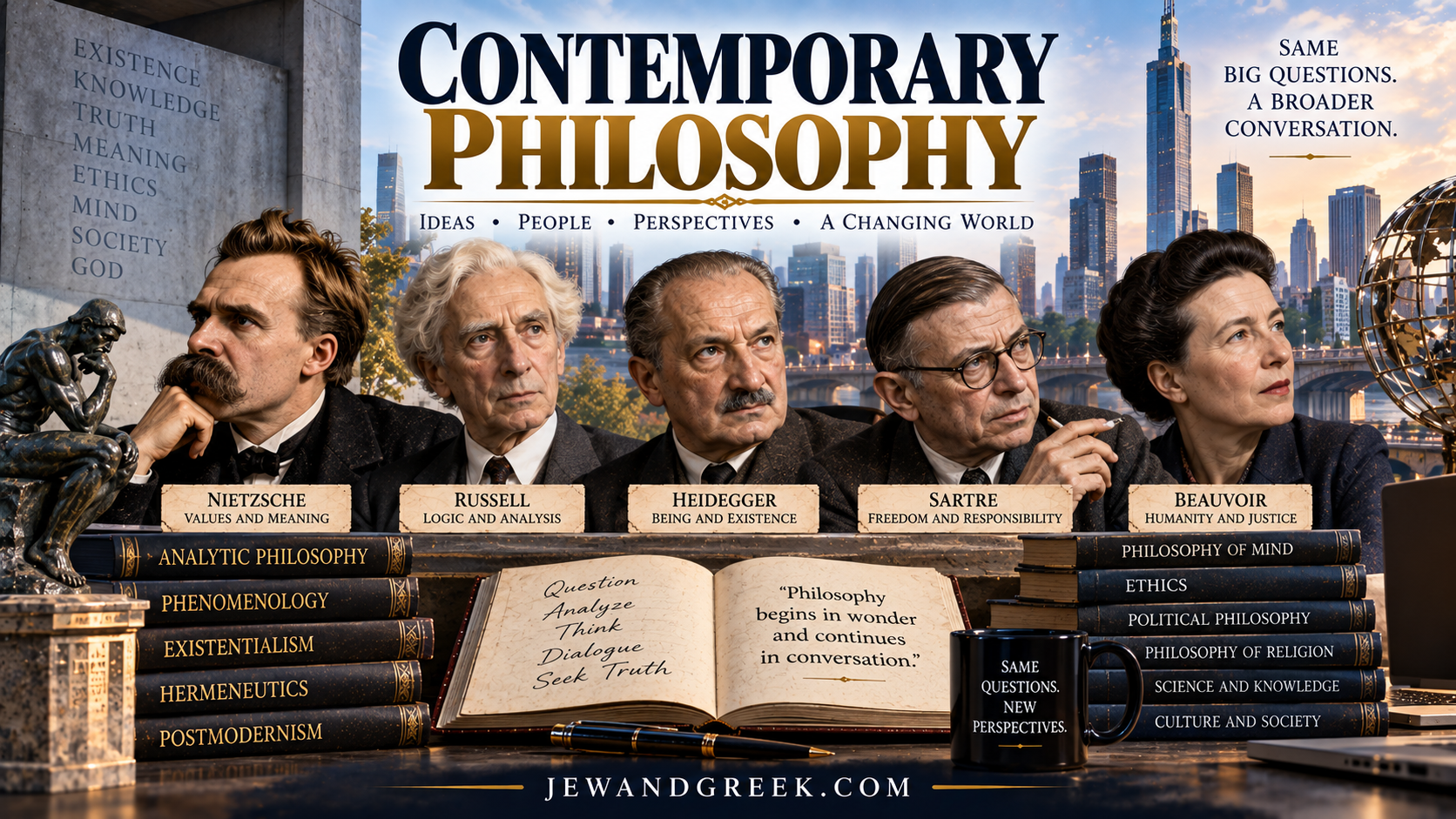
Contemporary philosophy is a little harder to define than ancient, medieval, or modern philosophy because there isn’t one philosophical movement that dominates the period. When we talk about ancient philosophy we immediately think of people like Socrates, Plato, and Aristotle. Medieval philosophy brings Augustine, Anselm, and Thomas Aquinas to mind, while modern philosophy is associated with Descartes, Locke, Hume, and Kant. Once we get into the late nineteenth, twentieth, and twenty-first centuries, however, philosophy branches off in so many different directions that it’s difficult to tell one story that ties everything together. Philosophers weren’t simply asking new questions. In many cases they were questioning whether the old questions had been asked correctly in the first place.
That’s one of the things that makes contemporary philosophy so interesting. During this period philosophers debated whether we can know anything with certainty, whether moral values are objective, whether religious statements are meaningful, whether human beings have free will, whether consciousness can be reduced to physical processes, and even whether traditional philosophy itself had been wasting its time. Some philosophers became increasingly skeptical of metaphysics while others brought it back. Some believed science would eventually explain virtually everything, while others questioned whether science could explain things like consciousness, morality, reason, and meaning. And while Christianity lost much of the influence it once had in Western academic philosophy, it certainly didn’t disappear. In fact, Christian philosophy experienced something of a revival during the second half of the twentieth century.
When Does Contemporary Philosophy Begin?
There isn’t a date when modern philosophy ended and contemporary philosophy began. Philosophical periods don’t work that neatly. A reasonable place to begin, however, is somewhere in the late nineteenth or early twentieth century. By then the philosophical world inherited several major problems from the Enlightenment. Descartes had emphasized reason and certainty, empiricists such as Locke and Hume had emphasized experience, and Kant had attempted to explain how the mind itself contributes to the way we experience reality. Hegel then developed an enormous philosophical system that influenced politics, history, theology, and later continental philosophy.
By the late nineteenth century, confidence in the grand philosophical systems of the past was beginning to break down. Friedrich Nietzsche attacked traditional morality and Christianity, Karl Marx interpreted history largely in terms of economic and class conflict, and Charles Darwin’s theory of evolution raised new questions about human nature and our place in the natural world. Sigmund Freud, although primarily associated with psychology, also contributed to a growing suspicion that human beings weren’t nearly as rational or self-aware as they imagined themselves to be. The twentieth century inherited all of this, along with two world wars, totalitarian governments, rapid scientific advancement, and enormous cultural change. It’s not surprising that philosophy became considerably more fragmented.
Analytic Philosophy
One of the two major traditions that developed during the twentieth century became known as analytic philosophy. It became especially influential in Britain and the United States and was associated early on with philosophers such as Gottlob Frege, Bertrand Russell, and G. E. Moore. Analytic philosophers generally placed a great deal of emphasis on clarity, logic, careful definitions, and the analysis of arguments. Instead of constructing massive philosophical systems that attempted to explain everything, they often concentrated on smaller and more precisely defined problems.
Bertrand Russell is probably one of the better-known names from this tradition. He worked extensively in logic, mathematics, epistemology, and the philosophy of language and was also an outspoken atheist. Along with Alfred North Whitehead, Russell attempted in Principia Mathematica to demonstrate the logical foundations of mathematics. Whatever you think about Russell’s religious conclusions, the analytic emphasis on defining terms and examining arguments carefully has been extremely valuable. A surprising number of disagreements turn out to involve people using the same words differently or drawing conclusions that don’t actually follow from their premises. That’s especially relevant to apologetics, where Christians and skeptics can spend considerable time arguing past each other without realizing it.
Logical Positivism
One influential movement that grew out of the analytic tradition was logical positivism. The logical positivists wanted philosophy to be much more closely connected to science and were suspicious of traditional metaphysical claims. They became particularly associated with what was called the verification principle, which held, in simplified terms, that a statement was cognitively meaningful only if it was analytically true or could in principle be verified through experience.
You can probably see where this was headed for theology. Statements about God, the soul, or realities beyond empirical observation weren’t merely considered false by some logical positivists. They were regarded as meaningless. Saying “God exists” wasn’t treated like making an incorrect scientific claim. It was treated as the kind of statement that couldn’t qualify as meaningful knowledge in the first place.
There was a pretty serious problem with this approach. How do you empirically verify the verification principle? You can’t put it in a test tube or observe it through a telescope. It isn’t analytically true either. In other words, the principle used to dismiss metaphysics didn’t appear to satisfy its own standard. Logical positivism eventually lost much of its influence, but the idea that only scientifically testable statements are meaningful has survived in popular culture. You’ll still hear people say that they only believe what science can prove without realizing that the statement “only believe what science can prove” isn’t itself something science can prove.
Philosophy of Language
Language became a major concern of twentieth-century philosophy. Ludwig Wittgenstein was one of the most important figures in this development, although his own views changed significantly during his lifetime. His early work attempted to describe the relationship between language and reality with considerable logical precision. His later work moved in a different direction and emphasized how words receive meaning through the ways they’re actually used within what he called language games.
This may sound like something that only professional philosophers would care about, but it has some very practical consequences. Words don’t always have one fixed meaning regardless of context. Think about the word bank. It can refer to a financial institution or the side of a river. Nobody becomes confused because the surrounding context normally tells us what the speaker means. The same thing happens with theological words. Faith, works, law, salvation, spirit, and even God can be used differently depending upon the speaker and context. That’s one reason theological debates can go badly when somebody pulls a word out of a passage, looks up a definition, and assumes that definition settles the matter.
Continental Philosophy
While analytic philosophy became particularly influential in the English-speaking world, a number of movements associated primarily with continental Europe developed along very different lines. The term continental philosophy is actually a broad label covering several traditions rather than one unified philosophy. Phenomenology, existentialism, hermeneutics, structuralism, post-structuralism, and deconstruction are all commonly placed somewhere under this umbrella.
Continental philosophers have often been more interested than analytic philosophers in questions involving human experience, history, culture, interpretation, power, and meaning. The writing can also be considerably more difficult. Anyone who has tried reading Martin Heidegger without some preparation knows what I mean. Still, it would be a mistake to dismiss the entire tradition because some of its writers are difficult. Continental philosophers raised important questions about what it means to be human and how our historical and cultural situation affects the way we understand the world.
Phenomenology
Phenomenology is most closely associated with Edmund Husserl, who wanted philosophy to examine experience as it actually presents itself to consciousness. Instead of beginning with scientific theories about the external world, phenomenology begins with the way things are experienced. Husserl’s work influenced a number of later thinkers, including Martin Heidegger, Jean-Paul Sartre, and others who took phenomenology in directions Husserl himself might not have anticipated.
For Christians, phenomenology raises interesting questions because human beings don’t encounter the world merely as machines collecting data. We experience love, guilt, beauty, fear, hope, worship, and the presence of other persons. A complete description of the chemical activity taking place in someone’s brain while he’s grieving may tell us something important, but it doesn’t seem to tell us everything about grief. Whether those first-person experiences can ultimately be reduced to physical processes remains one of the important questions in contemporary philosophy.
Existentialism
Existentialism is another movement that had an enormous cultural influence during the twentieth century. Søren Kierkegaard, who lived in the nineteenth century, is often regarded as one of its forerunners. Later existentialists included Martin Heidegger, Jean-Paul Sartre, Simone de Beauvoir, and Albert Camus, although they certainly didn’t all agree with one another. Kierkegaard was a Christian, while Sartre was an atheist, which should tell you immediately that existentialism isn’t a single set of religious beliefs.
Existentialists were concerned with things like freedom, choice, anxiety, death, authenticity, responsibility, and the apparent absurdity of human existence. Sartre famously argued that existence precedes essence. Without God, there is no predetermined human nature or divine purpose that tells us what we’re supposed to be. We exist first and then define ourselves through our choices. That gives human beings tremendous freedom, but it also places tremendous responsibility upon them. You can’t blame God or some predetermined human nature for what you become.
Christianity obviously disagrees with Sartre’s atheistic starting point, but existentialism raised questions Christians shouldn’t ignore. What does it mean to live authentically? What do we do with anxiety and death? Are we responsible for our choices? Does human life have a meaning that we discover, or is meaning something we invent? Christianity and atheistic existentialism give very different answers, but they’re often addressing the same human questions.
Pragmatism
Pragmatism developed largely in the United States through philosophers such as Charles Sanders Peirce, William James, and John Dewey. Although they differed considerably from one another, pragmatists tended to emphasize the practical consequences of beliefs and ideas. Rather than treating thought as something completely detached from life, they asked what difference a belief actually makes in practice.
William James was particularly interested in religious experience and was much more open to religion than many philosophers of his time. His The Varieties of Religious Experience remains an important study of religious experience, although Christians certainly don’t have to accept all of his conclusions. Pragmatism can be useful when it reminds us that beliefs have consequences, but it can become problematic if “what works” becomes a substitute for “what is true.” A false belief can occasionally be useful, and a true belief can sometimes be extremely inconvenient. Christianity doesn’t claim merely that believing in Jesus makes life work better. It claims that certain things actually happened and are actually true.
Marxism and Critical Theory
Karl Marx lived during the nineteenth century, but his influence on twentieth-century philosophy, politics, economics, and culture was enormous. Marx interpreted history largely through material and economic conditions and particularly through conflict between social classes. Religion famously came under criticism because Marx believed it could function in ways that helped people tolerate oppressive conditions rather than changing them.
Later thinkers associated with the Frankfurt School developed what became known as critical theory. They expanded their analysis beyond economics to include culture, institutions, mass media, authority, and other forms of social power. These ideas eventually influenced a variety of later approaches to race, gender, politics, and culture, although it’s a mistake to assume that every modern theory using the word critical is simply Marxism with a different name.
Christians can evaluate these ideas without either accepting or rejecting everything associated with them. Power can certainly be abused. Institutions can become corrupt. Wealth can influence politics and culture, and Christians shouldn’t need Marx to tell them that human beings are capable of exploiting one another. The disagreement comes when all of human life is interpreted primarily through structures of power or material conditions. Christianity sees the human problem as deeper than economics or social structures because the people who build those structures have a problem called sin. Changing the system may be necessary at times, but putting sinful people in charge of a new system doesn’t automatically solve the problem.
Postmodernism
Few philosophical terms are used more loosely today than postmodernism. Sometimes it seems to mean anything somebody doesn’t like about contemporary culture. Strictly speaking, postmodernism refers to a collection of intellectual developments that became especially influential during the second half of the twentieth century. Thinkers commonly associated with it include Michel Foucault, Jacques Derrida, and Jean-François Lyotard, although none of them can be reduced to the slogan “there is no truth.”
Postmodern thinkers challenged many of the assumptions associated with the Enlightenment, including confidence that detached human reason could give us a completely objective view of reality. They emphasized the influence of language, culture, history, and power on the way people understand the world. Some of those criticisms were useful. Human beings aren’t perfectly objective, and our cultural assumptions can affect the way we interpret evidence. Christians should already know that human reasoning isn’t morally or intellectually infallible.
The problem comes when healthy skepticism about our ability to know truth turns into skepticism about truth itself. There is a major difference between saying, “I may be wrong about what is true,” and saying, “There is no objective truth.” The first statement is humility. The second is a philosophical claim about reality, and ironically it appears to be presented as objectively true. Christianity can acknowledge the limitations of human knowledge without concluding that truth is merely a product of culture or power.
Philosophy of Mind and Consciousness
One of the most interesting developments in contemporary philosophy is the renewed attention being given to consciousness. The growth of neuroscience and artificial intelligence has made the question even more important. We know that the brain and mental activity are closely connected. Injure the brain and you can alter memory, personality, perception, and behavior. The difficult question is whether knowing everything about the physical brain would tell us everything about the mind.
Suppose a scientist could describe every neurological event taking place in your brain while you’re looking at a red rose. Would that description tell someone what seeing red actually feels like? That’s where philosophers begin talking about subjective experience, sometimes called qualia. Materialists generally believe that consciousness ultimately arises from physical processes, although they disagree about exactly how that happens. Dualists maintain that mind can’t be reduced completely to matter, while other philosophers have proposed still other possibilities. This discussion obviously matters to Christianity because Christians have traditionally believed that human beings aren’t merely biological machines and that personal existence isn’t exhausted by the physical body.
Free Will and Determinism
The question of free will is hardly new, but contemporary philosophy has brought it into conversation with neuroscience, psychology, physics, and philosophy of mind. If every event in the brain is completely determined by prior physical causes, in what sense do I choose what I’m going to do? On the other hand, if my choices aren’t caused by anything at all, would that make them free or simply random?
Some philosophers are determinists and deny the kind of freedom most people assume they possess. Others are compatibilists, arguing that meaningful freedom can exist even if our choices arise within a determined causal order. Libertarians—not to be confused with the political party—argue that genuine freedom requires that at least some human choices aren’t completely determined by prior causes. Christians have their own versions of these debates because questions about free will also intersect with God’s foreknowledge, sovereignty, election, sin, and moral responsibility. Augustine, Aquinas, Calvin, Arminius, and many others wrestled with these questions long before neuroscience arrived, but contemporary philosophy has given us some new ways of approaching an old problem.
Ethics After the Enlightenment
Contemporary philosophers continue to debate what makes an action right or wrong. Utilitarian approaches judge actions largely by their consequences, while deontological approaches emphasize duties and moral rules. Virtue ethics, which goes back to Aristotle, experienced a significant revival during the twentieth century and focuses more on the kind of person we should become than on constructing a rule for every possible decision. Other approaches ground morality in human flourishing, social relationships, rational agreement, or various forms of moral realism.
One of the most important questions for Christian apologetics isn’t simply what moral rules people accept but what makes morality objectively binding. Most Christians and atheists agree that torturing children for entertainment is wrong. The philosophical question is why it’s wrong. Is morality ultimately a product of evolution and social cooperation? Does it exist as an objective feature of reality? Can there be objective moral obligations without a transcendent moral foundation? Christians shouldn’t pretend that atheistic philosophers haven’t thought seriously about these questions, because many of them have. The disagreement concerns which explanation ultimately makes the most sense.
The Return of Metaphysics
For a while it looked as though analytic philosophy might eliminate traditional metaphysics altogether. Logical positivism treated many metaphysical questions as meaningless, and some philosophers thought science would eventually make them unnecessary. That didn’t happen. Contemporary philosophers are once again seriously discussing causation, possible worlds, identity, time, necessity, consciousness, free will, abstract objects, and the nature of existence itself.
That’s important for Christian philosophy because questions about God are ultimately metaphysical questions. Does everything that exists have to be physical? Is the universe necessary or contingent? Can an immaterial mind exist? What is a person? What makes something the same thing over time? These aren’t questions that can simply be handed over to a laboratory, because science itself operates with certain philosophical assumptions about reality, reason, evidence, and causation. Science can provide information that affects philosophical arguments, but science and philosophy aren’t interchangeable.
The Revival of Christian Philosophy
One of the more interesting developments in twentieth-century philosophy was the revival of explicitly Christian philosophy within the academic world. Earlier in the century, particularly during the heyday of logical positivism, some philosophers treated belief in God as intellectually obsolete. By the latter part of the century that attitude had become much more difficult to maintain.
Alvin Plantinga became one of the most important figures in this revival. His work in epistemology, metaphysics, and philosophy of religion challenged the assumption that belief in God is irrational unless it’s based upon arguments that prove God’s existence. Richard Swinburne developed extensive arguments for theism using probability and cumulative reasoning. Other Christian philosophers have worked on the problem of evil, divine foreknowledge, miracles, religious epistemology, the resurrection, and the relationship between science and religion. This doesn’t mean that academic philosophy suddenly became Christian. Far from it. It does mean that serious philosophical arguments for theism and Christianity returned to discussions from which some people had assumed they had permanently disappeared.
Philosophy and Science
The relationship between philosophy and science is especially important today because we sometimes hear that science has replaced philosophy. That’s a strange claim when you think about it. The statement “science is the only reliable way of knowing truth” isn’t a scientific discovery. It’s a philosophical claim about knowledge. You can’t conduct an experiment that proves only experiments produce knowledge without going in a circle.
Science is one of the most successful methods human beings have ever developed for understanding the natural world. Christians have no reason to be threatened by that. But science can’t answer every kind of question simply because not every question is a scientific question. Science can investigate the neurological processes associated with moral decisions, but it can’t put “murder is wrong” under a microscope and measure its mass. It can describe what happened during the earliest stages of the universe, but the question of why anything exists at all is different. Knowing how something works and knowing why it ultimately exists aren’t necessarily the same thing.
Philosophy of Religion
Philosophy of religion has become a thriving field in contemporary philosophy. Philosophers debate arguments for and against God’s existence, the problem of evil, divine hiddenness, miracles, religious experience, the relationship between faith and reason, God’s foreknowledge, human freedom, the coherence of divine attributes, and whether religious belief can be rational without traditional proofs.
This is one area where philosophy and apologetics overlap considerably, but they aren’t exactly the same thing. Philosophy of religion can analyze whether the concept of an omniscient God is coherent without asking whether Christianity is true. Christian apologetics eventually has to go beyond philosophical theism and deal with historical claims. Did Jesus exist? What did He claim? How reliable are the New Testament documents? What happened after the crucifixion? Philosophy can help us determine whether miracles are possible, but history has to help us determine whether a particular miracle actually occurred.
Where Does Philosophy Go From Here?
It’s difficult to predict where contemporary philosophy is headed because we’re still living in the period we’re trying to describe. Artificial intelligence is already raising philosophical questions about consciousness, personhood, creativity, knowledge, and moral responsibility. Advances in neuroscience continue to challenge assumptions about the mind and free will. Developments in cosmology raise questions about the origin and nature of the universe, while biotechnology forces us to think carefully about what it means to be human. Questions about truth, language, identity, morality, and religious belief certainly aren’t going away.
What strikes me most about contemporary philosophy is that many of the questions are remarkably old. We have computers Socrates couldn’t have imagined and scientific instruments Aristotle couldn’t have dreamed of, but we’re still asking many of the same questions they asked. What is real? How do we know what we know? What makes something right or wrong? What is a human being? Do we have free will? Does God exist? What is the good life? Technology has changed tremendously over the last 2,500 years. Human beings, apparently, still want answers to the same questions.
Why Contemporary Philosophy Matters
Christians sometimes treat philosophy as though it’s an unnecessary distraction from the Bible, but everybody has philosophical assumptions whether they recognize them or not. When someone says that only physical things exist, that’s philosophy. When someone says morality is relative, that’s philosophy. When someone says science is the only path to knowledge, that’s philosophy. Even the claim that philosophy is useless is itself a philosophical position.
We don’t need to agree with every philosopher, and we certainly don’t need to turn Christianity into a philosophical system. Christianity is grounded in God’s revelation and ultimately in the historical person of Jesus Christ. But philosophy can help us recognize assumptions, define our terms, identify bad arguments, and think more carefully about what we believe and why we believe it. Paul warned Christians against being taken captive by “philosophy and empty deceit” (Colossians 2:8), but he didn’t tell them to stop thinking. In fact, much of the New Testament requires us to distinguish truth from error and good reasoning from bad reasoning. If we’re going to engage the ideas shaping the world around us, we’d better understand where those ideas came from and whether they make sense.
Contemporary philosophy doesn’t give us one worldview to accept or reject. It gives us an enormous conversation about reality, knowledge, morality, consciousness, meaning, language, science, and God. Christians should be willing to enter that conversation without being intimidated by it. Some philosophical ideas are compatible with Christianity, some challenge it, and others can actually help us understand and defend it more clearly. The goal isn’t to make philosophy our authority. It’s to understand the questions well enough to give thoughtful answers.