
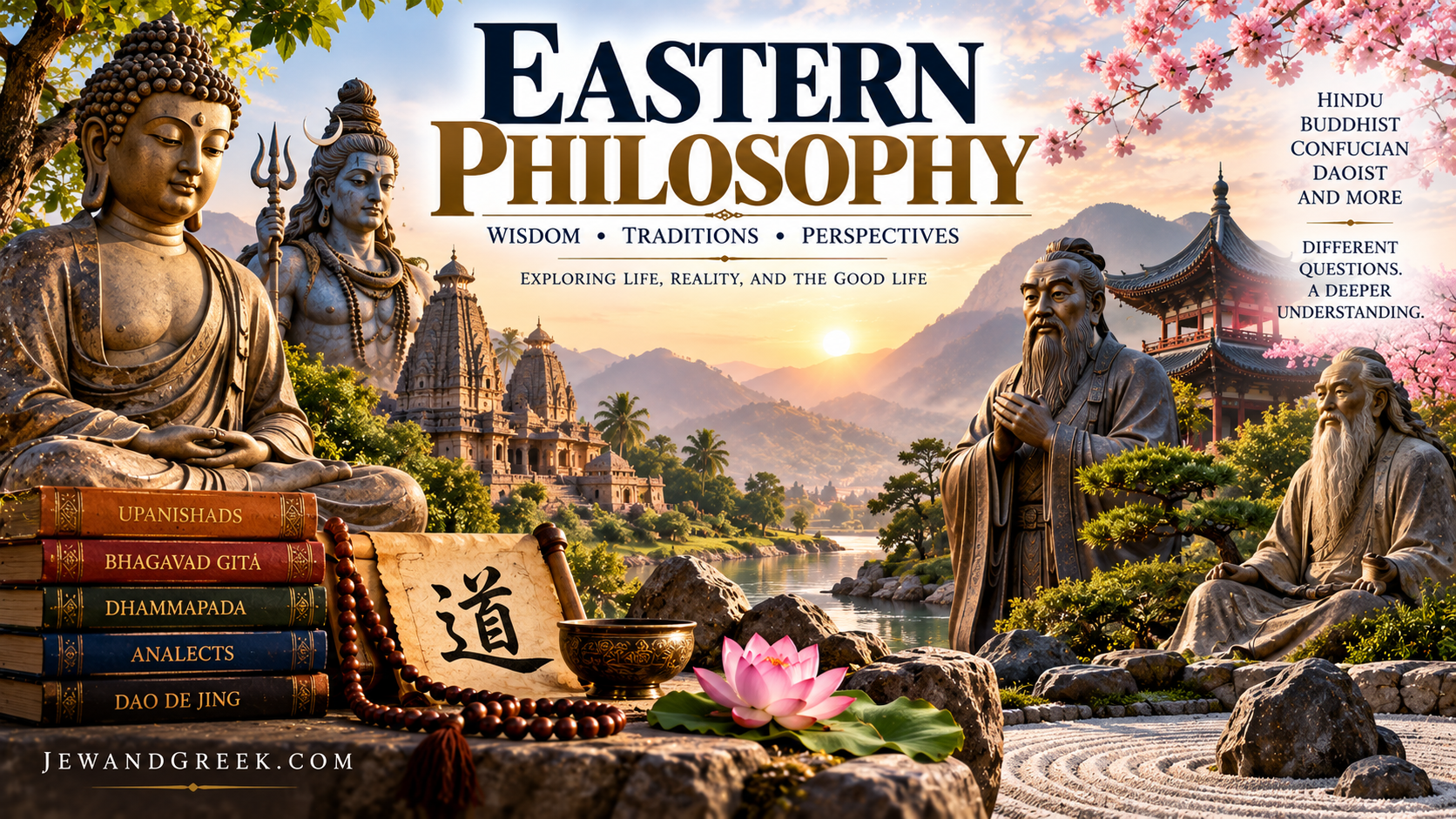
Eastern philosophy encompasses a vast and diverse collection of intellectual and religious traditions that developed primarily in India, China, Japan, and other parts of Asia. The term itself is a Western convenience rather than the name of a single philosophical tradition, and it should not suggest that Hindu, Buddhist, Jain, Confucian, and Daoist thinkers all approached reality in the same way. They disagreed about the nature of ultimate reality, the existence of a permanent self, the source of human suffering, moral obligation, political order, knowledge, and the possibility of liberation. Nevertheless, these traditions developed sustained philosophical reflection on many of the same fundamental questions that occupied Greek and later Western philosophers: What is real? What is a human being? How should we live? What can we know? Why do we suffer? What constitutes the good life?
The relationship between philosophy and religion is particularly important when approaching Asian thought. Western accounts sometimes attempt to classify Confucianism or Buddhism as either “philosophy” or “religion,” but those categories do not always correspond neatly to the way these traditions developed. Hindu philosophical systems grew within religious cultures containing sacred texts, rituals, devotion, and speculation about ultimate reality. Buddhism combines philosophical analysis with ethical practice, meditation, monastic institutions, and teachings concerning liberation. Confucianism addresses ethics, political order, ritual, family, and human cultivation, while Daoism contains both philosophical texts and extensive religious traditions. Eastern philosophy is therefore best approached on its own terms rather than forced into categories developed within Western intellectual history.
Philosophy in Ancient India
India produced one of the world’s oldest and richest philosophical traditions. The Vedic literature reaches deep into antiquity, while the later Upanishads contain sustained reflection upon the nature of reality, consciousness, the self, death, and liberation. Indian philosophers eventually developed sophisticated systems of metaphysics, epistemology, logic, ethics, language, and philosophy of mind. Debates occurred not only within traditions now grouped under Hinduism but also between Hindu, Buddhist, Jain, and materialist thinkers. Arguments about perception, inference, consciousness, causation, personal identity, and the existence of God could become highly technical.
Many Indian philosophical traditions shared concepts such as karma, samsara, and moksha, although they interpreted them differently. Karma concerns actions and their consequences, while samsara refers broadly to the cycle of birth, death, and rebirth. Moksha refers to liberation from that cycle, though schools disagree about the nature of liberation and the self that is supposedly liberated. These ideas produced a philosophical environment substantially different from the biblical and classical Greek frameworks that shaped Western thought. Rather than viewing a single earthly life followed by resurrection and judgment, many Indian traditions understood ordinary existence as part of a recurring cycle from which liberation was sought.
The Upanishads and Ultimate Reality
The Upanishads are among the foundational texts of Indian philosophical thought. Composed over a long period rather than by a single author, they contain discussions about Brahman, atman, consciousness, death, knowledge, and the ultimate structure of reality. They frequently move beyond the ritual concerns of earlier Vedic religion toward deeper reflection about what lies behind the changing world of ordinary experience. One of their most influential themes concerns the relationship between Brahman, ultimate reality, and atman, the deepest self, although different Hindu schools would later interpret that relationship in very different ways.
Some Upanishadic passages became foundational for traditions claiming a profound identity or unity between the deepest self and ultimate reality. Other interpreters understood the relationship differently and maintained stronger distinctions between God, individual souls, and the world. Consequently, Hindu philosophy should not be reduced to the popular formula that “everything is one.” Indian thinkers argued extensively about precisely what kind of unity or distinction exists within reality. Those disagreements eventually produced several major philosophical schools that offered competing interpretations of the Vedas and Upanishads.
The Six Orthodox Schools
Classical Hindu philosophy traditionally recognizes six major astika, or orthodox, schools: Nyaya, Vaisheshika, Samkhya, Yoga, Mimamsa, and Vedanta. “Orthodox” in this context primarily concerns acceptance of the authority of the Vedas rather than agreement upon one theological system. The schools developed distinctive approaches to knowledge, metaphysics, language, spiritual practice, and liberation. Some eventually became closely associated or interacted extensively with one another, such as Nyaya and Vaisheshika or Samkhya and Yoga.
Nyaya became particularly important for logic and epistemology, developing detailed arguments about valid sources of knowledge. Vaisheshika developed an atomistic account of the physical world and sophisticated categories for describing reality. Samkhya proposed a dualistic distinction between purusha, consciousness, and prakriti, material nature. Yoga adopted important elements of Samkhya while emphasizing disciplined practices intended to free consciousness from its identification with material and psychological processes. Mimamsa concentrated heavily upon Vedic interpretation, ritual, language, and duty, while Vedanta developed around interpretations of the Upanishads, the Bhagavad Gita, and the Brahma Sutras. This diversity demonstrates that classical Indian philosophy was not one system but an extended intellectual conversation.
Vedanta
Vedanta became one of the most influential families of Hindu philosophy. Its major schools agree upon the importance of foundational texts but disagree significantly about the relationship among Brahman, individual souls, and the world. These differences produced philosophical systems that range from strong forms of nondualism to explicitly theistic accounts maintaining genuine distinctions between God and created beings.
Advaita Vedanta, especially associated with Adi Shankara, teaches a form of nondualism in which Brahman is ultimate reality and the deepest truth of the self is understood in relation to that nondual reality. Ordinary experience appears to present a world of separate and independent entities, but ignorance prevents human beings from recognizing reality correctly. Ramanuja, associated with Vishishtadvaita or qualified nondualism, rejected aspects of Shankara’s interpretation and emphasized a more personal understanding of ultimate reality and a genuine relationship between individual souls and God. Madhva defended an explicitly dualistic Vedanta that maintained real distinctions between God, individual souls, and the material world. These disagreements are important because they demonstrate that Hindu philosophy contains debates over monism, theism, personal identity, and ultimate reality comparable in seriousness to major metaphysical debates in Western philosophy.
The Bhagavad Gita
The Bhagavad Gita is among the most influential religious and philosophical texts of Hindu tradition. It appears within the much larger Mahabharata and presents a dialogue between the warrior Arjuna and Krishna on the eve of battle. Arjuna faces a profound moral crisis because the coming conflict will require him to fight people to whom he is personally connected. The dialogue consequently addresses duty, action, knowledge, devotion, selfhood, and liberation.
The Gita presents several approaches to spiritual life, commonly associated with the paths of action, knowledge, and devotion. Rather than simply abandoning action, the text emphasizes acting according to one’s duty without selfish attachment to the results. Krishna’s identity and revelation within the text also make it central to Hindu devotional traditions. Philosophically, the Gita raises enduring questions about moral responsibility, motives, detachment, divine authority, and whether fulfilling one’s social or religious duty can require actions that would otherwise appear morally troubling.
Buddhism and the Problem of Suffering
Buddhist philosophy developed from the teachings associated with Siddhartha Gautama, the Buddha, probably during the first millennium BC in northern India. Rather than beginning primarily with speculation about the origin of the universe, early Buddhist teaching concentrates upon the human experience of suffering and the path toward liberation. The traditional Four Noble Truths identify suffering or dissatisfaction, its origin, its cessation, and the path leading to its cessation. Craving, attachment, and ignorance occupy central roles in explaining why human beings remain trapped in cycles of dissatisfaction and rebirth.
This practical orientation does not mean Buddhism lacks sophisticated philosophy. Buddhist thinkers produced extensive arguments about consciousness, perception, causation, language, personal identity, metaphysics, and knowledge. Different Buddhist schools disagreed with one another about many of these subjects. What unites much Buddhist thought is the conviction that mistaken ways of understanding ourselves and reality contribute directly to suffering. Philosophy therefore serves not merely as abstract intellectual speculation but as part of a transformative path.
Impermanence and No-Self
Two important Buddhist teachings concern impermanence and anatta, commonly translated as “no-self” or “not-self.” Buddhism emphasizes that conditioned things are impermanent: bodies change, emotions change, thoughts change, relationships change, and circumstances change. Human suffering is intensified when people cling to what is necessarily unstable as though it could provide permanent security.
The doctrine of no-self challenges the idea that beneath these changing experiences exists an eternal, independent, unchanging personal essence. Buddhist traditions analyze the person in terms of changing aggregates and processes rather than a permanent soul of the kind found in some other philosophical and religious systems. This creates difficult philosophical questions about personal identity and moral responsibility. If there is no permanent self, in what sense does a person remain the same person over time, and what is reborn? Buddhist philosophers developed sophisticated answers to these questions, making personal identity one of the most interesting points of comparison between Buddhist and Western philosophy.
Dependent Origination
Another foundational Buddhist concept is dependent origination. Things arise in dependence upon conditions rather than existing as completely independent realities. Applied to human suffering, dependent origination describes interconnected processes through which ignorance, craving, attachment, and other conditions perpetuate suffering and rebirth. In later Buddhist philosophy, the principle became associated with increasingly sophisticated metaphysical analyses of dependence and emptiness.
Dependent origination challenges the human tendency to treat objects and identities as though they possessed completely independent and permanent existence. It also differs from the classical Christian doctrine of creation, which understands contingent reality as dependent ultimately upon a Creator who exists independently of creation. Both traditions can speak of dependence, but they mean substantially different things by it. Comparison is therefore useful only when the underlying metaphysical differences remain clear.
Nagarjuna and Emptiness
Nagarjuna, generally associated with the second or third century AD, became one of the most influential philosophers in Mahayana Buddhism. He is especially associated with the Madhyamaka tradition and its analysis of shunyata, or emptiness. Emptiness does not simply mean that nothing exists. Rather, Nagarjuna argued against the idea that things possess independent, self-contained essences by which they exist entirely from themselves.
His method frequently examined philosophical positions and demonstrated contradictions that arise when concepts are treated as possessing fixed independent existence. Because things arise dependently, they are “empty” of independent inherent existence. Nagarjuna’s philosophy has sometimes been interpreted as nihilistic, but Madhyamaka thinkers reject that characterization. The point is not that reality is simply nothing but that ordinary conceptual categories can mislead us when treated as descriptions of independently existing essences.
Buddhist Traditions
As Buddhism spread beyond India, it developed into numerous traditions. Theravada Buddhism, influential especially in Sri Lanka and Southeast Asia, draws heavily upon the Pali Canon and preserves traditions tracing themselves to early Buddhist communities. Mahayana Buddhism developed a vast body of literature and philosophical schools emphasizing ideals such as the bodhisattva, who seeks enlightenment while working for the liberation of other beings. Vajrayana Buddhism, especially associated with Tibetan Buddhism and related traditions, incorporates elaborate ritual, meditation, symbolic practices, and esoteric teachings.
Mahayana Buddhism itself produced major philosophical traditions, including Madhyamaka and Yogacara. As Buddhism entered China, it interacted with indigenous Chinese traditions and eventually produced distinctive movements such as Chan Buddhism, which later became known in Japan as Zen. These developments mean that “Buddhist philosophy” cannot be treated as though one set of propositions represents every Buddhist school. Like Christianity, Buddhism possesses a long history of internal debate, interpretation, and doctrinal development.
Confucius and the Moral Life
Chinese philosophy developed within a very different intellectual environment from Indian philosophy. Confucius, who lived from approximately 551 to 479 BC, became one of the foundational figures of Chinese thought. His teaching concentrated heavily upon ethics, character, family relationships, education, political leadership, ritual, and the cultivation of a harmonious society. Rather than constructing a systematic metaphysics comparable to Plato or Aristotle, Confucius emphasized how human beings should live together and what kind of people they should become.
A central Confucian concept is ren, often translated as benevolence, humanity, or humaneness. Another is li, referring to ritual propriety, appropriate conduct, and the patterns of behavior through which social relationships are ordered. Confucius believed moral character could be cultivated through education, discipline, imitation of virtuous examples, and faithful participation in proper relationships. The good society therefore depends not merely upon laws and punishments but upon people whose character has been formed toward virtue.
Family, Society, and Confucian Ethics
Confucian ethics places great emphasis upon relationships. Human beings are not understood primarily as isolated individuals who later choose whether to enter communities; they are born into networks of family and social obligations. Relationships between parents and children, rulers and subjects, husbands and wives, older and younger siblings, and friends were traditionally understood as carrying reciprocal responsibilities. Filial piety, involving honor and responsibility toward parents and ancestors, became especially important.
This relational approach differs from modern Western ethical systems that frequently begin with individual rights and personal autonomy. Confucian thought asks what virtues and practices allow relationships and communities to flourish. At its best, this emphasis can encourage responsibility, loyalty, respect, education, and concern for social harmony. Critics have also asked whether strongly hierarchical relationships can reinforce unjust authority or restrict individual freedom, questions that contemporary Confucian philosophers continue to address.
Mencius and Human Nature
Mencius, who lived in the fourth century BC, became one of the most important interpreters of Confucian thought. He is particularly known for his optimistic account of human nature. Mencius argued that human beings possess natural beginnings or “sprouts” of virtues such as compassion and righteousness that can be cultivated through proper moral formation.
He famously illustrated this point by imagining someone suddenly seeing a child about to fall into a well. The immediate impulse of alarm and compassion, he argued, reveals something fundamental about human moral potential. Virtue requires cultivation, but its beginnings are already present within us. This view later faced an important challenge from another Confucian thinker, Xunzi, who argued that human nature left to itself tends toward selfish desires and requires education, ritual, and discipline. Their disagreement represents one of the great debates about human nature in Chinese philosophy.
Daoism
Daoism developed as another major Chinese philosophical tradition and is especially associated with the Daodejing, traditionally connected with Laozi, and the writings associated with Zhuangzi. The central concept is the Dao, usually translated as the Way. The Dao represents the fundamental way or pattern through which reality unfolds, yet the Daodejing famously warns that the Dao capable of being fully expressed in words is not the eternal Dao.
Daoist philosophy often criticizes excessive striving, artificial social conventions, rigid categories, and attempts to control reality through force. One of its most important concepts is wu wei, frequently translated as “non-action” but better understood as action that does not force itself against the natural course of things. The ideal is not literal inactivity but effortless or uncontrived action in harmony with the Way. Daoism therefore offers a striking contrast to philosophical systems emphasizing mastery, control, systematic classification, or aggressive transformation of the world.
Zhuangzi and Human Perspective
The Zhuangzi contains some of the most imaginative philosophical literature of ancient China. Through stories, paradoxes, humor, and unusual characters, it questions human certainty about categories and perspectives. One famous passage describes Zhuangzi dreaming that he was a butterfly and then awakening uncertain whether he was Zhuangzi who had dreamed of being a butterfly or a butterfly now dreaming of being Zhuangzi.
The story raises questions about identity, perception, and the limits of certainty, although its purpose should not necessarily be reduced to a Western skeptical argument. Throughout the Zhuangzi, apparently fixed distinctions are repeatedly examined from alternative perspectives. Human beings often mistake their limited viewpoint for the structure of reality itself. The resulting philosophical humility is one of Daoism’s most enduring contributions.
Confucianism and Daoism
Confucianism and Daoism are sometimes presented as straightforward opposites. Confucianism emphasizes social order, education, moral cultivation, family responsibilities, and ritual, while Daoism frequently warns against artificial conventions, excessive social regulation, and human attempts to impose order upon reality. There is truth in this contrast, but Chinese intellectual history is more complicated than a simple competition between two mutually exclusive systems.
Chinese thinkers and communities often drew upon more than one tradition. Confucian principles could guide public responsibility and family relationships while Daoist ideas influenced approaches to nature, contemplation, health, art, or personal spirituality. Buddhism later entered this environment and interacted with both. The resulting Chinese intellectual world demonstrates that religious and philosophical identities do not always operate according to the exclusive categories familiar from Western denominational history.
Zen Buddhism
Zen Buddhism developed from Chinese Chan Buddhism and became especially influential in Japan. It emphasizes disciplined meditation, direct insight, and the limitations of purely conceptual approaches to reality. Zen traditions sometimes employ paradoxical sayings or koans designed to disrupt ordinary patterns of thought rather than provide straightforward propositions to be logically analyzed.
Popular Western culture has often reduced Zen to relaxation, simplicity, or vague mindfulness. Historically, however, Zen developed within a specifically Buddhist framework involving monastic discipline, teachers, ethical practices, meditation, and teachings concerning awakening. Its suspicion of excessive conceptualization does not amount simply to irrationalism. Rather, Zen questions whether intellectual concepts alone can produce the kind of transformative insight Buddhism seeks.
Eastern Philosophy and the Self
One of the most illuminating comparisons between Eastern and Western philosophy concerns the nature of the self. Much Western philosophy has emphasized the individual person as a distinct rational subject. Descartes began his philosophical reconstruction with the certainty of the thinking self, while modern political philosophy often places individual autonomy and rights near the center of social thought. Christianity likewise affirms the enduring significance of individual persons, though it understands persons as created for relationships with God and others.
Eastern traditions present several alternatives. Confucian thought understands persons deeply through their relationships and responsibilities. Buddhist philosophy challenges belief in a permanent independent self. Hindu traditions disagree among themselves, with some identifying the deepest self with ultimate reality and others preserving distinctions between individual souls and God. These differences demonstrate that even the apparently simple question “What am I?” can receive radically different philosophical answers.
Eastern Philosophy and Christianity
Christianity and Eastern philosophy sometimes address similar questions while beginning from very different assumptions. Both Christian and Buddhist traditions take suffering seriously, but Christianity interprets suffering within a narrative of creation, fall, redemption, resurrection, and God’s ultimate restoration of creation, while Buddhism analyzes suffering largely through craving, ignorance, impermanence, and attachment. Hindu traditions may seek liberation from cycles of rebirth, whereas Christianity expects one earthly life followed ultimately by resurrection and judgment. Confucianism’s concern for virtue, family, and moral formation provides meaningful points of comparison with Christian ethics, yet Christianity grounds morality in a Creator and understands humanity within the biblical story.
Similar vocabulary can therefore conceal important differences. Christian contemplation is not identical to Buddhist meditation, Christian self-denial is not equivalent to the Buddhist doctrine of no-self, and the Christian doctrine of union with Christ is not the same as nondualistic claims about the identity of self and ultimate reality. At the same time, disagreement does not eliminate the possibility of learning from careful comparison. Eastern philosophers have asked penetrating questions about desire, ego, suffering, social responsibility, human perception, disciplined attention, and the assumptions people bring to their understanding of reality.
Eastern Philosophy in the Modern West
Interest in Eastern philosophy expanded considerably in Europe and North America during the nineteenth and twentieth centuries. Thinkers such as Arthur Schopenhauer engaged Indian philosophical and religious texts, while later writers, psychologists, artists, and religious movements introduced Western audiences to Hindu, Buddhist, and Daoist ideas. Immigration and globalization eventually brought Asian religious communities themselves into Western societies, making direct interaction increasingly common.
This encounter has sometimes produced serious scholarship and fruitful philosophical dialogue, but it has also encouraged simplified versions of Eastern traditions. Concepts such as karma, Zen, mindfulness, and enlightenment are frequently detached from their historical religious contexts and transformed into general ideas about personal fulfillment or psychological well-being. A careful study of Eastern philosophy resists that tendency. Buddhism should be allowed to be Buddhist, Hindu traditions should be understood in their genuine diversity, and Confucian and Daoist concepts should be studied within the civilizations that produced them before they are adapted to contemporary Western concerns.
The Continuing Importance of Eastern Philosophy
Eastern philosophy dramatically expands the intellectual conversation beyond the familiar Western progression from Socrates and Plato through Augustine, Aquinas, Descartes, Hume, and Kant. Indian philosophers developed sophisticated theories of knowledge, logic, consciousness, and metaphysics while European philosophy was developing along very different historical lines. Chinese thinkers created influential accounts of virtue, government, family, social harmony, nature, and human cultivation. Buddhist philosophers subjected concepts of selfhood, permanence, causation, and desire to sustained analysis, while Daoist thinkers challenged confidence in human categories and attempts to dominate reality.
Studying these traditions does not require treating every philosophical system as equally true, nor does intellectual openness require abandoning critical evaluation. The value of comparative philosophy lies partly in discovering assumptions that can remain invisible when one studies only a single intellectual tradition. Eastern philosophy asks Western readers to reconsider what they mean by self, freedom, knowledge, virtue, suffering, and ultimate reality. For Christians, the encounter also provides an opportunity to understand competing accounts of the human condition while thinking more carefully about what is distinctive in the biblical understanding of God, creation, humanity, salvation, and eternal life.
The deepest philosophical questions are not exclusively Western or Eastern. Human beings across civilizations have looked at the world, experienced suffering and death, confronted moral choices, wondered about consciousness, and asked whether ordinary experience points toward something greater. Their answers differ profoundly, but the questions reveal a common human search for wisdom. Eastern philosophy represents one of humanity’s richest contributions to that search and deserves to be studied not as an exotic alternative to “real” philosophy, but as an essential part of the history of human thought.