
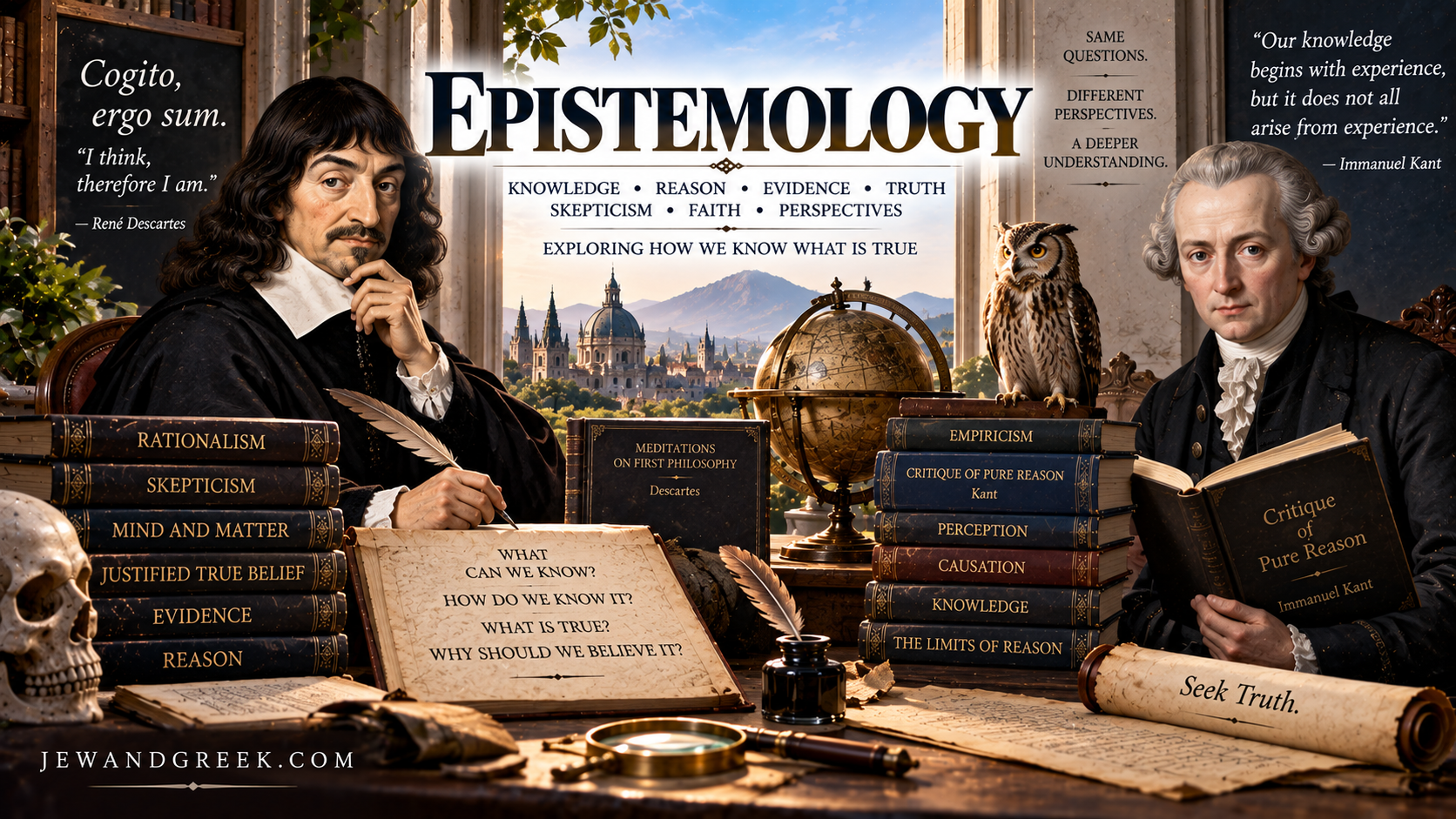
Epistemology is the branch of philosophy concerned with knowledge. It asks some of the most basic questions behind every other intellectual discipline: What does it mean to know something? How do we distinguish knowledge from opinion or belief? What makes a belief reasonable? Can our senses be trusted? What role should reason, experience, memory, testimony, and evidence play in forming our beliefs? Are there limits to what human beings can know? Whether we are evaluating a scientific theory, interpreting a historical document, considering a religious claim, or simply deciding whether another person is telling the truth, we are already dealing with epistemological questions.
These questions become especially important because human beings are capable both of acquiring genuine knowledge and of being profoundly mistaken. People misremember events, misunderstand evidence, reason badly, trust unreliable sources, interpret experiences incorrectly, and sometimes believe what they want to believe. Yet skepticism cannot simply be applied to everything without consequence, because even the skeptic normally assumes that some things can be known. Epistemology therefore attempts to explain how knowledge is possible while taking seriously the many ways in which human reasoning can fail. Its task is not merely to encourage doubt but to understand when confidence is justified.
What Is Knowledge?
One of the oldest philosophical attempts to define knowledge describes it as justified true belief. According to this account, a person knows something when three conditions are satisfied: the person believes it, the belief is true, and the person possesses adequate justification for believing it. If someone correctly guesses that it will rain tomorrow but has no good reason for the prediction, we would normally hesitate to call that knowledge. Truth alone is not enough; knowledge seems to require some appropriate connection between the belief and the reasons supporting it.
This apparently straightforward definition became one of the most famous problems in twentieth-century philosophy. In 1963, Edmund Gettier presented short examples suggesting that a person can possess a justified true belief and nevertheless arrive at the truth largely through luck. Philosophers have since proposed numerous additional conditions intended to distinguish genuine knowledge from accidentally correct belief. The resulting debate illustrates how difficult it can be to define concepts that seem obvious in ordinary conversation. We use the word know constantly, yet explaining exactly what knowledge is remains remarkably difficult.
Belief and Truth
Knowledge requires belief in at least a minimal sense. It would be strange to say that someone knows a proposition while sincerely denying that proposition. Yet believing something strongly does not make it true. A person can be completely convinced and completely mistaken, while another person may tentatively accept something that is actually true.
This distinction between belief and truth is foundational to epistemology. Truth does not ordinarily depend upon the intensity with which a person believes something. If the earth orbits the sun, that proposition remains true whether everyone believes it, nobody believes it, or society changes its opinion about it. Epistemology therefore resists the temptation to identify sincerity with knowledge. Sincerity may tell us something about the believer, but it does not by itself tell us whether the belief corresponds to reality.
What Is Truth?
Questions about knowledge quickly lead to questions about truth. The traditional correspondence theory holds that a statement is true when it corresponds to reality. “Snow is white” is true if snow actually is white, and “Socrates lived in Athens” is true if the historical Socrates actually lived there. This understanding fits naturally with the ordinary assumption that our statements are attempts to describe a world existing independently of what we happen to believe about it.
Other theories have emphasized coherence within a system of beliefs, practical success, or the role of language and social practices. Pragmatist philosophers, for example, have explored connections between truth and the practical consequences of belief, although different pragmatists formulated that relationship differently. Contemporary debates can become complicated when questions about truth are mixed with questions about how human beings gain access to truth. We may have difficulty determining whether a statement is true without concluding that there is no truth to determine. The distinction between what is true and how we know it is true is therefore essential.
Rationalism
Rationalism emphasizes reason as a major source of knowledge. Seventeenth-century philosophers such as René Descartes, Baruch Spinoza, and Gottfried Wilhelm Leibniz argued in different ways that important truths could be known through rational reflection rather than derived entirely from sensory experience. Mathematics provided an obvious model because propositions such as two plus two equals four appear capable of being known independently of observing particular objects in the world.
Descartes famously attempted to discover a foundation for knowledge that could survive radical doubt. He imagined that sensory experience might be deceptive and even entertained the possibility that a powerful deceiver could manipulate his perceptions. Yet the very act of doubting seemed to establish one truth beyond doubt: if he was thinking, then he existed as a thinking subject. His famous conclusion, cogito, ergo sum—“I think, therefore I am”—became one of philosophy’s best-known attempts to establish certainty through reason alone. Rationalism subsequently influenced debates concerning innate ideas, mathematics, metaphysics, and the ability of reason to discover truths beyond immediate experience.
Empiricism
Empiricism emphasizes experience as the primary source of human knowledge. British philosophers including John Locke, George Berkeley, and David Hume challenged the idea that the human mind begins with a substantial collection of innate concepts. Locke famously described the mind at birth as something like a blank slate upon which experience writes, though his actual theory was more sophisticated than the popular phrase sometimes suggests. Knowledge develops as human beings experience the world through sensation and reflect upon the operations of their own minds.
Empiricism fits naturally with scientific investigation because science depends heavily upon observation, experimentation, measurement, and evidence. Yet strict empiricism creates difficult questions. We do not directly observe mathematical necessity, logical laws, causation itself, or universal propositions extending beyond every experience we have actually had. Hume pushed empiricism toward skepticism by asking whether experience could justify many assumptions people ordinarily take for granted. His arguments concerning causation and induction became particularly important for later epistemology and philosophy of science.
The Problem of Induction
Human reasoning frequently moves from observed cases to conclusions about unobserved ones. The sun has risen every morning throughout recorded human experience, so we expect it to rise tomorrow. Scientists observe repeated patterns and formulate general laws intended to apply beyond the particular experiments already conducted. This kind of reasoning is called induction, and it is indispensable to ordinary life and scientific investigation.
David Hume famously asked what justifies our confidence that the future will resemble the past. We cannot justify induction merely by saying that inductive reasoning has worked reliably in the past, because that argument itself uses induction. Nor does the conclusion follow with deductive certainty from the evidence, since it is logically possible for a previously reliable pattern to change. Hume did not persuade humanity to stop using induction; indeed, doing so would be practically impossible. Instead, he exposed a fundamental philosophical problem concerning why inductive reasoning is rationally justified.
A Priori and A Posteriori Knowledge
Philosophers often distinguish between a priori and a posteriori knowledge. A posteriori knowledge depends upon experience. Knowing that water freezes under particular physical conditions, that Paris is in France, or that a certain tree is growing outside the window requires some form of empirical information about the world.
A priori knowledge can be known independently of particular sensory observations. Mathematical and logical truths are frequently offered as examples. A person does not need to count every possible collection of two objects to establish that two plus two equals four. The distinction does not imply that experience plays no role in learning mathematical concepts; rather, it concerns what ultimately justifies the proposition once the relevant concepts are understood. The nature and extent of a priori knowledge remain important subjects of philosophical debate.
Perception
Much of what we know appears to come through perception. We see trees, hear voices, feel heat, taste food, and interact with a physical world that seems to exist independently of our minds. Yet perception is not infallible. Optical illusions, hallucinations, dreams, neurological disorders, and ordinary mistakes demonstrate that sensory experience can sometimes misrepresent reality.
This creates what philosophers call the problem of perception. If our only direct access to the external world comes through sensory experiences, how can we know that those experiences accurately represent things outside our minds? Some philosophers have defended forms of direct realism, arguing that perception normally places us in direct contact with external objects. Others have proposed theories involving mental representations through which the world is perceived. Radical skeptics have gone further and questioned whether experience can establish the existence of an external world at all.
Skepticism
Skepticism challenges claims to knowledge. Moderate skepticism can be intellectually healthy because it demands evidence and discourages gullibility. Radical skepticism, however, asks whether human beings can know anything about the external world, other minds, the past, or even their own experiences with certainty.
Philosophers have developed famous skeptical scenarios to test theories of knowledge. Descartes imagined an evil deceiver manipulating his thoughts. Modern philosophers have imagined a brain in a vat receiving electrical signals that perfectly simulate ordinary experience. Popular culture presents similar scenarios in stories where people discover that their apparently normal world is an artificial simulation. Such possibilities are philosophically interesting because they ask what evidence distinguishes ordinary experience from a perfectly convincing deception.
Few philosophers live as though radical skepticism were true. The deeper challenge is explaining why we are rationally entitled to reject skeptical possibilities even when they cannot be disproved with absolute logical certainty. Epistemology therefore asks whether knowledge requires certainty or whether sufficiently reliable evidence can produce genuine knowledge even when some possibility of error remains.
Certainty and Knowledge
People often speak as though knowing something requires being absolutely certain. If that standard were applied consistently, however, much of what we ordinarily call knowledge would disappear. Historical knowledge, scientific conclusions, eyewitness testimony, memory, and even many ordinary perceptions are capable of being mistaken. Yet it seems excessive to conclude that because error is possible, knowledge is impossible.
Many epistemologists therefore distinguish knowledge from absolute psychological or logical certainty. A person can know something on excellent evidence while acknowledging a remote possibility of error. Scientific knowledge commonly operates this way, remaining open to revision when better evidence appears without becoming mere guesswork in the meantime. This distinction is especially important when discussing history and religion, where demands for mathematical certainty can impose a standard that we do not require in comparable areas of ordinary reasoning.
Foundationalism
One major attempt to explain the structure of justification is foundationalism. Imagine that every belief requires support from another belief. If belief A is justified by belief B, and B by C, we can continue asking what justifies each belief indefinitely. Unless the chain eventually reaches beliefs that possess some kind of noninferential justification, we appear to face either an infinite regress or circular reasoning.
Foundationalists argue that some beliefs function as epistemic foundations. Different versions disagree about which beliefs qualify and how secure those foundations must be. Descartes sought foundations possessing absolute certainty, while contemporary foundationalists often accept more modest foundations such as basic perceptual beliefs, memories, or awareness of one’s own mental states. Other epistemologists reject foundationalism and propose alternative accounts of how beliefs support one another.
Coherentism
Coherentism offers one such alternative. Rather than picturing knowledge as a building resting upon foundational beliefs, coherentists emphasize the way beliefs support one another within an interconnected system. A belief becomes justified partly because it fits coherently with a wider network of beliefs, experiences, explanations, and evidence.
The strength of coherentism is that human reasoning often does operate holistically. A historical claim may be supported simultaneously by documents, archaeology, background knowledge, testimony, and its consistency with other established facts. The difficulty is that an internally coherent system could conceivably still be false. A carefully constructed fictional universe can contain thousands of mutually consistent propositions without corresponding to reality. Coherence therefore appears important for rational belief, but philosophers disagree about whether it is sufficient by itself.
Internalism and Externalism
Another major debate concerns whether the factors making a belief justified must be accessible to the believer. Internalists generally maintain that justification depends significantly upon reasons or evidence that a person can, at least in principle, recognize or reflect upon. If someone claims knowledge but cannot provide any reason for the belief, the internalist may question whether genuine justification is present.
Externalist theories allow factors outside the person’s reflective awareness to contribute to knowledge. Reliabilism, for example, holds roughly that beliefs can qualify as knowledge when produced by cognitive processes that reliably generate true beliefs. A person does not need a sophisticated philosophical theory of eyesight in order to know that a tree is in front of him; normal vision may simply be a generally reliable belief-forming process. This debate raises an important question about whether knowing requires knowing why one’s method of knowing is trustworthy.
Testimony
An enormous portion of human knowledge comes from testimony. Few people have personally verified the distance between the earth and the sun, reconstructed the entire history of the Roman Empire from primary sources, performed every medical experiment behind modern treatments, or visited every country they believe exists. We depend constantly upon parents, teachers, historians, scientists, journalists, witnesses, documents, and other sources.
The philosophical question is when testimony should be trusted. It would be impossible to verify independently everything we learn from others, yet indiscriminate trust would make us extraordinarily vulnerable to deception. Reasonable evaluation considers factors such as expertise, proximity to events, corroboration, potential bias, track record, independence of witnesses, and whether competing explanations better account for the evidence. These principles are especially important in historical reasoning, where testimony and documents often provide our primary access to events that cannot be repeated experimentally.
Memory
Memory is another indispensable source of knowledge. We rely upon memory to maintain personal identity, learn from experience, keep commitments, recognize people, and connect present evidence with past events. Without memory, sustained reasoning itself would be nearly impossible because we would immediately lose track of the premises from which we were reasoning.
Yet memory is fallible. People forget details, combine separate events, become influenced by later information, and sometimes remember things that did not occur exactly as recalled. The fallibility of memory does not make memory worthless, any more than occasional visual illusions make eyesight useless. Epistemology instead asks under what circumstances memory is reliable and when independent confirmation becomes important. Once again, knowledge appears to require neither blind trust nor universal skepticism but disciplined judgment.
Evidence and Justification
Evidence plays a central role in rational belief. Good evidence increases the reasonableness of accepting a proposition, while contrary evidence may require reducing confidence or abandoning the belief altogether. Evidence can take many forms, including direct observation, documents, testimony, experiments, statistical data, logical arguments, physical artifacts, and background knowledge.
Not every claim requires the same kind or quantity of evidence. Ordinary claims may reasonably be accepted on ordinary testimony, while unusual claims may justify closer scrutiny. The often-repeated principle that “extraordinary claims require extraordinary evidence” captures an important intuition but also requires careful definition because what counts as extraordinary can depend partly upon one’s background assumptions. The more useful principle is that confidence should be proportioned to the quality and quantity of relevant evidence while alternative explanations are seriously considered.
Evidence and Worldviews
Evidence is not interpreted in a vacuum. People approach evidence with background beliefs about what kinds of things exist, what kinds of events are possible, which sources are trustworthy, and how the world normally works. These background assumptions are sometimes described as part of a worldview.
This does not mean that evidence is meaningless or that everyone is trapped inside an interpretation that can never be challenged. Evidence can force people to revise background assumptions precisely because some explanations account for the available facts better than others. Nevertheless, worldview assumptions matter. A person convinced beforehand that supernatural events are impossible will necessarily interpret reports of miracles differently from someone who believes that God may act within history. Productive disagreement therefore sometimes requires examining not only the immediate evidence but also the assumptions through which that evidence is being evaluated.
Bias and Motivated Reasoning
Human beings are not perfectly neutral processors of evidence. Confirmation bias can lead us to notice evidence supporting existing beliefs while overlooking evidence against them. Motivated reasoning can encourage us to apply stricter standards to conclusions we dislike than to conclusions we prefer. Group identity, fear, pride, financial interests, political commitments, religious loyalties, and social pressures can all influence judgment.
Recognizing bias presents an interesting problem because accusing everyone else of bias while assuming ourselves immune to it simply creates another bias. Intellectual humility requires applying critical scrutiny to our own reasoning as well as to the reasoning of opponents. This does not mean suspending judgment indefinitely or pretending that every position has equal evidence. It means cultivating habits that make correction possible: seeking contrary evidence, listening to informed criticism, distinguishing confidence from certainty, and being willing to change our minds when the evidence warrants it.
Reason and Logic
Reason allows human beings to move from what they already know or believe toward further conclusions. Deductive reasoning attempts to produce conclusions that necessarily follow from premises. If all human beings are mortal and Socrates is a human being, then Socrates is mortal. Assuming the premises are true and the argument valid, the conclusion cannot be false.
Other reasoning is probabilistic rather than deductively certain. Inductive arguments move from observed cases toward general conclusions, while abductive reasoning seeks the best explanation for available evidence. Historical investigation, scientific theorizing, medical diagnosis, criminal investigation, and everyday reasoning frequently rely upon combinations of these approaches. Epistemology therefore overlaps naturally with logic because knowing whether a conclusion is justified requires evaluating both the evidence and the reasoning connecting evidence to conclusions.
Science and Knowledge
Modern science represents one of humanity’s most powerful methods for acquiring knowledge about the natural world. Observation, controlled experimentation, measurement, mathematical modeling, peer criticism, replication, and predictive testing allow scientific communities to identify and correct errors in ways unavailable to isolated investigators. Scientific knowledge is especially strong when independent lines of evidence converge upon the same explanation.
Science nevertheless remains a human enterprise and does not produce omniscience. Scientific theories can be revised, data can be misinterpreted, experiments can contain errors, and scientific consensus can change as evidence accumulates. Recognizing this does not undermine science; its capacity for correction is one of its strengths. Epistemologically, science demonstrates how knowledge can be both genuine and revisable. Rational confidence need not require the claim that no future evidence could ever modify what we currently understand.
Historical Knowledge
History cannot usually be investigated through repeatable experiments because past events cannot be recreated. Historians instead work with surviving evidence such as documents, inscriptions, archaeological discoveries, coins, correspondence, official records, eyewitness reports, and the testimony preserved by later writers. They compare sources, examine chronology, identify dependence among accounts, consider motives, and ask which explanation best accounts for the available evidence.
This method allows substantial historical knowledge despite the impossibility of directly observing the past. We know that Julius Caesar crossed the Rubicon and that Jerusalem was destroyed by Roman forces in AD 70 even though nobody alive today witnessed those events. Historical conclusions can possess different degrees of confidence depending upon the evidence. These principles become especially important when Christianity makes historical claims concerning Jesus of Nazareth, his crucifixion, the experiences of his followers, and the origins of the early Christian movement.
Religious Knowledge
Religion introduces distinctive epistemological questions. Can human beings know anything about God through reason or observation of the natural world? Can God reveal truths that human beings could not discover independently? Can religious experience provide knowledge? How should claims of revelation be evaluated when different religions claim divine authority for different texts or traditions?
Christian thinkers have answered these questions in different ways. Some emphasize natural theology, arguing that reason and features of the world provide evidence concerning God’s existence and attributes. Others emphasize divine revelation, Scripture, religious experience, or the internal work of the Holy Spirit. Many combine several sources while distinguishing their respective roles. Christian epistemology therefore includes questions not only about what Christians believe but about why those beliefs should be regarded as knowledge rather than mere preference or inherited tradition.
Faith and Reason
Faith is sometimes portrayed as belief without evidence or even belief contrary to evidence. That definition does not adequately represent the way faith operates in much of historic Christian thought. Biblical faith includes trust, loyalty, and commitment, but those attitudes are directed toward someone believed to be trustworthy. Christians may disagree about how strongly particular beliefs can be demonstrated through philosophical or historical argument, yet Christianity does not normally present faith as a virtue precisely because it ignores truth.
Faith and reason therefore need not be enemies. Reason can examine arguments for God’s existence, evaluate historical claims, interpret texts, identify contradictions, and compare competing explanations. Faith concerns dimensions of trust and commitment that extend beyond merely recognizing propositions as true. A person can know many facts about another individual without trusting that individual, just as a person can intellectually accept theological propositions without living in reliance upon God. The relationship between faith and knowledge is consequently more complex than a simple choice between evidence and belief.
Revelation
If God exists, it is reasonable to ask whether God could communicate with human beings. Revelation refers to the idea that God makes truths known that might otherwise remain inaccessible or incompletely understood. Christian theology traditionally distinguishes general revelation, God’s disclosure through creation and aspects of human existence, from special revelation, God’s more particular self-disclosure through historical acts, prophetic communication, Scripture, and ultimately Jesus Christ.
The epistemological challenge is determining how claims of revelation should be recognized. Simply claiming that God has spoken cannot establish that God actually has spoken, especially when competing religions make incompatible revelatory claims. Questions of historical context, textual transmission, coherence, prophetic claims, theological consistency, eyewitness testimony, and the person of Jesus therefore become relevant to Christian claims of revelation. The believer’s conviction and the public reasons offered for that conviction can be distinguished without necessarily being separated.
Miracles and Testimony
Claims about miracles bring several epistemological issues together at once: testimony, probability, worldview assumptions, historical evidence, and beliefs about what is possible. David Hume famously argued that testimony for a miracle must be weighed against the uniform experience supporting the regularities of nature. His argument has profoundly influenced subsequent discussions of miraculous claims.
Critics respond that if God exists, a miracle is not intrinsically impossible and therefore cannot be dismissed simply because it is unusual. The appropriate question becomes whether the evidence for a particular event is strong enough to justify believing that an extraordinary event occurred. This requires evaluating witnesses, alternative explanations, historical context, and the broader evidence relevant to the existence of God. Neither automatic belief nor automatic dismissal constitutes careful epistemology.
The Resurrection and Historical Knowledge
Christianity makes an unusually strong historical claim in proclaiming that Jesus of Nazareth was raised from the dead. The resurrection is not presented merely as a timeless spiritual principle but as something Christians claim happened within history. That places at least part of the Christian claim within the domain of historical investigation.
Historical reasoning cannot place the resurrection in a laboratory and repeat it, but the same limitation applies to every unique event in ancient history. Investigation instead considers the relevant historical evidence, including Jesus’ crucifixion, early Christian testimony, the disciples’ proclamation that Jesus had appeared to them alive, the rapid emergence of resurrection belief, and competing explanations for these developments. Historical arguments cannot compel belief independently of broader metaphysical questions, because judgments about miracles are influenced by what one believes reality permits. Nevertheless, the resurrection claim demonstrates why Christian epistemology involves the intersection of history, testimony, metaphysics, and faith.
Can We Know God?
The question “Can we know God?” can mean several things. It may ask whether human reason can establish that God exists, whether human beings can know anything about God’s nature, or whether a personal relationship with God can constitute genuine knowledge. Classical Christian theology answers that God can be known because God has made himself known, while also maintaining that finite human beings cannot comprehend the infinite God exhaustively.
This distinction between genuine knowledge and exhaustive knowledge is important. We routinely know things without knowing everything about them. A person can genuinely know another human being without possessing complete knowledge of that person’s thoughts, history, or future actions. Christian theology similarly maintains that God’s incomprehensibility does not imply complete unknowability. Human knowledge of God is limited, dependent, and mediated through revelation, but limitation does not necessarily eliminate knowledge.
Intellectual Humility
Good epistemology should produce neither arrogance nor paralysis. Human beings can know many things, but we remain fallible. Intellectual humility recognizes that our conclusions can require correction without pretending that every conclusion is equally uncertain. Someone can reasonably hold a belief with strong confidence while remaining willing to reconsider it if significant contrary evidence emerges.
This virtue is particularly important in theology and philosophy, where people can confuse the certainty of their interpretation with the certainty of the truth they are attempting to interpret. Christians may affirm Scripture as authoritative while acknowledging that their own interpretation of a difficult passage can be mistaken. Philosophers can defend arguments strongly without assuming that opponents are irrational or dishonest. Intellectual humility is therefore not weakness of conviction; it is an honest recognition of the difference between truth itself and our finite understanding of it.
Why Epistemology Matters
Epistemology affects nearly every area of human life because every important belief raises the question of how we know it. Scientific conclusions depend upon evidence and inference. Historical claims depend upon documents, testimony, and interpretation. Legal decisions depend upon witnesses and standards of proof. Political arguments depend upon information sources and judgments about credibility. Religious beliefs involve revelation, testimony, experience, reasoning, and historical claims.
The modern information environment makes these questions especially urgent. People encounter enormous quantities of information through search engines, social media, videos, news organizations, artificial intelligence, friends, religious teachers, political advocates, and anonymous strangers. False information can spread as quickly as accurate information, while sophisticated images, audio, and video can increasingly be fabricated. Knowing where a claim came from, why it should be trusted, what evidence supports it, and what would count against it has become an essential intellectual skill rather than an academic luxury.
The Search for Knowledge
Epistemology begins with a remarkable fact: human beings are creatures within the universe who are nevertheless capable of asking whether their own beliefs about that universe are true. We can examine our perceptions, question our memories, test our theories, criticize our reasoning, compare testimony, and deliberately search for evidence that might prove us wrong. The very possibility of rational self-correction distinguishes knowledge from mere confidence.
The philosophical search for knowledge therefore requires a balance between trust and criticism. Radical skepticism threatens to make knowledge impossible, while unquestioning certainty makes error almost impossible to correct. Between those extremes lies the difficult work of rational inquiry: following evidence, reasoning carefully, recognizing our limitations, and remaining willing to revise our conclusions. Whether the subject is science, history, philosophy, or theology, the central epistemological question remains the same: What good reason do we have for believing that this is true?