

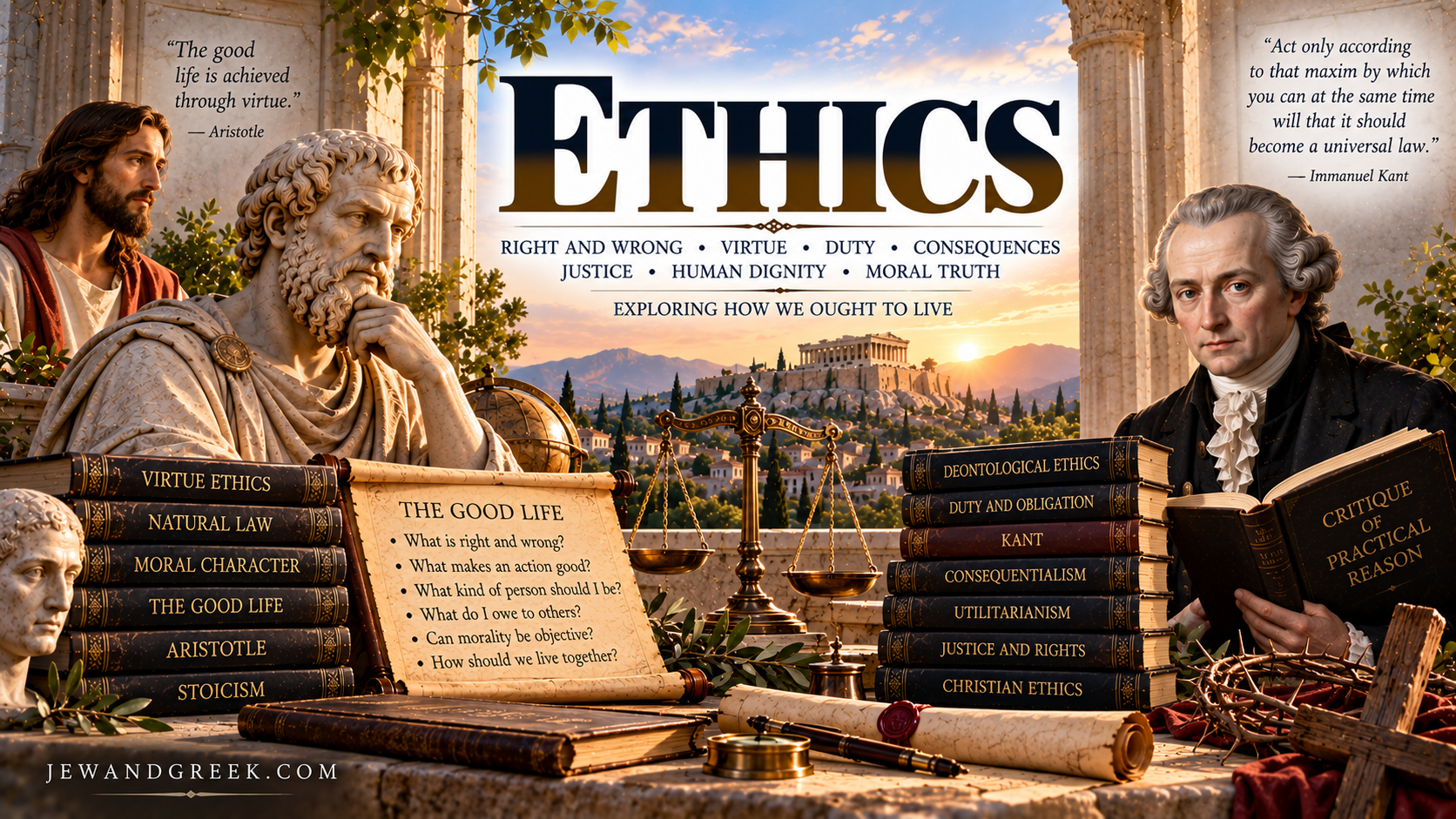
Ethics is the branch of philosophy concerned with morality and the question of how human beings ought to live. It asks what makes actions right or wrong, whether moral truths exist independently of human opinion, what constitutes a good life, what responsibilities we have toward other people, and what kind of persons we should become. Questions of justice, honesty, courage, sexuality, violence, wealth, loyalty, punishment, compassion, and human dignity all ultimately involve ethical judgments. Even the claim that people should be free to determine their own values is itself a moral claim requiring some account of why such freedom ought to be respected.
Ethics is therefore both intensely practical and deeply philosophical. People make moral decisions every day, often without consciously considering the theories behind them. Yet disagreement eventually forces deeper questions to the surface. If one person says an action is wrong and another says it is acceptable, how can the dispute be resolved? Is morality determined by consequences, duties, virtues, intentions, divine commands, human nature, cultural traditions, personal preferences, or some combination of these? Philosophy attempts to move beyond simply announcing moral convictions and asks what makes those convictions rationally defensible.
What Is Morality?
Morality concerns standards governing how people ought to act and what kinds of lives they ought to pursue. Moral judgments differ from simple descriptions. Saying that people sometimes lie is a descriptive statement about human behavior; saying that people ought not lie is a normative statement about how they should behave. This distinction between what is and what ought to be lies near the heart of ethical philosophy.
Moral language includes concepts such as good and evil, right and wrong, justice and injustice, duty and obligation, virtue and vice. These concepts appear across human societies even though cultures sometimes disagree dramatically about their application. Ethics examines both the similarities and differences among moral systems while asking whether any standard exists by which the systems themselves can be evaluated. Without such a standard, moral disagreement may ultimately amount to competing preferences. If objective moral truth exists, however, individuals and entire cultures can potentially be mistaken about morality.
Metaethics
Before asking which actions are right, philosophers can ask what statements about right and wrong actually mean. This area is called metaethics. When someone says that murder is wrong, is that person describing an objective moral fact, expressing a personal attitude, reporting a cultural rule, issuing a command, or doing something else?
Metaethical questions lie underneath ordinary moral debates. Moral realism generally maintains that at least some moral claims describe objective truths. Various forms of moral anti-realism deny that moral properties or facts exist independently in that sense. Other theories interpret moral language primarily through emotions, prescriptions, social practices, or human responses. The disagreement matters because arguing about what people should do presupposes something about what the word should means and whether moral claims can actually be true or false.
Moral Realism
Moral realism holds that at least some moral truths exist independently of individual preference. If deliberately torturing an innocent person merely for amusement is objectively wrong, its wrongness does not disappear because the perpetrator approves of it or because a society decides to permit it. The moral realist therefore distinguishes what people happen to believe from what is actually morally true.
The difficulty lies in explaining the nature and foundation of those truths. Some philosophers ground morality in rational principles, human flourishing, natural law, or facts about conscious creatures. Theistic philosophers often argue that objective morality ultimately depends upon God’s nature and the moral order God has established. Different versions of realism therefore disagree significantly about moral foundations even while agreeing that morality cannot simply be reduced to personal taste.
Moral Relativism
Moral relativism emphasizes the relationship between moral judgments and particular cultures, societies, or perspectives. Anthropological observation clearly demonstrates that cultures have disagreed about marriage, warfare, punishment, property, sexuality, gender roles, religious obligations, and numerous other moral questions. Awareness of such diversity can encourage humility about assuming that one’s own customs are universal.
Yet cultural disagreement does not by itself demonstrate that there is no objective moral truth. Societies have also disagreed about astronomy, medicine, and history without making truth relative to each society. Moral relativism also encounters difficulty when evaluating practices such as slavery, genocide, or systematic abuse. If whatever a society approves automatically becomes morally right for that society, there appears to be no moral standpoint from which reformers can correctly say that their own culture is unjust. Ethical diversity is therefore an important fact requiring explanation, but its existence does not settle the philosophical question of moral truth.
Subjectivism
Moral subjectivism locates morality primarily in individual attitudes or preferences. On a simple version, saying “stealing is wrong” means something like “I disapprove of stealing.” This explains why moral judgments can be deeply connected with personal commitments and emotions, but it creates difficulties when people genuinely disagree.
If one person says slavery is wrong while another says slavery is acceptable, subjectivism can transform the disagreement into two reports about personal preference: one person dislikes slavery and another does not. Yet moral argument ordinarily seems to claim something stronger. Abolitionists were not merely announcing that slavery did not suit their tastes; they were arguing that people ought not be enslaved, including in societies that accepted slavery. The persistence of moral criticism therefore raises questions about whether morality can be explained entirely through individual attitudes.
The Is-Ought Problem
David Hume famously observed that writers sometimes move from statements about what is the case to conclusions about what ought to be the case without explaining the transition. Descriptive facts alone do not obviously generate moral obligations. Knowing that stronger people are capable of dominating weaker people does not establish that they ought to do so.
The is-ought problem remains important because ethical arguments frequently contain hidden moral premises. Scientific facts can tell us what consequences an action will probably produce, but deciding whether those consequences are desirable requires some value judgment. Biology can describe aspects of human behavior without automatically telling us which behaviors should be encouraged. Good ethical reasoning therefore makes its normative assumptions explicit rather than smuggling them into apparently factual conclusions.
Virtue Ethics
Virtue ethics focuses primarily upon character rather than isolated actions or rules. Instead of beginning with “What should I do?” virtue ethics asks, “What kind of person should I become?” The tradition is strongly associated with Aristotle, though discussions of virtue appear much earlier and across numerous philosophical and religious traditions.
For Aristotle, the goal of human life involved eudaimonia, often translated as flourishing or living well. Virtues such as courage, justice, wisdom, generosity, and self-control are stable dispositions that enable people to live excellent human lives. Virtue is developed through habit and practice rather than acquired merely by learning rules. A courageous person becomes courageous by repeatedly learning to respond properly to fear, while a just person develops patterns of acting justly.
Aristotle and the Golden Mean
Aristotle often described virtue as a mean between extremes, though this should not be misunderstood as recommending mediocrity or always choosing the middle position. Courage, for example, lies between cowardice and recklessness. Generosity lies between stinginess and wastefulness. The appropriate response depends upon the circumstances, which is why moral wisdom cannot be reduced to a mechanical formula.
Aristotle called the practical wisdom required for good moral judgment phronesis. A virtuous person must learn not only general principles but how those principles apply in complex situations. This insight continues to influence ethics because real moral decisions often involve competing responsibilities, incomplete information, and circumstances that no simple rule anticipates perfectly. Character and judgment therefore remain essential even within ethical systems that emphasize duties or consequences.
Stoic Ethics
The Stoics developed another influential approach to virtue. Thinkers such as Seneca, Epictetus, and Marcus Aurelius argued that the genuinely good life depends upon virtue rather than external circumstances such as wealth, reputation, health, or political power. Human beings should distinguish what lies within their control from what does not and should cultivate wisdom, courage, justice, and self-discipline.
Stoicism has experienced a significant modern revival because its emphasis upon emotional discipline and resilience resonates with contemporary concerns. Yet ancient Stoicism was more than a collection of techniques for reducing stress. It belonged to a comprehensive philosophical worldview involving nature, reason, providence, and human participation in a rational cosmic order. Removing Stoic practices from that larger framework can therefore obscure the philosophical foundations from which the practices originally developed.
Deontological Ethics
Deontological ethics emphasizes duties, obligations, and principles rather than judging actions solely by their consequences. Certain actions may be morally required or forbidden because of what they are, regardless of whether violating the rule could produce desirable results in a particular case.
Immanuel Kant developed the most influential modern form of deontological ethics. Kant believed morality should be grounded in reason and should apply universally rather than depend upon changing desires or circumstances. Human beings possess a dignity that requires treating persons as ends in themselves rather than merely as tools for achieving other objectives. This principle has profoundly influenced modern discussions of human rights, autonomy, consent, and personal dignity.
Kant and the Categorical Imperative
Kant formulated his moral philosophy through what he called the categorical imperative. One formulation instructs us to act only according to principles that we could rationally will to become universal laws. If someone considers lying whenever dishonesty is personally convenient, that person should ask what would happen if everyone adopted the same principle. A universal practice of deceptive promises would eventually undermine the very institution of promising.
Another formulation commands people to treat humanity, whether in themselves or others, always as an end and never merely as a means. This emphasizes the intrinsic worth of rational persons. Even when we legitimately cooperate with others to accomplish goals, we should not manipulate or exploit them as though their own purposes and dignity were irrelevant. Kant’s theory has therefore remained enormously influential even among philosophers who reject portions of his broader philosophical system.
Consequentialism
Consequentialism evaluates actions primarily according to their results. Rather than asking whether an action conforms to a particular rule or expresses a particular virtue, consequentialist theories ask what consequences the action produces.
This approach has considerable intuitive appeal because consequences clearly matter morally. Good intentions do not make catastrophic outcomes irrelevant, and responsible decision-making normally requires considering how our choices affect other people. Yet consequentialism raises difficult questions about which consequences matter, how they should be measured, whose welfare should count, and whether some actions should remain prohibited even when violating a rule might produce better overall results.
Utilitarianism
The most influential form of consequentialism is utilitarianism, associated especially with Jeremy Bentham and John Stuart Mill. Classical utilitarianism seeks the greatest overall happiness or well-being for the greatest number. Each person’s welfare counts, and moral decisions should attempt to maximize overall good rather than privilege the interests of a particular individual merely because that person happens to be making the decision.
Utilitarian reasoning has influenced economics, public policy, medicine, and discussions of animal welfare. It also produces famous moral dilemmas. If sacrificing one innocent person could save five others, would doing so be morally justified? Strict calculations of overall welfare can sometimes conflict with intuitions concerning individual rights and justice. Defenders have developed more sophisticated forms, including rule utilitarianism, which evaluates general rules according to their consequences rather than calculating every individual act independently.
The Trolley Problem
The trolley problem is one of philosophy’s best-known ethical thought experiments. Imagine a runaway trolley heading toward five people who will be killed unless it is redirected onto another track where one person will die. Should someone pull the lever and redirect the trolley?
Variations make the problem increasingly uncomfortable. Would it be permissible to push a person from a bridge if doing so would stop the trolley and save five others? Many people who would pull the lever hesitate to push the person, even though the numerical consequences appear identical. Philosophers use these scenarios not because runaway trolleys are a major social problem but because they expose intuitions about intention, responsibility, direct harm, consequences, and the moral difference between causing and allowing harm.
Intention and Moral Responsibility
Consequences are not the only factors people ordinarily consider when evaluating actions. Intentions matter as well. Accidentally causing harm is generally judged differently from deliberately causing the same harm, even when the physical result is identical. Legal systems likewise distinguish negligence, recklessness, and intentional wrongdoing.
Christian ethics gives particular attention to motives because moral evaluation extends beyond outward behavior to the intentions of the heart. Jesus’ teachings concerning anger, lust, hypocrisy, love, and forgiveness emphasize that moral transformation cannot be reduced to external compliance. Yet good intentions alone are insufficient. A person can sincerely intend to help while acting recklessly or ignorantly. Mature moral reasoning therefore considers intention, action, character, circumstances, and consequences together.
Natural Law
Natural law theory holds that moral principles can in some sense be discovered through reason and reflection upon human nature and the purposes inherent in human life. The tradition has ancient roots but became especially influential through Thomas Aquinas, who integrated Aristotelian philosophy with Christian theology.
For Aquinas, moral goodness corresponds to the rational ordering of human life toward genuine goods and ultimately toward God. Natural law does not mean merely observing what commonly occurs in nature and imitating it. Rather, it involves understanding the kinds of beings humans are and the goods toward which human capacities are properly directed. Natural law reasoning has influenced Christian thought on justice, sexuality, marriage, political authority, human rights, and the moral limits of government.
Divine Command Theory
Divine command theory connects moral obligation with the commands of God. On a straightforward version, actions are morally required because God commands them and wrong because God forbids them. This approach fits naturally with the importance of divine commandments within Judaism, Christianity, and Islam.
Yet the theory raises an ancient philosophical challenge known as the Euthyphro dilemma, originating in Plato’s dialogue Euthyphro. Is something good because God commands it, or does God command it because it is independently good? The first option can appear to make morality arbitrary, while the second seems to place a moral standard above God. Many Christian philosophers respond that the dilemma presents a false choice: goodness is grounded ultimately in God’s nature, while divine commands express that morally perfect nature. On this account, God neither invents goodness arbitrarily nor submits to a moral reality external to himself.
The Euthyphro Dilemma
The Euthyphro dilemma remains important because it forces theistic ethics to explain the relationship between God and morality carefully. Simply saying “God commands it” does not answer every philosophical question concerning why God’s commands are good. At the same time, treating goodness as entirely independent of God can create tension with classical Christian claims that God is the ultimate foundation of reality.
A nature-based response maintains that God is necessarily loving, just, faithful, and good, and that moral values reflect God’s character. Commands therefore have moral authority because they proceed from a perfectly good God rather than from arbitrary power. Philosophers continue to debate whether this solution succeeds, but the discussion illustrates how ancient Greek philosophical questions became deeply intertwined with Christian theology.
Moral Arguments for God
Some philosophers reverse the question and ask whether objective morality itself provides evidence for God. Moral arguments for God’s existence generally reason that if objective moral values and duties exist, they may require a transcendent foundation capable of grounding their authority. If moral obligations are more than human preferences or evolutionary behaviors, what explains their objective character?
Critics argue that morality may be grounded without God through reason, human flourishing, necessary moral truths, or other naturalistic and philosophical accounts. Others question whether invoking God explains morality rather than relocating the problem. The debate therefore involves both ethics and metaphysics. It asks not merely whether people possess moral beliefs but what kind of reality would have to exist for objective moral obligations to be genuinely binding.
Human Nature and the Good Life
Ethical systems often depend upon assumptions about human nature. Aristotle’s ethics assumes that human beings possess characteristic capacities whose proper development contributes to flourishing. Utilitarian theories emphasize conscious experiences of happiness and suffering. Kant emphasizes rational agency. Christian ethics understands human beings as creatures made in the image of God but affected by sin and in need of redemption.
Different accounts of human nature naturally produce different visions of the good life. If human beings are primarily pleasure-seeking organisms, morality may focus upon maximizing satisfaction. If they are rational agents, autonomy and rational duty become central. If they are creatures designed for relationship with God and others, then love, holiness, worship, community, and moral transformation acquire fundamental significance. Ethical disagreement therefore often reaches deeper than individual moral rules into competing understandings of what a human being actually is.
Justice
Justice concerns what people are owed and how benefits, burdens, opportunities, rights, and responsibilities should be distributed. Ancient philosophers treated justice as both a personal virtue and a feature of properly ordered society. Plato devoted much of The Republic to the question of justice, while Aristotle distinguished several kinds of justice involving distribution, correction, and fairness.
Modern political philosophy has developed extensive theories of justice involving equality, liberty, rights, property, opportunity, punishment, and social institutions. John Rawls famously proposed evaluating principles of justice from behind a hypothetical veil of ignorance, where people would choose social arrangements without knowing what position they themselves would occupy. Robert Nozick offered a contrasting defense of individual rights and limited government. These debates show how ethical principles eventually become questions about political institutions and social organization.
Rights
The language of rights dominates much modern ethical and political discussion. Human rights are generally understood as claims or protections belonging to persons because of their status as human beings rather than because governments happen to grant them. Rights may involve life, liberty, conscience, property, due process, speech, religious exercise, or protection from certain forms of coercion and abuse.
Rights language nevertheless raises philosophical questions. Where do rights come from? What grounds them? Can rights conflict, and if so, how should those conflicts be resolved? Does every important human good generate a corresponding right? Christian thinkers have contributed to the development of ideas concerning natural rights and human dignity, frequently grounding them in creation and the image of God. Secular philosophers have developed alternative foundations based upon rational agency, autonomy, human needs, or social cooperation.
The Image of God and Human Dignity
Christian ethics begins with a distinctive claim about human beings: humanity is created in the image of God. Human worth therefore does not ultimately depend upon intelligence, productivity, wealth, race, nationality, social status, physical ability, age, or usefulness to society. Human beings possess a dignity grounded in their relationship to their Creator.
This conviction has significant ethical implications. The vulnerable cannot simply be valued according to what they contribute economically or socially. The powerful do not possess greater intrinsic human worth than the weak. Even enemies remain human beings toward whom moral obligations exist. Christians have not always lived consistently with these principles, but the biblical doctrine provides a basis from which Christian communities themselves can be morally criticized when their practices contradict the dignity they profess.
Love and Christian Ethics
Jesus summarized the moral law through love of God and love of neighbor. Christian love, however, is not merely emotional affection. It involves seeking the genuine good of another person, including when doing so requires sacrifice, patience, forgiveness, courage, or truthfulness.
This emphasis does not eliminate moral rules. Rather, it gives them a relational orientation. Prohibitions against murder, theft, adultery, deception, and exploitation protect goods essential to human relationships. The New Testament’s descriptions of love include both positive actions and restrictions upon harmful behavior. Christian ethics therefore resists both a legalism concerned only with rule keeping and a sentimentalism that defines love as unconditional approval of whatever another person desires.
The Sermon on the Mount
The Sermon on the Mount contains some of Christianity’s most influential ethical teaching. Jesus addresses anger, reconciliation, lust, divorce, truthfulness, retaliation, love for enemies, generosity, prayer, material possessions, judgment, and treatment of others. Again and again, the teaching reaches beyond outward compliance toward the dispositions and motivations underlying behavior.
The command to love enemies is particularly striking because it challenges the ordinary human tendency to limit moral concern to friends and members of one’s own group. Jesus does not deny the existence of wrongdoing or require calling evil good. Rather, he rejects hatred and personal vengeance as governing principles for his followers. Christian ethics consequently combines moral seriousness with mercy, justice with forgiveness, and truth with love.
Virtue and the Fruit of the Spirit
Christian moral formation contains significant parallels with virtue ethics. The New Testament repeatedly describes character traits believers are expected to develop rather than presenting morality merely as compliance with isolated commands. Paul’s description of the fruit of the Spirit—love, joy, peace, patience, kindness, goodness, faithfulness, gentleness, and self-control—portrays moral life as transformation of character.
Christian virtue nevertheless differs from purely Aristotelian self-development because transformation is understood as involving divine grace and the work of the Holy Spirit. Human beings practice obedience, discipline their desires, acquire wisdom, and develop habits, but moral maturity is not portrayed merely as autonomous self-improvement. The goal is conformity to the character of Christ within a life reconciled to God.
Conscience
Conscience refers broadly to a person’s internal awareness and judgment concerning right and wrong. Christian theology gives conscience significant importance, and the apostle Paul discusses situations in which believers possess different conscientious judgments concerning disputed practices.
Conscience, however, is not treated as infallible. A person’s conscience can be weak, misinformed, insensitive, or shaped by cultural assumptions. Simply saying “my conscience tells me” cannot settle every moral question. Conscience itself requires formation through truth, wisdom, experience, Scripture, and mature judgment. Respecting conscience therefore differs from treating every sincere moral intuition as automatically correct.
Moral Dilemmas
Real life sometimes presents situations in which important moral principles appear to conflict. Is lying permissible to protect an innocent person from a murderer? Can property be taken to prevent starvation? When should confidentiality yield to the need to prevent serious harm? Such moral dilemmas expose differences among ethical theories because consequentialists, deontologists, virtue ethicists, and natural-law thinkers may analyze the same case differently.
Thought experiments can clarify principles, but real situations often contain details absent from hypothetical scenarios. Moral wisdom therefore requires more than memorizing solutions to famous puzzles. It requires accurate information, understanding relevant duties, anticipating consequences, recognizing the people affected, and possessing the character necessary to choose responsibly when no option feels entirely satisfactory.
Applied Ethics
Applied ethics brings ethical principles into concrete areas of human life. Bioethics considers abortion, euthanasia, genetic engineering, organ transplantation, medical consent, and emerging reproductive technologies. Business ethics addresses honesty, labor, contracts, environmental responsibility, advertising, and corporate power. Environmental ethics asks what responsibilities human beings possess toward animals, ecosystems, and future generations.
Technology has created additional questions concerning privacy, artificial intelligence, surveillance, automation, digital manipulation, and responsibility for decisions made partly by algorithms. These issues demonstrate why ancient ethical questions remain relevant. Technology changes what human beings are capable of doing much faster than it answers whether they ought to do it.
Ethics and Science
Science provides essential information for many ethical decisions but cannot by itself determine every moral conclusion. Medical research can tell us how a treatment affects the body, but deciding whether a procedure is morally permissible involves additional judgments concerning autonomy, harm, dignity, justice, and responsibility. Climate science can describe environmental consequences, while ethical reasoning addresses what obligations current populations have toward future generations.
This is another expression of the is-ought distinction. Facts matter enormously because ethical decisions based upon false information can produce disastrous results. Yet facts must be combined with values before they generate prescriptions. Ethical reasoning and scientific knowledge therefore complement one another without being identical.
Ethics in a Pluralistic Society
Modern societies contain people with profoundly different religious, philosophical, and moral commitments. This creates the practical challenge of living together despite disagreement over questions people consider extremely important. A pluralistic society must develop institutions capable of protecting meaningful freedoms while establishing laws that inevitably reflect some judgments about justice, rights, harm, and public responsibility.
Pluralism does not mean pretending moral disagreements are insignificant or that every position is equally correct. Nor does tolerance require approving everything that is tolerated. The challenge is determining which disagreements can coexist peacefully, which actions legitimately require legal restriction, and what principles should govern those decisions. These questions lie at the intersection of ethics, political philosophy, law, and religion.
Can Morality Exist Without God?
One of the most important debates in philosophy of religion asks whether morality requires God. Many nonreligious people clearly possess strong moral convictions and live compassionate, principled lives, so the philosophical question is not whether atheists can behave morally. The deeper question concerns what ultimately grounds objective moral values and obligations if God does not exist.
Secular ethical theories appeal to human flourishing, rationality, social cooperation, empathy, evolutionary development, or objective moral facts that do not depend upon a deity. Christian philosophers respond in different ways, often arguing that these accounts can describe moral behavior or recognize moral truths without fully explaining their ultimate foundation. The debate should therefore distinguish moral knowledge, moral behavior, and the metaphysical grounding of morality. These are related but different questions.
Christian Ethics
Christian ethics is rooted ultimately not in an abstract philosophical formula but in the character and purposes of God revealed through Scripture and supremely through Jesus Christ. Creation establishes the goodness and dignity of human life, sin explains the corruption of human desires and relationships, redemption calls people into reconciliation with God and one another, and the hope of resurrection gives moral significance to embodied human existence.
This framework includes commandments, consequences, virtues, intentions, relationships, and moral wisdom without fitting neatly into any single philosophical category. Christian ethics contains duties, but it is more than deontology. It values consequences, but it is not simply utilitarian. It emphasizes character, but virtue is understood in relation to God and transformation through the Spirit. Its central moral vision is ultimately personal: to love God, love one’s neighbor, become conformed to Christ, and live faithfully within God’s purposes for creation.
Why Ethics Matters
Ethics matters because every vision of human life contains some idea of what is worth pursuing. Individuals and societies make decisions about whom to protect, what behavior to praise or condemn, how resources should be distributed, when force is justified, what obligations parents and children possess, what governments may require, and how vulnerable people should be treated. Refusing to discuss morality does not eliminate these judgments; it merely leaves their assumptions unexamined.
The study of ethics forces us to ask not only what we believe but why we believe it. Are our moral convictions inherited customs, emotional reactions, rational conclusions, divine commands, expressions of human nature, or responses to objective truths? Can we consistently apply our principles when doing so disadvantages us or benefits someone we dislike? Ethical reflection becomes especially valuable when it exposes inconsistencies between the moral standards we demand from others and those we apply to ourselves.
The Search for the Good Life
From Socrates asking how one ought to live, through Aristotle’s account of virtue, the Stoics’ pursuit of wisdom, Aquinas’s natural law, Kant’s duties, Mill’s utilitarianism, and contemporary debates about rights and justice, philosophers have returned repeatedly to the same fundamental question: What is the good life? The answers differ because they arise from different understandings of reality, human nature, freedom, happiness, and ultimate purpose.
Christianity enters this conversation with a distinctive answer. The good life is not simply the life containing the greatest pleasure, the greatest autonomy, or even the most impressive moral achievements. Human flourishing is ultimately found in right relationship with God and with others, expressed through truth, love, justice, faithfulness, holiness, mercy, and the transformation of character. Ethics therefore asks more than which rules we should obey. At its deepest level, it asks what is good, why it is good, and what kind of people we ought to become.