

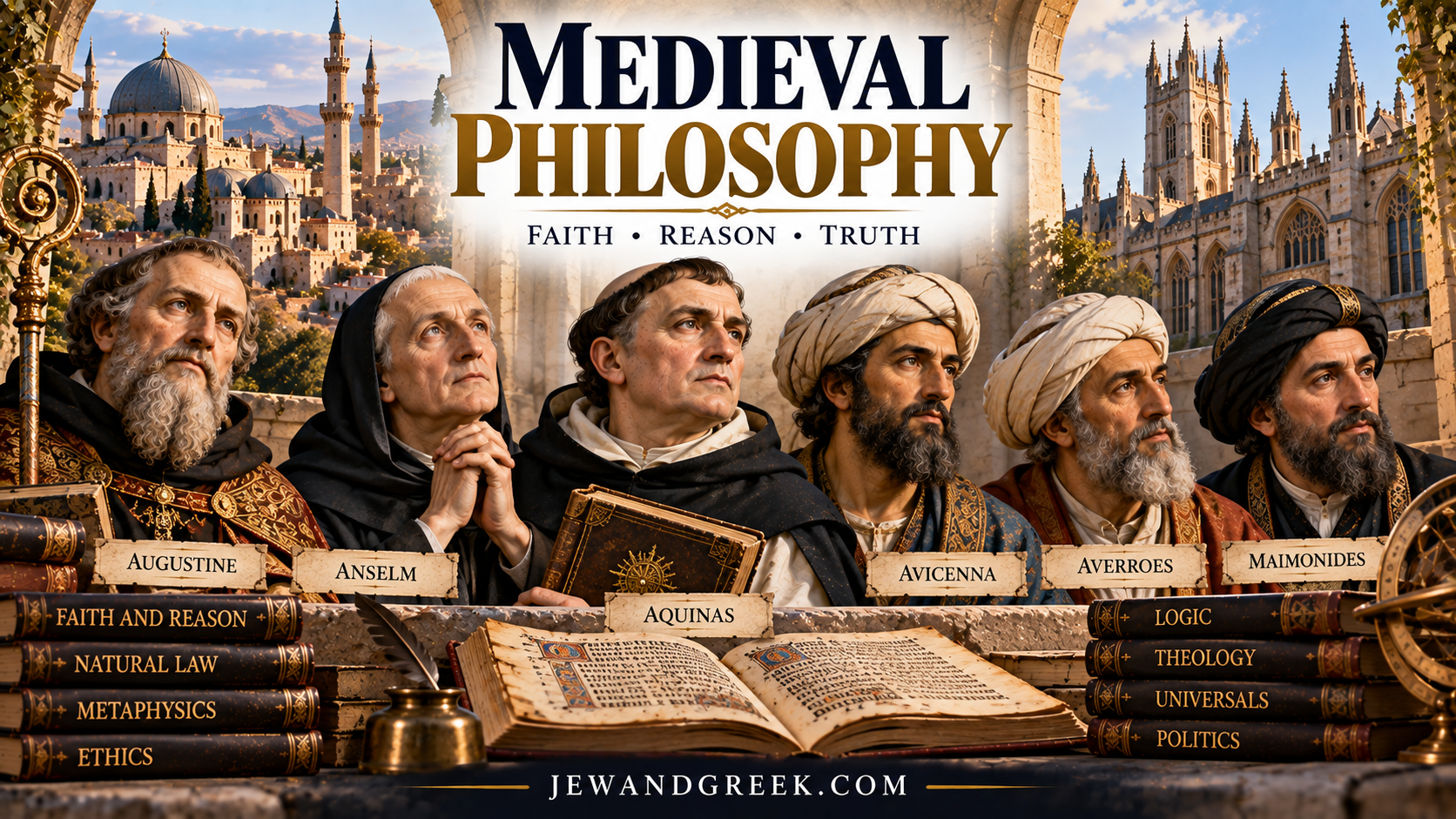
Medieval philosophy developed during the long period between the decline of the ancient Greco-Roman world and the emergence of early modern philosophy. Although the boundaries are approximate, it is commonly associated with the centuries from late antiquity through the Renaissance. Far from being an intellectual interruption between ancient Greece and the Enlightenment, the medieval period produced sophisticated debates about God, existence, knowledge, morality, human freedom, language, logic, and the relationship between faith and reason.
Christian thinkers played a central role in this tradition, but medieval philosophy was not exclusively Christian. Jewish and Islamic philosophers made major contributions, preserving and interpreting Greek philosophical works while developing philosophical traditions of their own. Thinkers such as Avicenna, Averroes, Maimonides, Anselm, and Thomas Aquinas participated in an intellectual world in which philosophical ideas crossed religious, linguistic, and geographical boundaries.
One of the defining questions of medieval philosophy was how truths discovered through human reason relate to truths believed to have been revealed by God. Could philosophy demonstrate God’s existence? Could reason explain the nature of the soul? Are moral truths accessible apart from revelation? What happens when philosophical conclusions appear to conflict with Scripture? These questions produced one of history’s most sustained examinations of the relationship between faith and reason.
From Ancient Philosophy to the Medieval World
Medieval philosophy inherited an enormous intellectual legacy from ancient Greece. Plato and Aristotle were particularly influential, although their influence developed differently over time. During late antiquity, Platonic and Neoplatonic philosophy strongly shaped the intellectual environment encountered by early Christian thinkers. Aristotle’s works later became increasingly important, especially after many of them were translated and transmitted through Islamic and Jewish intellectual traditions.
Christianity brought its own theological commitments into this philosophical environment. The biblical doctrine of creation differed significantly from many Greek accounts of an eternal cosmos. Christianity affirmed a personal God who acts in history, creates the world, reveals himself, judges human beings, and raises the dead. Christian teachings concerning incarnation and resurrection also resisted philosophical systems that regarded material existence as inherently inferior or salvation primarily as escape from the physical world.
The resulting encounter was neither simple acceptance nor wholesale rejection of Greek philosophy. Christian thinkers adopted philosophical vocabulary, criticized philosophical conclusions they considered incompatible with revelation, and transformed concepts to address distinctly Christian theological questions.
Augustine of Hippo
Augustine of Hippo stands at the transition between ancient and medieval thought and became one of the most influential thinkers in Western Christianity. Born in North Africa in AD 354, Augustine passed through several intellectual and religious stages before becoming a Christian. His encounter with Platonist and Neoplatonist writings helped him overcome some intellectual objections to Christianity, particularly his earlier difficulty conceiving of nonphysical reality.
Augustine did not simply become a Christian Platonist. He appropriated philosophical concepts selectively while subordinating them to Christian beliefs concerning creation, incarnation, sin, grace, and resurrection. His writings explored memory, time, free will, evil, knowledge, language, political society, divine foreknowledge, and the nature of human happiness.
Two of his most influential works are the Confessions and The City of God. The Confessions combines autobiography, theology, and philosophical reflection, including remarkable discussions of memory and time. The City of God, written partly in response to pagan accusations that Christianity had contributed to Rome’s decline, offered an extensive Christian interpretation of history, society, politics, and humanity’s ultimate destiny.
Augustine on Faith and Reason
Augustine rejected the idea that faith and reason must be enemies. Human beings inevitably begin with beliefs they have received from others, and understanding frequently develops from what is initially accepted through trust. At the same time, faith should seek understanding rather than celebrate ignorance.
This approach helped establish an enduring Christian intellectual tradition in which reason operates within a broader framework of faith. Augustine believed that all truth ultimately belongs to God, so genuine philosophical truth cannot finally contradict divine revelation when both are correctly understood.
Augustine also emphasized the inward search for truth. Human beings encounter truths of logic, mathematics, and morality that appear to possess a stability exceeding the changing human mind. His reflections contributed to later arguments that eternal truths ultimately require grounding in an eternal divine intellect.
Augustine and the Problem of Evil
One of Augustine’s most important philosophical contributions concerns evil. Earlier in his life, he had been attracted to Manichaeism, which understood good and evil in strongly dualistic terms. Christianity forced Augustine to reconsider whether evil could possess independent existence.
Augustine eventually argued that evil is not a substance created alongside good. Instead, evil is a privation or corruption of something that is fundamentally good. Blindness, for example, is not an independently existing substance but the absence of sight where sight should exist.
This understanding allowed Augustine to affirm that everything God creates is good while explaining evil as the disorder or corruption of created goods. His account became deeply influential in subsequent Christian discussions of the problem of evil.
Boethius and the Transition to the Middle Ages
Anicius Manlius Severinus Boethius, who lived around the turn of the sixth century, became an important bridge between ancient and medieval philosophy. He intended to translate and interpret major works of Plato and Aristotle for the Latin-speaking world, although political circumstances and his execution prevented completion of that ambitious project.
His best-known work, The Consolation of Philosophy, was written while he awaited execution. Presented as a dialogue between Boethius and Lady Philosophy, it examines fortune, happiness, providence, freedom, and the apparent prosperity of evil people.
Boethius also made important contributions to logic and theological terminology. His discussions of personhood and divine foreknowledge influenced medieval debates for centuries. Particularly important was the problem of reconciling God’s complete knowledge of future events with genuine human freedom.
The Rise of Islamic Philosophy
Beginning in the eighth and ninth centuries, scholars in the Islamic world participated in a major translation movement that brought Greek philosophical and scientific texts into Arabic. Works by Aristotle, Plato, and other ancient thinkers were translated, studied, criticized, and developed within Islamic intellectual culture.
Muslim philosophers did much more than preserve Greek philosophy. They constructed sophisticated philosophical systems addressing God, creation, causation, knowledge, medicine, logic, metaphysics, and the soul. Their writings eventually became crucial to the transmission of Aristotle and other Greek thinkers into medieval Western Europe.
Among the important early Islamic philosophers was Al-Farabi, who drew extensively upon Plato and Aristotle while developing theories concerning logic, politics, metaphysics, and the structure of reality. His work helped prepare the intellectual environment in which Avicenna would develop one of medieval philosophy’s most influential metaphysical systems.
Avicenna
Ibn Sina, known in the Latin West as Avicenna, was a Persian philosopher and physician who lived from 980 to 1037. His intellectual influence extended across Islamic, Jewish, and Christian philosophy. Although deeply influenced by Aristotle, Avicenna developed an original philosophical system rather than simply commenting on Aristotelian texts.
One of his most important distinctions was between essence and existence. Knowing what something is does not necessarily tell us whether it actually exists. A horse, for example, possesses a definable essence whether or not a particular horse exists. Avicenna argued that contingent things do not contain within themselves a sufficient explanation for their own existence.
This led to his influential argument for a Necessary Existent—a reality whose existence is not dependent upon anything else. Everything contingent ultimately depends upon that which exists necessarily. Later Christian thinkers, including Thomas Aquinas, interacted extensively with this distinction between essence and existence.
Avicenna also developed the famous “Flying Man” thought experiment. He asks us to imagine a person created fully formed but suspended so that he receives no sensory information about his body or surroundings. Avicenna argues that such a person would nevertheless remain aware of his own existence, suggesting a distinction between self-awareness and bodily sensation.
Anselm of Canterbury
Anselm of Canterbury, who lived from 1033 to 1109, became one of the leading Christian philosophers and theologians of the early scholastic period. His intellectual approach is frequently summarized by the expression “faith seeking understanding.” Anselm did not approach philosophy as an attempt to replace Christian faith with autonomous reason. Instead, he sought deeper rational understanding of what he already believed.
Anselm is especially famous for the argument for God’s existence presented in his Proslogion. Rather than beginning with observations about the physical universe, he began with the concept of God as the greatest conceivable being.
The argument, later called the ontological argument, reasons in simplified form that if God is the greatest conceivable being, God cannot exist merely as an idea in the mind, since a being existing in reality would be greater than one existing only conceptually. The precise logic and interpretation of Anselm’s argument have been debated ever since.
A contemporary monk named Gaunilo objected that similar reasoning could seemingly prove the existence of a greatest conceivable island. Anselm responded that his reasoning applied uniquely to the kind of necessary being meant by God. Centuries later, philosophers including Descartes, Kant, and Alvin Plantinga would develop, criticize, or reformulate versions of the argument.
The Development of Scholasticism
Scholasticism was not a single philosophical doctrine. It was a method and intellectual culture that developed especially within medieval schools and universities. Scholastic thinkers carefully formulated questions, presented arguments on opposing sides, analyzed authorities, distinguished different meanings of terms, and attempted to resolve apparent contradictions through precise reasoning.
A typical scholastic discussion might begin with a question, present several objections to a proposed answer, cite arguments pointing in another direction, offer a carefully reasoned conclusion, and then respond individually to the original objections.
To modern readers this method can initially appear overly formal. In practice, however, it forced scholars to confront opposing arguments directly rather than ignoring them. Thomas Aquinas’s Summa Theologiae provides the most famous example of this method.
The rise of universities in cities such as Paris, Oxford, and Bologna created institutions where theology, philosophy, law, medicine, and the liberal arts could be studied systematically. Logic and disputation became central tools of academic education.
The Rediscovery of Aristotle
Aristotle’s increasing availability transformed medieval European philosophy. For centuries, much of Aristotle’s work had been inaccessible in the Latin West. Through translations from Greek and Arabic, medieval scholars gained access to a far larger body of Aristotelian writings on metaphysics, natural philosophy, psychology, ethics, and other subjects.
This created both excitement and controversy. Aristotle offered an extraordinarily comprehensive account of nature and reality, but some of his conclusions appeared difficult to reconcile with Christian doctrine. The philosophical tradition associated with Aristotle also arrived accompanied by interpretations from major Islamic philosophers.
Christian thinkers therefore faced the challenge of determining what could be adopted, what required modification, and what had to be rejected.
Averroes
Ibn Rushd, known in Latin as Averroes, lived from 1126 to 1198 in Islamic Spain and became one of history’s most influential commentators on Aristotle. His interpretations became so important in medieval Europe that he was frequently referred to simply as “the Commentator,” while Aristotle was called “the Philosopher.”
Averroes defended the legitimate use of philosophical reasoning and attempted to reconcile philosophy with Islamic revelation. His writings generated extensive discussion concerning the intellect, the eternity of the world, causation, and the relationship between philosophical demonstration and religious teaching.
Latin interpretations of Averroes became controversial within Christian universities. Certain positions associated with Latin Averroism appeared incompatible with Christian teachings about creation and individual immortality. Aquinas engaged seriously with Averroes while rejecting conclusions he believed contradicted both sound philosophy and Christian revelation.
Maimonides and Jewish Philosophy
Moses Maimonides, who lived from 1138 to 1204, was one of the most important Jewish philosophers of the medieval period. Born in Córdoba and later active in Egypt, he combined Jewish theological scholarship with extensive engagement with Aristotelian philosophy.
His Guide for the Perplexed addressed educated Jews troubled by apparent conflicts between Scripture and philosophical reasoning. Maimonides argued that biblical language about God must often be understood carefully rather than interpreted in crudely literal terms.
He became particularly important for his use of negative theology. Because God transcends created categories, positive descriptions can easily imply limitations inappropriate to God. Maimonides therefore emphasized explaining what God is not rather than pretending that human concepts can comprehensively describe the divine essence.
His writings influenced both Jewish philosophy and Christian thinkers, including Thomas Aquinas.
Thomas Aquinas
Thomas Aquinas, who lived from approximately 1225 to 1274, became the most influential Christian Aristotelian philosopher of the Middle Ages. A Dominican friar educated in the developing university tradition, Aquinas sought to demonstrate that properly understood Aristotelian philosophy could be integrated with Christian theology without allowing philosophy to control revelation.
Aquinas distinguished truths accessible to natural reason from truths known only because God reveals them. Human reason, he argued, can reach certain conclusions about God’s existence and attributes by examining creation. Doctrines such as the Trinity and Incarnation, however, cannot be discovered by unaided philosophical reasoning and depend upon revelation.
For Aquinas, faith and reason ultimately cannot contradict because God is the source of both created reality and divine revelation. Apparent conflicts arise from errors in reasoning, errors of interpretation, or incomplete understanding.
Aquinas and the Five Ways
Aquinas is especially famous for the “Five Ways” presented near the beginning of the Summa Theologiae. These are brief arguments intended to demonstrate that human reason can arrive at the existence of God from features of the world.
The arguments begin from change, efficient causation, contingency, gradations of qualities, and the apparent directedness of natural processes. The first way, for example, draws upon Aristotle’s analysis of actuality and potentiality and reasons from things undergoing change toward a first unmoved source of change.
These arguments are sometimes presented as though they were five modern scientific proofs. That can distort Aquinas’s project. His reasoning depends upon a broader Aristotelian metaphysical framework concerning causation, actuality, potentiality, contingency, and explanation.
The Five Ways continue to be defended, criticized, and reformulated within contemporary philosophy of religion.
Essence and Existence
One of Aquinas’s most important metaphysical developments concerned the relationship between essence and existence. In ordinary created things, what something is and the fact that it exists are distinguishable. Nothing about the essence of a horse, tree, or human being requires that a particular instance must exist.
Aquinas argued that created things therefore possess existence dependently. God, by contrast, does not merely possess existence as one property among others. In Aquinas’s metaphysics, God’s essence and existence are identical. God is not simply one existing being alongside other beings but the ultimate source upon which all finite existence depends.
This understanding became foundational for the philosophical tradition later known as Thomism.
Natural Law and Ethics
Aquinas also developed an influential theory of natural law. Drawing partly upon Aristotle, Stoic traditions, Roman law, and Christian theology, he argued that moral order is rooted in the rational structure of creation.
Human beings possess characteristic goods corresponding to their nature. Because human beings are rational creatures, they can recognize basic moral principles through reason. Natural law therefore does not mean merely observing what happens in nature and copying it. It concerns rational participation in an objective moral order grounded ultimately in God’s eternal law.
Natural-law reasoning profoundly influenced later Christian ethics, political philosophy, jurisprudence, and debates concerning human rights.
Universals and the Problem of Categories
Medieval philosophers devoted enormous attention to questions about universals. When we describe Socrates and Plato as human beings, what exactly does the common term human refer to? Does humanity exist as some reality shared by individual people, or is the universal merely a name humans use to classify similar things?
These debates produced positions often associated with realism, conceptualism, and nominalism. The disagreements were not trivial disputes over words. They involved deeper questions about how language corresponds to reality and how human knowledge identifies common features among individual things.
The problem of universals connects medieval philosophy directly to contemporary questions in metaphysics and philosophy of language.
William of Ockham
William of Ockham, an English Franciscan philosopher of the fourteenth century, became closely associated with nominalism and with a principle later called “Ockham’s Razor.” The familiar principle advises against multiplying entities beyond necessity when explaining something.
Ockham did not invent the general preference for explanatory simplicity, nor did he formulate the principle exactly in the modern slogan commonly attributed to him. Nevertheless, his philosophical method emphasized avoiding unnecessary metaphysical assumptions.
His work contributed to changing discussions about universals, knowledge, theology, and the limits of philosophical demonstration. Ockham also became involved in significant disputes concerning papal authority and political power.
Faith and Reason in Medieval Philosophy
The relationship between faith and reason runs throughout medieval philosophy, but medieval thinkers did not all understand that relationship in the same way. Augustine emphasized understanding emerging within faith. Anselm described his project as faith seeking understanding. Aquinas distinguished truths available to natural reason from mysteries accessible only through revelation.
Islamic and Jewish philosophers confronted analogous questions within their own religious traditions. Avicenna developed a highly systematic philosophical metaphysics. Averroes defended philosophical demonstration while interpreting its relationship to revelation. Maimonides attempted to help religious believers navigate apparent conflicts between Scripture and philosophy.
The medieval period therefore cannot be reduced to a simple claim that philosophers tried to prove what religion already taught. It contained genuine disagreements over what reason can establish, how revelation should be interpreted, and where the limits of philosophical inquiry lie.
Was Medieval Philosophy a “Dark Age”?
Popular accounts sometimes describe the Middle Ages as a “Dark Age” in which religious authority suppressed intellectual inquiry until the Renaissance and Enlightenment restored reason. This picture is historically inadequate.
The medieval period certainly contained political instability, religious conflict, censorship, and intellectual limitations. But it also witnessed the creation and expansion of universities, major developments in logic, systematic study of Aristotle, extensive translation movements, sophisticated philosophical debates, and substantial work in mathematics, medicine, astronomy, law, and natural philosophy.
Medieval thinkers preserved ancient ideas, but they also criticized and developed them. Moreover, much of the recovery of Greek philosophy in Western Europe occurred through interaction with Islamic and Jewish scholars. The history is therefore better understood as a complicated transmission and transformation of intellectual traditions than as a simple disappearance and rediscovery of reason.
Medieval Philosophy and the Reformation
By the late Middle Ages, scholastic philosophy had developed into several competing schools. Thomists, Scotists, nominalists, and other traditions disagreed over metaphysics, knowledge, grace, freedom, and theological method.
The Protestant Reformers inherited this intellectual environment. Martin Luther was educated within a late-medieval scholastic context and became sharply critical of certain uses of Aristotle in theology. Yet Protestantism did not permanently abandon philosophical or scholastic reasoning. Later Lutheran and Reformed theologians developed sophisticated Protestant scholastic traditions of their own.
The Reformation therefore changed the relationship between theology and medieval philosophical authority without eliminating philosophy from Christian intellectual life.
The Legacy of Medieval Philosophy
Medieval philosophy created much of the intellectual framework inherited by early modern Europe. Debates concerning universals anticipated later questions about language and categories. Discussions of divine foreknowledge and free will remain alive in philosophy of religion. Arguments developed by Anselm and Aquinas continue to be debated. Natural-law theory remains influential in ethics, law, and political philosophy.
Perhaps most importantly, medieval philosophy demonstrates that the relationship between faith and reason cannot be reduced to simple opposition. Christian, Jewish, and Islamic thinkers disagreed profoundly about revelation and theology, yet all participated in philosophical debates concerning reality, knowledge, causation, morality, and God.
The medieval period therefore stands as an intellectual bridge between ancient and modern philosophy, but it was much more than a bridge. It produced philosophical systems and arguments that continue to shape discussions about God, existence, morality, human freedom, and the limits of reason.