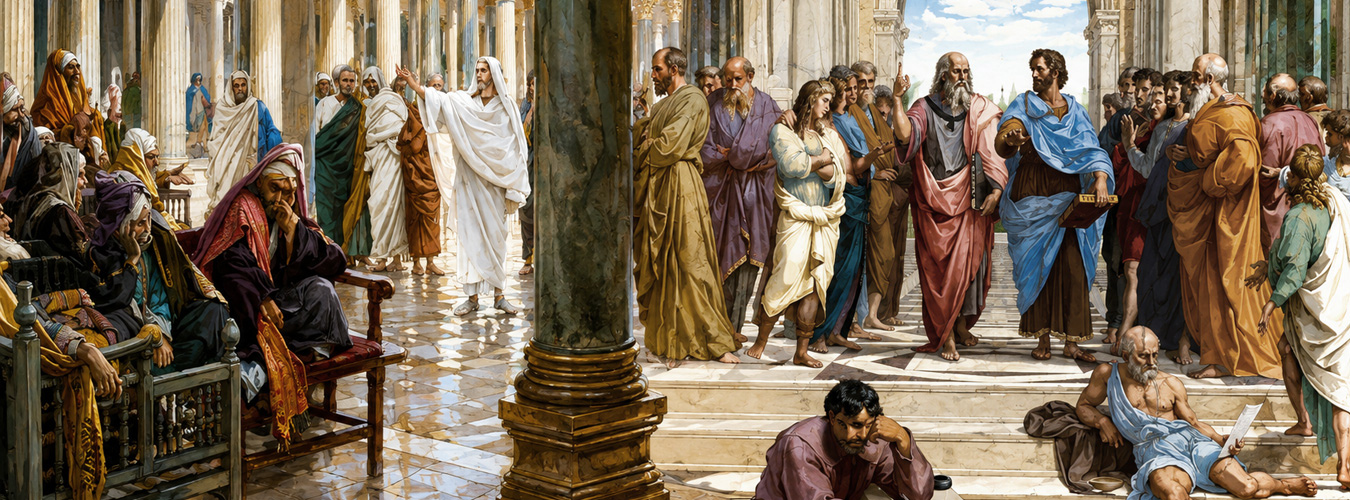

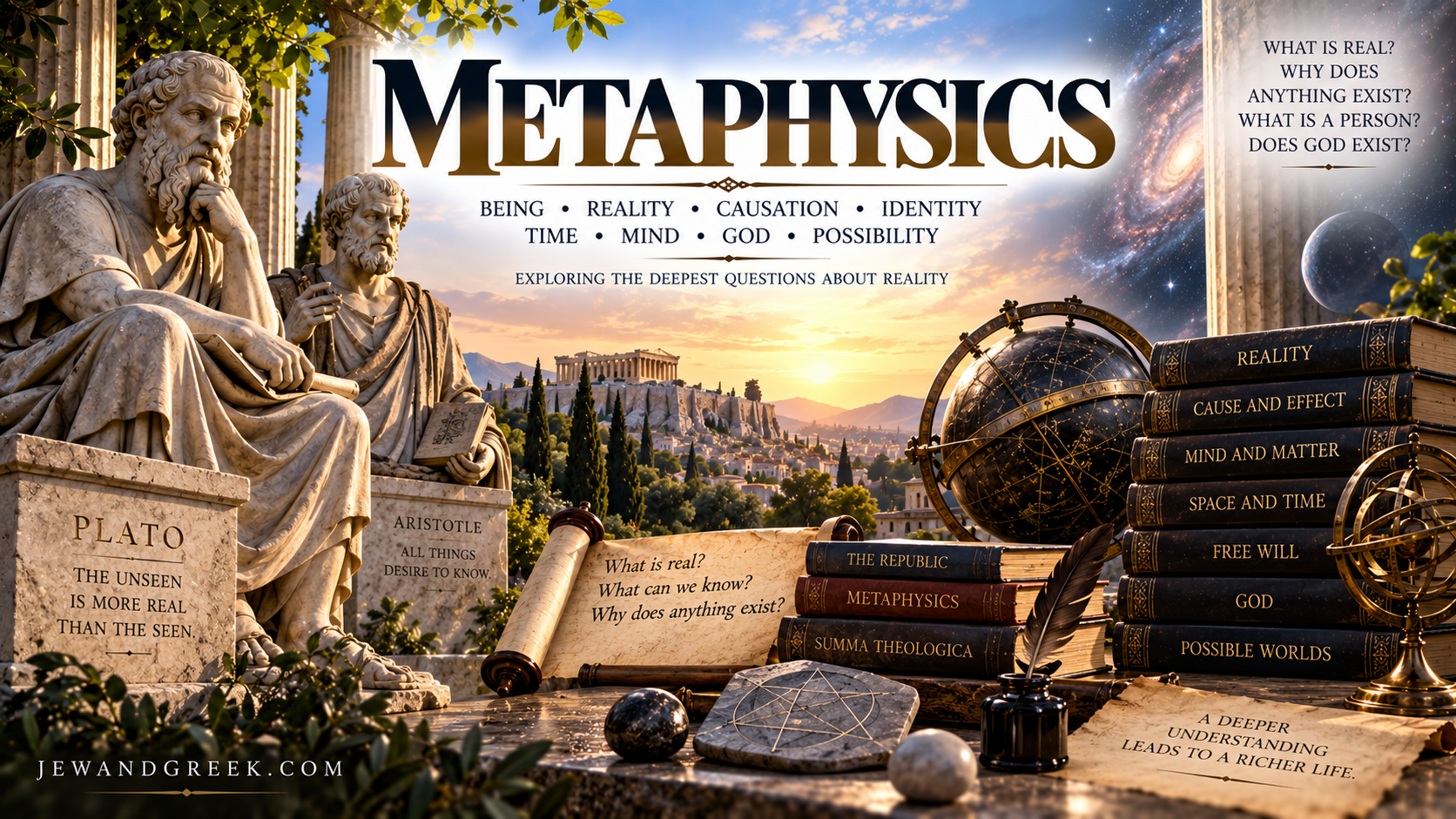
Metaphysics is the branch of philosophy concerned with the most fundamental questions about reality. While the natural sciences investigate particular aspects of the world—matter, energy, organisms, planets, or physical laws—metaphysics asks what ultimately exists and what it means for anything to exist at all. What is a thing? What makes something the same thing through change? What are space and time? Are causes real features of the world or simply patterns we observe? Do human beings possess genuine freedom? Is the mind entirely physical? Does God exist necessarily rather than contingently? These questions reach beneath particular scientific explanations toward the basic structure of reality itself.
The name comes from the works of Aristotle that were placed “after the Physics” in later arrangements of his writings, but the philosophical questions themselves are much older than the label. Ancient Greek thinkers were already debating whether reality consisted fundamentally of matter, mind, mathematical structures, unchanging being, or some combination of these. Plato distinguished the changing world of ordinary experience from the eternal Forms, while Aristotle developed an extensive account of substance, causation, actuality, potentiality, and being. Medieval Christian, Jewish, and Islamic philosophers incorporated these questions into discussions of God and creation, and modern philosophers transformed the debate through new theories of mind, matter, knowledge, and causation. Contemporary metaphysics continues the conversation using increasingly sophisticated tools of logic, philosophy of science, philosophy of mind, and analytic philosophy.
What Is Reality?
The most basic metaphysical question is deceptively simple: What is real? Ordinary experience presents us with people, animals, trees, buildings, planets, thoughts, numbers, institutions, events, and countless other things. Yet philosophers ask whether all of these exist in the same sense. A tree appears to exist physically, but what about the number seven, a law of logic, a nation, a promise, or the possibility that something could have happened differently? If these things are real, their reality seems different from the reality of a physical object.
Metaphysics attempts to identify the basic categories of existence and explain their relationships. Some philosophers have argued that only physical things ultimately exist, while others maintain that reality includes minds, abstract objects, moral truths, spiritual beings, or other nonphysical realities. Still others question whether ordinary categories such as “objects” adequately describe the deepest structure of the universe. The resulting debates are not merely exercises in classification because our understanding of reality influences how we approach consciousness, morality, religion, science, and human identity.
Being and Existence
The study of being—sometimes called ontology—is one of the oldest parts of metaphysics. To ask about being is to ask what it means for something to exist and what kinds of things can exist. The ancient philosopher Parmenides argued that genuine being could not arise from nonbeing or pass into nonbeing, leading him toward a radically unchanging conception of reality. Heraclitus, by contrast, emphasized change and becoming, creating one of the earliest great metaphysical tensions in Western philosophy.
Aristotle approached the problem differently by examining the different ways in which we speak about things that exist. He distinguished substances from properties and developed categories intended to explain how things can possess characteristics while remaining identifiable entities. Medieval philosophers later developed increasingly detailed accounts of being, especially when considering the distinction between created things and God. Metaphysics therefore does not merely ask whether something exists; it asks what kind of existence it possesses and whether existence itself requires explanation.
Substance and Properties
Consider an ordinary apple. It may be red, round, sweet, cool, and relatively heavy, but none of these properties seems identical with the apple itself. The color can change, the temperature can change, and part of the apple can be removed while we continue to identify it as the same apple. This led philosophers to distinguish between a substance, the thing that possesses properties, and the properties belonging to it.
Aristotle’s theory of substance became enormously influential because it provided a framework for understanding objects as enduring entities capable of undergoing change. Later philosophers questioned whether substances exist independently of their observable qualities. John Locke famously suggested that substance was something underlying qualities without claiming that we clearly understand what that underlying reality actually is. David Hume became even more skeptical, arguing that when we examine experience we encounter collections of perceptions rather than an independently perceived substance holding them together. Contemporary metaphysics continues to debate whether objects are substances possessing properties, bundles of properties, collections of particles, patterns, processes, or something else entirely.
Universals and Particulars
Individual objects often share characteristics. Two apples may both be red, two people may both possess courage, and thousands of objects may all be triangular. This raises the ancient problem of universals: when different things possess the same property, is there something genuinely common to them beyond the fact that we use the same word?
Plato’s theory of Forms offered one influential answer. Particular beautiful things participate in or reflect Beauty itself, while individual triangles correspond imperfectly to the Form of the triangle. Aristotle rejected Plato’s separate realm of Forms but maintained that universal characteristics could exist in particular things and be understood by the intellect. Medieval philosophers developed extensive debates between various forms of realism and nominalism, with nominalists arguing that universals do not exist as independent realities but are instead names or concepts applied to similar particulars. The issue remains relevant because it concerns whether categories such as humanity, justice, goodness, or even biological species correspond to genuine structures of reality or primarily reflect human ways of organizing experience.
Identity and Change
Everything around us changes, yet we routinely speak of things remaining the same. A person changes physically from infancy to adulthood, replaces much of the material composing the body, acquires new memories and beliefs, and may undergo dramatic changes of personality. Nevertheless, we ordinarily regard the adult and the infant as the same person. What, then, makes something remain itself through change?
The famous Ship of Theseus illustrates the difficulty. Imagine a ship whose wooden boards are gradually replaced until none of the original material remains. Is it still the same ship? Suppose someone collects the discarded boards and reconstructs another ship from them; which vessel is the original? Similar questions become much more significant when applied to human beings. Whether personal identity depends upon the body, brain, memories, consciousness, soul, or continuity of some other kind has implications for resurrection, immortality, moral responsibility, and even the possibility of surviving radical neurological change.
Actuality and Potentiality
Aristotle introduced the distinction between actuality and potentiality partly to explain how genuine change is possible. An acorn is actually an acorn but potentially an oak tree. A person who knows how to play the piano possesses a capacity that may or may not be actualized at a particular moment. Change can therefore be understood as the actualization of a potential rather than the mysterious emergence of something from absolute nothingness.
This distinction became extremely important in medieval philosophy, particularly in the thought of Thomas Aquinas. Aquinas used Aristotelian concepts of actuality and potentiality when developing arguments concerning causation, change, and the existence of God. Created things possess unrealized potentials and undergo change, whereas God was understood as pure actuality, possessing no unrealized potential and therefore not changing from one state into another. Although contemporary philosophers do not universally accept Aristotelian metaphysics, the concepts of dispositions, capacities, possibilities, and powers continue to play significant roles in modern discussions.
Causation
Human beings naturally ask why things happen. We say that fire causes water to boil, gravity causes objects to fall, and one person’s actions can cause consequences for another. Aristotle famously distinguished four kinds of explanation: the material cause, concerning what something is made from; the formal cause, concerning what kind of thing it is; the efficient cause, concerning what produces it; and the final cause, concerning its purpose or end. Later Western thought increasingly concentrated upon efficient causation, particularly as modern science developed mechanical explanations of natural processes.
David Hume challenged traditional assumptions about causation by arguing that we never directly perceive a necessary connection between cause and effect. We observe one kind of event repeatedly followed by another and develop an expectation that the pattern will continue. This raised a fundamental question: is causation an objective feature of reality or a way the human mind organizes recurring sequences of events? Contemporary philosophers continue to debate causal powers, laws of nature, counterfactual theories of causation, probability, and whether scientific explanations describe genuine causal structures in the world.
Why Is There Something Rather Than Nothing?
One of the deepest metaphysical questions asks why anything exists at all. The universe contains galaxies, matter, energy, physical laws, living organisms, consciousness, and human beings capable of asking why they exist. Yet it is possible to ask whether reality as a whole requires an explanation. Why should there be a universe rather than absolutely nothing?
Some philosophers argue that the universe may simply exist as a brute fact requiring no further explanation. Others appeal to some version of the Principle of Sufficient Reason, according to which contingent realities require adequate explanations for their existence. This line of reasoning has historically played an important role in arguments for God, particularly in the work of philosophers such as Leibniz. The question ultimately forces metaphysics to consider whether reality terminates in something necessary, something that cannot fail to exist, or whether explanation simply ends with an unexplained universe.
Necessary and Contingent Being
The distinction between necessary and contingent existence has been central to metaphysics and philosophy of religion. A contingent thing exists but could conceivably have failed to exist. Individual human beings, planets, stars, and perhaps the universe itself appear contingent because we can coherently imagine circumstances in which they never existed. A necessary being, by contrast, would exist in every possible circumstance in which anything could exist and would not depend upon something else for its existence.
Jewish, Christian, and Islamic philosophers developed this distinction extensively. Avicenna distinguished between what is necessary in itself and what receives its existence through another, while Aquinas argued that contingent beings ultimately require a reality whose existence is not dependent in the same way. Modern philosophers such as Leibniz continued this tradition, and contemporary philosophers of religion often formulate arguments using the language of possible worlds and modal logic. Whether necessary existence is coherent and whether God qualifies as a necessary being remain important questions in contemporary metaphysics.
Space and Time
Space and time seem so fundamental to ordinary experience that it can be difficult to imagine reality without them. Nevertheless, philosophers have long debated whether space and time exist independently of objects and events or merely describe relationships among them. Isaac Newton understood space and time as possessing an absolute character, whereas Leibniz argued that they should be understood relationally. Immanuel Kant later proposed that space and time are fundamental forms through which human beings experience the world rather than properties of things as they exist independently of our experience.
Modern physics transformed the discussion dramatically. Einstein’s theories of relativity connected space and time into spacetime and showed that measurements of distance and duration depend upon frames of reference in ways classical physics had not anticipated. Yet scientific theories do not eliminate philosophical questions about what spacetime actually is, whether the passage of time is objectively real, and whether the past and future exist in the same sense as the present. The philosophy of time consequently remains an active area where metaphysics and physics interact closely.
The Nature of Time
Human experience seems to divide time naturally into past, present, and future. The past is fixed, the present appears immediately real, and the future seems open. Some philosophers defend versions of presentism, according to which only the present truly exists. Others defend eternalism, according to which past, present, and future events all belong to the structure of reality even though conscious observers experience them differently.
These positions raise significant questions about change, freedom, causation, and divine knowledge. If future events already exist in some sense, can human beings genuinely act otherwise? If only the present exists, how should we understand statements about past events that no longer exist? Christian theology introduces additional questions concerning God’s relationship to time, including whether God exists outside time, experiences succession, or relates to temporal creation in some other way. Metaphysics provides the conceptual tools needed even to formulate these questions carefully.
Possible Worlds and Modality
Human beings constantly distinguish between what actually happened and what could have happened. A person who stayed home could have gone to work, a glass that remained intact could have broken, and history might have unfolded differently. Philosophers use the term modality for questions involving possibility, necessity, impossibility, and contingency.
Contemporary metaphysics often discusses these issues through the language of possible worlds. A possible world need not mean another physical universe; it can function as a way of describing a complete possible state of affairs. Something is necessary if it is true in every possible world and possible if it is true in at least one. Modal reasoning has become particularly important in philosophy of religion, where philosophers have reformulated arguments concerning God’s necessary existence, divine attributes, freedom, and the problem of evil.
Determinism and Free Will
Are human choices genuinely free, or are they ultimately determined by prior conditions? Determinism holds, broadly speaking, that given the complete state of reality and the laws governing it, only one future is possible. If every human thought and decision results entirely from previous physical states, genetic influences, environmental conditions, and neurological processes, it becomes difficult to explain what it means to say that a person could genuinely have chosen otherwise.
Philosophers respond to this problem in several ways. Compatibilists argue that meaningful freedom can coexist with determinism, usually defining freedom in terms of acting according to one’s desires or reasons without external coercion. Libertarians about free will maintain that at least some human choices are genuinely undetermined in a way that permits alternative possibilities. Hard determinists accept determinism and deny the kind of freedom commonly associated with moral responsibility. These positions carry significant consequences for ethics, law, theology, praise, blame, and our understanding of human personhood.
Mind and Matter
Another major metaphysical question concerns the relationship between consciousness and the physical world. Human brains are physical objects composed of matter, yet human beings also experience thoughts, sensations, intentions, memories, emotions, and a first-person awareness of being conscious. How can subjective experience arise within a physical universe?
Materialism or physicalism maintains that reality is fundamentally physical and that mental phenomena must ultimately be explained in physical terms. Dualism, famously associated in modern philosophy with René Descartes, holds that mind and matter represent fundamentally different kinds of reality. Other positions include idealism, property dualism, panpsychism, emergentism, and various theories attempting to explain consciousness without reducing it either to traditional substance dualism or straightforward physicalism. These debates overlap heavily with philosophy of mind but remain metaphysical because they concern what kinds of things ultimately exist.
Abstract Objects
Numbers present another unusual metaphysical problem. Two apples are physical objects, but the number two does not seem to be located anywhere in space. Mathematical truths also appear to remain true regardless of whether human beings recognize them. The statement that two plus two equals four seems different from a human convention such as deciding which side of a road vehicles should use.
Platonists about mathematics argue that mathematical entities possess a kind of objective existence independent of human minds. Nominalists deny that abstract objects need to exist in this sense and attempt to explain mathematical language without committing themselves to an independently existing realm of numbers. Other theories understand mathematics through conceptual, structural, or formal frameworks. The debate illustrates how quickly an apparently simple question—“Do numbers exist?”—leads directly into fundamental questions about what reality contains.
Laws of Nature
Science describes nature through laws involving gravity, electromagnetism, thermodynamics, quantum mechanics, and other regularities. Metaphysics asks what these laws of nature actually are. Are they merely descriptions summarizing patterns observed in the universe, or do they possess some deeper reality that explains why physical events occur as they do?
Some philosophers regard laws as descriptions of regularities, while others understand them as genuine relations, powers, or structures governing natural events. The distinction matters because saying that objects behave according to a law can mean either that the law summarizes what objects happen to do or that something about reality makes them behave that way. Questions about natural law also intersect with debates concerning divine action, miracles, causation, and whether the universe’s fundamental order itself requires explanation.
Naturalism
Naturalism has become one of the most influential metaphysical outlooks in contemporary intellectual life. Although definitions vary, metaphysical naturalism generally holds that the natural world is all that exists and that supernatural beings or realities are unnecessary. It is important to distinguish this position from methodological naturalism, the practical scientific principle of seeking natural explanations for observable phenomena. A scientist can use methodological naturalism professionally without believing that nature constitutes the whole of reality.
Metaphysical naturalism raises questions that extend beyond science itself. Can consciousness, rationality, objective morality, mathematical truths, intentionality, and human freedom be fully explained within a purely naturalistic framework? Naturalists have developed sophisticated accounts attempting to do so, while critics argue that some aspects of reality resist reduction to physical processes. The disagreement therefore concerns not whether scientific investigation is valuable but whether scientific descriptions exhaust everything that can truthfully be said about reality.
Theism and Metaphysics
Classical Christian theism presents a metaphysical picture fundamentally different from naturalism. God is not understood as merely one additional object located somewhere inside the universe. Rather, God is understood as the Creator upon whom the entire contingent order depends for its existence. Classical Christian thinkers such as Augustine and Aquinas consequently spoke of God in categories such as necessary existence, immateriality, eternity, actuality, and ultimate causation.
This distinction is important because questions such as “Who created God?” can misunderstand the traditional argument. Classical theism does not propose God as another contingent being requiring the same kind of explanation as the universe. It proposes God as the ultimate explanation for contingent reality precisely because God’s existence is understood as noncontingent. Whether this account succeeds is a legitimate philosophical question, but it must first be represented accurately before it can be evaluated.
Creation and Contingency
The biblical doctrine of creation carries significant metaphysical implications. Christianity teaches that the universe is not divine, eternal in the same sense as God, or metaphysically self-sufficient. God created reality and continually sustains its existence. Creation therefore possesses genuine reality and order while remaining dependent upon its Creator.
This differs both from strict materialism and from philosophies that dissolve the distinction between God and the universe. Christianity does not ordinarily identify God with nature, nor does it regard the material world as an illusion from which spiritual beings must escape. The biblical affirmation that creation is good gives physical reality substantial theological significance. Christian metaphysics therefore contains a distinctive combination of Creator-creature distinction, contingency, material goodness, personal identity, moral responsibility, and hope for bodily resurrection.
Miracles and the Natural Order
Miracles raise metaphysical as well as historical questions. Before asking whether a particular miracle occurred, one can ask whether miracles are even possible. If the physical universe constitutes a causally closed system and nothing beyond nature exists, then supernatural intervention appears impossible by definition. If God exists as Creator and sustainer of the natural order, however, the metaphysical situation is different.
This does not establish that any particular miracle has occurred. Historical evidence must still be considered, and extraordinary claims require appropriate justification. The metaphysical point is simply that conclusions about miracles frequently depend upon prior assumptions concerning the nature of reality. David Hume’s influential discussion of miracles therefore intersects not only with historical reasoning but with broader questions about causation, probability, experience, and what kinds of events reality permits.
Metaphysics and Science
Metaphysics and science should neither be confused nor separated completely. Scientific discoveries can overturn metaphysical assumptions about matter, space, time, causation, and the structure of the universe. At the same time, scientific theories themselves employ concepts such as laws, causes, objects, properties, possibilities, identity, and explanation that raise philosophical questions. Science can tell us enormously important things about how physical systems behave without necessarily resolving every question about what physical reality ultimately is.
The relationship works in both directions. A metaphysical system that simply ignores established scientific evidence risks becoming detached from reality, while claims that science has eliminated metaphysics often depend upon unrecognized metaphysical assumptions of their own. Questions about whether only physical things exist, whether laws of nature are real, whether consciousness can be reduced to matter, or whether the universe requires an explanation are philosophical questions even when scientific evidence contributes importantly to the discussion. Metaphysics therefore remains a partner in the larger intellectual effort to understand reality.
Why Metaphysics Matters
Metaphysics can appear abstract because its questions concern concepts such as being, substance, causation, necessity, identity, and possibility. Yet those abstractions lie underneath many questions people regard as intensely practical. Whether human beings possess free will affects our understanding of moral responsibility. Whether persons are merely physical organisms affects questions about death, consciousness, and resurrection. Whether objective moral truths exist affects ethics, while the nature of causation affects scientific reasoning and the possibility of miracles.
Religious belief is likewise filled with metaphysical claims. Statements that God exists, created the universe, acts within history, became incarnate in Jesus Christ, raised Jesus from the dead, and will resurrect human beings are not merely statements about religious feelings. They are claims about what reality is actually like. Christian theology therefore cannot avoid metaphysics even when Christians do not use the term. The moment we ask what God is, what human beings are, what creation is, or how divine and created realities relate, we have entered metaphysical territory.
The Continuing Search for Reality
Metaphysics begins with questions so basic that ordinary life often allows us to overlook them. Why does anything exist? What is a person? What makes something remain the same through change? Are causes, possibilities, numbers, minds, and moral truths genuine features of reality? Is everything ultimately physical, or does reality include dimensions that cannot be reduced to matter and energy? Is the universe self-explanatory, or does its existence point beyond itself?
More than two thousand years of philosophical debate have not made these questions disappear. Scientific discoveries have transformed the context in which some of them are asked, while developments in logic and analytic philosophy have allowed others to be formulated with greater precision. Yet the central problem remains what it was for the earliest philosophers: What is ultimately real? Metaphysics represents philosophy’s sustained attempt to answer that question and, in doing so, to understand the fundamental structure of the world in which we find ourselves.