

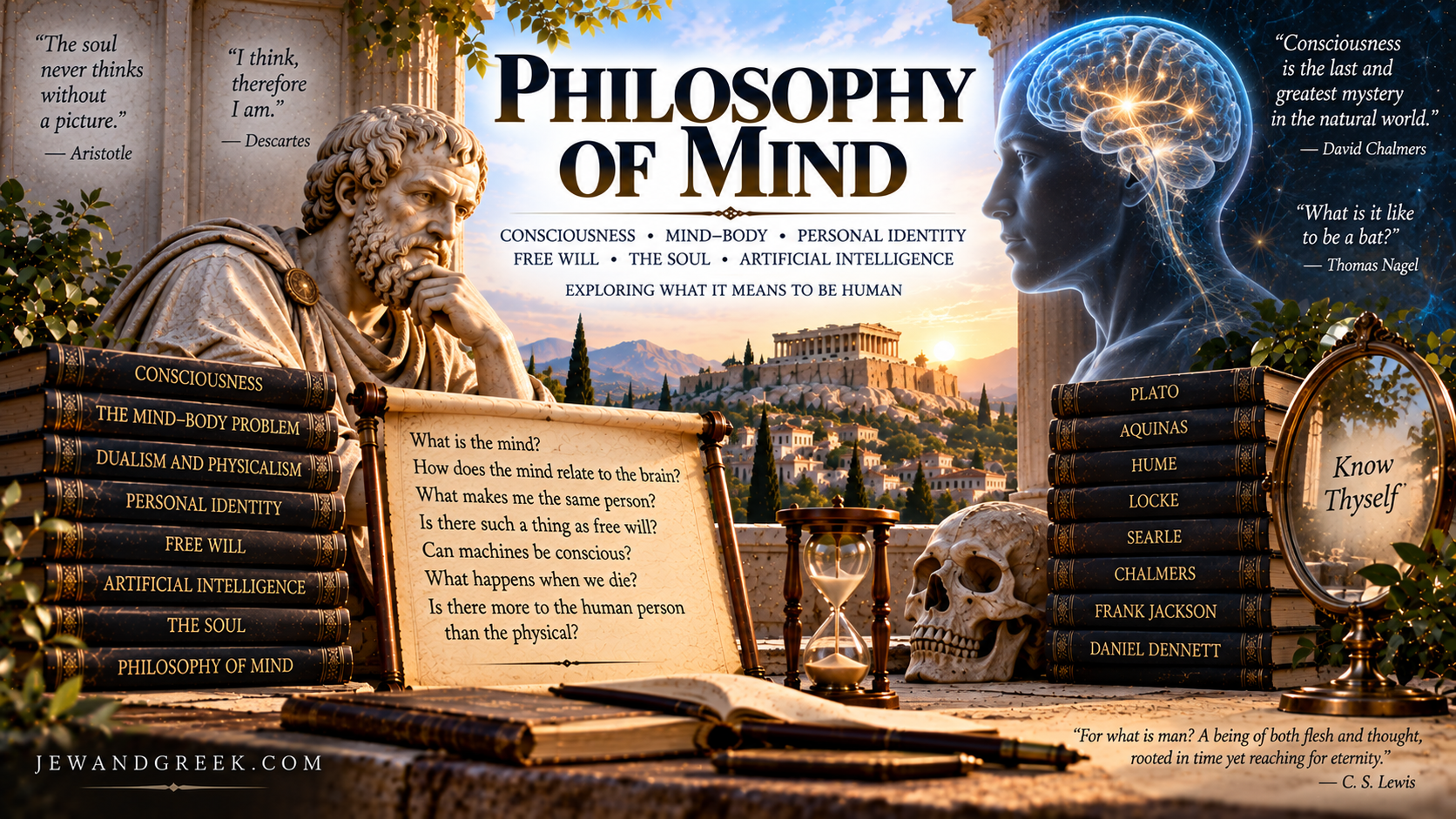
Philosophy of mind investigates one of the most intimate and difficult mysteries in philosophy: What is a mind? Human beings think, remember, imagine, reason, experience emotions, make choices, feel pain, recognize themselves, and encounter the world from a first-person point of view. These mental experiences are closely connected with the brain, yet explaining exactly what that connection means has proven remarkably difficult. Is the mind simply what the brain does, or is there something about consciousness that cannot be reduced to physical processes? Are human beings entirely physical organisms, embodied souls, or some more complicated unity of mind and body?
These questions reach far beyond abstract speculation. Our understanding of the mind affects how we think about personal identity, free will, moral responsibility, death, artificial intelligence, mental illness, human dignity, and the possibility of life after death. Philosophy of mind therefore intersects with neuroscience, psychology, computer science, metaphysics, epistemology, and theology. For Christianity the subject carries additional significance because Scripture describes human beings as created in the image of God, speaks of body, soul, and spirit, and ultimately promises not escape from embodiment but resurrection.
What Is the Mind?
The word mind refers broadly to the capacities and experiences associated with consciousness, thought, perception, memory, emotion, intention, imagination, and reasoning. We know minds differently from the way we know most physical objects. A neuroscientist can observe activity in another person’s brain, but the person whose brain is being observed experiences thoughts and sensations directly from the inside. This distinction between third-person observation and first-person experience creates one of the central problems in philosophy of mind.
Suppose someone touches a hot surface. Scientists can trace signals from sensory receptors through nerves and into the brain, identify neural activity associated with pain, and observe the person’s behavioral response. Yet the person also experiences something that those measurements do not themselves appear to contain: the feeling of pain. Philosophers therefore ask whether a complete description of the brain would also constitute a complete description of the experience or whether something important would remain unexplained.
The Mind-Body Problem
The mind-body problem asks how mental reality relates to physical reality. Human thoughts seem capable of affecting the body: deciding to raise your hand is normally followed by your hand rising. Physical events likewise affect the mind: an injury produces pain, alcohol alters judgment, anesthesia eliminates consciousness, and damage to particular areas of the brain can affect memory, personality, language, or perception.
These connections establish that the brain is deeply involved in mental life, but they do not by themselves settle what the mind is. One possibility is that mental states are ultimately nothing more than physical brain states. Another is that mental and physical properties are genuinely distinct even though they interact closely. Still another is that the traditional distinction between mental and physical categories needs to be reconsidered. Much of philosophy of mind consists of evaluating these competing explanations.
Plato and the Soul
Plato offered one of Western philosophy’s most influential accounts of the soul. In dialogues such as the Phaedo, he presents the soul as distinct from the body and capable of surviving bodily death. Plato’s broader philosophy reinforced this distinction because he regarded the changing physical world as less fundamental than the eternal realities apprehended through reason.
Plato’s account profoundly influenced later Western thought, including some Christian thinkers, but Platonic anthropology should not simply be equated with biblical teaching. Christianity inherited philosophical vocabulary from the Greek world while also emerging from a Jewish understanding in which embodied human existence is fundamentally important. The Christian hope of resurrection differs significantly from a philosophy in which salvation is essentially the soul’s escape from the body.
Aristotle and the Soul
Aristotle rejected a simple picture of the soul as an independent person temporarily inhabiting a body. In De Anima (On the Soul), he described the soul as the form of a living body. The soul is what makes a living organism the kind of living thing it is, rather than another object added to the organism from outside.
Plants possess capacities for nutrition and growth, animals add sensation and movement, and human beings possess rational capacities. Aristotle’s view is often called hylomorphism, from Greek terms referring to matter and form. Later Christian thinkers, especially Thomas Aquinas, adapted Aristotelian concepts in developing accounts of human beings that sought to preserve both the unity of body and soul and the possibility of personal existence beyond bodily death.
Descartes and Mind-Body Dualism
René Descartes transformed the modern debate through his famous distinction between mind and matter. Beginning with systematic doubt, Descartes concluded that while he could doubt the existence of the external world, he could not doubt that he was thinking. This produced his famous formulation, Cogito, ergo sum—“I think, therefore I am.”
Descartes described mind as a thinking substance and matter as extended substance. The mind is not spatial in the way a physical body is, while matter occupies space and operates according to physical laws. This view became known as substance dualism. A human being therefore involves both a physical body and an immaterial mind or soul, with the two somehow interacting during earthly life.
The Interaction Problem
Cartesian dualism immediately creates a difficult question: How can an immaterial mind cause changes in a physical body? If mental and physical substances are fundamentally different kinds of reality, the mechanism connecting them is not obvious. Descartes famously associated their interaction with the pineal gland, but locating a place in the brain where interaction occurs does not explain how an immaterial substance interacts with matter.
Critics have treated this as a major weakness of substance dualism. Dualists respond that causation itself is philosophically mysterious and that we should not reject mental causation merely because we cannot describe its mechanism. They also point out that ordinary experience strongly suggests that reasons, intentions, and decisions have causal consequences. The interaction problem nevertheless remains one of the central challenges facing traditional mind-body dualism.
Physicalism
Physicalism holds broadly that everything that exists is ultimately physical or dependent upon physical reality. Applied to human beings, this means that mental life does not require an immaterial soul or substance. Thoughts, memories, emotions, and consciousness arise from or are constituted by processes involving the brain and nervous system.
Physicalism has become highly influential partly because of the extraordinary success of neuroscience. Changes to the brain can dramatically alter mental experience, and researchers increasingly identify neural processes associated with perception, memory, emotion, decision-making, and consciousness. Yet correlation between brain states and mental states does not automatically settle the philosophical question of whether the two are identical. The central challenge for physicalism is explaining how physical processes produce or constitute subjective experience.
Identity Theory
Mind-brain identity theory proposes that mental states are literally identical with brain states. Pain, for example, would not merely be caused by a particular neural process; pain would ultimately be that physical process, described from another perspective.
The theory offers an elegantly naturalistic account of the mind and fits comfortably with the close dependence of mental life upon brain function. Difficulties arise, however, when philosophers ask whether the same mental state could occur in creatures with very different neurological structures or even in artificial systems. If pain is strictly identical with one particular human neural state, it becomes difficult to explain how another kind of organism could experience pain through a differently structured nervous system.
Functionalism
Functionalism attempts to solve this problem by defining mental states according to what they do rather than what physical material realizes them. A mental state is identified through its causal relationships with sensory inputs, other mental states, and behavioral outputs. Pain, for example, might involve a state normally caused by injury that produces distress, avoidance behavior, and other characteristic responses.
This approach opened an important connection between philosophy of mind and artificial intelligence. If mental states depend upon functional organization rather than biological material, then perhaps a sufficiently sophisticated machine could possess mental states if it performed the appropriate functions. Yet this possibility immediately raises another question: would performing the functions associated with consciousness actually produce an inner experience, or would the machine merely behave as though it were conscious?
Behaviorism
Earlier twentieth-century approaches sometimes attempted to explain mental language primarily through observable behavior. Behaviorism interpreted claims about mental states in terms of behavioral dispositions. Saying that someone is in pain might therefore mean that the person is disposed to cry out, withdraw from injury, seek relief, or display other characteristic behavior.
Behaviorism helped encourage rigorous attention to observable evidence, but philosophical behaviorism encountered serious difficulties. Someone can experience intense pain while deliberately suppressing every visible response, while an actor can display pain behavior without actually suffering. Mental life therefore appears to involve something more than outward behavior. The decline of behaviorism helped restore consciousness and internal mental states to the center of philosophy of mind.
Consciousness
Consciousness is perhaps the greatest challenge in contemporary philosophy of mind. Conscious creatures do not merely process information; there appears to be something it is like to be them. Seeing red has a distinctive subjective quality. So do tasting coffee, hearing music, experiencing grief, remembering childhood, feeling pain, or contemplating one’s own existence.
Scientists can increasingly identify neural processes correlated with conscious experiences, but philosophers disagree about whether explaining those processes fully explains consciousness itself. Why should electrical and chemical activity in neural tissue produce any subjective experience whatsoever? Why should information processing feel like something from the inside? These questions form what philosopher David Chalmers famously called the hard problem of consciousness.
The Hard Problem of Consciousness
Chalmers distinguishes relatively “easy” problems of consciousness from the hard problem, though the easy problems are scientifically extremely difficult. Researchers can investigate how brains discriminate stimuli, integrate information, control behavior, report internal states, and direct attention. These questions concern functions that can at least in principle be described through objective mechanisms.
The hard problem asks why any of those processes should be accompanied by subjective experience. A complete physical account might explain how wavelengths of light trigger neural processes that allow a person to identify a red object, yet philosophers ask why those processes are accompanied by the particular experience of redness. Physicalists propose various strategies for closing or dissolving this explanatory gap, while dualists and other critics argue that consciousness may reveal something fundamentally incomplete about purely physical descriptions of reality.
Qualia
Philosophers often use the term qualia for the subjective qualities of conscious experience—the redness of red, the painfulness of pain, the taste of chocolate, or the sound of a violin. Qualia seem directly accessible to the person having the experience while remaining inaccessible in precisely the same way to outside observers.
Whether qualia represent irreducible features of reality is intensely disputed. Some philosophers regard them as powerful evidence that consciousness cannot be completely reduced to physical information. Others argue that traditional descriptions of qualia create philosophical confusion and that a sufficiently complete account of cognitive processes will eventually explain what appears mysterious. The disagreement turns partly upon whether third-person scientific descriptions can ever capture everything contained within first-person experience.
Mary’s Room
Philosopher Frank Jackson developed a famous thought experiment known as Mary’s Room. Imagine Mary is a brilliant scientist who knows every physical fact about color vision but has lived her entire life in a black-and-white environment. She understands wavelengths, retinal processes, neural activity, and every physical mechanism involved when human beings see red.
When Mary finally leaves the room and sees red for the first time, does she learn something new? If she does, then it appears that complete physical knowledge did not include knowledge of what seeing red is like. This is known as the knowledge argument against physicalism. Physicalists have developed numerous responses, including the claim that Mary gains a new ability or form of acquaintance rather than learning a new fact about reality.
Philosophical Zombies
Another famous thought experiment asks us to imagine a philosophical zombie—a being physically identical to an ordinary human being that behaves exactly like one but possesses no conscious experience. It says “ouch” when injured, discusses philosophy, claims to experience colors, and behaves normally, yet there is supposedly nothing it feels like to be that creature.
If such a being is genuinely conceivable and metaphysically possible, some philosophers argue that physical facts cannot determine all facts about consciousness. Critics question whether conceivability establishes genuine possibility or whether the zombie concept merely reflects limitations in our understanding. The debate demonstrates how philosophy uses thought experiments to investigate whether consciousness can be logically separated from physical structure and function.
Thomas Nagel and “What Is It Like to Be a Bat?”
Thomas Nagel’s influential essay “What Is It Like to Be a Bat?” highlights the subjective character of consciousness. Humans can study a bat’s brain, anatomy, echolocation system, and behavior in extraordinary detail, yet such knowledge does not obviously reveal what echolocation feels like from the bat’s own perspective.
Nagel’s argument does not simply claim that humans currently lack enough scientific information. The deeper point is that objective scientific description deliberately abstracts away from a particular point of view, while consciousness seems essentially connected to a point of view. The challenge is therefore to explain how an objective account of reality can incorporate phenomena whose defining feature appears to be their subjective character.
Intentionality
Mental states possess another unusual characteristic philosophers call intentionality: thoughts are generally about something. A person can think about Paris while sitting thousands of miles away, remember an event that no longer exists, fear something that has never happened, or contemplate an imaginary creature that has never existed.
Physical objects do not obviously possess this kind of aboutness on their own. Ink marks on a page represent ideas only because minds interpret them, and computer data appear to have meaning partly because human beings design and interpret the systems processing them. Philosophers therefore ask how brain states acquire semantic content. Naturalistic theories attempt to explain intentionality through causal, informational, evolutionary, or functional relationships, while critics argue that genuine meaning may resist complete reduction to physical processes.
The Chinese Room
John Searle’s Chinese Room thought experiment challenges the idea that manipulating symbols according to rules is sufficient for understanding. Imagine a person who knows no Chinese sitting inside a room with instructions telling him how to respond to Chinese symbols passed through a slot. By following the rules perfectly, he might produce responses indistinguishable from those of a fluent Chinese speaker while understanding none of the symbols.
Searle argues that computers similarly manipulate symbols syntactically without necessarily understanding their meaning. Critics respond that while the person inside the room does not understand Chinese, perhaps the entire system does, or that sufficiently sophisticated embodied systems might possess forms of understanding absent from Searle’s simplified scenario. The argument remains central to debates over whether computation alone can produce genuine understanding.
Artificial Intelligence and the Mind
Artificial intelligence has transformed philosophy of mind from a largely theoretical discussion into an increasingly practical one. Modern AI systems can generate language, recognize images, solve problems, compose music, imitate conversation, and perform tasks once associated strongly with human intelligence. These achievements raise the question of whether intelligent behavior is sufficient evidence for mentality.
Intelligence and consciousness, however, should not automatically be equated. A system might perform sophisticated cognitive tasks without possessing subjective experience, just as a calculator performs arithmetic without anyone ordinarily assuming that it understands mathematics. The difficult question is what evidence could establish consciousness in something whose internal architecture differs radically from the human brain. As artificial systems become increasingly capable, questions concerning machine consciousness, moral status, responsibility, and personhood will become increasingly important.
The Turing Test
Alan Turing proposed replacing the vague question “Can machines think?” with a more operational test. In what became known as the Turing Test, a human judge communicates through text with unseen participants and attempts to distinguish a machine from a human being. If the machine’s conversation becomes indistinguishable from human conversation, Turing suggested that refusing to call its performance intelligent may lose much of its significance.
Passing such a test would demonstrate extraordinary behavioral competence, but whether it demonstrates consciousness is another matter. Searle’s Chinese Room directly challenges the inference from convincing linguistic behavior to genuine understanding. Contemporary AI therefore makes Turing’s question more relevant while simultaneously demonstrating why intelligence, language, understanding, self-awareness, and consciousness need careful philosophical distinction.
Other Minds
We experience our own consciousness directly but infer the consciousness of other people. This creates the philosophical problem of other minds. How do I know that anyone besides myself possesses conscious experiences rather than merely behaving as though they do?
In ordinary life the problem rarely troubles us because other humans share our biology, behavior, language, emotional responses, and neurological structure. These similarities provide powerful grounds for inferring consciousness. The question becomes more difficult with animals and potentially artificial systems because the degree of similarity decreases. Philosophy of mind therefore asks what evidence justifies attributing consciousness and where the boundaries of morally significant experience should be drawn.
Animal Minds
Animals clearly process information, learn, remember, pursue goals, respond to their environments, and display behaviors associated with pain and pleasure. The philosophical question concerns the extent and character of their mental lives. Which animals are conscious? Which possess self-awareness, intentions, concepts, emotions, or some form of reasoning?
Scientific research increasingly informs these questions, but ethical consequences make the philosophical interpretation important. If an organism can experience pain, that fact creates moral considerations even if its cognitive capacities differ substantially from those of human beings. Christianity’s distinctive account of human beings as bearing the image of God need not require denying animal consciousness or the moral importance of animal suffering. It instead raises the additional question of what, if anything, uniquely characterizes human personhood.
Personal Identity
What makes you the same person throughout your life? Your body changes continuously, memories are gained and lost, personality can develop, and nearly every aspect of your physical existence changes over time. Yet people ordinarily assume that the elderly individual and the child visible in an old photograph can literally be the same person.
Philosophers have proposed bodily continuity, psychological continuity, memory, brain continuity, the soul, and combinations of these as explanations of personal identity. John Locke famously connected personal identity with continuity of consciousness and memory. Difficult cases involving amnesia, dementia, split-brain research, hypothetical brain transplantation, and duplication challenge simple solutions. The question becomes particularly important for Christian theology because resurrection requires explaining how the resurrected person remains the same individual who previously lived and died.
Memory and Identity
Memory seems intimately connected with personal identity because our memories help create the narrative through which we understand ourselves. Yet memory cannot straightforwardly define identity. People forget enormous portions of their lives while remaining the same persons, and memories can be inaccurate or even artificially induced.
There is also a circularity problem: calling an experience my memory may already assume that I am the same person who originally experienced the event. Memory therefore provides important psychological continuity without necessarily explaining the deeper metaphysical basis of identity. This distinction matters when considering conditions such as dementia, where memory and personality can deteriorate dramatically without thereby eliminating the individual’s human dignity or necessarily making that person someone else.
Split-Brain Cases
Research involving patients whose cerebral hemispheres were surgically disconnected has generated fascinating philosophical questions. Under certain experimental conditions, the two hemispheres can respond differently to information, creating behavior that seems to suggest partially independent streams of awareness.
These cases complicate simple assumptions about a single unified consciousness. Do they reveal two minds within one body, one mind with divided information processing, or something that does not fit comfortably into either description? Neuroscience supplies the observations, while philosophy attempts to determine what those observations imply about consciousness and personal unity. Such cases illustrate why empirical research and philosophical analysis must work together.
Free Will
Philosophy of mind connects directly with the problem of free will. Human beings experience themselves as making choices for reasons, but if every brain event is completely determined by prior physical events and laws of nature, in what sense could anyone have chosen differently?
Some philosophers accept hard determinism, concluding that traditional free will does not exist. Compatibilists argue that meaningful freedom can exist even within a determined universe if people act according to their own desires and reasons without external coercion. Libertarian accounts maintain that genuine freedom requires some choices not to be completely determined by prior states. The debate has enormous implications for moral responsibility, punishment, praise, guilt, and Christian doctrines concerning sin and accountability.
Neuroscience and Free Will
Experiments associated with Benjamin Libet and later researchers have sometimes been interpreted as showing that the brain initiates decisions before people become consciously aware of choosing. Popular discussions occasionally present these findings as proof that free will is an illusion.
The philosophical implications are much less straightforward. Researchers debate what the measured brain activity represents, whether the experiments involve genuine decisions comparable to morally significant choices, and whether conscious deliberation must initiate every neural event associated with action in order for a decision to be free. Neuroscience can reveal how decisions are implemented in the brain, but moving from neural measurements to a conclusion about whether agency exists requires philosophical assumptions about what agency would have to be.
Mental Causation
If beliefs and desires are real, do they actually cause behavior? We ordinarily explain actions through reasons: someone opens an umbrella because she believes it is raining and wants to remain dry. Yet if physical events already possess sufficient physical causes, philosophers ask what additional causal work mental states perform.
This is the problem of mental causation. A strict physicalist might identify mental causes with physical brain processes, while nonreductive theories attempt to preserve mental properties without duplicating physical causes. Dualists must explain how nonphysical mental events influence physical systems. The problem demonstrates that every major theory of mind faces challenges; simply rejecting one position does not automatically provide an adequate alternative.
Emergentism
Emergentism proposes that sufficiently complex physical systems can produce genuinely new properties that are not obvious when examining their components individually. Consciousness might therefore emerge from organized neural activity without being reducible in any simple way to individual neurons.
Emergence is attractive because nature contains many higher-level phenomena that depend upon lower-level structures while possessing distinctive properties. Critics, however, ask whether calling consciousness “emergent” actually explains anything unless a mechanism or principle of emergence can be identified. If consciousness has genuine causal powers not reducible to physical processes, emergentism begins to resemble forms of property dualism; if it has no independent causal role, questions arise about why conscious experience exists at all.
Property Dualism
Property dualism attempts to distinguish mental and physical properties without claiming that human beings consist of two separate substances. On this view there may be only one underlying kind of substance—perhaps physical organisms—while conscious experiences possess properties that cannot be reduced completely to physical properties.
This approach seeks to preserve the reality and distinctiveness of consciousness while avoiding some difficulties of Cartesian substance dualism. Yet it faces its own problem of mental causation. If physical events are fully caused by physical processes, what causal role remains for irreducible mental properties? If mental properties influence physical events, philosophers must explain how that influence fits within the physical causal order.
Panpsychism
One increasingly discussed position is panpsychism, which proposes that consciousness or consciousness-like properties are fundamental features of reality rather than late products emerging mysteriously from entirely nonconscious matter. The theory does not usually claim that rocks think in anything resembling a human way. Instead, it suggests that basic physical entities possess extremely primitive experiential properties that combine somehow within complex organisms.
Panpsychism attempts to address the hard problem by refusing to derive consciousness from something wholly nonconscious. Its greatest difficulty is the combination problem: how would countless primitive experiential properties combine into the unified consciousness of a human person? Although once regarded as highly unusual, panpsychism has received renewed attention because dissatisfaction with both reductive physicalism and traditional dualism has encouraged philosophers to reconsider a wider range of possibilities.
The Soul
The concept of the soul has been understood differently across philosophical and religious traditions. Plato emphasized the soul’s distinction from the body, Aristotle described the soul as the form of a living organism, Descartes conceived of an immaterial thinking substance, and Christian thinkers have adopted variations of these and other accounts.
Biblical terminology does not map neatly onto later philosophical categories. Hebrew and Greek words translated as soul, spirit, body, heart, and mind can carry overlapping meanings depending upon context. Consequently, establishing that Scripture speaks about the soul does not by itself settle whether Cartesian dualism, Thomistic hylomorphism, holistic dualism, or another philosophical model best describes human nature. Christian philosophy must therefore distinguish biblical affirmations from philosophical theories developed to explain them.
Body, Soul, and Spirit
Christian discussions sometimes ask whether human beings consist of body and soul or body, soul, and spirit. These positions are commonly called dichotomy and trichotomy. Particular biblical passages distinguish soul and spirit, while others use the terms in ways that appear overlapping.
The philosophical issue is broader than counting components. Scripture often describes human beings holistically, and Christian hope centers upon bodily resurrection rather than permanent disembodied existence. Whatever distinctions are made among body, soul, and spirit must therefore preserve the unity of the human person. Christian anthropology cannot treat the body as an accidental prison from which the true person ultimately escapes without moving toward a view more Platonic than biblical.
The Image of God
Genesis describes humanity as created in the image and likeness of God, a doctrine with major implications for Christian understandings of mind and personhood. Philosophers and theologians have proposed that the image involves rationality, moral agency, relational capacity, spiritual nature, vocation, representation of God’s rule, or some combination of these.
Identifying the image exclusively with a particular cognitive ability creates difficulties. Infants, people with profound intellectual disabilities, and people suffering severe neurological deterioration remain fully human and possess dignity that does not fluctuate with measurable intelligence. A Christian account of personhood must therefore avoid making human worth depend upon current cognitive performance. Whatever consciousness and rationality reveal about human uniqueness, human dignity rests more fundamentally upon God’s relationship to humanity.
Death and Disembodied Existence
If the mind or soul can exist apart from the body, then some form of conscious existence between death and resurrection becomes philosophically conceivable. Substance dualism provides a relatively straightforward model: the soul survives when the body ceases functioning. Physicalist Christian models face a different challenge and may emphasize divine preservation, recreation, or other accounts of continuity.
Christian traditions differ concerning the intermediate state, but historic Christianity ultimately places its hope in resurrection, not permanent disembodiment. This makes the philosophy of mind inseparable from the philosophy of personal identity. If a person dies and later receives a transformed body, what preserves that individual’s identity across death? Theological answers appeal ultimately to God’s power and faithfulness, while philosophical models attempt to clarify how such continuity might be understood.
Resurrection and Personal Identity
The resurrection presents a fascinating metaphysical problem because the atoms composing a human body change even during ordinary life and disperse after death. Resurrection therefore cannot depend simply upon recovering every physical particle that once belonged to a person. Many of those particles may have belonged to multiple organisms across history.
Christian theology instead emphasizes that God raises the person. Philosophical accounts differ concerning what establishes continuity between the mortal and resurrected individual. An immaterial soul could provide continuity, while other theories appeal to bodily, psychological, causal, or divinely maintained identity. Paul’s discussion in 1 Corinthians 15 simultaneously affirms continuity and transformation: what is raised is genuinely connected with what died, yet resurrection produces a dramatically transformed mode of embodied existence.
The Mind and Christian Hope
Christianity’s vision of human destiny differs from both strict materialism and forms of spirituality that treat embodiment as something ultimately disposable. The body matters because creation matters. Jesus’ resurrection is presented not simply as the survival of his consciousness but as victory over death involving transformed bodily life.
This gives philosophy of mind an unexpectedly practical significance. Questions about consciousness and personal identity eventually become questions about what human beings are and what kind of future could meaningfully count as our survival. Christian hope claims that personal identity is neither extinguished by death nor fulfilled through eternal escape from embodiment. The final hope is renewed human existence within God’s restored creation.
Philosophy of Mind and Christianity
Christian thought need not fear discoveries about the brain. Showing that memory, emotion, decision-making, or religious experience involves neural processes does not demonstrate that these experiences are unreal any more than identifying the neural processes involved in vision demonstrates that the visible world is imaginary. Human beings are embodied creatures, so Christian theology should expect mental life to be deeply connected with bodily processes.
The more difficult question is whether a complete account of neural activity would exhaust everything true about a human person. Consciousness, rationality, intentionality, moral agency, personal identity, and spiritual experience continue to generate philosophical questions that neuroscience alone may not be equipped to answer. Christianity contributes a larger metaphysical claim: human beings are embodied creatures whose existence, rational capacities, moral significance, and ultimate destiny are grounded in God.
Why Philosophy of Mind Matters
Philosophy of mind matters because theories about the mind eventually become theories about people. If consciousness is entirely reducible to computation, that conclusion could influence how we think about artificial intelligence and human uniqueness. If personal identity depends primarily upon memory, severe dementia raises difficult questions about personhood. If free will is an illusion, traditional concepts of moral responsibility may require reconsideration. If consciousness cannot be explained entirely through physical processes, materialistic accounts of reality may be incomplete.
These questions increasingly move from philosophy seminars into medicine, technology, law, ethics, and ordinary life. Brain-computer interfaces, artificial intelligence, neurological enhancement, genetic technologies, and increasingly sophisticated models of the brain will force societies to make assumptions about consciousness and personhood whether those assumptions have been examined philosophically or not. Philosophy of mind helps make those assumptions visible.
The Mystery of the Mind
From Plato and Aristotle to Descartes, Locke, contemporary neuroscience, and artificial intelligence, human beings have attempted to understand the strange reality that they are both objects within the world and subjects who experience the world. We can examine our brains as physical objects while simultaneously possessing an interior life of thoughts, memories, desires, sensations, intentions, and self-awareness. No theory of mind has eliminated every difficulty.
Christian philosophy adds another dimension to the mystery. Human consciousness is not merely an isolated philosophical puzzle but part of the larger question of what it means to be a creature made in God’s image. The mind belongs to an embodied person created for relationship with God and others, morally responsible for choices, vulnerable to death, and promised resurrection. Philosophy of mind therefore eventually confronts questions that are both intellectually difficult and deeply personal: What am I? What makes me the same person through time? Am I more than my brain? Can I survive death? And what does it mean to be a human person?