

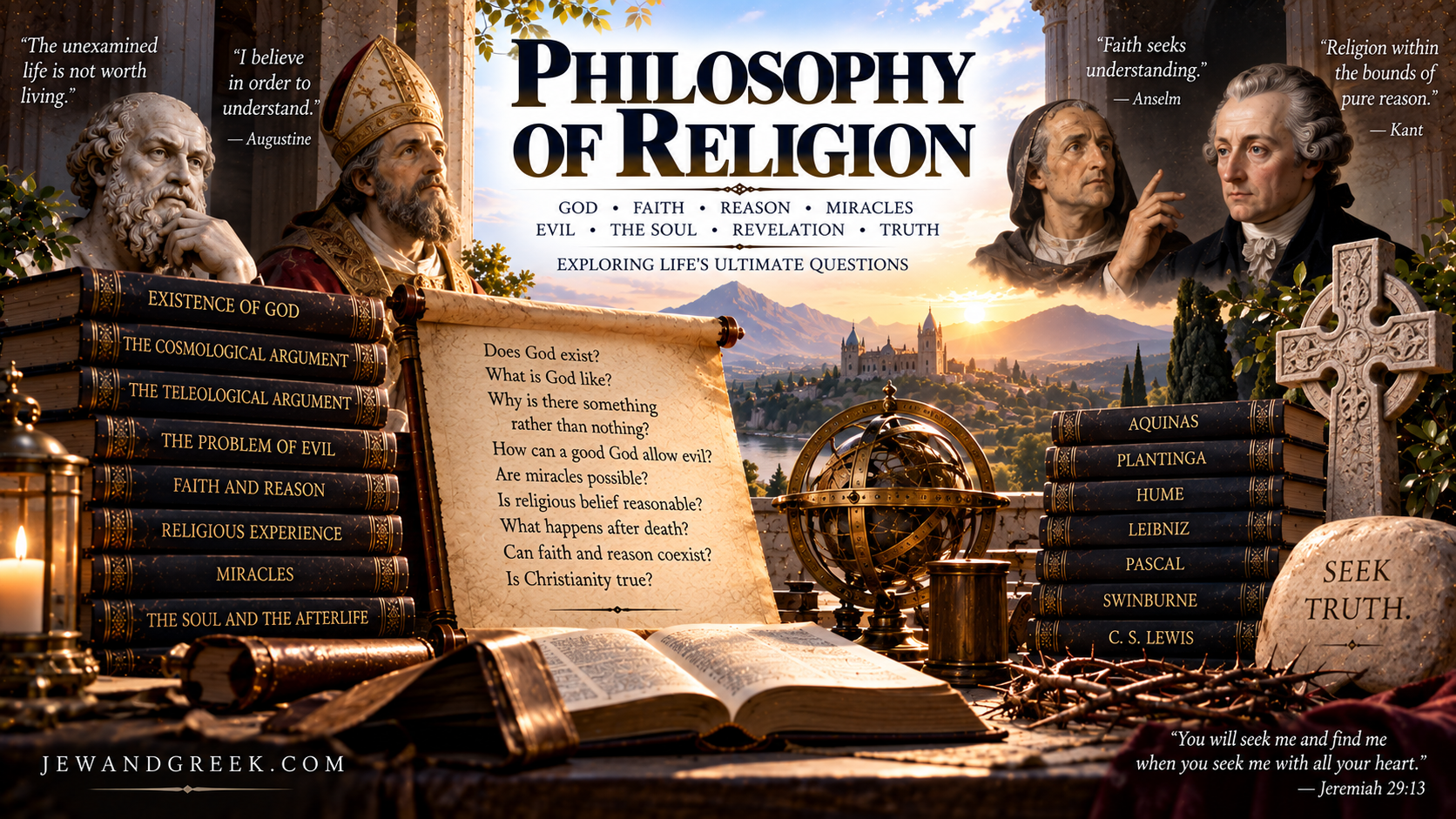
Philosophy of religion examines religious beliefs and claims using the methods of philosophical reasoning. It asks whether God exists, what can reasonably be said about God’s nature, whether faith and reason are compatible, whether miracles are possible, why evil exists, whether human beings possess souls, and whether there is rational justification for believing in life after death. Unlike theology, which normally reasons within a particular religious tradition and its sources of revelation, philosophy of religion can begin with questions accessible to people regardless of their religious commitments. Yet the two disciplines inevitably overlap whenever theology makes claims about reality, knowledge, morality, or human nature.
For Christianity, philosophy of religion has particular importance because Christian faith makes claims about events and realities that believers understand as objectively true. Christianity does not merely prescribe a way of life or provide private spiritual experiences; it claims that God exists, created the world, acts within history, revealed himself through Israel, became incarnate in Jesus Christ, and raised Jesus from the dead. Such claims naturally invite philosophical questions about evidence, causation, possibility, knowledge, and historical reasoning. Christian thinkers have therefore engaged philosophical arguments from the earliest centuries of the church.
What Is Philosophy of Religion?
Philosophy of religion differs from simply studying religions historically or sociologically. A historian might investigate when a particular belief developed, while a sociologist might examine how that belief functions within a community. The philosopher asks whether the belief is coherent, what reasons support it, what objections can be raised against it, and what follows if it is true.
This means philosophy of religion is not inherently either religious or anti-religious. Augustine, Anselm, Thomas Aquinas, Blaise Pascal, Alvin Plantinga, and Richard Swinburne have used philosophical reasoning in defense of religious belief, while David Hume, Bertrand Russell, J. L. Mackie, and many other philosophers have raised influential objections. Others have occupied positions that do not fit neatly into either category. The discipline is therefore best understood as a sustained rational investigation of religious claims rather than as an attempt to guarantee a predetermined conclusion.
Does God Exist?
The existence of God is the central question in classical philosophy of religion. Philosophers have developed numerous arguments intended to show that belief in God is rationally justified or that God’s existence provides the best explanation for important features of reality. These arguments usually do not begin by assuming the authority of the Bible or another sacred text. Instead, they reason from features of the world such as existence, causation, order, consciousness, morality, or contingency.
No single argument has commanded universal agreement, and even philosophers who believe in God disagree about which arguments succeed. The significance of the discussion therefore lies partly in cumulative reasoning. A person might regard no individual argument as mathematically demonstrating God’s existence while nevertheless concluding that several independent features of reality together make theism more plausible. Critics respond by proposing alternative explanations or questioning whether the phenomena require any ultimate explanation at all.
The Cosmological Argument
Cosmological arguments reason from the existence of the universe or dependent things toward some ultimate explanation of their existence. Different versions should not be treated as though they were one argument. Aristotle reasoned toward an unmoved mover, medieval Islamic philosophers developed sophisticated arguments concerning necessary and contingent existence, and Thomas Aquinas presented several arguments beginning with motion, efficient causation, and contingency.
The underlying intuition is straightforward: things within ordinary experience do not appear to explain their own existence completely. They depend upon causes, conditions, or realities beyond themselves. If everything were ultimately dependent in this way, philosophers ask whether the entire structure of dependent reality would still require an explanation. Classical theists answer by proposing a necessary reality whose existence does not depend upon something else and which provides the ultimate ground for contingent existence.
Aquinas and the Five Ways
Thomas Aquinas’s famous Five Ways are often presented as five simple proofs of God’s existence, but they belong to a much larger metaphysical system. Aquinas begins with observations concerning change, causation, contingency, degrees of perfection, and the apparent directedness of natural processes. He then argues that these features point beyond themselves toward an ultimate source.
Aquinas’s first way, for example, depends upon the Aristotelian distinction between actuality and potentiality. Change occurs when something potential becomes actual, but a potential cannot actualize itself in precisely the same respect. Aquinas therefore reasons toward a first actualizer that does not itself require actualization. His argument is not merely that everything has a cause and therefore God must have one too; in classical theism, God is proposed precisely as the kind of necessary reality that does not possess the dependent mode of existence requiring such an explanation.
The Kalam Cosmological Argument
The Kalam cosmological argument has roots in medieval Islamic philosophy and has become prominent in contemporary Christian apologetics. Its familiar form argues that whatever begins to exist has a cause, that the universe began to exist, and therefore that the universe has a cause.
Much contemporary debate concerns the second premise. Philosophers and scientists discuss whether the universe had an absolute beginning, what modern cosmology actually establishes, and whether physical descriptions of an early universe answer the metaphysical question of why a universe exists at all. Even if the argument establishes a cause beyond the universe, additional reasoning is required before identifying that cause with the God described by Christianity. The argument therefore functions most naturally as one stage within a broader case for theism rather than as a complete Christian theology.
The Argument from Contingency
The argument from contingency begins not necessarily with a temporal beginning but with the distinction between things that could have failed to exist and something that exists necessarily. Human beings, planets, stars, and apparently the physical structures of the universe are contingent: their existence does not seem logically or metaphysically inevitable.
This leads to a question associated especially with Gottfried Wilhelm Leibniz: Why is there something rather than nothing? Leibniz’s principle of sufficient reason maintains that there should be an adequate explanation for why reality is one way rather than another. The theistic answer proposes a necessary being as the ultimate explanation of contingent reality. Critics dispute whether every contingent fact requires such an explanation or whether the universe itself might simply exist as a brute fact.
The Ontological Argument
The ontological argument, associated most famously with Anselm of Canterbury, takes a radically different approach. Rather than beginning with observations about the universe, Anselm reasons from the concept of God as the greatest conceivable being. He argues that a being existing in reality is greater than one existing only in the understanding and concludes that the greatest conceivable being cannot exist merely as an idea.
The argument has fascinated philosophers for nearly a thousand years because its simplicity conceals difficult questions concerning existence, necessity, and possibility. Gaunilo challenged Anselm with an analogy involving a perfect island, while Kant later argued that existence is not a predicate that adds a property to a concept. Modern philosophers have developed modal versions using the logic of possible worlds. Even many theists remain divided over whether ontological arguments demonstrate God’s existence, but their continuing discussion has contributed significantly to philosophical thinking about necessary existence.
The Teleological Argument
Teleological arguments reason from order, complexity, regularity, or apparent purpose within nature. William Paley famously compared the world to a watch whose organized complexity suggests an intelligent watchmaker. Darwinian evolution later provided a natural mechanism capable of explaining much biological complexity without requiring separate acts of design, substantially changing the form of the philosophical debate.
Contemporary versions often focus instead upon the fundamental conditions that make a life-permitting universe possible. Physical constants and initial conditions appear to fall within ranges compatible with complex life, producing the modern discussion of fine-tuning. The proposed explanations commonly include physical necessity, chance, some form of multiverse, intelligent design, or combinations of these possibilities. Philosophy enters the discussion by asking how competing explanations should be evaluated rather than pretending that scientific measurements alone automatically settle the metaphysical question.
God and the Laws of Nature
The regularity of nature raises another philosophical question. Why does the universe exhibit stable patterns that can be described mathematically? Why should human minds be capable of discovering those patterns? The extraordinary success of mathematics in describing physical reality has led both religious and nonreligious thinkers to reflect upon the intelligibility of the universe.
Theists have sometimes argued that an ordered universe is unsurprising if it originates from a rational Creator and if human rationality reflects that Creator in some way. Naturalists respond that observers capable of asking such questions would necessarily find themselves within a sufficiently ordered environment and that physical laws need not have a personal explanation. The disagreement illustrates a recurring feature of philosophy of religion: the same feature of reality can be incorporated into different larger explanations, and the philosophical task is to compare their explanatory strengths and assumptions.
The Moral Argument
Moral arguments begin with features of moral experience. If some actions are objectively right or wrong regardless of individual or cultural preference, philosophers can ask what ultimately grounds those moral truths and obligations. Theistic arguments commonly propose that objective moral values are grounded in God’s perfectly good nature and that moral duties arise within a reality created and morally ordered by God.
Critics argue that objective morality may exist without God, perhaps as necessary moral truths or as principles grounded in rationality, human flourishing, or facts about conscious creatures. Others deny objective morality altogether. The debate therefore should not be confused with the claim that atheists cannot behave morally. The philosophical question concerns the foundation of morality, not whether religious and nonreligious individuals are capable of kindness, sacrifice, honesty, or moral reasoning.
The Euthyphro Dilemma
Plato’s Euthyphro presents a question that later became central to discussions of God and morality: Is something good because the gods command it, or do the gods command it because it is good? Applied to monotheism, the dilemma appears to create two undesirable alternatives. If actions become good merely because God commands them, morality might seem arbitrary. If God commands actions because they conform to an independent moral standard, goodness appears to exist above God.
Many Christian philosophers answer by rejecting the dilemma’s two alternatives. They argue that goodness is grounded in God’s nature rather than in arbitrary commands or an independent standard external to God. God commands consistently with who God necessarily is—good, loving, just, and faithful. Whether this fully resolves the philosophical problem remains debated, but it illustrates the close relationship between ethics, metaphysics, and theology.
The Problem of Evil
Perhaps the most powerful philosophical challenge to belief in God is the problem of evil. If God is perfectly good, all-knowing, and all-powerful, why does the world contain profound suffering and evil? The problem becomes particularly intense when considering apparently pointless suffering: children dying painfully, natural disasters destroying communities, diseases producing prolonged agony, or human beings committing atrocities against one another.
The challenge appears in several forms. The logical problem of evil argues that the existence of God and evil may be logically incompatible. The evidential problem of evil makes the more modest claim that the amount, distribution, or apparent pointlessness of suffering counts as evidence against the existence of such a God. These forms should be distinguished because an answer showing that God and evil are logically compatible does not automatically explain why the world contains the particular suffering that it does.
The Free Will Defense
One influential response is the free will defense. If God creates creatures genuinely capable of significant moral choices, the possibility of wrongdoing may be inseparable from that freedom. A world populated by beings programmed always to perform good actions would lack the kind of morally significant freedom involved in love, courage, faithfulness, sacrifice, and responsibility.
Alvin Plantinga famously developed a sophisticated version intended primarily to answer the logical problem of evil. The defense does not claim that every instance of suffering can be traced directly to someone’s free decision. Natural disasters, diseases, and animal suffering create additional problems. Nor does showing that God could have morally sufficient reasons for allowing evil tell us exactly what those reasons are. The defense instead challenges the claim that the existence of God and the existence of evil are logically contradictory.
Soul-Making and Suffering
Another approach emphasizes what is sometimes called soul-making. Associated especially with interpretations of Irenaeus and, in modern philosophy, John Hick, this view argues that certain virtues can develop only within a world containing danger, difficulty, and genuine consequences. Courage requires circumstances in which fear and danger are possible; compassion requires suffering to which compassion can respond; perseverance requires adversity.
This perspective may explain some suffering, but it can appear inadequate when applied to extreme horrors. Not every tragedy visibly produces character development, and some suffering appears to destroy rather than strengthen people. Christian theology therefore usually addresses suffering through a larger framework involving creation, human freedom, the fall, divine providence, redemption, God’s participation in human suffering through Christ, final judgment, and resurrection. Philosophy can evaluate the coherence of that framework even where it cannot provide a satisfying explanation for every individual tragedy.
Divine Hiddenness
The problem of divine hiddenness asks why God, if he desires relationship with human beings, is not more obvious. Some people sincerely seek God yet remain unconvinced that God exists. Philosopher J. L. Schellenberg has developed this observation into an argument against the existence of a perfectly loving personal God.
Theists have proposed several responses. Some argue that overwhelming awareness of God might alter the conditions under which human beings respond freely to him, while others maintain that God has provided sufficient but not coercive evidence through creation, conscience, history, religious experience, and revelation. Critics question whether these explanations account adequately for sincere nonbelief. Divine hiddenness therefore shifts the debate from whether evidence for God exists to the more personal question of what kind of evidence a loving God might reasonably be expected to provide.
What Is God Like?
If God exists, philosophy then asks what properties such a being would possess. Classical theism describes God as necessary, eternal, immaterial, omnipotent, omniscient, perfectly good, and the ultimate source of all other reality. Christian theology adds claims concerning God’s triune identity and God’s actions within history, but philosophy can examine whether the underlying attributes are coherent.
Questions quickly arise. Can an omnipotent being create a stone too heavy for itself to lift? Does divine foreknowledge conflict with human freedom? Can an eternal God interact with temporal events? Can a perfectly simple God possess knowledge of changing circumstances? Philosophical theology attempts to clarify such concepts carefully rather than assuming that familiar religious words automatically have obvious meanings.
Omnipotence
Omnipotence is often loosely described as the ability to do anything, but philosophers generally qualify this definition. Logical contradictions do not describe genuine tasks. Creating a square circle or making two plus two equal five is not an example of power that a stronger being might possess; the phrases fail to describe coherent states of affairs.
Classical accounts therefore understand omnipotence in terms of the ability to accomplish anything that is genuinely possible and consistent with God’s nature. This also explains why statements such as “God cannot lie” have traditionally not been considered limitations upon divine power. If God is necessarily perfectly good, the inability to act contrary to perfect goodness reflects God’s nature rather than weakness.
Omniscience and Human Freedom
If God knows everything, including future human choices, are those choices genuinely free? Suppose God infallibly knows today what someone will choose tomorrow. Can that person tomorrow choose differently from what God already knows?
One response distinguishes certainty from causation. God’s knowing an action does not necessarily cause the person to perform it. Others argue that the problem is deeper because infallible foreknowledge seems to make alternative possibilities impossible. Christian philosophers have developed several models, including classical foreknowledge, Thomistic accounts of divine eternity, Molinism and its concept of middle knowledge, and open theism. These disagreements show that affirming both divine knowledge and meaningful human agency leaves substantial philosophical work to be done.
Faith and Reason
The relationship between faith and reason has shaped Christian intellectual history. Faith is sometimes portrayed as belief without evidence or even belief contrary to evidence, but this definition does not adequately represent many historical Christian understandings. Augustine, Anselm, Aquinas, Pascal, and numerous later thinkers treated faith and reason as distinct but potentially complementary.
Reason can evaluate arguments, interpret evidence, expose contradictions, and examine whether beliefs cohere with one another. Faith involves trust and commitment as well as belief. In ordinary life, people regularly place reasonable trust in persons and testimony without possessing deductive proof. The philosophical issue is therefore not whether faith goes beyond what can be demonstrated with certainty, but whether religious faith goes beyond the evidence reasonably or unreasonably.
Pascal’s Wager
Blaise Pascal approached religious belief differently from philosophers seeking deductive proofs. Pascal’s Wager argues roughly that human beings must live either as though God exists or as though God does not, and the potential consequences make commitment to God rationally advantageous under conditions of uncertainty.
The wager is frequently misunderstood as an argument proving God’s existence. It is instead an argument about rational decision-making. Critics raise important objections, including the problem of many possible religions, the ethics of believing for personal advantage, and whether people can choose beliefs voluntarily. Pascal himself also situated the wager within a much broader analysis of human nature, distraction, misery, greatness, and the human search for God, making the famous betting analogy only one portion of his religious thought.
Religious Experience
Millions of people report experiences they interpret as encounters with God or transcendent reality. These range from dramatic visions to quieter experiences of divine presence, conviction, guidance, awe, or answered prayer. Philosophy asks whether such experiences can provide rational justification for religious belief.
Religious experience cannot simply be dismissed because it is subjective; much ordinary knowledge begins with personal experience. Yet religious experiences occur across different traditions and can receive contradictory interpretations. Psychological and neurological explanations are also possible. The philosophical task is therefore to consider whether religious experience should be treated as prima facie evidence, how competing interpretations should be evaluated, and whether cumulative evidence changes its significance.
Revelation
Christianity claims that God has not left humanity to discover ultimate reality through philosophical reasoning alone but has revealed himself. General revelation refers broadly to what can be known of God through creation, reason, conscience, and human experience, while special revelation concerns particular acts of divine self-disclosure, especially those recorded in Scripture and culminating for Christians in Jesus Christ.
Philosophy cannot simply assume revelation when addressing people who do not already accept it. It can, however, ask whether revelation is possible, whether testimony can transmit knowledge, how claims to revelation might be distinguished from error or deception, and whether historical evidence can support claims that God has acted within history. At that point philosophy of religion begins to overlap significantly with epistemology, history, biblical studies, and apologetics.
Are Miracles Possible?
A miracle is generally understood as an extraordinary event involving divine action, though definitions vary. David Hume’s famous critique argued that testimony for miracles should be evaluated against the extremely strong evidence provided by the regular course of nature. Reports of miracles, he argued, are generally less probable than the possibility that testimony is mistaken.
The debate depends partly upon prior assumptions. If God does not exist or cannot act within nature, miracles are impossible. If a Creator exists who sustains the natural world, divine action within that world is not obviously incoherent. The question then becomes historical and evidential: what evidence would justify believing that an extraordinary event occurred? A law of nature describes regularities under certain conditions; it does not by itself establish that no agent beyond the natural system could ever act.
The Resurrection of Jesus
The resurrection occupies an unusual position because Christianity presents it simultaneously as a miracle and as an event within history. The apostle Paul explicitly connected Christian faith to the claim that Christ was raised, arguing that if Christ had not been raised, Christian faith would be futile. The claim therefore invites historical investigation rather than functioning solely as an inward spiritual symbol.
Historians can examine early Christian testimony, beliefs about Jesus’ appearances, the transformation of his followers, the development of resurrection proclamation, and competing explanations for the available evidence. Historical methods cannot place God under laboratory observation, but historians routinely reason toward explanations of past events that cannot be repeated experimentally. The philosophical question is whether supernatural explanations should be excluded in advance or considered when evaluating the evidence. The answer often depends upon larger judgments concerning whether God exists and whether divine action is possible.
The Soul and Personal Identity
Religious beliefs about death raise philosophical questions concerning the soul and personal identity. Are human beings entirely physical organisms, or does a nonphysical dimension of human existence exist? Plato defended a form of soul-body dualism, while Aristotle understood the soul differently as the form of a living body. Christian thinkers have drawn from these traditions while attempting to integrate them with biblical teaching.
Contemporary philosophy of mind has revived many of these debates through questions about consciousness. If mental states can ultimately be reduced entirely to brain states, traditional concepts of the soul may appear unnecessary. If consciousness, rationality, intentionality, or personal identity resist complete physical explanation, some form of dualism or nonreductive account may remain plausible. Christianity’s ultimate hope, however, is not merely the immortality of a disembodied soul but the resurrection of the body, making embodiment central to Christian anthropology.
Death and the Possibility of an Afterlife
Can a person survive bodily death? Philosophical discussion of the afterlife involves both metaphysical and epistemological questions. If human persons are entirely identical with functioning biological organisms, continued personal existence after the destruction of the body seems difficult to explain. Dualist accounts provide one possibility by distinguishing the person or soul from the physical body.
Resurrection introduces another problem of identity. If God raises a person whose body has decomposed, in what sense is the resurrected individual numerically the same person rather than a perfect copy? Christian philosophers have proposed different answers involving the soul, divine preservation of identity, bodily continuity, or other metaphysical accounts. These discussions demonstrate how an apparently straightforward religious confession can generate profound philosophical questions about what it means to be a person.
Religious Pluralism
The existence of many religions creates both practical and philosophical challenges. Christianity, Judaism, Islam, Hindu traditions, Buddhism, and other religions make claims that sometimes overlap but often contradict one another. Christianity and Islam, for example, cannot both be correct about every major claim concerning Jesus because their traditional teachings concerning his identity, crucifixion, and divine status differ significantly.
One response is religious pluralism, which proposes that major religious traditions may represent different culturally conditioned responses to the same ultimate reality. John Hick became an influential modern defender of this approach. Critics argue that pluralism may achieve unity by reinterpreting religions in ways their own adherents would reject. Respect for religious diversity does not require pretending contradictory claims are identical. Philosophy instead asks how religious disagreement should affect confidence, evidence, humility, and claims to truth.
Exclusivism, Inclusivism, and Pluralism
Christian theology commonly distinguishes exclusivism, inclusivism, and pluralism when discussing salvation and other religions. Exclusivist approaches emphasize the necessity of explicit faith in Christ, though versions differ significantly. Inclusivist approaches maintain that salvation remains entirely through Christ while allowing that people without explicit knowledge of Christ may nevertheless receive that salvation under certain circumstances. Pluralist approaches generally treat multiple religious traditions as independently valid paths toward ultimate reality or salvation.
These categories simplify a much more complicated discussion, but they help identify important differences. The central philosophical issue concerns whether contradictory religious claims can simultaneously be true in the same sense. If one religion claims that Jesus is God incarnate while another denies that claim, both propositions cannot simply be affirmed without changing what at least one of them means. Religious tolerance and epistemic humility are therefore distinguishable from the assertion that all religions are equally true.
Science and Religious Belief
Religion and science are often portrayed as inevitable enemies, but their historical and philosophical relationship is more complicated. Modern science developed partly within cultures deeply influenced by Christian assumptions about an ordered and intelligible creation, though conflicts between religious authorities and scientific theories have also occurred. Today religious believers occupy positions throughout the scientific community, while scientists themselves hold widely differing philosophical views concerning religion.
Science investigates the natural world through empirical methods. Philosophy asks what those methods can establish and where their boundaries lie. Methodological naturalism, which seeks natural explanations when doing science, does not logically entail metaphysical naturalism, the philosophical claim that nothing beyond nature exists. Confusing those two propositions can turn a scientific method into a metaphysical conclusion without supplying the additional argument required.
Naturalism and Theism
Naturalism generally holds that reality consists entirely, or fundamentally, of the natural world studied by the sciences. Theism maintains that the natural universe depends upon a transcendent personal reality—God. The disagreement therefore extends far beyond isolated debates over miracles or particular scientific theories. It concerns the fundamental nature of reality.
Each worldview generates questions for the other. Theists ask naturalists how they account ultimately for existence, rationality, consciousness, objective morality, mathematical order, and the apparent intelligibility of nature. Naturalists ask theists why an additional divine reality is necessary, how God’s existence is explained, why divine action is not more obvious, and how theism accounts for suffering and religious disagreement. Serious philosophy requires allowing both sides to face their strongest questions rather than comparing one’s own most sophisticated arguments with caricatures of the alternative.
The Epistemology of Religious Belief
Must a person possess an argument for God before belief in God can be rational? Religious epistemology asks what kind of justification religious belief requires. Classical evidentialist approaches emphasize arguments and publicly available evidence. Other philosophers maintain that some beliefs can be rational without being inferred from other propositions.
Alvin Plantinga’s Reformed epistemology famously argues that belief in God may under appropriate conditions be properly basic, somewhat as belief in other minds, the external world, or the reliability of memory can be rational without first being proved through formal argument. Critics question whether this permits incompatible religious beliefs to claim the same status. Plantinga’s approach does not mean evidence is irrelevant; rather, it challenges the assumption that every rational belief must rest upon an argument from more fundamental beliefs.
Reasonable Disagreement
Intelligent and informed people can examine many of the same arguments and reach different conclusions about religion. Some philosophers find cosmological, moral, or fine-tuning arguments persuasive, while others regard naturalistic explanations as sufficient. Some consider the problem of evil powerful evidence against theism, while others believe theism can account for evil within a broader theological framework.
The existence of disagreement should encourage intellectual humility without forcing skepticism about everything. Disagreement exists in ethics, politics, history, science, and philosophy without making knowledge impossible in those fields. The appropriate response is to examine arguments carefully, distinguish confidence from certainty, acknowledge genuine difficulties, and remain willing to revise conclusions when stronger evidence or reasoning appears.
Christianity and Philosophy of Religion
Christianity has always existed within a world of competing philosophical and religious claims. The New Testament itself records engagement with Jewish theology, Greek philosophy, Roman culture, pagan religion, skepticism, and competing interpretations of Jesus. Later Christian thinkers used philosophical concepts to articulate doctrines concerning God, creation, Christ, human nature, morality, and knowledge.
Christian engagement with philosophy nevertheless requires discernment. Philosophy can clarify concepts and test arguments, but Christian theology does not reduce God to the conclusion of a syllogism. The God proclaimed by Christianity is not merely a metaphysical first cause or abstract necessary being. Christianity claims that the Creator has acted personally within history, entered human existence in Jesus Christ, suffered, died, and was raised. Philosophy can investigate whether those claims are coherent and reasonably supported, but Christianity ultimately presents them as realities to which human beings are called to respond.
Why Philosophy of Religion Matters
Questions about God cannot easily be isolated from other philosophical questions. Whether God exists affects how one understands the universe, human beings, morality, consciousness, freedom, death, purpose, and the possibility of revelation. Conversely, beliefs about those subjects influence how arguments concerning God are evaluated. Philosophy of religion therefore sits at an intersection connecting metaphysics, epistemology, ethics, philosophy of mind, history, and theology.
Its purpose is not merely to provide intellectual ammunition for believers or skeptics. At its best, philosophy of religion teaches people to identify assumptions, distinguish arguments from assertions, represent opposing positions accurately, recognize the limits of particular arguments, and follow evidence wherever it leads. Questions concerning God are too significant to be approached carelessly, whether the person asking them begins with faith, doubt, or uncertainty.
The Search for God
For thousands of years, philosophers have asked whether the existence of the world points beyond itself. Aristotle reasoned toward an unmoved mover. Augustine explored the relationship between God, truth, and the human soul. Anselm considered necessary existence. Aquinas developed arguments from change, causation, and contingency. Hume challenged natural theology, Kant investigated the limits of theoretical reason, Pascal examined faith under uncertainty, and contemporary philosophers continue debating cosmology, fine-tuning, morality, consciousness, evil, hiddenness, miracles, and religious experience.
Christianity ultimately makes a claim that goes beyond natural theology: the God sought through philosophical reasoning has made himself known within history. For Christian thought, the question is therefore not only “Does God exist?” but “Has God revealed himself, and if so, what has he revealed?” Philosophy cannot answer that question by reasoning alone, but it can help determine whether the Christian answer is coherent, whether objections succeed, and whether the historical and philosophical evidence deserves serious consideration.