

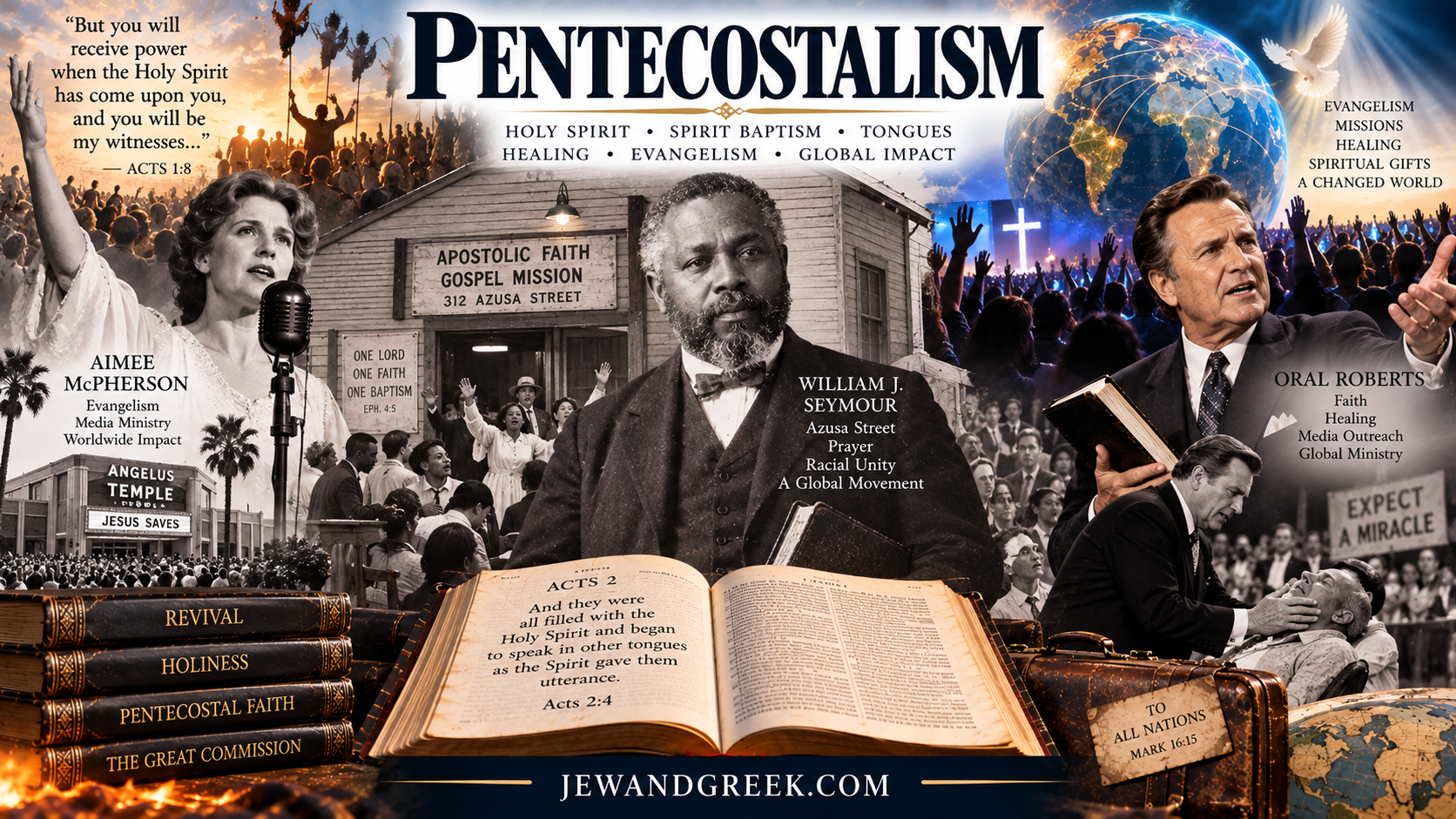
Pentecostalism is a major movement within Protestant Christianity distinguished by its emphasis on the present work of the Holy Spirit, baptism in the Holy Spirit, spiritual gifts, divine healing, evangelism, and an expectation that the supernatural experiences described in the New Testament remain available to Christians today. Emerging at the beginning of the twentieth century from the broader Evangelical and Holiness environment, Pentecostalism spread with remarkable speed and developed into a global Christian movement encompassing numerous denominations, independent churches, missionary networks, and revival traditions.
The name “Pentecostal” comes from the events of Pentecost recorded in Acts 2, when the Holy Spirit came upon the disciples and they spoke in other tongues. Early Pentecostals believed the gifts and experiences described in Acts and 1 Corinthians had not ceased with the apostolic age. They sought a Christianity in which conversion was accompanied by a continuing experience of the Holy Spirit’s power for worship, witness, holiness, healing, and ministry.
Pentecostalism eventually influenced Christianity far beyond churches bearing the Pentecostal name. During the twentieth century, charismatic renewal brought Pentecostal beliefs and practices into Anglican, Lutheran, Presbyterian, Methodist, Catholic, and other established traditions. Later independent charismatic and neo-Pentecostal churches expanded the movement still further. As a result, Pentecostal and charismatic forms of Christianity have become a major presence in contemporary global Christianity.
Roots in the Holiness Movement
Pentecostalism did not appear in isolation. Its immediate theological background included nineteenth-century Evangelical revivalism, the Wesleyan-Holiness movement, divine-healing ministries, and growing Protestant interest in the person and work of the Holy Spirit. Holiness Christians had already taught that believers could experience a decisive work of God subsequent to conversion, commonly described as entire sanctification or a second work of grace.
Some nineteenth-century Christians increasingly used the language of “baptism with the Holy Spirit” to describe experiences of sanctification, spiritual empowerment, or both. Revivalists prayed for a deeper work of God, missionaries sought supernatural power for evangelism, and divine-healing movements encouraged Christians to expect God’s direct intervention in physical illness. These streams helped create an environment in which a new interpretation of Spirit baptism could emerge.
Early Pentecostals inherited this expectation of a post-conversion encounter with God but increasingly associated baptism in the Holy Spirit with supernatural empowerment and the spiritual gifts described in Acts. Speaking in tongues became particularly important as Pentecostals attempted to identify the biblical evidence of Spirit baptism.
Charles Parham and Topeka
One important figure in early Pentecostal history was Charles Fox Parham, a Holiness evangelist and teacher. In 1900, Parham established a Bible school in Topeka, Kansas, where he and his students studied the book of Acts and considered what evidence accompanied baptism in the Holy Spirit.
During a prayer meeting beginning on December 31, 1900, and continuing into January 1, 1901, student Agnes Ozman asked for prayer to receive the Holy Spirit and began speaking in tongues. Other members of the school subsequently reported similar experiences.
Parham concluded from his reading of Acts that speaking in tongues constituted the biblical evidence of baptism in the Holy Spirit. He began preaching this message elsewhere, particularly in the American Midwest and Southwest. His ministry remained relatively limited, but one of the people who encountered his teaching would become far more influential in the worldwide spread of Pentecostalism: William J. Seymour.
William J. Seymour
William Joseph Seymour was born in Louisiana in 1870 to formerly enslaved parents. He became involved in the Holiness movement and eventually encountered Parham’s teaching concerning baptism in the Holy Spirit.
Because of racial segregation, Seymour’s relationship with Parham’s Bible school in Houston was constrained by the racial practices of the period. Nevertheless, Seymour learned the emerging Pentecostal teaching and was subsequently invited to preach at a Holiness mission in Los Angeles.
His message concerning Spirit baptism initially produced controversy. After being excluded from the church where he had been invited to preach, Seymour began meeting with believers in homes. Prayer meetings intensified, participants reported speaking in tongues and other spiritual experiences, and increasing numbers of people began attending.
The meetings soon outgrew the available space and moved to a building on Azusa Street.
The Azusa Street Revival
The Azusa Street Revival began in Los Angeles in 1906 and became one of the most important events in Pentecostal history. Meetings were held at the Apostolic Faith Gospel Mission at 312 Azusa Street under Seymour’s leadership. Services were often spontaneous and included prayer, testimony, singing, preaching, speaking in tongues, interpretations, reports of healing, and other manifestations participants understood as gifts of the Holy Spirit.
One of the most remarkable features of Azusa Street was its interracial character during an era of severe racial segregation in the United States. Black and white Christians worshiped together, and women as well as men participated prominently in ministry. Visitors came from across the United States and other countries, experienced the revival, and carried Pentecostal teaching back to their own communities.
Azusa Street was not the sole origin of Pentecostalism, and Pentecostal revivals were occurring in other places during the same period. Nevertheless, its international influence made it one of the principal centers from which Pentecostal Christianity spread around the world.
Baptism in the Holy Spirit
The doctrine of baptism in the Holy Spirit became a defining characteristic of classical Pentecostalism. Pentecostals generally understand Spirit baptism as an experience of divine empowerment associated particularly with Christian witness and ministry.
Acts 1:8 became a foundational text: “You will receive power when the Holy Spirit has come upon you, and you will be my witnesses.” Pentecostals frequently distinguish this empowerment from the Spirit’s work in conversion and regeneration. A person may therefore be a genuine Christian and possess the Holy Spirit while still seeking a further experience described as baptism in the Holy Spirit.
This distinction separates classical Pentecostal theology from traditions that understand Spirit baptism as occurring automatically at conversion. Pentecostals have nevertheless differed concerning the precise relationship among conversion, sanctification, Spirit baptism, and subsequent experiences of the Holy Spirit.
Speaking in Tongues
Speaking in tongues became the most recognizable practice associated with Pentecostal Christianity. Pentecostals appeal especially to Acts 2, Acts 10, Acts 19, and Paul’s discussion of spiritual gifts in 1 Corinthians 12–14.
Classical Pentecostal denominations commonly teach that speaking in tongues is the initial physical evidence of baptism in the Holy Spirit. In this understanding, tongues do not cause Spirit baptism but provide an outward sign that the experience has occurred.
Pentecostals also distinguish between tongues associated with Spirit baptism and the continuing gift of tongues used in Christian worship. In public congregational settings, 1 Corinthians 14 provides instructions concerning interpretation and orderly use. Tongues may also be practiced privately as prayer or personal spiritual edification.
Not every charismatic Christian accepts the classical Pentecostal doctrine of initial evidence. Many charismatics practice or affirm tongues while maintaining that Spirit baptism can occur without them.
The Gifts of the Spirit
Pentecostals are continuationists, meaning they believe the supernatural gifts described in the New Testament continue to operate in the church. First Corinthians 12 became especially important because it describes gifts including prophecy, tongues, interpretation of tongues, gifts of healing, miracles, faith, words of wisdom, words of knowledge, and discernment of spirits.
These gifts are understood as manifestations of the Holy Spirit rather than natural abilities alone. Pentecostals generally believe the Spirit distributes gifts according to God’s purposes and that they should operate for the benefit and edification of the church.
Early Pentecostals often contrasted their position with cessationism, the belief that at least some miraculous gifts were limited to the apostolic period. The continuation of spiritual gifts subsequently became one of Pentecostalism’s most influential contributions to broader Evangelical theology.
Prophecy
Prophecy occupies an important place within Pentecostal worship and theology. Pentecostals generally distinguish contemporary prophecy from the unique authority of Scripture. Modern prophetic speech does not add books to the biblical canon or possess authority equal to the Bible.
Drawing particularly from 1 Corinthians 14, Pentecostals have often understood prophecy as Spirit-enabled speech that can encourage, strengthen, comfort, warn, or guide a congregation. Some Pentecostals also believe prophecy may occasionally contain predictions concerning future events.
Practices concerning evaluation and accountability vary among Pentecostal churches. Historically, responsible Pentecostal theology has insisted that prophetic claims must be judged according to Scripture and should not displace biblical authority or responsible Christian discernment.
Divine Healing
Divine healing was central to Pentecostalism from its earliest years. Pentecostals believe Christians may pray expectantly for God to heal physical illness and frequently practice laying hands on the sick and anointing with oil according to passages such as James 5:14–16.
Early Pentecostal evangelists often included healing prayer in revival meetings, and testimonies of healing contributed significantly to the movement’s expansion. Later healing evangelists brought the practice to radio, television, large evangelistic campaigns, and international ministries.
Pentecostal approaches to medicine have varied, but belief in divine healing does not inherently require rejection of physicians or medical treatment. Many contemporary Pentecostals understand prayer and medicine as compatible means through which healing may be sought while recognizing that not every person prayed for experiences physical recovery.
Miracles and Supernatural Ministry
Pentecostalism is characterized by an expectation that God continues to intervene supernaturally in human life. Alongside healing, Pentecostals may pray for miracles, deliverance from demonic oppression, supernatural guidance, and other manifestations of the Spirit’s activity.
This expectation arises from a reading of Acts in which the ministry of the early church provides not merely a historical record but a model of Spirit-empowered Christian mission. Pentecostals therefore tend to read accounts of healing, prophecy, deliverance, and miracles with an expectation that similar works of God remain possible.
The movement’s supernatural emphasis has also generated internal debates about discernment, exaggerated claims, financial abuses, and the need to test spiritual experiences. Pentecostal leaders have repeatedly faced the challenge of encouraging openness to spiritual gifts while maintaining biblical accountability.
Holiness and Sanctification
Early Pentecostalism inherited differing understandings of sanctification. Pentecostals emerging directly from Wesleyan-Holiness Christianity commonly retained entire sanctification as a distinct second work of grace. Spirit baptism then became an additional experience, producing a three-stage pattern: conversion, entire sanctification, and baptism in the Holy Spirit.
This theology continues in denominations such as the Church of God (Cleveland, Tennessee) and the International Pentecostal Holiness Church.
Another stream developed through William H. Durham’s “Finished Work” teaching. Durham rejected entire sanctification as a necessary separate crisis experience and taught that sanctification begins through Christ’s completed saving work and continues throughout the believer’s life. In this framework, conversion is followed by Spirit baptism without requiring an intervening second work of entire sanctification.
The Finished Work position became influential in much of Pentecostalism, including the theological environment from which the Assemblies of God developed.
The Assemblies of God
The Assemblies of God was organized in Hot Springs, Arkansas, in 1914 by Pentecostal ministers seeking greater cooperation in missions, ministerial credentials, publishing, and doctrine. Rather than creating a tightly centralized denomination, the founders initially envisioned a cooperative fellowship of Pentecostal churches and ministers.
The Assemblies of God affirmed salvation through Christ, divine healing, baptism in the Holy Spirit, speaking in tongues as initial evidence, spiritual gifts, and evangelistic mission. It also adopted the Finished Work understanding of sanctification rather than the Wesleyan three-stage model.
The movement expanded internationally through missionary activity and indigenous church development and became one of the largest classical Pentecostal fellowships in the world.
The Church of God
The Church of God headquartered in Cleveland, Tennessee, developed from a revival movement originating in the Appalachian South during the late nineteenth century. It embraced Pentecostal experience in the early twentieth century while retaining its Wesleyan-Holiness understanding of sanctification.
Its theology therefore illustrates the Holiness Pentecostal pattern: conversion is followed by entire sanctification and baptism in the Holy Spirit. The denomination also emphasizes divine healing, spiritual gifts, evangelism, and missions.
The Church of God became an international Pentecostal denomination and demonstrates how Pentecostalism developed through several independent revival streams rather than from a single institution.
The Church of God in Christ
The Church of God in Christ, commonly known as COGIC, became one of the most important historically Black Pentecostal denominations in the United States. Its early development was associated particularly with Charles Harrison Mason, a Holiness preacher who embraced Pentecostal teaching after visiting the Azusa Street Revival.
COGIC combined Wesleyan-Holiness theology with Pentecostal spirituality and became a major institutional home for African American Pentecostal Christianity. Its worship, preaching, music, evangelism, and church culture exercised an influence far beyond its denominational boundaries.
The denomination also preserves an important connection to the interracial beginnings of early Pentecostalism, even though American racial segregation soon contributed to the development of separate Black and white Pentecostal organizations.
Racial Integration and Division
The Azusa Street Revival became famous for worship that crossed racial boundaries during an era when segregation was deeply entrenched in American society. Contemporary observers sometimes expressed astonishment or hostility toward the interracial character of the meetings.
That early integration did not remain characteristic of all Pentecostal institutions. Social pressures, racism, and existing patterns of segregation contributed to the development of racially divided denominations and ministerial networks.
This history contains both an important interracial ideal and significant failures to sustain it. In later generations, Pentecostal organizations made various efforts toward racial reconciliation and cooperation, while historically Black Pentecostal denominations developed influential traditions of their own.
Oneness Pentecostalism
An important theological controversy emerged within Pentecostalism beginning in the 1910s concerning the doctrine of God and the proper formula for baptism. Some Pentecostals began teaching that baptism should be administered specifically in the name of Jesus rather than using the traditional Trinitarian formula of Father, Son, and Holy Spirit.
The controversy developed into a broader theological position commonly called Oneness Pentecostalism. Oneness believers reject the traditional Christian doctrine that the one God eternally exists as three distinct persons—Father, Son, and Holy Spirit—and instead understand these biblical designations within a different conception of God’s unity and self-revelation.
Trinitarian Pentecostal denominations rejected the Oneness position as incompatible with historic Christian doctrine. The Assemblies of God formally affirmed Trinitarian theology in its 1916 Statement of Fundamental Truths. Oneness Pentecostalism nevertheless survived and developed its own denominations, including the United Pentecostal Church International.
Consequently, the term “Pentecostal” includes both Trinitarian and Oneness bodies, although they differ fundamentally concerning the doctrine of God.
Women in Pentecostal Ministry
Women played prominent roles in Pentecostalism from its earliest years. The movement’s emphasis on the Holy Spirit’s empowerment and passages such as Acts 2:17—“your sons and your daughters shall prophesy”—provided theological support for women’s participation in ministry in many Pentecostal communities.
Women served as evangelists, missionaries, pastors, church planters, healers, teachers, and founders of ministries. Aimee Semple McPherson became one of the most famous Pentecostal evangelists of the early twentieth century and founded the International Church of the Foursquare Gospel.
Pentecostal denominations have nevertheless differed concerning women’s ordination and leadership. Some grant women broad access to ministerial offices, while others restrict particular leadership roles. The question therefore remains an area of diversity within the movement.
Evangelism and Missions
From its beginning, Pentecostalism possessed a strong missionary impulse. Spirit baptism was closely connected with Acts 1:8 and the promise of power to become Christ’s witnesses. Early Pentecostals often believed they were participating in a final worldwide evangelistic movement preceding Christ’s return.
Missionaries left for other countries remarkably quickly, sometimes with limited financial resources or formal preparation. Early misunderstandings concerning tongues occasionally led some to believe they had supernaturally received foreign languages for missionary work, an expectation that experience generally corrected. Pentecostal missions subsequently developed more conventional approaches to language learning and cross-cultural ministry.
Over time, Pentecostal Christianity became increasingly indigenous. Churches established outside North America and Europe developed local leaders, missionary movements, theological institutions, and forms of worship adapted to their own cultures. This development became crucial to Pentecostalism’s worldwide expansion.
Worship
Pentecostal worship traditionally emphasizes active congregational participation and openness to spontaneous expressions of the Holy Spirit. Services may include contemporary or traditional music, spontaneous prayer, testimonies, speaking in tongues, interpretation, prophecy, healing prayer, altar ministry, and extended periods of worship.
Preaching generally occupies a central place, but the service is not always organized entirely around the sermon. Pentecostals traditionally expect the Holy Spirit to work throughout the gathering and may allow the planned order of service to change in response to what participants understand as the Spirit’s direction.
Worship styles vary enormously across cultures and denominations. A Pentecostal congregation in rural Appalachia may look very different from a large church in Seoul, Lagos, São Paulo, or Los Angeles, even though both share an expectation of experiential encounter with the Holy Spirit.
The Charismatic Movement
During the mid-twentieth century, Pentecostal experiences began appearing increasingly among Christians who remained within historic non-Pentecostal denominations. This development became known as the Charismatic movement.
Anglicans, Episcopalians, Lutherans, Presbyterians, Methodists, Roman Catholics, and others reported experiences of Spirit baptism, speaking in tongues, prophecy, healing, and other spiritual gifts without necessarily leaving their existing churches.
The Charismatic movement generally adopted Pentecostal spirituality while displaying greater theological diversity concerning doctrines such as initial evidence. Many charismatics rejected the requirement that every Spirit-baptized believer must speak in tongues while continuing to affirm the contemporary operation of spiritual gifts.
This development expanded Pentecostal influence far beyond classical Pentecostal denominations.
The Catholic Charismatic Renewal
Pentecostal spirituality entered Roman Catholicism prominently during the 1960s through what became known as the Catholic Charismatic Renewal. Participants emphasized personal conversion, prayer, praise, baptism in the Holy Spirit, spiritual gifts, healing, and renewed devotion to Jesus while remaining within the Catholic Church.
Catholic charismatics integrated these experiences with Catholic sacramental theology, devotion, and ecclesiastical structures rather than adopting Protestant Pentecostal theology wholesale.
The movement illustrates the distinction between classical Pentecostalism and the broader charismatic renewal. Pentecostal forms of spiritual experience could now appear within traditions possessing very different understandings of church authority, sacraments, and theology.
The Third Wave and Neo-Charismatic Christianity
Beginning especially in the late twentieth century, another stream of supernatural Evangelical Christianity developed among people who did not necessarily identify themselves as either Pentecostal or charismatic. This movement is sometimes called the “Third Wave.”
Associated with figures and networks emphasizing healing, prophecy, spiritual warfare, church growth, and contemporary spiritual gifts, Third Wave Christians generally affirmed continuationism without adopting the classical Pentecostal doctrine of tongues as the necessary initial evidence of Spirit baptism.
The boundaries among Pentecostal, charismatic, and neo-charismatic Christianity have subsequently become increasingly fluid. Independent churches may practice nearly all the spiritual gifts associated with Pentecostalism without using the Pentecostal label.
Pentecostalism and Prosperity Teaching
Some forms of modern Pentecostal and charismatic Christianity became associated with teachings commonly called the prosperity gospel or Word of Faith movement. These teachings emphasize varying connections among faith, confession, physical healing, financial prosperity, and God’s promises.
It is important not to equate Pentecostalism itself with prosperity theology. Many Pentecostal denominations and theologians criticize exaggerated prosperity teaching, particularly claims that financial wealth necessarily demonstrates faith or divine favor.
The association exists historically because some prosperity teachers emerged from Pentecostal and charismatic environments, but the movement represents a particular stream rather than a defining doctrine of Pentecostal Christianity.
Pentecostalism Around the World
Pentecostalism experienced extraordinary international expansion during the twentieth and twenty-first centuries. Strong Pentecostal and charismatic movements developed throughout Latin America, sub-Saharan Africa, Asia, and other regions, often through indigenous evangelism rather than continued dependence on Western missionaries.
Its adaptability contributed to this growth. Pentecostal churches could be established with relatively simple organizational structures, strong lay participation, energetic evangelism, and worship readily expressed through local music and culture. Its emphasis on healing, spiritual power, prayer, and direct encounter with God also resonated strongly in many cultural settings.
Global expansion transformed Pentecostalism itself. The movement can no longer be understood primarily as an American religious phenomenon exported abroad. Christians in Africa, Latin America, Asia, and other regions increasingly shape Pentecostal theology, worship, missions, and leadership.
Pentecostalism in Perspective
Pentecostalism emerged from the revivalist and Holiness currents of Protestant Christianity with a simple but far-reaching conviction: the Holy Spirit described in the book of Acts continues to empower the church. Early Pentecostals expected the gifts, healing, prophecy, tongues, miracles, and missionary power of the New Testament to remain part of Christian experience.
From the small prayer meetings of the early twentieth century and the interracial mission at Azusa Street, Pentecostal Christianity developed into a worldwide movement. Its influence subsequently moved beyond Pentecostal denominations through the Charismatic movement, Catholic Charismatic Renewal, independent churches, and newer continuationist movements.
The movement’s history includes theological controversies, institutional divisions, racial failures, disputed revival claims, and continuing debates over the proper use of spiritual gifts. Yet its central contribution to modern Protestantism remains unmistakable: Pentecostalism restored questions concerning the person, gifts, power, and experiential presence of the Holy Spirit to the center of Christian discussion and helped reshape the character of global Christianity.