

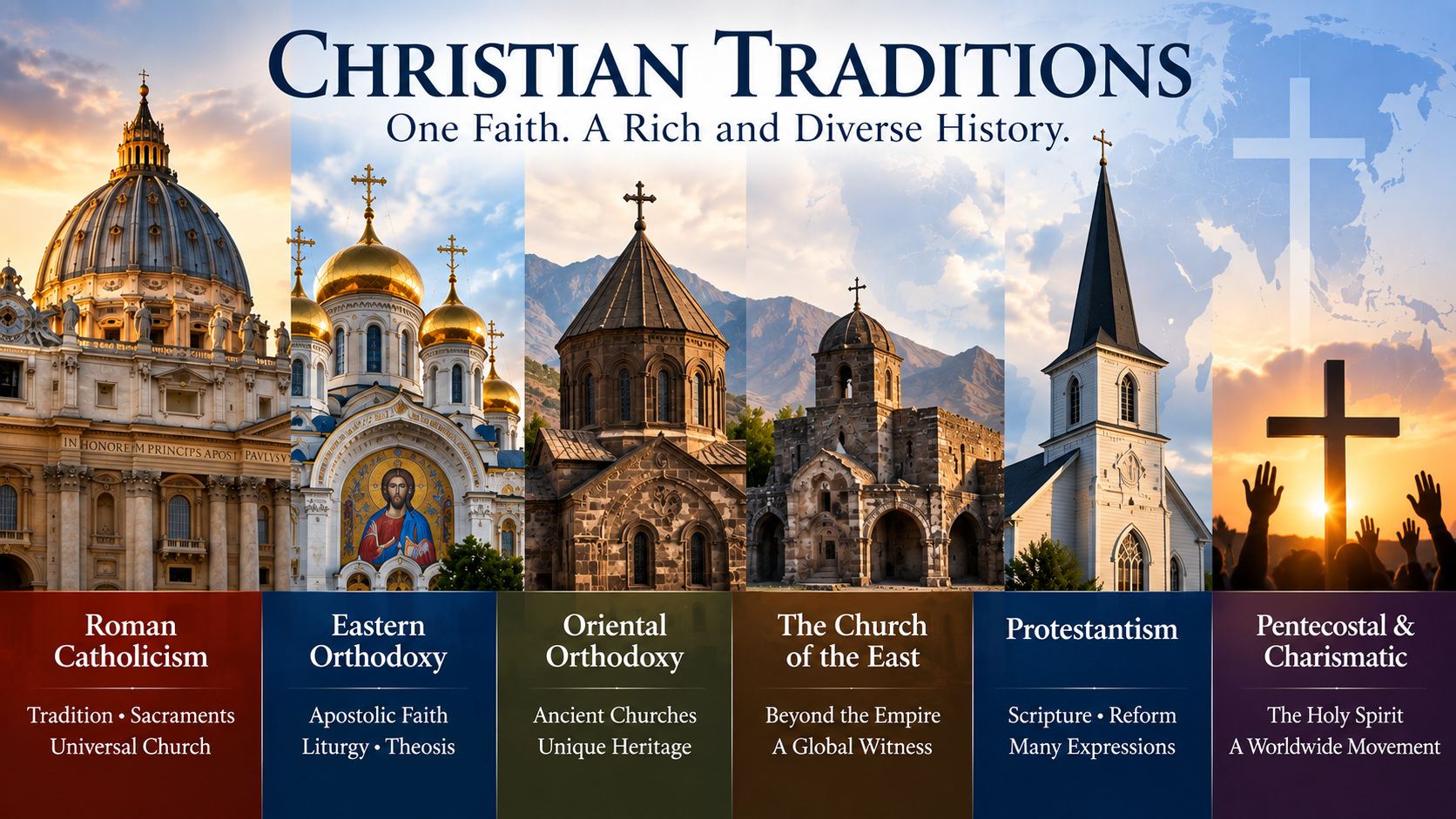
Christianity began with Jesus and His apostles, but it did not remain one organizationally unified church. Over nearly two thousand years, differences in theology, church authority, worship, culture, language, and history produced a number of distinct Christian traditions.
Some of those divisions are ancient. The Church of the East and the Oriental Orthodox churches separated from other Christians during controversies of the fifth century. The division between Eastern Orthodoxy and Roman Catholicism developed over centuries and is traditionally associated with the Great Schism of 1054. The Protestant Reformation produced still more branches beginning in the sixteenth century.
That history makes Christianity difficult to squeeze into a simple family tree. Baptists and Methodists are both Protestants, for example, but they didn’t emerge at the same time or from exactly the same branch. Pentecostalism began largely within Protestant Christianity but eventually crossed denominational boundaries through the Charismatic movement.
The categories below therefore aren’t meant to suggest that every Christian fits neatly into one box. They’re a way of understanding the major traditions that have developed during Christian history.
Roman Catholicism
Roman Catholicism is the largest Christian tradition and understands itself as standing in historical continuity with the church established by Christ and the apostles. It recognizes the bishop of Rome—the pope—as the successor of Peter with a unique role of authority within the universal church.
Catholic theology emphasizes Scripture and Sacred Tradition, the teaching authority of the church, seven sacraments, and the historic episcopate.
Explore Roman Catholicism →
Eastern Orthodoxy
Eastern Orthodoxy developed primarily among the ancient churches of the eastern Roman Empire. Orthodox Christians understand themselves as preserving the faith, worship, and apostolic tradition of the early church.
Eastern Orthodoxy shares much of the ancient theological heritage of Roman Catholicism but rejects the Catholic understanding of papal supremacy. Its worship is strongly liturgical and sacramental, and its theology places particular emphasis on theosis—participation in the life of God.
Explore Eastern Orthodoxy →
Oriental Orthodoxy
The Oriental Orthodox churches separated from churches accepting the Council of Chalcedon in 451. They include ancient traditions such as the Coptic Orthodox, Armenian Apostolic, Syriac Orthodox, Ethiopian Orthodox Tewahedo, Eritrean Orthodox Tewahedo, and Malankara Orthodox Syrian churches.
Their disagreement with Chalcedonian Christianity has often been summarized as a dispute about the nature of Christ, although centuries of differences in terminology, language, and politics make the history more complicated than that description suggests.
Explore Oriental Orthodoxy →
The Church of the East
The Church of the East developed largely outside the Roman Empire, particularly within the Persian world. Historically associated with the controversies surrounding Nestorius and the Council of Ephesus in 431, its Christology and history are more complicated than the traditional label “Nestorian” suggests.
At its height, churches belonging to this tradition extended astonishingly far east, with Christian communities established along trade routes reaching into Central Asia, India, and China.
Explore the Church of the East →
Protestantism
Protestant Christianity emerged from the sixteenth-century Reformation. Reformers such as Martin Luther, Huldrych Zwingli, and John Calvin challenged important teachings and practices of the medieval Roman Catholic Church and argued for the supreme authority of Scripture.
But Protestantism was never one church. Lutheran, Reformed, Anglican, and Anabaptist traditions developed during the Reformation itself, and later centuries produced Baptists, Methodists, Restorationists, Holiness churches, and numerous other movements.
Calling someone “Protestant,” therefore, tells you something—but sometimes not nearly as much as you might think.
Explore Protestantism →
Pentecostal and Charismatic Christianity
Pentecostalism emerged at the beginning of the twentieth century with a particular emphasis on baptism in the Holy Spirit and the continuing operation of spiritual gifts such as speaking in tongues, prophecy, divine healing, and miracles.
During the twentieth century, similar beliefs spread beyond explicitly Pentecostal denominations through the Charismatic movement. Today Pentecostal and charismatic Christians can be found in Protestant churches, independent churches, and even within Roman Catholicism and other historic traditions.
For that reason, Pentecostalism doesn’t fit quite as neatly on the Christian family tree as some of the older traditions.
Explore Pentecostal and Charismatic Christianity →