

Eastern Orthodoxy has no pope and no single administrative headquarters governing the entire Orthodox world. Yet that does not mean Orthodox churches operate independently of one another or that authority rests primarily with individual congregations.
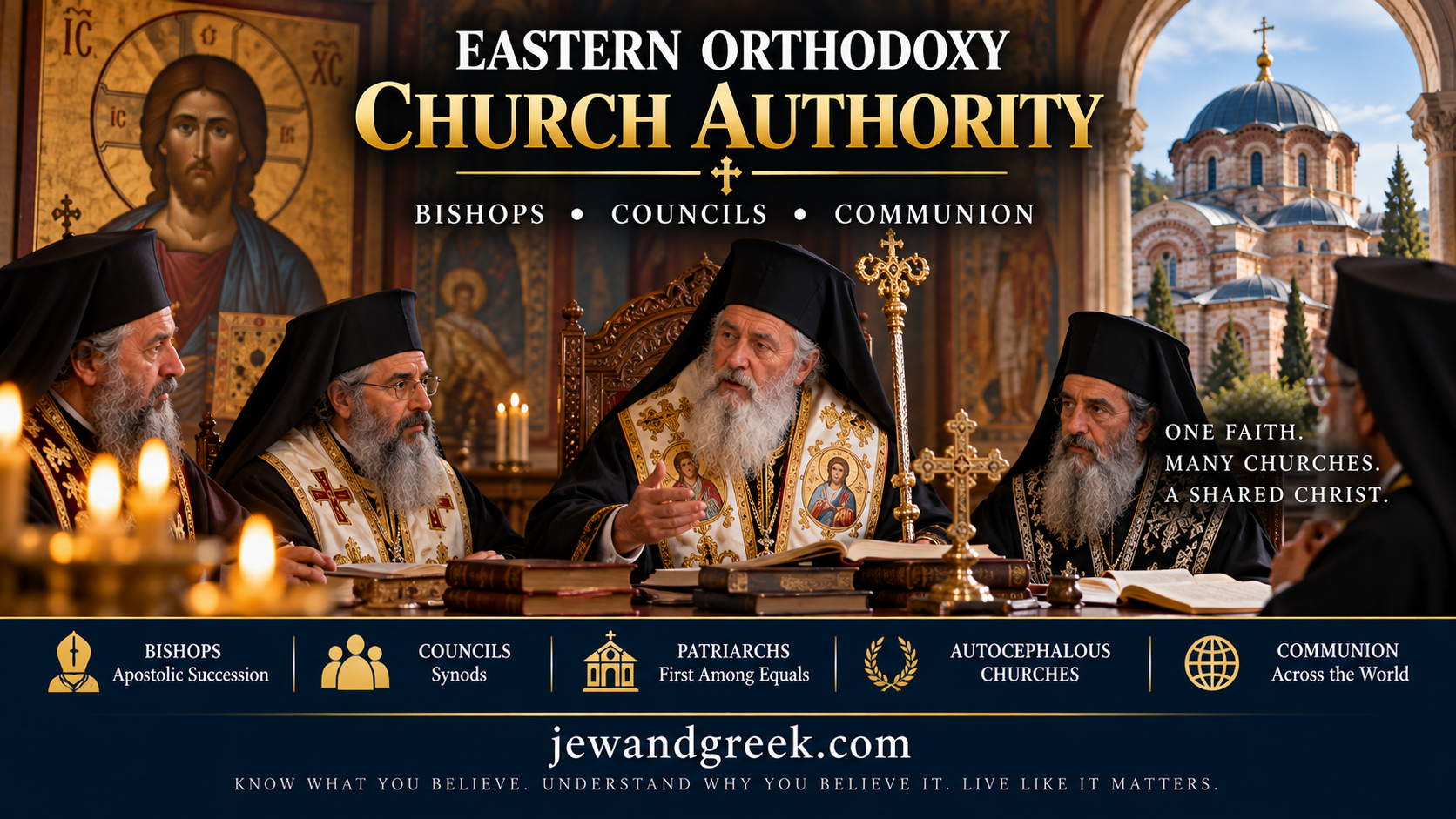
Orthodox church government is built around bishops, councils, and the principle of apostolic succession. Authority is shared among a family of self-governing churches that recognize one another as belonging to the same Orthodox communion.
This arrangement can look complicated from the outside. To be fair, it occasionally looks complicated from the inside too.
Bishops and Apostolic Succession
The bishop occupies a central place in Orthodox church government. Orthodox Christians understand the office of bishop as continuing the pastoral and teaching ministry entrusted by Christ to the apostles.
This continuity is expressed through apostolic succession. Bishops are ordained by other bishops whose ordinations are understood to form an historical succession reaching back to the apostles.
Apostolic succession, however, means more to Orthodoxy than simply possessing an unbroken chain of ordinations. A bishop is expected to preserve the apostolic faith. Historical succession and faithfulness to apostolic teaching belong together.
Bishops oversee dioceses containing multiple local churches. Priests normally lead individual congregations and administer the mysteries under the authority of their bishop, while deacons serve in liturgical and other ministries.
Councils and Synods
Orthodox church government is fundamentally conciliar, meaning that bishops exercise authority together rather than under a single universal bishop.
This pattern can be seen in the ancient ecumenical councils, where bishops gathered to address controversies affecting the wider church. Orthodoxy continues that principle through synods of bishops who make decisions concerning doctrine, discipline, administration, and church life.
A bishop therefore possesses genuine authority within his diocese, but he is not an isolated authority. He belongs to a larger body of bishops and is accountable within the wider church.
The Orthodox ideal is neither government by one worldwide bishop nor government by independent congregations. It is government through bishops acting in communion with one another.
Patriarchs
Some of the most prominent Orthodox bishops bear the title patriarch. Historically important patriarchates include Constantinople, Alexandria, Antioch, and Jerusalem. Other Orthodox churches, including the Russian, Serbian, Romanian, Bulgarian, and Georgian churches, are also headed by patriarchs or comparable senior bishops.
A patriarch exercises significant authority within his own church, but he does not exercise the kind of universal jurisdiction that Roman Catholicism attributes to the pope.
That distinction is essential for understanding Orthodox church government. Orthodox Christians may recognize differences in honor and responsibility among bishops without concluding that one bishop possesses supreme authority over every other bishop.
The Ecumenical Patriarch
The Ecumenical Patriarch of Constantinople occupies a special position within Eastern Orthodoxy. He is traditionally described as “first among equals” among Orthodox bishops.
The phrase is important. The Ecumenical Patriarch receives a primacy of honor, and he performs important coordinating and representative functions within worldwide Orthodoxy. But Eastern Orthodoxy does not generally understand his position as equivalent to that of the pope in Roman Catholicism.
Precisely how far the authority of the Ecumenical Patriarch extends is itself a subject of disagreement within contemporary Orthodoxy. Different Orthodox churches have sometimes interpreted his role differently, particularly when disputes involve the recognition or independence of other Orthodox churches.
Apparently, eliminating the pope does not eliminate arguments about jurisdiction.
Autocephalous Churches
Eastern Orthodoxy consists largely of autocephalous churches. The word literally refers to being “self-headed.” An autocephalous church governs its own internal affairs and selects its own senior bishop without being administratively subordinate to another Orthodox church.
Examples include the Churches of Constantinople, Alexandria, Antioch, Jerusalem, Russia, Serbia, Romania, Bulgaria, Georgia, Greece, Cyprus, Albania, and others.
These churches are administratively independent but are intended to remain united in doctrine, sacramental life, and communion. Their relationship is therefore different from either a centralized denomination or a collection of completely independent churches.
Questions about when and how a church becomes autocephalous can become contentious. There is not always universal agreement about which body has the authority to grant or recognize that status.
Communion
One of the keys to understanding Orthodox authority is the concept of communion.
Orthodox unity does not depend upon every congregation answering to one central administrative office. Instead, bishops and churches recognize one another, share the same faith, and participate together in the sacramental life of the church.
When serious disputes occur, communion can sometimes be strained or even broken between particular Orthodox jurisdictions. Such conflicts do not necessarily mean that either side has abandoned Orthodox theology. They may involve questions of jurisdiction, recognition, territory, or church government.
This can make Orthodox organizational relationships difficult to represent with a simple organizational chart. The church understands its unity primarily in theological and sacramental terms rather than merely administrative ones.
Authority and Holy Tradition
Bishops themselves are not considered free to invent Christian doctrine. Their authority exists within the apostolic faith preserved by the church.
Scripture, Holy Tradition, the ecumenical councils, the creeds, the Church Fathers, and the worship of the church all contribute to the Orthodox understanding of that inheritance.
This also means that Orthodoxy does not have a single living individual who can unilaterally settle every theological controversy for the entire church. Major doctrinal decisions historically have been associated with councils and their eventual reception by the wider church.
Authority, then, is both hierarchical and communal. Bishops teach and govern, but they do so as guardians of a faith they have received rather than owners of one they are free to redesign.
A Different Model of Church Government
For Protestants accustomed to denominations, congregational voting, elected boards, or independent churches, Orthodox church government can initially seem unfamiliar. For Roman Catholics, the absence of a universal pope creates another obvious difference.
Eastern Orthodoxy sees its structure as preserving an older pattern: local churches gathered around bishops, bishops united with one another, and major questions addressed through councils.
Whether that structure has always functioned as neatly in practice as it does in theory is another question. Church history rarely cooperates with organizational charts.
But the underlying Orthodox principle is fairly clear. No individual Christian stands alone, no congregation stands alone, and ideally no bishop stands alone. Authority is exercised within the communion of the church and in continuity with the faith received from the apostles.