

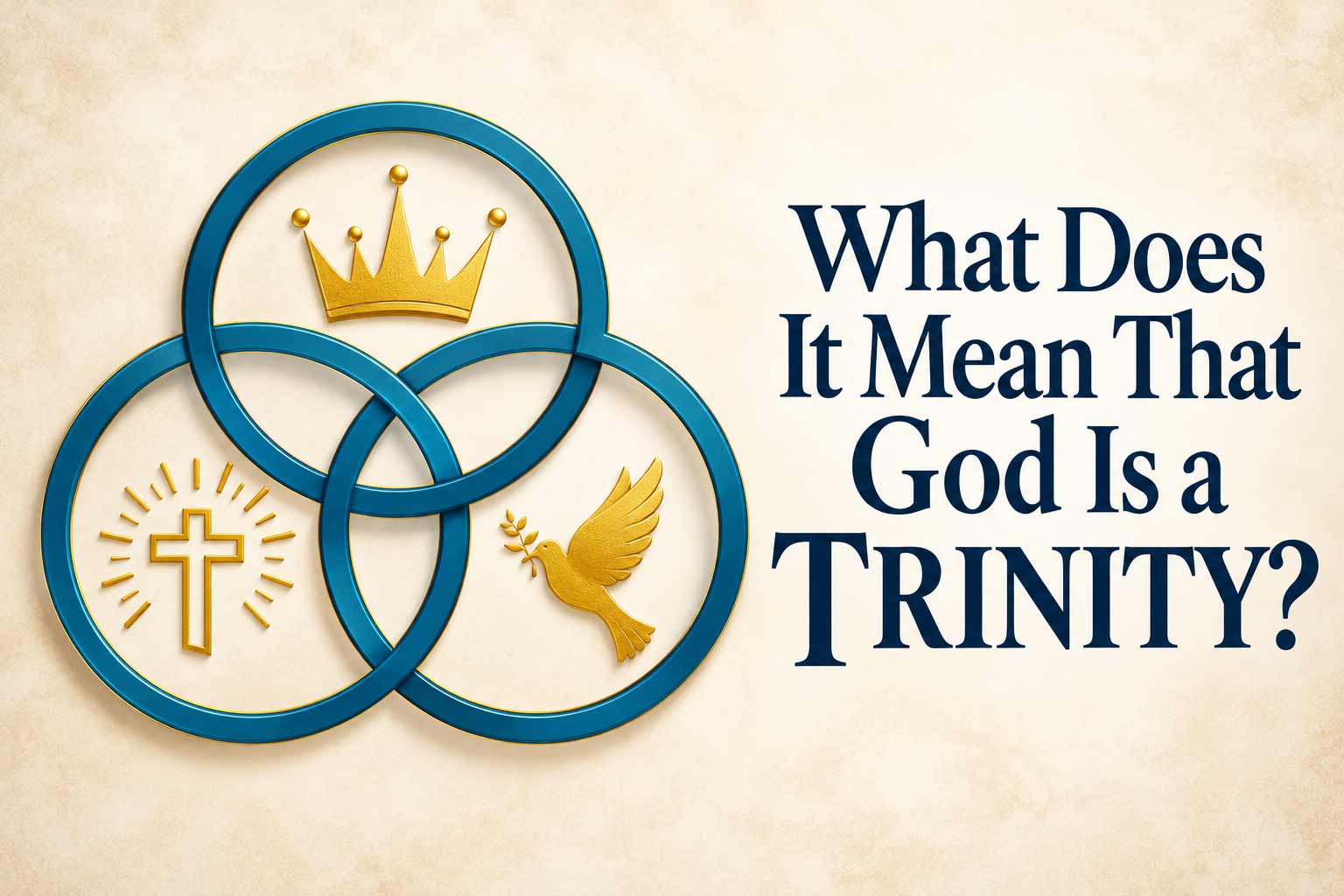
The Trinity is the Christian doctrine that there is one God who eternally exists as three distinct Persons: the Father, the Son, and the Holy Spirit. The Father is God, the Son is God, and the Holy Spirit is God. Yet the Father is not the Son, the Son is not the Holy Spirit, and the Holy Spirit is not the Father.
That sounds complicated because it is.
Christians didn’t come up with the doctrine because someone thought God needed to be made more difficult to understand. The doctrine developed because Christians were trying to make sense of several things the Bible teaches at the same time: there is only one God; the Father is God; Jesus is described in ways that identify him with God; the Holy Spirit is likewise associated with God’s identity and activity; and yet the Father, Son, and Holy Spirit are distinguished from one another.
How do we put all of that together without ending up with three gods?
The historic Christian answer is the Trinity.
Is the Word Trinity in the Bible?
No.
You can read from Genesis to Revelation without finding the word Trinity. But that really doesn’t settle the question.
Christians use theological words all the time to summarize biblical ideas. The question isn’t whether the word itself appears in Scripture. The question is whether the doctrine accurately describes what Scripture teaches.
So rather than asking only, Where does the Bible say “Trinity”? I think the better question is:
What does the Bible say about the Father, the Son, and the Holy Spirit?
That’s where the discussion needs to begin.
There Is One God
The doctrine of the Trinity starts with monotheism.
Christianity grew out of Judaism, and the Jewish confession that there is one God wasn’t something the first Christians simply discarded when they began following Jesus.
That means the Trinity isn’t:
1 God + 1 God + 1 God = 3 Gods
Christians aren’t claiming to worship three gods.
Historic Trinitarian theology instead makes a distinction between being and person. God is one in being or essence and three in person.
That’s theological language, and we need to be careful not to imagine that using the words solves the mystery. But the distinction is important. Christians aren’t claiming that God is one God and three Gods at the same time. They’re trying to describe how Father, Son, and Holy Spirit can each be identified as divine while maintaining that there is only one God.
Why Do Christians Believe Jesus Is God?
This is really where the problem became unavoidable for the early church.
John opens his Gospel by saying:
“In the beginning was the Word, and the Word was with God, and the Word was God.”
Then John tells us that the Word became flesh.
Notice the difficulty. The Word was God, but the Word was also with God.
The rest of the New Testament continues to distinguish Jesus from the Father. Jesus prays to the Father. He says that the Father sent him. He speaks to the Father and about the Father.
So Christians couldn’t simply say that Jesus and the Father are the same Person.
But if Jesus is divine and the Father is divine, have we now got two gods?
The early Christians said no.
That forced them to think much more carefully about what it means to say that there is one God.
What About the Holy Spirit?
Then we have the Holy Spirit.
The New Testament doesn’t simply treat the Holy Spirit as another name for the Father or Jesus. The Spirit speaks, acts, leads, can be grieved, and is distinguished from both the Father and the Son.
At the same time, the Spirit is associated with God’s presence and activity.
So the early church wasn’t dealing merely with a Father-and-Son problem. It eventually had to answer a threefold question:
Who is the Father? Who is the Son? Who is the Holy Spirit? And how are all three related to the one God?
There are also places where all three appear together.
Jesus tells his disciples to baptize “in the name of the Father and of the Son and of the Holy Spirit” (Matthew 28:19). Paul closes 2 Corinthians by bringing together Jesus Christ, God, and the Holy Spirit.
Neither passage gives us a theological lecture explaining the Trinity. But they certainly help us understand why Christians began asking these questions.
One God in Three Persons
The traditional Christian formula is:
One God in three Persons: Father, Son, and Holy Spirit.
The Father is not one-third of God. Neither is the Son or the Holy Spirit.
And God isn’t one Person switching between three different roles—Father for a while, Son for a while, and Holy Spirit for a while.
The Father is not the Son.
The Son is not the Holy Spirit.
The Holy Spirit is not the Father.
Yet historic Christianity maintains that each is fully divine and that there is still only one God.
Eventually Christians used terms such as essence, substance, and person to express these distinctions. The Greek word homoousios—usually translated “of the same substance” or “consubstantial”—became particularly important during the theological controversies of the fourth century.
Those words aren’t inspired. They’re attempts to put into theological language what Christians believed Scripture required them to affirm.
Did the Early Christians Believe in the Trinity?
Yes, but that answer needs some qualification.
The earliest Christians obviously spoke about the Father, Jesus Christ, and the Holy Spirit. What they didn’t have was the complete theological vocabulary Christians would develop over the next several centuries.
That shouldn’t surprise us.
The first Christians didn’t sit down after Pentecost and produce a systematic theology textbook. Questions arose, controversies developed, and Christians were forced to explain more precisely what they meant.
How could Jesus be divine if there is only one God?
Is the Son eternal?
Is the Son equal with the Father?
What is the relationship between the Holy Spirit and the Father and Son?
Those questions required increasingly precise answers.
So I don’t think it’s historically accurate to say, “The Trinity was invented at Nicaea.” The issues that produced Trinitarian theology existed long before Nicaea.
But I wouldn’t go to the other extreme either and pretend that the Christians of the first century were already using the complete theological formulation of the fourth century. The terminology really did develop over time.
Recognizing that development doesn’t mean the doctrine is false. It means Christians became increasingly precise about how they expressed it.
What Happened at the Council of Nicaea?
The Council of Nicaea met in AD 325 during a major controversy about the relationship between the Father and the Son.
One of the central questions was whether the Son was eternal and fully divine or whether the Son was, in some sense, a subordinate or created being.
The council used the word homoousios to affirm that the Son shared the same divine substance or essence as the Father.
That didn’t end the controversy.
Christians continued arguing about these questions for decades, and the language concerning the Father, Son, and Holy Spirit continued to develop.
The important point is that Nicaea didn’t suddenly introduce Jesus into Christian belief as divine. It was attempting to settle a controversy over how Christians should understand the divine identity of the Jesus they were already worshiping.
Is the Trinity Illogical?
A common objection goes something like this:
How can God be one and three at the same time? Isn’t that a contradiction?
It would be if Christians claimed that God is one Person and three Persons, or one God and three Gods, in exactly the same sense.
But that’s not the doctrine.
The claim is that God is one in one respect and three in another—one divine being or essence and three Persons.
That avoids the simple logical contradiction.
It doesn’t mean we’ve solved every philosophical problem surrounding the Trinity. We haven’t.
In fact, once you start asking exactly what person means when we’re talking about God, or precisely how three distinct Persons possess one indivisible divine essence, things get complicated rather quickly.
I’m comfortable admitting that.
If we’re talking about the nature of an infinite God, I don’t expect everything about his existence to fit neatly into categories developed from our experience with human beings.
Mystery isn’t the same thing as contradiction.
Why Most Trinity Analogies Don’t Work
People understandably try to make the Trinity easier to understand with illustrations.
Unfortunately, most of the illustrations make something easier to understand that isn’t actually the Trinity.
Water can be liquid, ice, or vapor. But that can sound like one thing appearing successively in three different forms.
One man can be a father, husband, and son. But that’s still one person occupying three different relationships or roles.
An egg has a shell, white, and yolk. But each one is only part of the egg.
Historic Christianity doesn’t teach that the Father, Son, and Holy Spirit are three roles God performs or that each Person is one-third of God.
So if someone asks me for a perfect physical illustration of the Trinity, I don’t have one.
And I’m not sure we should expect one. If God is unique, why would we assume there must be something else in creation that works exactly like him?
Do All Christians Believe in the Trinity?
No.
There have been competing understandings throughout Christian history.
Some have understood Father, Son, and Holy Spirit primarily as different manifestations of the one God. Others have maintained that the Father alone is the one true God and that the Son is subordinate to him. There have been other attempts to explain the biblical evidence as well.
That’s why the disagreement isn’t really about whether we’re allowed to use the word Trinity.
You could throw the word away tomorrow and the theological questions would still be there.
Who is Jesus?
Is he truly divine?
Who is the Holy Spirit?
How are the Father, Son, and Holy Spirit related?
And how do we answer those questions while continuing to affirm that there is only one God?
Those are the real issues.
Does Someone Have to Understand the Trinity to Be Saved?
This is an area where I would make an important distinction.
I believe in the historic Christian doctrine of the Trinity. I believe there is one God who eternally exists as Father, Son, and Holy Spirit, that the three Persons are distinct, and that each is fully divine.
But I don’t believe someone is saved because he passed a theology examination.
Salvation rests in Christ, not in someone’s ability to explain homoousios.
That doesn’t make the doctrine unimportant. What someone believes about Jesus can obviously become important enough to affect the gospel itself. There is a considerable difference between misunderstanding Trinitarian terminology and consciously rejecting who Christ is.
But I would be very reluctant to say that everyone who misunderstands the Trinity—or even rejects the doctrine because he doesn’t understand it—is therefore automatically lost.
The thief on the cross didn’t have time for a course in fourth-century Trinitarian controversies.
He had Christ.
That’s an important distinction.
Why Does the Trinity Matter?
The Trinity isn’t merely an abstract theological puzzle.
What we believe about the Trinity affects what we believe about Jesus, and it’s difficult to think of many questions more important than that.
It also affects how we understand the Holy Spirit, worship, prayer, salvation, revelation, and God’s relationship with us. If Jesus is truly divine, worshiping Christ means something very different from worshiping a created messenger. If the Holy Spirit is truly divine, his presence in the believer means something considerably greater than the influence of an impersonal force.
That’s why Christians spent centuries arguing about these things.
They weren’t merely arguing over Greek vocabulary.
They were trying to answer one of the most basic questions Christianity can ask:
Who is God?
The doctrine of the Trinity is the historic Christian answer: There is one God who eternally exists as three distinct Persons—the Father, the Son, and the Holy Spirit.
I don’t pretend that removes every mystery.
But I do think it makes the best sense of the biblical evidence we’re trying to explain.