

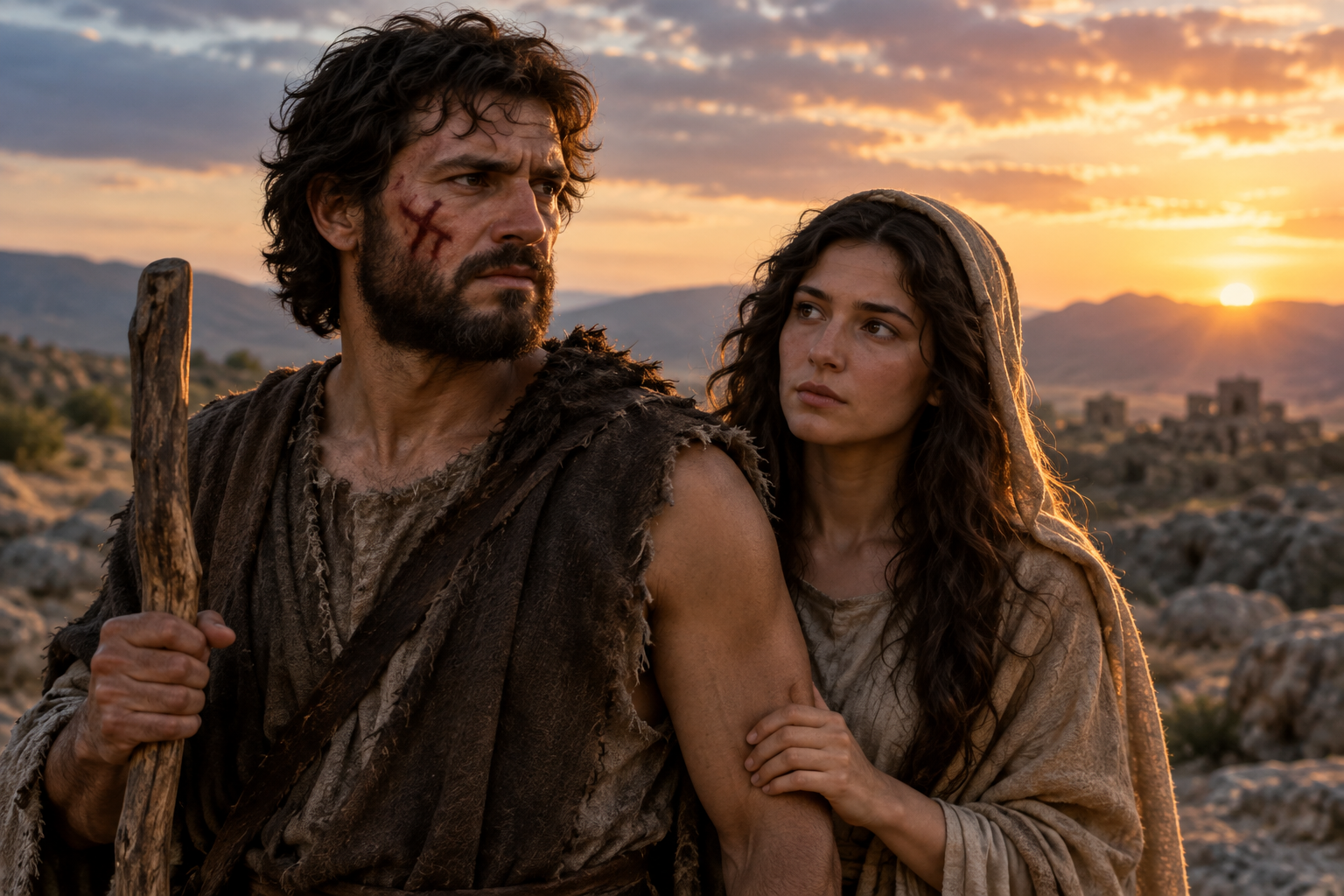
Where Did Cain Get His Wife?
The Short Answer
The Bible doesn’t tell us Cain’s wife’s name or specifically identify her parents. It simply says that Cain “knew his wife,” she conceived, and she gave birth to Enoch (Genesis 4:17).
So where did she come from?
I lean toward the traditional explanation that Cain married one of his sisters, or possibly another close female relative. Genesis later tells us that Adam and Eve had other “sons and daughters” (Genesis 5:4), and Adam supposedly lived 930 years. The Bible doesn’t tell us how many children Adam and Eve had during those centuries.
That seems to me the simplest explanation.
But notice the words “I lean.” Genesis doesn’t actually say Cain married his sister. There have been other explanations, and some deserve more consideration than others. So let’s look at what we know, what we can reasonably infer, and what is simply speculation.
Key Scriptures
- Genesis 4:16–17 — Cain settles in the land of Nod, and the text mentions his wife and the birth of Enoch.
- Genesis 5:4–5 — Adam has other sons and daughters and lives 930 years.
- Genesis 3:20 — Eve is called “the mother of all living.”
- Genesis 4:14 — Cain fears that someone who finds him will kill him.
- Leviticus 18:6–18 — The later Mosaic Law prohibits sexual relationships between close relatives.
Where Did All These People Come From?
People sometimes read the early chapters of Genesis as though Cain, Abel, Adam, and Eve were the only people alive until Seth suddenly appeared.
Genesis doesn’t say that.
It names Cain and Abel because they’re important to the story. Later it names Seth because his descendants are important to the story. Then Genesis 5:4 casually tells us that Adam “became the father of sons and daughters.”
How many?
We don’t know.
When were they born?
We don’t know that either.
This also helps with Cain’s strange statement after murdering Abel:
“Whoever finds me will kill me.”
Whoever?
If the only people on earth were Adam, Eve, and Cain, that’s a strange thing to say.
But it doesn’t require another race of human beings. Cain may simply have known that Adam and Eve’s family was already growing—or would grow—and that Abel’s relatives would have good reason to want revenge.
Genesis gives Adam a lifespan of 930 years (Genesis 5:5). If we’re reading that chronology historically, there is plenty of room for a family to become much larger than the few people Genesis happens to name.
Did Cain Marry His Sister?
I think that’s probably what happened.
If Adam and Eve were the original human couple, their children initially had a rather limited dating pool.
Genesis doesn’t seem particularly concerned about explaining this. It simply tells us Adam had sons and daughters and later refers to Cain’s wife.
Later Jewish writers noticed the same gap and filled it in more explicitly. The ancient Book of Jubilees, for example, names a daughter of Adam and Eve called Awan and says Cain married her. That’s interesting evidence for how some ancient Jews understood the story, but it isn’t evidence that her name really was Awan. Genesis never names her.
So I wouldn’t add “Awan” to the Cain family Bible trivia contest.
What the tradition does show is that the sister explanation isn’t something modern Christians invented to get Genesis out of a jam. It’s an ancient interpretation of the story.
But Wouldn’t That Be Incest?
By our definition, yes.
And later biblical law expressly prohibits sexual relationships between brothers and sisters and other close relatives (Leviticus 18:6–18).
But those laws weren’t given until much later.
That doesn’t automatically solve every moral question, but it does mean we shouldn’t take a command given under Moses and assume Genesis portrays that command as already governing Adam’s children.
If Adam and Eve really were the first human couple and the entire human race descended from them, close-relative marriages would have been unavoidable in the earliest generations. Traditional Christian interpreters have long recognized that implication.
What About the Genetic Problem?
This is where I think Christians sometimes claim more than we actually know.
Today, reproduction between very close relatives carries increased genetic risks. So a reasonable question is: wouldn’t Cain and his sister have faced the same problem?
Maybe.
A common creationist answer is that Adam and Eve possessed essentially pristine genomes and that harmful mutations accumulated gradually over subsequent generations. On that theory, close-relative reproduction wouldn’t have presented the same risks immediately after creation that it presents today. Some Christian apologetic treatments state that explanation quite confidently.
I think it’s possible.
But I don’t know.
And neither does anyone else.
Genesis doesn’t give us Adam’s genome.
What it does tell us is that the earliest people supposedly lived extraordinarily long lives. Adam lived 930 years, Seth 912, Enosh 905, and so forth. Whatever we make of those numbers, the world Genesis describes isn’t exactly the world we experience today.
So I’m open to the possibility that the genetic situation was different as well. I just wouldn’t turn that possibility into something the Bible teaches.
Sometimes there’s nothing wrong with saying, “That sounds plausible, but we don’t know.”
Were There Other Humans Outside the Garden?
Another explanation is that Adam and Eve weren’t the only human beings.
On this interpretation, God created—or humanity otherwise included—other people outside Eden. Cain later encountered that population and married one of its women.
This would certainly provide Cain with a wife.
But it raises another question: Where did those people come from?
Genesis doesn’t mention God creating another human population. Instead, Eve is called “the mother of all living” (Genesis 3:20).
Someone adopting a different interpretation of the early chapters of Genesis may understand that statement differently. But within a straightforward historical reading of Genesis, I don’t see much reason to introduce a second population when Adam’s unnamed daughters already provide a perfectly reasonable explanation.
Was Cain’s Wife a Neanderthal?
Various attempts have been made to connect the unnamed people of early Genesis with archaic human populations such as Neanderthals.
I don’t find that explanation persuasive.
Neanderthals are a legitimate subject for anthropology, archaeology, and genetics. How they fit into a Christian understanding of human origins is an interesting question in its own right.
But saying “Cain married a Neanderthal” doesn’t come from Genesis.
It’s importing a modern scientific category into a biblical silence and then using it to answer a question the text doesn’t answer.
That’s speculation piled on top of speculation.
I’d rather admit that Genesis doesn’t identify Cain’s wife than manufacture an identity for her.
Was Cain’s Wife an Ape?
Believe it or not, versions of that explanation have actually been suggested—even in church settings.
No.
Cain did not need to marry a female ape to solve the population problem.
For one thing, the explanation isn’t in Genesis. For another, if Cain and his wife produced human descendants, introducing an ape doesn’t make the problem easier. It makes it considerably harder.
Genesis already gives us female human beings: Adam “became the father of sons and daughters.”
We don’t need Mrs. Planet of the Apes.
What About Panspermia?
Panspermia is the proposal that life—or the ingredients necessary for life—came to Earth from somewhere else in space. Different versions range from microorganisms arriving naturally on meteorites to “directed panspermia,” in which intelligent extraterrestrials deliberately seeded life on Earth.
Whatever scientific questions panspermia might raise, I don’t think it explains Cain’s wife.
If extraterrestrial life seeded humanity, we still have to explain where that life came from. Moving the beginning of life from Earth to another planet doesn’t explain the ultimate origin of life. It changes the address.
More importantly for this particular question, nothing in Genesis suggests that Cain found his wife among a population descended from extraterrestrial life.
That’s not interpreting the text. It’s replacing the story with another one.
What If Genesis Isn’t Giving Us Literal History?
There’s another approach that needs to be mentioned because many biblical scholars take some form of it.
Some understand the early chapters of Genesis primarily as theological or archetypal literature rather than as a modern historical account of the first biological human family. From that perspective, asking who Cain literally married may be asking the narrative a question it wasn’t intended to answer.
I understand the argument.
And if that’s your view of Genesis 1–11, the Cain’s-wife problem largely disappears.
But it disappears because you’ve changed the nature of the question.
If Adam and Eve are being presented as the actual ancestors of humanity, then Cain’s wife has to come from somewhere. If they’re primarily archetypal figures within a theological narrative, identifying Cain’s biological wife isn’t particularly important.
Those are different ways of reading Genesis, and the disagreement goes well beyond one unnamed woman in Genesis 4.
So Who Do I Think Cain Married?
I lean toward Cain marrying one of his sisters—or possibly another close relative descended from Adam and Eve.
Why?
Because I think it’s the explanation that requires the fewest additional assumptions.
Genesis tells us Adam and Eve had sons and daughters. It gives the earliest generations remarkably long lifespans. It gives us no indication that God created a separate population of human beings outside Adam’s family.
That gets us to Cain’s wife without Neanderthals, extraterrestrials, a second creation of human beings, or an unfortunate female ape.
What about the genetics?
Maybe the genetic situation early after creation was substantially different from ours. That sounds plausible to me. But I don’t know, and the Bible doesn’t tell us. All it tells us in this regard is that those early generations lived much longer than we do.
So I wouldn’t be dogmatic about Cain marrying his sister.
Genesis tells us Cain had a wife. It doesn’t tell us her name or who her parents were.
I think a sister or close relative is the simplest explanation. But there’s a difference between saying, “This is what probably happened,” and saying, “The Bible says this happened.”
And in this case, I think we should respect that difference.