
Why Was God Going to Kill Moses?
The Short Answer
This is one of the strangest episodes in Exodus. God has just commissioned Moses to return to Egypt and confront Pharaoh. Moses begins the journey, and then, almost without warning, we’re told that the Lord met him at a lodging place and sought to kill him. Zipporah circumcises their son, touches the foreskin to “his feet,” calls him a “bridegroom of blood,” and the threat ends (Exodus 4:24–26).
So what happened?
I think the most likely explanation is that Moses had failed to circumcise his son in accordance with God’s covenant with Abraham. Moses was about to represent the covenant God before Israel and Pharaoh, but the sign of that covenant had been neglected in his own household.
Zipporah’s actions are our biggest clue. Whatever the offense was, circumcision resolved it.
That doesn’t answer every question in the passage. In fact, Exodus leaves us with quite a few. But I think it gives us enough to understand what’s going on.
Key Scriptures
- Exodus 4:24–26 — The Lord encounters Moses on the journey, Zipporah circumcises their son, and the threat ends.
- Genesis 17:9–14 — God establishes circumcision as the sign of his covenant with Abraham and his descendants.
- Exodus 4:22–23 — Immediately before the incident, God identifies Israel as his firstborn son and warns of the death of Pharaoh’s firstborn.
- Exodus 12:21–23 — At Passover, blood protects Israelite households from death.
- Numbers 20:7–12 — Moses later learns again that being God’s chosen leader does not exempt him from obedience.
Why Is This Passage So Difficult?
Part of the problem is that Exodus tells the story in only three verses and doesn’t explain some things we’d really like explained.
The Hebrew text doesn’t explicitly identify Moses as the person God sought to kill. It essentially says that the Lord met “him” and sought to kill “him.” We’re not told which son Zipporah circumcised. We’re not told exactly what she means by “bridegroom of blood.” And, perhaps most surprisingly, we’re never directly told what Moses had done wrong.
That’s a lot of ambiguity for three verses.
So I wouldn’t be too dogmatic about every detail.
But the sequence of events is pretty hard to miss:
God threatens someone. Zipporah circumcises her son. The threat ends.
Whatever else is happening, circumcision is obviously at the center of the story.
Why Was Circumcision So Important?
To understand that, we have to go back to Genesis 17:9–14.
Circumcision wasn’t simply an Israelite custom. God had established it as the sign of his covenant with Abraham and his descendants. Every male within the covenant community was to be circumcised, and God attached serious consequences to ignoring the sign.
Now consider Moses’ situation.
God is sending him back to Egypt to lead the descendants of Abraham out of slavery. Moses will stand before Pharaoh as the representative of the God of Abraham, Isaac, and Jacob.
Yet apparently the covenant sign had been neglected in Moses’ own family.
That’s quite a contradiction.
How could Moses demand that Pharaoh obey the covenant God when Moses himself had neglected the covenant in his own household?
I think that’s the heart of the episode.
Had Moses Failed to Circumcise His Son?
Probably.
But this is one of those places where we need to distinguish between what the Bible says and what we’re inferring from what it says.
Exodus never says:
“God sought to kill Moses because Moses failed to circumcise his son.”
We infer that because Zipporah circumcises the child and the danger immediately disappears. It’s a very reasonable inference, but it’s still an inference.
Why hadn’t the child been circumcised?
I don’t know.
Some have suggested that Zipporah opposed it. Others have suggested that it had been delayed because of their travel.
Maybe.
But Exodus doesn’t tell us either of those things, so I wouldn’t build much on them.
All we really know is that a circumcision hadn’t taken place when it should have, and suddenly that omission had become a very serious matter.
Why Did Zipporah Circumcise Him?
That’s another question the passage doesn’t answer.
Moses doesn’t do anything in these three verses.
Zipporah does.
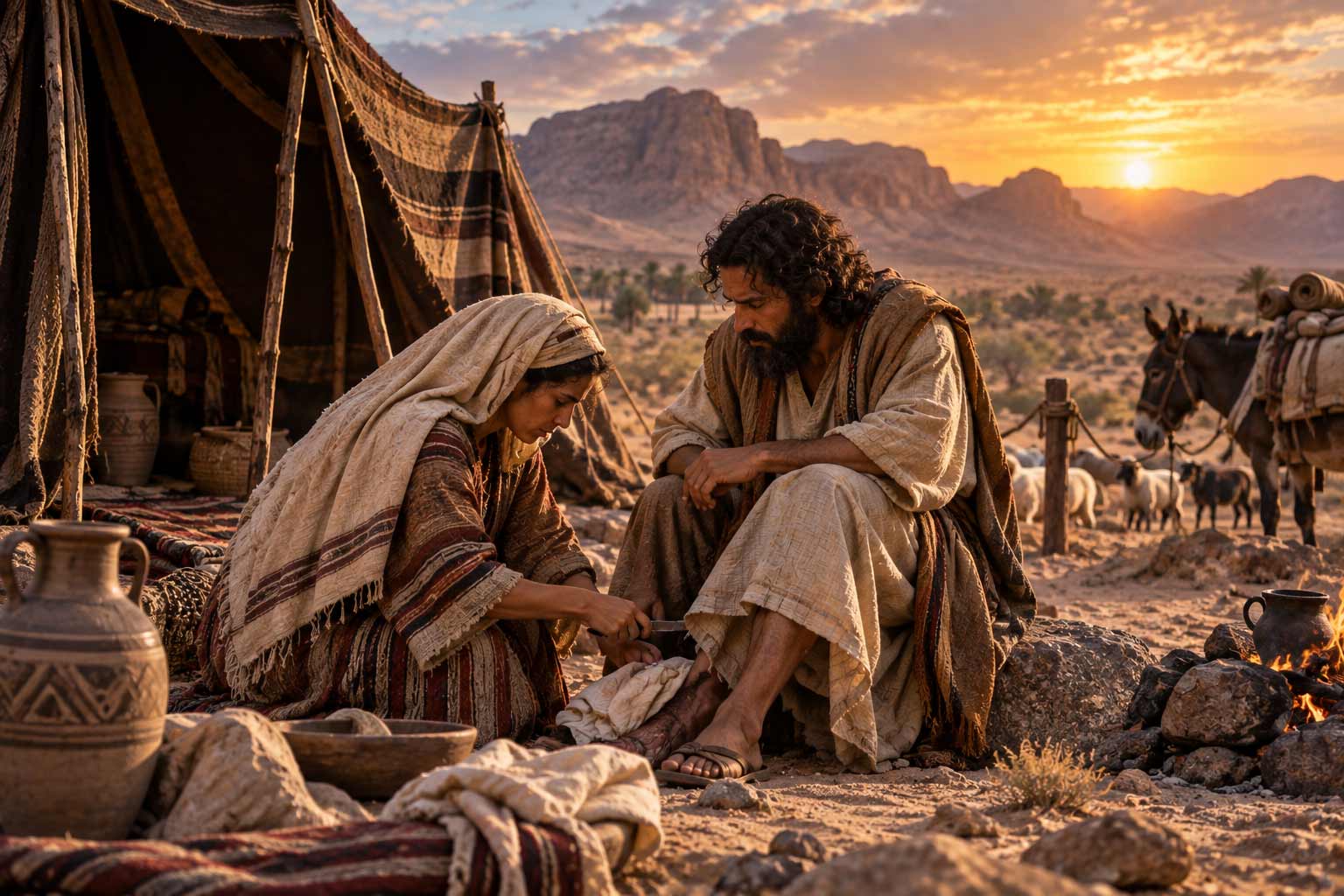
She recognizes what’s happening, takes a flint knife, circumcises her son, and performs the action that ends the threat.
Maybe Moses was physically incapable of doing it because of whatever God was doing to him. Maybe Zipporah understood immediately what was wrong.
Again, we don’t know.
But give Zipporah credit. Whatever else we may not understand about this incident, she figured out what needed to be done and did it.
What Does “Bridegroom of Blood” Mean?
I wish I could give you a definitive answer.
After circumcising her son, Zipporah says:
“Surely you are a bridegroom of blood to me.”
Exodus itself connects the expression with circumcision, but its precise meaning isn’t clear.
It could express Zipporah’s horror or anger at the bloody procedure. It might refer to a relationship being preserved through circumcision. Some scholars have suggested that it reflects an older expression associated with circumcision whose original meaning is no longer recoverable.
We can speculate, but that’s about all we can do.
Fortunately, we don’t have to understand “bridegroom of blood” perfectly to understand the main movement of the story.
There is a threat of death.
Circumcision takes place.
The threat disappears.
That’s the part Exodus makes clear.
Was God Actually Trying to Kill Moses?
Probably, although even that isn’t absolutely certain.
The traditional interpretation is that Moses is the “him” in Exodus 4:24. That makes sense. Moses is the main subject of the surrounding narrative. He’s received his commission and is traveling back toward Egypt.
But Hebrew pronouns can occasionally leave us wishing Moses had brought along an editor.
The text doesn’t actually name the person being threatened.
Because Moses’ sons are also part of the context, some scholars have suggested that the endangered person may have been one of his sons rather than Moses himself. One proposal identifies Gershom and connects the incident with the judgment about to fall upon the firstborn sons of Egypt.
That’s possible.
Still, I think Moses remains the most natural reading. It also makes good sense of the larger point: before Moses goes to Egypt as God’s representative, God confronts Moses himself.
Is There a Connection With Passover?
I think there may be.
Look at what happens immediately before this story.
In Exodus 4:22–23, God tells Moses to say to Pharaoh that Israel is his firstborn son. Because Pharaoh refuses to release God’s son, Pharaoh’s own firstborn will die.
Then, immediately afterward, we get this strange little story involving Moses’ household, a son, threatened death, and blood associated with escaping that death.
Later, at Passover, blood again marks the difference between life and death (Exodus 12:21–23).
Coincidence?
Maybe. We should be careful not to force every detail into a parallel.
But I think the connection is worth noticing. Moses is about to lead Israel through an event in which covenant identity, firstborn sons, blood, and deliverance from death will all become central themes.
This strange incident on the journey may anticipate what’s coming.
Why Would God Be So Severe?
That’s probably the question most modern readers have.
Really? Moses’ son wasn’t circumcised, so God was prepared to kill Moses?
Circumcision doesn’t carry the same significance for us that it did within the Abrahamic covenant, so the punishment can seem wildly disproportionate.
But within the biblical story, circumcision wasn’t an optional religious custom. It was the covenant sign God had specifically commanded Abraham and his descendants to observe.
And Moses wasn’t just another Israelite.
He was about to walk into Pharaoh’s court and say, in effect, “The God of Israel commands you to obey.”
That creates an obvious problem if Moses is disregarding God’s command in his own household.
Being chosen by God doesn’t exempt someone from obeying God.
If anything, Moses’ calling made his responsibility greater.
God’s Leaders Are Still Accountable to God
Moses would learn this lesson again.
Much later, his own disobedience at Meribah would keep him from entering the Promised Land (Numbers 20:7–12).
God used Moses in extraordinary ways, but Moses was never above the God he represented.
That’s what I think makes this strange little episode more than an obscure story about circumcision.
Before Moses confronts Pharaoh about Pharaoh’s disobedience, Moses has to confront disobedience in his own household.
The man who is about to proclaim God’s authority has to submit to it himself.
So Why Was God Going to Kill Moses?
There are details here that I don’t think we can settle with certainty.
I don’t know exactly why the circumcision had been neglected. I don’t know exactly what Zipporah meant by “bridegroom of blood.” And although I think Moses was the person whose life was threatened, I understand why some scholars question that.
But I don’t think the central point is nearly as mysterious as some of those details.
Moses had apparently neglected the covenant requirement of circumcision in his own household. God confronted him over it. Zipporah circumcised their son, correcting the problem, and the threat ended.
And there’s an uncomfortable lesson in that.
Moses was about to stand before the most powerful ruler in Egypt and demand obedience to God.
Before he did, Moses himself had to obey God.