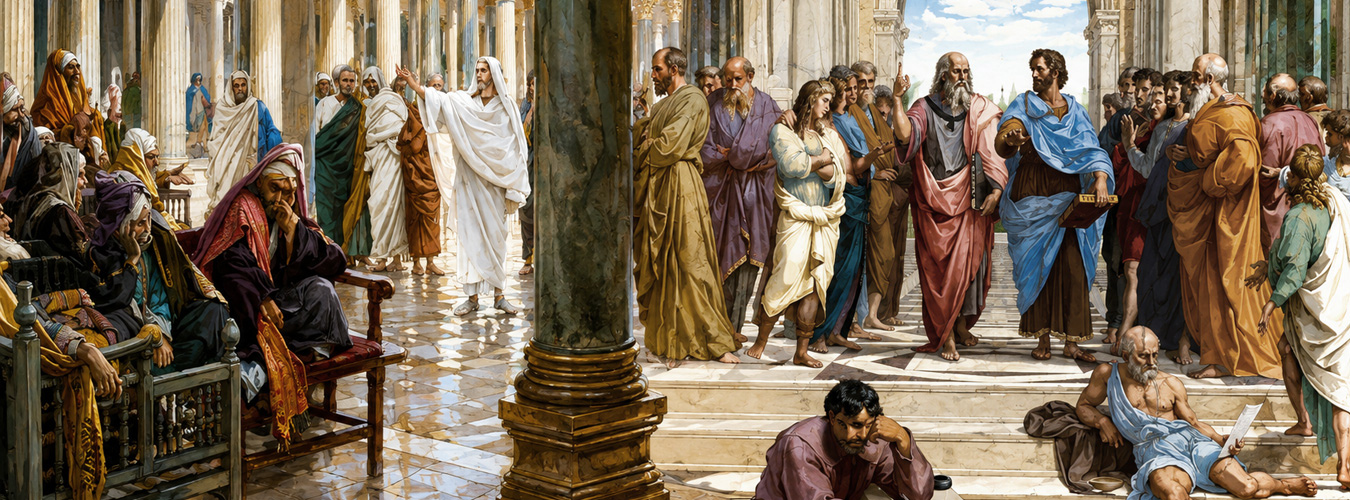

The Queen of Sheba
(No. 3351)
A SERMON PUBLISHED ON THURSDAY, APRIL 24, 1913.
DELIVERED BY C. H. SPURGEON,
AT THE METROPOLITAN TABERNACLE, NEWINGTON, ON LORD'S-DAY EVENING,
DECEMBER 8, 1867.
"The Queen of the South shall rise up in thejudgment with this
generation, and condemn it: for she came from the ends of the earth to
hear the wisdom of Solomon and, behold, a greater than Salomon is
here." Matthew 12:42.
Our LORD, on this occasion, was addressing a number of captious critics
who, instead of listening to what He said and giving it the attention
due to its own weight, said, "Show us a sign." Our Lord replies to them
that He will give them no sign except the two signs of Jonah and of the
Queen of the South. The first was very much to the point. Jonah, a lone
man, working no miracle, went to Nineveh, a great city, where he was
completely unknown. There he commenced to preach. The whole subject of
his testimony was, "Yet forty days and Nineveh shall be overthrown."
Through the broad streets of that gigantic city and through its lanes
and alleys, in its public squares the voice was heard, sharp and
shrill, of that lone man–"Yet forty days and Nineveh shall be
overthrown." No rod was turned into a serpent. No mountains were made
to smoke. None were struck dead by the sudden hand of God. No
paralytics and sick folk were healed. No signs were given to the men of
Nineveh, but the declaration of that one man sent of God was sufficient
to denounce and discover their sin! They felt that they had been guilty
of sins that deserved to be denounced. He pronounced their punishment
and they also felt that the punishment was well deserved and,
therefore, from the king on the throne to the meanest of the citizens,
all the inhabitants of that great city humbled themselves and Jonah's
work was done! And God forgave the city. And the Lord Jesus seemed to
say, "I also speak to you and tell you Truths of God which ought to
have as much power upon your consciences as Jonah's testimony had upon
the men of Nineveh, but you turn away, albeit that I speak truth which
you cannot answer, and tell you things which you cannot meet nor deny.
Yet you say, 'Show us a sign,' fools that you are! There shall no sign
be given you except the sign of Jonah, the Prophet." The second sign
was also quite as much to the point. It was the case of the Queen of
Sheba. She had heard, by report, that Solomon was the wisest of men.
She knew that men flocked to his court to be instructed from his lips.
Under many disadvantages and at much expense, she set out upon a long
journey that she might listen to the wise man's teaching. She found it
to her benefit and returned with joy. "But"–Christ seems to say, "I am
as wise as Solomon. I am able to instruct you as well as that monarch
instructed those who came to his court and yet you show no eager desire
to know what it is I teach! You are not willing to open your ears to
receive, nor your minds to give a candid judgment upon what I utter,
but you cry out at once, 'Show us a sign.' You would open your eyes and
stare in vacant wonder at a miracle, but the mightiest wisdom that I
can deliver to you, you tread under foot as swine tread under feet the
choicest pearls."
So Christ would give them no sign. He felt that they needed it not and,
indeed, it would be wasted upon them. If they had possessed the same
naive mind that was found in the Queen of the South, they would have
listened to Him. And if they had been of the same honest spirit with
the men of Nineveh, they would have repented upon His testimony, even
as they did of old, who heard the Prophetic voice of Jonah!
Ah, my dear Hearers, this very night the same spirit broods over
thousands! They do not, when they go to hear a sermon, think of the
matter of what they hear, but they must have it delivered with
cleverness, with refined speech, with polished periods. Ah, if men were
wise, they would care but little how these Truths of God were given to
them, but they would weigh the Truths themselves! We do not claim that
you should believe all that we say–if we speak anything contrary to
God's Word, we charge you to reject what we say, but we do ask you to
judge it, to weigh it and to let the im-
portant Truths which we are charged by God to deliver to you, have a
place in your attention–let them exercise your judgment, let them move
your heart and will–let them influence your lives!
Coming now, however, at once to the text, we shall notice, in the first
place, that Jesus is ' "greater than Solomon."n the second place, that
Jesus "is here." And in the third place, that if we do not listen to
Him and obey Him, the Queen of the South may well rise up to condemn
us.
These things, I think, are very evidently in the text. In the first
place, then, in the text–
I. OUR LORD JESUS CHRIST CLAIMS TO BE "GREATER THAN SOLOMON."
You all know the history of Solomon. Solomon was great in several
particulars and we shall point out to you that in each of these, Christ
is greater than he.
In the first place, Solomon was very great as a ruler. His father,
David, had, by much perseverance, valor and industry, very much
enlarged the boundaries of his once small dominion. He was a man of war
and he left to Solomon a heritage, indeed–a well-filled treasury and
an army of veterans. Solomon ruled over the whole of Israel. There
seems to have been no disloyal rebellion, no revolt throughout the
whole of his reign. In David's reign there were many rivals and the
people were a restless, discontented, turbulent people. No people,
perhaps, were more difficult to govern than the Jewish people in the
days of David! But Solomon was so judicious, noble and just a ruler,
that he left the whole nation at peace with itself.
He was a monarch whom all respected and Solomon, too, in his time,
enlarged the boundaries of his territory until it reached to the
borders of Egypt and to the river Euphrates on the other side. They
that dwelt in the wilderness "bowed before him and his enemies licked
the dust." Many nations paid him tribute and all the strangers who
remained in the land, whom the children of Israel did not destroy, did
him service. He had dominion from sea to sea and, to use an Oriental
extravagance of expression, "from the river even unto the end of the
earth." Solomon had a kingdom from his father and with it a special
Divine Blessing–the gift of wisdom which enabled him to rule well. His
army was one of the largest of the various armies of the Oriental
kings. He ruled with wonderful state. The throne which he had built for
himself is said to have had none like it in the whole of the then known
world. His treasury was filled so full that as for silver, it was
accounted for nothing. He made gold to be as silver, and silver as
stones in Jerusalem! He was the greatest monarch that Israel had ever
seen!
And yet, dear Friends, what a petty, little king he was, and when we
compare him for a single moment with our Lord Jesus Christ, what a
contrast there is! All the power of Solomon is gone and not a speck of
it is left. He had dominion in his day over vast numbers of humankind,
but he has no dominion now. But the Throne of the Man who was crucified
on Calvary has power over tens of thousands of human hearts at this
present moment. Lo, these 1,800 years Christ has reigned over
multitudes who have been all too glad to kiss His feet and have
rejoiced in the light of His Countenance! His Kingdom, instead of
waning, has continually increased and the day shall come when all kings
shall yield their scepters to Him and He shall gather sheaves of them
beneath His arm when all monarchs shall doff their diadems and He,
alone, shall reign King of kings and Lord of lords–the universal Head
of the great monarchy–the Stone cut out of the mountain without hands
which shall yet fill all the earth! The power of the Lord Jesus Christ
over His Church is like the power of Solomon over Israel. He keeps it
at one, and together!
Apart from Christ, the Church is a broken thing, divided into sects and
parties, but in Christ Jesus, the Savior's prayer is answered, "That
they all may be one." Bring any one of us to the Cross and you shall
not know this from that, for there we all agree to trust Him, to
worship Him, to count His authority to be paramount and His example to
be our pattern! Yes, Lord Jesus Christ, all Your children praise You!
All those that are of Your household put the crown upon Your head. You
rule in the household and You rule well, You "first-born among many
brethren." Moreover, our Lord's dominion extends beyond His Church. He
rules even to the river of Egypt. Know you not that Christ is Lord
paramount over Providence? Nothing occurs without Jehovah-Jesus'
purpose, decree, or permission! The very hairs of your head are all
numbered–
"He overrules all mortal things, And manages our mean affairs."
Nor is this all. The Lord Jesus has the government upon His
shoulders–and that government extends not only to earth, but to Heaven
and Hell–
"Lo!In His hands, the Sovereign keys Of Heaven, and death, and Hell."
The power of Christ is felt beneath Hell's most profound wave and His
Glory is sung on Heaven's most starry heights! He has put all things
under His feet. He is exalted far above all principalities and powers,
and every name that is named, that at the name of Jesus every knee
should bow, of things in Heaven, and things on earth, and things that
are under the earth, and that every tongue should confess that He is
Lord, to the Glory of God the Father. Our Lord Jesus Christ, then, has
a dominion which, for duration and for extent, is infinitely superior
to anything of which Solomon ever conceived! And as for majesty and
glory–talk not of the peacock–throne of the Great Mogul, all set with
many colors and with gems and precious stones that shine resplendent
like a rainbow in the glittering sun! There is no throne like unto the
Throne of Jesus, the Emperor of all worlds! See before Him the sea of
glass mingled with fire. Around Him stand His seraphic courtiers. There
stand the elders with their "vials full of sweet odors." And as you
listen you can hear their "harps of sweeter sound." And mark you not
the countless hosts who all cast their crowns before Him and, with one
soul and voice, cry, "You are worthy to take the book and to loose the
seals thereof, for You were slain and have redeemed us to God by Your
blood"? Oh, cannot your ears hear this very moment the mighty booms of
that great sea of music which rolls up to the Throne of Jesus? Can you
not catch some stray notes from the harps of angels and archangels, as
unceasingly they sing, "You are worthy! You are worthy to take the book
and to loose the seals thereof"? Beloved, we cannot thinkof comparing
Christ with Solomon, but we must contrast them, for a "greater than
Solomon is here, as a Ruler."
Let us learn from this the obvious lesson of practical value and
wisdom. If, from the far-off South, the Queen of She-ba came to see
Solomon, how wise will it be for us to come to see Jesus! Oh, that we
would do so and make Him our King! Let us enlist in His warrior bands.
None ever served so great a master! Let us be members of His household,
for happy are they that stand continually in His Presence. Let us give
over our enmity and cast down the weapons of our rebellion! And let us
say by Grace —
"Oh, King of Grace, my heart subdue–
I would be led in triumph, too,
A willing captive to my Lord,
To sing the triumphs of His Word,"
Solomon was great as a builder For this, perhaps, he is best known
among us. 'Twas a mighty deed to bring the towering cedars of Lebanon,
all fashioned and prepared, to Jerusalem to make a house for the
Lord–to hew from the quarries in the mountains, great stones and
goodly ones, all squared, and each one fitted and made ready for its
place so that there might be no sound of hammer, nor lifting up of
chisel in the building of the house. Happy were the eyes that looked
upon the Temple of Solomon! Even at this very day, when the explorers
come upon what they suppose to be the Temple, they are astounded at the
masses of stone which they find there! Our Lord said that one stone
should not be left upon another, but that all should be cast down–but
even as they lie in the places where they were cast down–they are
amazing! Even modern engineers have marveled how they could ever have
been brought and put into their places–they are of such enormous size
and yet so well squared and prepared for the building! Besides this,
Solomon built a house of the forest of Lebanon, of which we have a
descriptive account in the pages of Inspiration and which also seems to
have been a marvelous work. In addition to that, he was great in the
erection of works for the carrying of water. He made pools in Zion–the
upper and the nether pools. He seems to have carried aqueducts where
they were never heard of before his time, and it is possible that many
of the great discoveries of modern days were well known to Solomon,
even all those years ago. He seems to have built an ascent to the house
of the Lord, which particularly struck the Queen of Sheba as being a
most wonderful piece of masonry. Besides this, he was the builder of
treasure cities. He also built Gezer, Bethhoron, Baalath, Tadmor in the
wilderness, and so on. Solomon was a great master builder–none could
excel him as a piler of huge stones, one upon another.
Ah, but my Brothers and Sisters, a greater than Solomon is the Lord
Jesus! It is easy enough to build with stones, granite, bricks and
cedar. These are dead, coarse things that you can hew and cut as you
will. Get enough sawing and cutting power and you can make what you
will of these things. It is only brute mechanical force that is needed,
with judgment here and there to direct and guide it. Get strength
enough and, as Archimedes said, you might move the world with a
lever–it is only one physical force pitted against another. But what
shall we say of Christ, who has built a house
that is made of living, immortal souls, built of what Peter, taught of
the Spirit, calls, "living stones"? You do not cut these, nor polish
them quite so easily. Men with strong, stubborn wills. Men with
diseased imaginations. Men with perverse affections, men altogether
gone from original righteousness–our Lord Jesus Christ has taken these
and He has prepared them to make a Temple in which there shall be
nothing but holiness and perfection! I trust that some of us have been
prepared to be built into "a living Temple, for an habitation of God
through the Spirit." But if the Lord Jesus Christ shall ever make tens
of thousands–and thousands of thousands of once guilty men all
perfect, and shall build these altogether, fitting each one into its
place and making each one willing to maintain and stay in its
place–this will be such a thing as a thousand Solomons could not have
attempted! This is no work of brute force, of mechanical power, my
Brothers and Sisters–this is the power of the Holy Spirit Himself–a
spiritual'power, a power which comes from God, who is a Spirit, and who
will have those who worship Him, worship Him in spirit and in truth!
Can you conceive of this Temple? My soul seems to rise upon the wings
of imagination at the very thought of it–a Temple all alive, a living
Temple–each stone a priceless soul, glittering with immortality! John
tells us of a city, the foundations whereof were of precious stones and
he tells us of the "new Jerusalem coming down out of Heaven," and I
know not what besides. That was but a faint picture of the living
Temple of Jesus, where each soul shall be more precious than the whole
world, even though all the world were one pearl of the purest water–a
Temple built by Him, for Him, to His own praise!
Moreover, our Lord Jesus Christ, as the great Master Builder, has built
many a pool and aqueduct. We sang about one just now, such as Solomon
never knew–
"There is a fountain filled with blood,
Drawn from Immanuel's veins!
And sinners plunged beneath that flood,
Lose all their guilty stains!"
This is more glorious than the Pool of Gihon, the upper and the nether
pool! Moreover, Solomon brought a river into Jerusalem that the
multitude might drink, but it was not like this–"The water that I
shall give you, shall be in you a well of water, springing up into
everlasting life." Beloved, we have said that Solomon built treasure
cities, but our Lord has given us promises that hold richer treasures
than Tadmor ever knew–a Covenant–oh, the grandeur of that word,
Covenant–a Covenant stored with all the fullness of God, for in Christ
"dwells all the fullness of the Godhead bodily"!
I shall lose myself if I attempt to extol my Master as a Builder! I
only pray that you and I may be built upon His Foundation–that we may
come to the Fountain which He has opened and may be cleansed
therein–that we may come to His treasure city and be enriched, all our
necessities being removed. And may we dwell with Him in the palace
which shall never be taken down! A greater than Solomon, then, is
Christ as a Builder!
And now for a third view of Solomon. Solomon was the greatest man of
his age as a trader A careless reader may not observe this, but a
careful student of the narrative will discern the reason why Solomon
was so immensely rich. Possessed of great wisdom, he saw at once that
the wealth of a people must largely depend upon its commercial
enterprise and activity. He therefore took a city upon the banks of the
Euphrates, and when the great caravans, laden with costly treasures
from India and China, sought to make their way to Egypt, Greece and
Rome, they crossed at the very ford which Solomon possessed. He seized
upon an oasis in the great desert and upon it he built a city, known to
this day as Tadmor– "Baalath and Tadmor in the wilderness." This
little oasis, this spot of green earth in the midst of the desert, the
caravans must pass. It was the only place where they could obtain
water–and here Solomon built these cities which became the great
depot, where exchanges were continually made of the productions of
Egypt, India and China! The trade which, after the days of Solomon,
went farther west and at last passed through the port of Venice–and
then went still farther west and went through Holland, and has now come
to London–all that trade was in the hands of Solomon. If you read
carefully the record of his life, you will see that he was a most
clever trader and managed for a time to secure a complete monopoly of
all the provinces of the East. For this, the Queen of Sheba marveled at
him. She wondered how it was that he could have been so wise as to be
able to do this.
But our Lord says that "a greater than Solomon is here." Our Lord Jesus
Christ has been a Trader of no common sort, my Brothers and Sisters. By
His most precious blood He has brought us the supplies of the skies!
Solomon could only bring to himself gold, and silver, and spices, and
apes, and peacocks–but our Lord Jesus Christ has, by His precious
blood, opened up the skies to the commerce of souls so that now,
through Christ, there comes to us pardon for our sin, acceptance in the
Beloved, sanctification by the Spirit, preservation by the indwelling
of God and all those priceless
gifts of which we cannot now speak particularly, only we must say of
them, "Blessed be the name of Jesus, that ever our souls learned to
trade in this heavenly direction." Yes, Christ is, indeed, greater than
Solomon! Oh that you would seek to be enriched by Him! Oh that you
would seek to obey that text in which He says, "I counsel you to buy of
Me gold, yes, fine gold, tried in the fire, and the white raiment that
you may be clothed." God give us Grace that we may come to this greater
Trader than Solomon!
Moreover, Solomon was exceedingly great as a sage. I shall not amuse
you, for that is no objective of mine, with the various legends that
are told of him. The one instance of his decision between the two women
reminds us of the excellency of his judgment.
He was renowned for this. You have his Proverbs, his Ecclesiastes, one
of his thousand and one songs, and you may be assured that he was a
mastermind in his day.
But the wisdom of our Lord Jesus Christ far transcends this, for He can
open up all the dark questions of your mind! He can teach you, O man,
what you most want to know. He can teach you the way to Heaven, the way
to escape from the power as well as the result of your sins, the way to
get peace with God! The sages could not tell you this, but Jesus can.
Seek Him, for He is greater than Solomon! I had more to say upon this
point, but time will not allow, for I must have a word or two upon the
second head, which is–
II. THIS JESUS IS HERE
He is not here in body. As we reminded you last Sabbath evening, He is
gone. He is not here in that sense, "for He is risen." But Christ is
here by His Spirit. If you want to get to Christ, this is the
way–think of Him. That is, coming towards Him. Read His life. Study
His death. Meditate upon Him. Let the thought of His laying down His
life for His enemies dwell upon your minds. I wish that some of you
would read the story of His Crucifixion very, very often. If you have
not any faith, perhaps faith will come while you are reading it. "God
commended His love towards us in that while we were yet sinners, in due
time Christ died for the ungodly." He did not die for those good people
who have not any sin. He had nothing to do with those good people who
are so righteous that they can get to Heaven their own way. Christ died
for the guilty, the lost, the worthless. He comes like a physician to
the sick–like one who gives sustenance to the perishing poor. Oh, read
His life, for this will help you to come to Him!
The true way in which to come to Christ is to believe Him, to trust
Him. If any man trusts in Christ to save him, he has come to Him! When
I used to hear sermons about coming to Christ, I thought, "Well, I
would do it if I only knew how! If I had to walk from here to York, or
no matter how far, I would find my way." But you do not come to Christ
with your feet–you come to Him with your mind, heart and will–and he
that trusts in Jesus, who says, "I will lean alone upon what Christ has
done. I have been trying a thousand ways of salvation, but they shall
all go to the winds and now, sink or swim, I believe that Jesus Christ
died to save sinners and I trust in Him"–that man is saved! If you
trust in Him, and lean on Him and if, just as you now see me throw the
whole of my weight upon this rail, you lean the whole weight of your
soul on Christ, you are saved!
That is the only way of salvation, to throw yourselves completely on
Jesus! God must punish sin, but Christ bore what was due to our sin in
the place of sinners, of all who trust Him! If you trust Him, then
Christ was punished instead of you and no penalty can fall on you. Your
debts have all been paid by Christ and God cannot–for He is
righteous– demand from you what Jesus has already endured for your
sake. If you trust Jesus Christ, then, as sure as God is true, He will
save you! It is His own promise, "He that believes and is baptized
shall be saved." Now, for the purpose of trusting, Christ is here. If
you could see Him with your eyes, you could not trust Him any more than
you can tonight when you cannot see Him, though He is here and oh,
wonder of wonders, He is also engaged yonder in Heaven, according to
this Book, in pleading for you! You do not need to see a man to trust
him. I can trust a man who is in India. I can trust a brother whom I
may have in Australia, I can trust a man who may be in the backwoods of
America and trust him quite as well as if I saw him–perhaps my trust
might be all the more like trust because I did not see him. We say that
there are some people whom we can only trust as far as we can throw
them, that is to say, we cannot trust them at all! But Christ is not of
that kind. For all the purposes that are needed, then, to save you,
Christ is here! By His Spirit He is here, and here now, and He will now
whisper into your soul, "Peace. Your sins are forgiven you." If you
will now trust Him, you shall have in your heart a peace which passes
all understanding, which shall be the best proof to you that Jesus is
here. Oh, why do you put it off? Oh, why do you who feel you need a
Savior, continue so long away from this simple faith." I prayed for you
just now–the Lord knows how sincerely I prayed–that we might all meet
in Heaven. We never shall, unless we all believe in Jesus, for He is
the one Door–if we will not enter by Him, we cannot enter–there is no
stealing or climbing our way there.
If we have to come and rest in Christ, why should we not do it tonight?
Oh, why should we this night not be led to rest alone in Christ? If we
do this, we are saved, already saved, completely saved, irrevocably
saved–so saved that neither death nor Hell shall ever divide the
Believer from his Lord! May this be done by us all, for Jesus is here.
And now I have to close by saying that if, with this Gospel before us,
we do not come to this greater than Solomon– III. THE QUEEN OF SHEBA
WILL CONDEMN US!
For look! She was a heathen who had heard but a little about Solomon
and yet she came to see if it were true. You profess to be Christians,
many of you. You have heard about Jesus from the time when you left the
cradle. If you come not, these many Sundays, these many sermons, these
good books and these Bibles of yours–what shall they be but like the
big stones that were hurled at Achan to destroy him for his sin? May
God grant that you may not sin against the Light of God, but may the
Light lead you to Christ that you may be saved!
This woman came to see Solomon from afar We know not how far it
was–whether she was the queen of the southern part of Arabia, or
whether her territory was upon the other side of the Red Sea in
Abyssinia–she seems to have been the queen of both countries. But from
whichever she might have come, it was a long journey. You have no
distance to go. Thought can travel all the distance in a moment! Faith
can throw a bridge across every difficulty! Believe in Christ and you
are with Christ! Trust Christ and Christ is with you–and you are with
Him and in Him!
The Queen of Sheba had to meet a thousand dangers. Traveling in those
days was no easy task. The Bedouins would attack her caravans. She had
many trials and hardships to put up with, but there are no such
hardships to you. You have simply to trust. All the way to Heaven is
only two steps–the first is to step out of yourselves and the second
is to step into Christ. First to have done with all that you can do and
secondly, to ask for all that Christ has done. You have no
difficulties, then.
Now, this woman, when she came, did not come bringing her own wisdom to
Solomon, but she came to learn from Solomon. You must come to Christ,
not to bring your own knowledge, but to learn of Him what He would have
you to do. If you are to be saved, you must be taught as well. "Unless
you are converted and become as little children, you shall in no wise
enter into the Kingdom of Heaven."
And this woman did bring very great presents to Solomon–spices and I
know not what. Now Christ asks you to bring nothing! And if you do not
come on such terms, well may she condemn you. He needs no merits of
yours. He needs no good heart. He needs nothing good from you. "Surely
He needs faith and repentance," says one. Yes, but–
"True belief and true repentance, Every Grace that brings me nigh,
Without money,
Come to Jesus Christ and buy."
"But I must felmy needs," says one. Yes, but–
"This He gives you– 'Tis His Spirit's rising beam."
You are to come to Christ without anything–and Christ will give you
everything!
This woman had never been invited to come. She went on a haphazard
journey. Solomon never sent the Queen of Sheba an invitation to visit
his court, but she came and was well rewarded. But you have been
invited hundreds of times. I must bear this witness against you. I have
invited you very earnestly times without number. Oh, why, why,
why–when the Gospel is so simple, why do you kick against it? If my
Lord were hard I could understand your lifting up the heel against Him.
If He laid down some difficult conditions, I could excuse you if you
said, "Master, we cannot come up to them." But when the only thing He
says is, "Take what I give you. Receive it as a gift of Grace"–oh, not
to receive it is unkindness, is madness, is wickedness! May God forgive
your unbelief! I know the very difficulty in your case is that it is so
easy. I do believe if salvation were more difficult, some of you would
like it better. You are just like Naaman. If the Prophet had bid him do
some great thing, he would have done it, but when it was nothing but,
"Wash and be clean," it did not suit his pride. And it does not suit
yours just to come and trust in Christ. I know you say you are afraid
it would not be true. Ah, then you prefer your opinion to the testimony
of God, for this is God's simple testimony, "Believe on the
Lord Jesus Christ and you shall be saved." "He that believes and is
baptized shall be saved. He that believes not shall be condemned."
May the Eternal Spirit bring you, empty-handed and ruined, to the
All-Sufficient Savior and may you be enabled to now rely upon Him and
you shall find that He is true! "Him that comes unto Me," He says, "I
will in no wise cast out." The Lord bless you for Christ's sake!
EXPOSITION BY C. H. SPURGEON: PSALM 119:113-120.
The proper way in which to read these verses is to peruse them in the
spirit of prayer, turning every verse into a personal supplication to
God. I trust that many of us may be so in the Spirit, today, that these
words may suit us.
Verse 113. I hate vain thoughts: but Your Law do I love. The moralist
is quite content to look after his actions, but the Christian is never
happy until his thoughts are sanctified. The true Believer hates vain
thoughts because they lead to vain words and to vain actions–because
vain thoughts nailed his Savior to the tree, because vain thoughts
spoil his devotion, mar his communion with God and, like the birds
which came down upon Abraham's sacrifice–would destroy all his
offering. "I hate vain thoughts." The converse of this is, "But Your
Law do I love." There is nothing vain there. Nothing in Your Law to
distract me. Nothing to give me unhallowed thoughts. Brothers and
Sisters, here is a cure for vain thoughts! When you have been assailed
by vain thoughts, let your mind be lovingly stored with texts of
Scripture, with passages of God's Word! The Psalmist, while writing
these words, is evidently under a sense of danger, so he said–
114. You are my hiding place and my shield: I hope in Your Word. Here
is a hiding place to escape to from danger and a shield to protect
while in danger. A hiding place is not enough because that cannot be
moved–but the shield can be carried everywhere. It is buckled on the
warrior's arm and into every conflict he can take it. So, at evening,
when I tell my troubles to my God, He is my hiding place. But all the
day long, while I myself abide in the heat of the conflict, He is my
shield! See where the Christian's hope is, dear Friends! It is not in
his own integrity, or faithfulness, or sincerity– but, "I hope in Your
Word."–
"The Gospel bears my spirit up! A faithful and unchanging God Lays the
foundation for my hope In oaths and promises, and blood."
115. Depart from me, you evildoers: for I will keep the commandments of
my God. By which David did not mean that he would not speak with
ungodly men. Monkish seclusion would be no advantage to a Christian! We
are to be in the world, though not of it, as a ship is in the sea, but
the sea is not in the ship, or else soon would she go to the bottom. We
are to take care of the world–to hold such society with them as may
come from necessity–but as to any nearer communion, "Depart from me,
you evildoers. Your company I cannot bear! Your example pollutes the
air! You do me damage, you vex my ears, you dishonor my God–depart
from me, you evildoers, for I will keep the commandments of my God."
You see, it seems as if this was not possible as long as there was an
intimate association with the ungodly. I know nothing that is so likely
to destroy the purity of a Christian's life as an intimate association
with ungodly people. You cannot run with the hare and hold with the
hounds, too. It is impossible for you to join with world and yet be
true followers of Christ.
116. Uphold me according unto Your Word, that I may live: and let me
not be ashamed of my hope. You see, he feels his weakness and he cries
to his God.
117. Hold You me up, and I shall be safe: and I will have respect unto
Your statutes continually. The brightest archangel owes all his glory
to God–and the perpetuity of that glory depends upon the constant gift
of the Gracious One. How wise, then, is it of men, conscious of their
weakness, to hang constantly upon their God! As the vessel hangs upon
the nail, and if the nail can move, the vessel must fall, so must we
hang upon God. If He is not faithful, and true, and potent, then we
must perish–but, thank God, concerning this we have no doubt!
118-119. You have trodden down all them that err from Your statutes:
for their deceit is falsehood. You put away all the wicked of the earth
like dross: therefore I love Your testimonies. You see, the Psalmist's
mind is entirely occupied
with this spirit of perseverance. He seems to tremble and to be filled
with awe lest he should by any means prove an apostate and be unworthy
to enter into the Kingdom. He looks with solemn mind upon God as
casting all the wicked of the earth down under His feet, just as men
cast out the refuse–as the slag of the furnace is sometimes thrown
down to make the footpath. So he says, "You put away the wicked of the
earth like dross. You have trodden them down." David was filled with a
heavy trembling lest this should be his lot–lest, after he had thought
he had known and experienced the happiness of communion with God, he
should be found to be reprobate silver and be given over to
destruction! Does such a fear as this come upon you, my Brothers and
Sisters? If it does not, there is room for you to fear, for even our
holy Apostle had this as his anxiety, "Lest, after having preached to
others, I myself should be a castaway." It is not as to whether God
will be faithful to me, but whether I am really His, whether my
conversion has been genuine and my union to Christ vital. These are
questions which breed a holy anxiety, which is one of the very best
means of keeping a Christian in the path of right and so of
guaranteeing the perseverance which God has promised. 120. My flesh
trembles for fear of You and'I am afraid of Your judgments