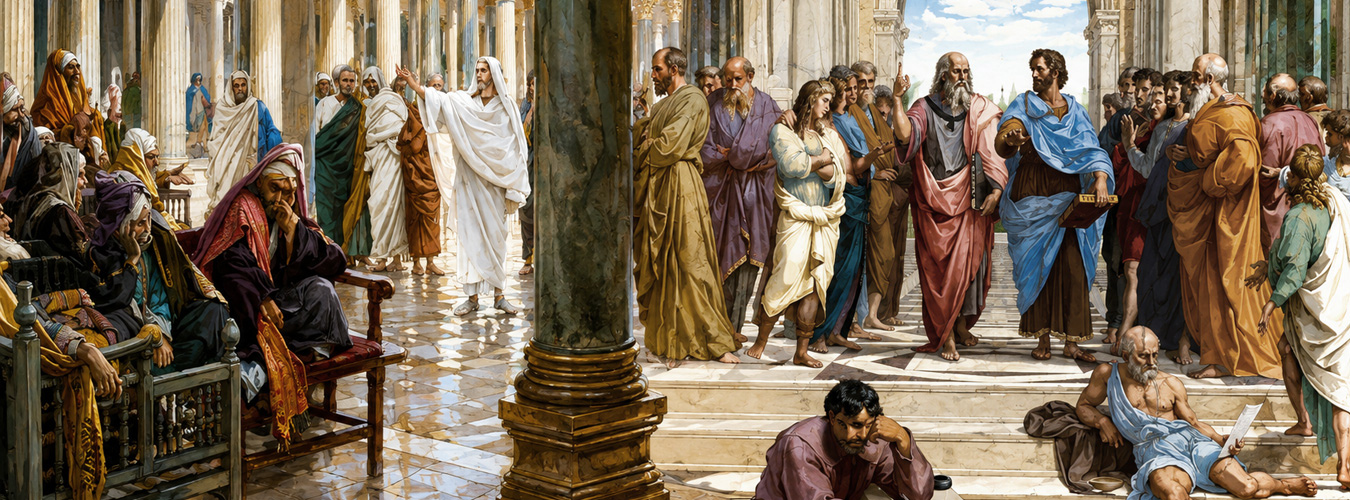

The Savior's Charity
(No. 3491)
A SERMON PUBLISHED ON THURSDAY, DECEMBER 23, 1915.
DELIVERED BY C. H. SPURGEON,
AT THE METROPOLITAN TABERNACLE, NEWINGTON.
"Jesus answered and said unto Aim, What do you want Me to do for you?"
Mark 10:51.
THE story of this miracle is wonderfully attractive. It has always been
a favorite theme with preachers. From the days of the Apostles and the
fathers of the Church they have delighted to dwell upon any single item
of it as it is described by the three Evangelists who record it. We
have frequently spoken of the incident as a whole–let us, therefore,
now confine our attention to the question which Jesus asked of the
blind man, "What do you want Me to do for you?" He asks the same
question at this good hour–He asks it of blind men and, I think, He
asks it of partly blind men, too. There are some of us whose eyes are
opened, but whose vision is obscure–we cannot see afar off. Our
blessed Lord and Master says to us, as well as to the blind ones, "What
do you want Me to do for you?"
Let us consider this question attentively, first on our
Savior'spart–the disposition it shows. And then on our own part–the
appeal to which we should respond.
I. THE QUESTION, AS PUT BY OUR SAVIOR, is expressive of much
tenderness. There is a beautiful delicacy in its manner. The absence of
any distinct allusion to the privation the poor man suffered from, is
kind. I have noticed, in many cases, that to afflicted persons, any
allusion to their infirmities is very distasteful. You could hardly do
anything that would be more ungracious to a blind person than to be
perpetually reminding him of his blindness, or to a person who was lame
than constantly referring to his misfortune. Such people are hopeful
that, bearing the evil patiently, themselves, it will not be detected
by others and they are anxious to avoid the pity which is grievous when
it becomes obtrusive. Now our Savior did not say to this man, "Alas,
poor Creature, what a sad state you are in!" There was not a word
concerning the man's blindness to wound his sensibility. He was a
beggar, to boot, and his dependence on alms for his subsistence would
be, of itself, humiliating enough without referring to that poverty
which, if keenly felt, is apt to crush a man's spirit and shear him of
self-respect. There is not a word about poverty here. Christ did not
say, "How long have you been sitting by the wayside begging? How much
have you obtained from the cold hand of charity during the last few
days?" You would not know that the man was a beggar and blind by the
question which the Savior addressed to him. "What do you want Me to do
for you?"–that might have been spoken to a prince or to a king as
gracefully as it was spoken to the poor blind beggar of Jericho!
I do not know whether you see much to admire and appreciate in this
tenderness. I think it needs a man of fine feeling and generous
sympathy to fully estimate it. Very characteristic was it of the way in
which Christ deals with souls, as other instances show. The parable of
the prodigal son is a correct picture of our Heavenly Father's dealings
with His returning sons. In that parable we are told of the youth's
nakedness, poverty, hunger and so on, but the father never mentions any
one of these things–but he fell upon his son's unwashed neck and
kissed his yet filthy face–and received him to his arms, all ragged as
he still was! To anyone else he would have been a loathsome object, and
yet to his father's heart he was still lovely, for he was his own dear
child! He perceived the jewel, though it was lying on a dunghill. He
did not say, "My dear Son, how sad a thing it is that you should have
left my roof! How could you be so foolish as to spend your living with
harlots? Alas, my dear Son, to what a degradation have you been brought
in feeding swine." No, there must be no sort of allusion at all to the
plight in which the prodigal youth returned. He was acknowledged and
welcomed just as he was–in his sinnership.
Neither does the Gospel of Jesus Christ come to you with taunts and
upbraiding, continually reminding you of your sin. That is the work of
the Law of God. The Law is like a sharp needle. It must go through the
fabric and draw after it
the silver thread of the Gospel. The Gospel's message is not so much
about your sin as it is about the remedy for it! And when it comes to
deal with your sin, it deals less with it as a crime than as a disease.
It looks upon it as an affliction. It takes the most merciful view that
is possible–and how little does it say to you even of disease? It
gives you many invitations, "Ho, every one that thirsts." Nothing about
sin there. "Come unto Me, all you who labor and are heavy laden."
Nothing about sin there. You remember that hymn of Rowland Hill's,
which says–
"Come filthy, come naked, come just as you are."? I am not quite
certain that that is precisely the style of the Gospel invitation, for
that seems to say, "Come unto Me, all you who will. Whoever will, let
him come and drink of the Water of Life freely." There is as little
allusion made by the Gospel, itself, to the sin of the sinner as
possible. Of course, the sinner must be called a sinner, and the Gospel
never says, "Peace, peace," where there is no peace–and at the same
time it does not expose the disease without prescribing the remedy. The
Gospel does not appeal to us so much in tones of thunder to acquaint us
with our peril as it admonishes us to fly without delay to a place of
safety! The Gospel does not speak from Sinai, but from Calvary! From
Sinai you hear the voice of rigid justice–from Calvary you hear the
voice of tender mercy and gracious pardon.
There is something, I think, then, in this omission of the Savior's
which has a blessed tenderness in it. Do you ask, "Why such tenderness
to the sinner?" The reply is, "Because he is one who needs to be
tenderly dealt with." It has been said that the good surgeon should
have a lion's heart and a lady's hands. He should have the courage to
do anything that is of vital moment to the physical frame, be it to set
a joint, to amputate a limb, or to uncover a sensitive nerve, yet he
should have the utmost delicacy of touch, and the most tender of hearts
in performing an operation that involves pain to the patient. To have
his bones set with downy fingers is the injured man's desire. The
awakened conscience is extremely sensitive. The Law has been using its
cat-o'-ten-tails upon the sinner's back until it has been furrowed with
deep gashes. "The whole head is sick, and the whole heart faint–from
the sole of the foot, even unto the head, there is no soundness in it,
but wounds, and bruises, and putrefying sores." Such a man needs to be
gently handled! The Physician of souls knows this! The Savior of
sinners acts thus. Not a harsh word is spoken, but Grace is poured out
from His lips. Not threats, terror, rebuke, but Grace, and peace, and
love!
I revel in this thought–commonplace it may be, but practical and
precious it certainly is! What instruction is affords us! How it
teaches us wisely to deal with the tender conscience! Like the Savior,
Himself, we ought to minister to those who feel their need of help and
healing very lovingly and gently, lest we break the bruised reed, or
quench the smoking flax. The hypocrite and self-righteous need have no
tenderness shown towards them. Caresses would but nourish their
conceit. The Savior addresses them with loathing threats–"Woe unto
you, Scribes, Pharisees, hypocrites!" What indignant epithets does He
use! With what utter contempt does He assail them, calling them,
"fools, and blind," "serpents, and a generation of vipers!" Yes,
"whitewashed sepulchers," and I know not what besides! But when He
comes to deal with the shorn lambs, how tenderly He carries them in His
bosom! How gently He addresses those whose broken hearts need
gentleness! Let us do the same. Let us try to bring out the sweets of
the promise. Let us seek to break the promise into small pieces, that
it may give them the meaning and sense, so that they can understand it.
Let us pray that the Holy Spirit, the Comforter, would effectually make
us the instruments of comforting every soul that is depressed and
dejected.
Not less remarkable is the wisdom of the Savior. You notice the
question, "What do you want Me to do for you?" It is a rule with Christ
never to do for us what we can do for ourselves. He did not tell the
man that he was blind, because the man knew that himself. He did not
undertake to do the work of conscience. In vain you look to Jesus
Christ or to the Holy Spirit to do for a man that which it behooves the
man to do for himself! This poor fellow could tell that he was blind,
hence our Lord asked him a question which set his own mind to work.
Now, dear Friend, if you are desirous of being saved, Christ asks you,
"What do you want Me to do for you?" Your own conscience, if it is at
all enlightened, will tell you that you have many sins that need to be
forgiven. Why should Christ tell you that? The inward monitor, when
fully awakened, knows that there is much sin that you have committed
which requires absolution–and much sin cleaving to your nature from
which you require to be cleansed. You have much depravity to overcome.
Your conscience tells you so. Christ does not come to you in the Gospel
and tell you this. He does not accuse you or excuse you in this way.
With all mildness and gentleness, He puts the question thus, "What do
you want Me to do for you?"–as if to make the blind man really think
of the darkness in which he had lived so long, of the scales that were
over his eyes and the disease
that affected his optic nerve. It was well to make him think of all
this, that his conscience should be naturally and thoroughly exercised.
It seems to me to have been a salutary lesson, without which he would
never have felt the gratitude that the gift of sight should inspire.
Full many a mercy we receive and inadequately appreciate because we
have never known the lack of it. People who have never been sick in
their lives are not so grateful for health as those who are restored
after a long illness, or those who have often been cast upon a bed of
languishing. Those who have never known the pinch of poverty are seldom
so grateful as they ought to be for food and raiment. While this man
could see nothing, he could discern a great deal with his inward
consciousness. His privation would suggest such manifold disadvantages
that when he got the light, he would be sure to bless Christ for it!
With the power of vision, once more to gaze upon the outward world, he
would have a song in his mouth, as well as light in his eyes! It was
wise in Christ thus to exercise his conscience that he might evoke his
gratitude.
By means of this question, Christ was giving the man lessons in prayer
A schoolboy is encouraged by his master to apply to him if he finds any
difficulty in his exercises that he cannot grapple with. Suppose it is
the translation of a sentence from Latin into English. When he asks
help, does the master at once take the matter out of his hands and do
it for him? Certainly not! He says, "Where is your difficulty? Is it
the meaning of that noun, or the construction of that verb, or what is
it that perplexes you? Put your finger on the point that distresses
you, and I will give you the assistance you require." When the blind
man said, "You, Son of David, have mercy on me," his request was valid,
but vague. He craved mercy, but what particular mercy was he in need
of? He had need to learn the sacred art of pleading. The most advanced
Christian has still need to pray, "Lord, teach us how to pray." I have
noticed that though the disciples often heard Christ preach, they never
said, "Lord, teach us how to preach"–but when they heard Him pray–you
recollect the passages– "As He was praying in a certain place, the
disciples said to Him, Lord, teach us how to pray." They were so
astonished with such praying as the Savior's, that though, perhaps,
they thought that they might emulate His preaching, His praying seemed
too masterly, too infinitely above them, and they could not help
exclaiming, "Oh, God, show us how to pray like that!" They felt that
the majesty of His prayer was a great thing if they could but attain
unto it. They desired to be taught how to pray. This is what Christ was
doing with this man–He was teaching him how to pray! He did not at
once open his eyes, but encouraged him to ask what he needed done for
him. When the child first begins to walk, it runs, eager to catch hold
of something. The mother gets a little farther back, and a little
farther, and the child goes tottering onwards to reach what it
desires–and so it learns to walk. So is it with the mercy of God–He
holds it out a little farther, and yet a little farther–that the soul
may pray yet more. It was wisdom on the part of Christ, then, for this
reason to propound the question.
And oh, what marvelous generosity this question implies! The Savior's
liberality knows no bounds. "What do you want Me to do for you?" If the
Messrs. Rothschild, or some other eminent capitalists were to place in
one's hand a book of blank checks, and say, "There, draw what you
like," it would be a liberality unheard of! To whatever extent a man
may be willing to benefit his fellow man, there must be a limit. But
when Jesus says, "What do you want Me to do for you?" there is no limit
to His resources, or His readiness to bestow! The will of the person of
whom the question is asked may limit the petition, but as the Savior
put it, He gave, as it were, a sort of challenge to the poor beggar to
ask whatever he liked. Now, Brothers and Sisters, this is much the way
the Savior deals with all His people. "What do you want Me to do for
you?" Whatever your desire may be, He will hear you and attend to it. I
say not that He will grant it to you if it is not for your profit, but
He would have you tell Him what it is you are desirous to ask. We have
an example in this Chapter of this kind of limitation–when James and
John asked for something which our Lord thought it would do them no
good to have. Nevertheless, if it is truly for your benefit and for His
Glory, you shall have it, ask what you will! You are not to
dictate–you entreat pressingly. You are not Omniscient and, therefore,
your will can never be wiser than His– but you are God's child and,
therefore, your desire shall be very prevalent with Him. "Ask what you
will, and it shall be done unto you." Take this Book–the promises in
it are exceedingly great and inestimably precious–so great that no man
need ever complain that they are not large enough for him to stretch
himself upon them! There are promises of God in this Book, the bottom
of which no man can ever touch–streams of mercy which flow on with
such a volume of Grace that it is impossible they should ever be
exhausted! Even though we should be like that mighty one who drinks up
Jordan at a draught, yet should we never exhaust the mighty promises of
God! I wish we could really feel how freely Christ gives.
When we consider that He spared not His own self, but gave up His whole
heart and emptied out His whole soul unto death for us, we can well
understand that, having given Himself for us, He will also freely give
us all things.
Thus much have I spoken concerning the question of our text as it
interprets the goodwill of Christ. Let us now turn it over again–
II. AS IT APPEALS TO OURSELVES.
What do you think it ought to say to us? Or what should we say in
response to it? It strikes me that, as it shows Christ's tenderness,
so, on our part, it ought to prompt a corresponding tenderness.
Horrible is the state of that man's mind who can presume upon Christ's
tenderness and yet love sin! I have heard some preach the Doctrine that
God sees no sin in Jacob, neither iniquity in Israel, in such a way as
to make you feel that they could not see any sin in the people of
Jehovah's choice. But I would like to feel that His great forbearance
excited my scrupulousness. Does the Lord say that He can see no sin?
Then I will see it all the more. Does He say of His exquisite
tenderness, "You are all fair, My Love, there is no spot in you"–shall
I, therefore, treat sin as though it were nothing, trifle with it and
call it a nonentity? Oh, no! I will weep because of the tenderness of
Him who knows all about me! And though He is too gracious to throw my
sin in my teeth, yet I will take care to bemoan it myself. God forgives
me–and for that reason I cannot forgive myself. God casts my sin
behind His back–therefore, I have it continually before my face. Such
love as His makes me appear the more black, the more detestable in my
own eyes. If I had a friend who knew that I had some besetting sin,
some grievous infirmity, and if that dear friend, out of the tenderness
of his heart for me, never mentioned it to me, though it had grieved
him much, should I, therefore, treat it with levity? Suppose I had
injured him in business, do you think I should forget it for that
reason? Or had I been the instrument of his losing some dear relative,
and yet he never said a word to me about it, never upbraided me, never
looked as if he felt that I had wronged him–never even hinted in a
side way that I was the cause of his pain–well, I hope I speak
honestly when I say that his kind reticence would wound and cut me to
the heart more than if he spoke bitterly to me! If you, as a servant,
have committed a fault and your master never says a word by way of
blame, I am sure you will feel the more sorry rather than the less
concerned for the wrong you have done. If a man comes to me in a rage
and calls me evil names, I consider, then, that whatever my fault may
be, he has taken his revenge and I am not bound to humble myself–but
when he says, "Ah well, I will say nothing about it," or when he passes
it over in silence and is as quiet and tender to me as if I had never
done him an injury, why, then I must chastise myself, even if he will
not chastise me! I must blame myself, since he will not blame me. Dear
Christian Friends, let us cultivate a holy sensibility. There is what
is called the sensitive plant which turns up its leaves when it is
touched. Let us be like that plant. If Christ has been tender to us,
let us also be tender!
Did we not also say that Christ exhibits wisdom in the question which
He put to this blind man? Let us always seek to acquire wisdom. The
text suggests the idea of studying. "What do you want Me to do for
you?" How few students among us are studious to do the will of the
Lord! They may take to studying Ezekiel, and Daniel, and the
Revelation–and they get a blessing out of those three Books–but I
wish they would do a little more for the Master than they are
ordinarily known to do! Some people are so busy studying the stars that
they have no time to trim the lamps here below, and yet I think the
stars would shine as brightly without their study, whereas the lamps
below might give clearer light if only they gave them a careful
trimming. But while this is the fault of some, the fault of others is
that they are all for sowing, but they scatter seed out of an empty
basket! They are all for working, but their tools are out of order!
They would go fishing, but they forget to mend their nets. It were well
if some who are teachers were but learners. Martha worked for Christ,
but Mary learned of Christ. A holy mixture of these employments would
be profitable. Would we have Martha and Mary in one–first learn of
Christ and then work for Christ–this would be comely. Very familiar is
that quotation from Pope–
"Theproper study of mankind is man."
I am not so sure that it deserves the currency it has obtained. It is
hardly standard gold. The proper study of mankind is God, but in order
to get to God one must know something about man! It is well for us to
know something of man's ruined estate, and especially to be acquainted
with our own weakness, our own danger and our present exposure.
Christian, study this! It is a very black book, but read on, for it is
useful because of another Book which shall follow. For, in order to get
wisdom, we had need study the Scriptures, too, with a view to the
practical testing of what we learn abroad.
This leads me to the remark that it would be profitable to us were we
to study our prayers. Does that sound strange? You do not think it
right to come to the Lord's Table without some degree of
preparation–why should you not prepare to go to the Mercy Seat and to
the Throne of Grace? If you were permitted to have an audience of Her
Majesty, I will guarantee you that if you intended to ask anything, you
would weigh your thoughts and almost construct your sentences before
you were ushered into her presence! Certainly you would not go without
considering what you intended to ask! When a man sends up a petition to
the House of Commons, he knows what he wants–it were idle to throw
together a mere jumble of words. It is true that the Holy Spirit has
promised to help our infirmities, but He will not do for us what we can
do for ourselves! I love extemporaneous prayer, for I believe that when
the thoughts are clear, and the emotions vigorous, fit words will not
be lacking. But I am not so fond of extemporaneous prayer when the
sentiment, itself, is extemporized. Let a sermon be delivered
extempore, it will be doubtless more effective than the reading of an
elaborate essay, but it would be a poor sermon which the preacher never
thought about before he uttered it! I have heard of a certain Divine,
who, after preaching, observed to some of his hearers that he had never
thought of it before he went into the pulpit. The answer he got was,
"That is just what we suspected." They had noticed how void it was of
meaning and method. We ought to well consider our prayers. Are we not
told that we have not because we ask amiss? I fear we often ask amiss
from lack of preparation! The archer, when he draws his bow, not only
puts his whole strength into the effort, but he diligently takes aim
before he actually discharges his arrow. So let the suppliant pray!
"Unto you," says David, "will I direct my prayer." Follow David's
example, my Friend. Be considerate of the requests you present before
the Most High.
The generosity involved in our Lord's question, "What do you want Me to
do for you?" supplies us with a strong incentive to boldness at the
Throne of Grace. This is our last thought. Should we not seek much
liberty in prayer when we are encouraged by such liberality, such a
profusion of Grace? Let us not be so reluctant to ask while our Lord
and Master is so ready to supply! "Open your mouth wide, and I will
fill it," says our God. A traveler thinks that this passage must bear
an allusion to a custom which prevails in the East and was practiced
not many months ago by a Persian Shah. The monarch told one of his
subjects to open his mouth, and when the man had done so, he began to
put into it diamonds, pearls, emeralds, rubies and all sorts of jewels!
Well, though I suppose that these are not very pleasant things to have
in one's mouth, I can readily understand that a man who knew he was to
have as many of them as he could hold in his mouth would open his mouth
rather wide! And are not God's mercies so rich that they are like
diamonds of the first water and jewels beyond all price? Surely there
should be no need to press the exhortation–we do not ask enough. This
is a complaint which was never brought against any poor mendicant in
quest of this world's comforts, and yet it is a complaint which God
brings against us! Our puny souls do not crave so much as His infinite
bounty is willing to bestow! Let us so account of God as that courtier
whom Alexander bid to ask what he would. He asked for so much that the
king's treasurer was staggered at the demand. Not so Alexander the
Great! He said, though it was much for a subject to ask, it was not
much for Alexander to give! Let the riches of God's Glory, rather than
the meanness of your own estate, measure the compass of your requests,
when He says, "What do you want Me to do for you?"
Now the Savior is present with us in Spirit. He will soon be here in
Person. I think I hear His voice as He puts this question, in loving
tones, to each one of us, "What do you want Me to do for you?" You aged
folks who have passed your "best days" (as they are called, though I
hope your best days are really now coming), what do you want Christ to
do for you? You venerable saints, if you have little to ask for
yourselves in this world, what will you ask for us who are bearing the
heat and burden of the day? You soldiers of Christ, who are in middle
life, what do you want Christ to do for you? Have you no children to
pray for, no household mercies to seek, no troubles from which you
would be delivered? And you young men and maidens, the Master says to
you, "What do you want Me to do for you?" If you can, I trust you will
put up a desire while you are in your pews. If not, let the question
greet you at the bedside where you have bowed so often. Pause a while
before you pray. Think what you shall ask. It may be that the Lord, who
appeared unto Solomon and said, "I will give you whatever you shall
ask," may have appeared to you to make this the night of mercy. Ask not
wealth of Him, ask not honor, ask not rank and station, but ask Him to
give you His dear Son! Ask to have the Savior to be yours forever–and
if you ask this, it will be a wide-mouthed prayer, but God will answer
it, and you shall have this grateful response, "According to your faith
be it done unto you." Amen.
MARK10:13-27,32-52.
Verse 13. And they brought young children to Him, that He should touch
them: and His disciples rebuked those that brought them.They thought
them too little, too insignificant, and that the Master had greater
things to do. But He thought not so. None are too little for Him! He
receives even childish honors to Himself.
14. But when Jesus saw it, He was much displeased, and said unto them,
Suffer the little children to come unto Me, and forbid them not for of
such is the Kingdom of God. Many of them come into that Kingdom and all
who come there must be like they. The child is not the hardest subject
of conversion! No, rather–
15. Verily I say unto you, Whoever shall not receive the Kingdom of God
as a little child, he shall not enter therein. Instead of growing
wiser, in order to be fit for Christ, we must be more conscious of
ignorance, more trustful towards Him, more dependent upon Him, more
childlike.
16-18. And He took them up in His arms, put His hands upon them, and
blessed them. And when He was gone forth into the way, there came one
running, and kneeled to Him, and asked Him, Good Master, what shall I
do that I may inherit eternal life. And Jesus said unto Him, Why do you
call Me good? There is none good but One, that is, God. He did not here
unveil His Deity to that young man, but if he had thought a while, he
might have seen it. However, He answered his question. "If you are to
be saved by your doings, this is what you have to do–not attend to
sacraments and go through performances, but this."
19, 20. You know the commandments, Do not commit adultery, Do not kill,
Do not steal, Do not bear false witness, Defraud not Honor your father
and mother And he answered and said unto Him, Master, all these have I
observed from my youth.And he probably had very cautiously and
anxiously done so, yet, for all that, he had not really kept all those
commands without a flaw. We are right well sure of that, but as yet his
eyes were not open to see his own shortcomings.
21. Then Jesus, beholding him, loved him. There was so much that was
amiable about him.
21, 22. And said unto him, One thing you lack go your way, sell
whatever you have, and give to the poor, and you shall have treasure in
Heaven: and come, take up the Cross, and follow Me. He knew that there
was a weak point in the young man's character–that he did not yet
supremely love God, but loved his wealth–that he was living for this
world, after all. And are there not many such–most correct in
character? No one could point to a single flaw in their morals, but
they are living purely for self–altogether that they may buy and sell
and get gain. No thought of God, except a fear lest they should come
under His rod–but no thought of serving Him, or laying themselves out
for His Glory–nor much thought, either, for their fellow men. Christ
had hit the blot–marked it out for him.
23. And the disciples were astonished at His words.For the Rabbis had
pretty well taught that money would answer everything–that if you
could give so much, and pay so much, it was all well with you. Christ
went against all such teaching, and showed that, in this respect, money
was of no service–in fact, that it often was a hindrance.
24. But Jesus answered again, and said unto them, Children, how hard is
it for them that trust in riches to enter into the Kingdom of God/It is
an impossibility. Only God can do it.
25-35. It is easier for a camel to go through the eye of a needle, than
for a rich man to enter into the Kingdom of God. And they were
astonished out of measure, saying among themselves, Who, then, can be
saved? And Jesus looking upon them said, With men it is impossible, but
not with God: for with God all things are possible. And they were in
the way going up to Jerusalem; and Jesus went before them: and they
were amazed: and as they followed, they were afraid. And He took the
twelve, and began to tell them what things should happen unto Him,
Saying, Behold, we go up to Jerusalem; and the Son of Man shall be
delivered unto the chief priests, and unto the scribes. And they shall
condemn Him to death andshall deliver Him to the Gentiles. And they
shallmock Him, and shall scourge Him, andshallspit upon Him, and shall
kill Him. And the third day He shall rise again.From the number of
these sentences it is clear that our Savior entered into a very
detailed account of His sufferings, dwelling upon each particular which
He plainly foresaw, wherein we see His Prophetic Character. But it is
more to our point to see that He knew beforehand what it would cost Him
to redeem our souls–
"When the Savior knew the price of pardon Was His blood, Hispity never
withdrew."
He knew not only that He must die, but He knew all the circumstances of
pain and shame with which that death should be attended. They would
condemn Him, deliver Him to the Gentiles, mock Him, scourge Him, spit
upon Him and kill Him. Thus we learn that we also should dwell in holy,
grateful meditation upon every point of our Lord's Passion. There is
something in it. He would not, Himself, thus have divided it out, and
laid it, as it were, piece by piece, if He had not intended us to do
with it as they did with the burnt offering of old, when they divided
it–a picture of what every intelligent, instructed Believer should do
with the Passion of His Master. He should try to look into the details
of the great Sacrifice and have communion with God therein. Now, albeit
that this Revelation of His coming shame, and sorrow, and death
afflicted the hearts of His disciples, yet, for all that, observe what
they did.
35. And James and John, the sons of Zebedee, come unto Him, saying,
Master, we would that You should do for us whatever we shall desire.
Strange request! First of all, read those words, "We would that You
should do for us." Now the genuine spirit of a Christian is not to ask
that something should be done for him, but to ask his Master,
especially in such a time as that, what they could do for Him! Christ
was all unselfishness, but His disciples had not yet learned the
lesson. "We would that You should do for us." And then see how much
they indulged their ambition. "We would that You should do for us
whatever we desire." And yet I question whether we are, any of us, free
from this spirit! For when the Lord reproves us a little and we have
not everything our own way, how apt we are to rebel! The fact is, we
have got this tincture–this gall already in us–we would that He
should do for us whatever we desire! Should it be according to your
mind? Should the disciple dictate to his Master? Should the child be
lord of the family?
36-39. And He said unto them, What do you want Me to do for you? They
said unto Him, Grant unto us that we may sit, one at Your right hand,
and the other at Your left hand, in Your Glory. But Jesus said unto
them, You know not what you ask can you drink of the cup that I drink
of and be baptized with the baptism that I am baptized with? And they
said unto Him, We can. Again, He might have said, "You know not what
you say."
39, 40. And Jesus said unto them, You shallindeed drink of the cup that
I drink of; and with the baptism that I am baptized withal shall you be
baptized. But to sit at My right hand and at My left hand is not Mine
to give; but it shall be given to them for whom it is prepared. They
are not content, you see, with being ambitious–they would fire Him
with ambition–that humble, lowly Servant of God, who had laid aside
for a while the power to distribute crowns and thrones! But He does not
forget Himself, nor the position which He had taken up in reference to
the Father, but said, "It is not Mine to give."
41-43. And when the ten heard it, they began to be much displeased with
James and John. But Jesus called them to Him, and said unto them, You
know that they which are accounted to rule over the Gentiles exercise
lordship over them; and their great ones exercise authority upon them.
But so shall it not be among you.However, how sad the contrast is– the
Master's thoughts all taken up with His death for others–and their
thoughts occupied with little petty jealousies as to who should be the
greatest! It is a sad thing when this creeps into Christian Churches
(and it still does), when souls are perishing, and this poor world
needs our weeping eyes and our laborious hands, and we get to
quarreling about points of precedence! This Brother thinks the other
too forward. This one has not enough respect paid to him. This one has
spoken sharply and the other cannot bear it. Oh, what poor disciples we
are! What a blessing it is we have a patient Master who still bears
with us, and will not leave us until He has infused His own spirit into
us, which spirit is the spirit of self-denial, self-abnegation–the
spirit which desires not its own, but looks on the things of others.
God grant us all to be full of it!
43. But whoever will be great among you, shall be your minister Your
servant.
44. And whoever of you will be the chief, shall be servant of all.And
that is the way to be truly great in the Church of God–it is to be
less and less in your own esteem, and willing to be nothing! The way up
is downward! That is not a contradiction, but it is a paradox. Sink,
and you shall rise. Be willing to serve the very leas,and you shall
have honor among your Brothers and Sisters. Remember that the King of
Kings was the Servant of Servants! "Whoever of you will be the chief,
shall be servant of all."
45-49. For even the Son of Man came not to be ministered unto, but to
minister and to give His life a ransom for many. And they came to
Jericho: and as He went out of Jericho with His disciples and a great
number of people, blind Bartimaeus, the son of Timaeus, sat by the
highway side begging. And when he heard that it was Jesus of Nazareth,
he began to cry out, and say, Jesus, Son of David, have mercy on
me.> And many charged him that he should hold his peace; but he
cried the more a great deal, Son of David, have mercy on me! And Jesus
stood still, and commanded him to be called. And they called the blind
man, saying unto him, Be of good comfort. "Cheer up." That would be a
very exact translation.
49-51. Rise; He calls you> And he, casting away his garment, rose,
and came to Jesus. And Jesus answered and said unto him, What do you
want Me to do for you?Do you notice here a sort of gentle rebuke that
the Savior gives to James and John? Read the 36th verse, and then read
this again. "He said unto them, What do you want Me to do for you?" And
now here is a blind beggar, and He sweetly puts the same question to
Him, "What do you want Me to do for you?"
51. The blind man said unto Him. And here he might well have shamed
John and James! He asked for no thrones or kingdoms.
51. Lord, that I might receive my sight. "Lord, that I might look up."
That is the exact translation, for no doubt he had been conscious that
the light came from the sun as he felt its warmth upon him as he sat by
the wayside! And, therefore, he thought that seeing must be looking up
towards the place from where the sunlight came. "Lord, that I might
look up."
52, 53. And Jesus said unto him, Go your way; your faith has made you
whole. And immediately he received his sight, and followed Jesus in the
way.It is a very remarkable thing that you will not often find the Lord
Jesus Christ granting a favor without ascribing it to some excellence
in the person to whom He grants it. It is generally, "Great is your
faith," or something of that sort–"I have not seen such faith." Now
this is a very remarkable thing because we know there really was
nothing whatever in the persons, that they should deserve His great
favor!