
The Water and the Blood
(No. 3311)
A SERMON PUBLISHED ON THURSDAY, JULY 18, 1912.
DELIVERED BY C. H. SPURGEON,
AT THE METROPOLITAN TABERNACLE, NEWINGTON.
"But one of the soldiers with a spear pierced His side, and forthwith
came there out blood and water." John 19:34.
IT is with much fear and trembling that I usually stand upon this
platform–not that I shrink before the face of the multitude however
large, but the weight of the subject which I have continually to bring
before your minds fills my own soul with awe. And yet it is with more
than usual anxiety I approach my subject this evening, because although
it is full of tender interest and touching pathos, I feel that without
the unction of the Holy Spirit, it would be insipid and unprofitable.
And yet, on the other hand, with that Divine anointing, it is one of
the richest topics that can possibly engage our meditation!
Readers of old theology will have remarked how constantly the fathers
were accustomed to dwell upon the wounds of Jesus slain. And this fifth
wound which penetrated His heart was peculiarly attractive to them.
They said a great many things about it. Some, indeed that were
fanciful, but other remarks that were truly excellent and well deserve
to be treasured up. I would it were more the practice of Believers
nowadays than it is to study the very Person of Christ, as well as the
Doctrines of the Gospel, and to learn the Divine lessons which are
discoverable in the wounds of Jesus as well as the sacred admonitions
bequeathed to us by the words of His mouth.
One of these old Divines says that Jesus Christ was typified by our
first father, Adam. As Adam fell asleep, and out of his side Eve was
taken, so Jesus slept upon the Cross, the sleep of death, and from His
side, where the spear was thrust, His Church was taken. He who redeemed
us unto God by His blood, formed us as a peculiar people for Himself.
The Church is one with Him–she came out of His side, and as He looks
upon her, He can say–"You are bone of My bone, and flesh of My flesh.
With My blood have I redeemed you." Others have been pleased to compare
Christ to the Rock in the wilderness, which was smitten, and this
spear-thrust is the great cleft in the Rock. You may remember how
Toplady puts it–
"Rock of Ages, cleft for me! Let me hide myself in Thee."
And he clearly has this in view, for the next lines are–
"Let the water and the blood
From Your riven side which flowed,
Be of sin the double cure,
Cleanse me from its guilt andpower " I do not consider this allusion
fanciful, nor can I think it distorts the type. Moses hidden in the
cleft of the rock, that he might see God's Glory, had not a standing
place one-half so glorious as you and I have when, sheltered in the
wounds of the Savior slain, we see the glorious Justice and the
Infinite Love of God reconciled in the Person of the dying Lamb.
In the course of reading, I have met with some remarkable expressions
in regard to this great wound of Christ. Some have called it, "a gate
of Heaven." Why should I object to the title? Do we not enter into
Heaven through the wounds of Jesus? It is, of course, a metaphorical
expression, yet quite allowable. If the teaching is that there is no
other way of access to God except through the torn veil of Christ's
body–and that veil was torn in two, indeed, when the soldier with the
spear pierced His side–we may, without straining the thought, call
that wound one of the gates of Heaven. Another calls it "a celestial
window, a window of Paradise," and we have versified that idea in one
of our own familiar sonnets–
"Look through Jesus' wounds on me;
Him, and then the sinner see."
Another writer, carried away by the consideration of this spear-thrust,
calls it "a palace of refuge." A palace! Surely, never kings had such
an one! Solomon's palace of ivory was nothing like it! And what a
refuge it is! When the poor heart, like the dove hunted by the hawk,
needs a shelter, if it can fly to Jesus' wounds, it is sheltered from
all its sins. Well does our song put it–
"Come, guilty souls, and flee away Like doves to Jesus' wounds! This is
the welcome Gospel Day, Wherein free Grace abounds."
1 forget the name of the writer, who, in speaking upon his Master's
wounds, seems to get so exalted and carried away by the subject that He
calls this wound "the sacred wellhead of the rivers of golden sand
which cover all the earth"–two rivers, one of water and the other of
blood. Two quickening rivers that carry life through the realms of
death. Two purifying rivers cleansing the Augean stable of this filthy
world. Two mighty rivers which bear the elect vessels onwards towards
the sea of everlasting bliss, not one of them suffering shipwreck on
the voyage, for this mighty river is too deep to have quicksands, too
broad for the mariner to be cast away upon a rock-bound shore! I like
the thought, and so let it be–the sacred wellhead of that river of
more than golden sand–the streams whereof make glad the multitudes of
God's chosen throughout the earth!
In this wound of Christ, caused by the soldier, I discern four obvious
meanings. It has many more, but these four will be enough to occupy our
attention this evening.
I. It was THE MARK OF PROPHECY. In order that it might be fully known
that Jesus Christ was the Messiah that was to come, the Prophets had
given many marks, all of which must be found in the Person of the Man
who should be the Great Deliverer. Among the rest was this one that
John quotes, "A bone of Him shall not be broken." This description
concerned the paschal lamb, of which it was expressly said by the Lord,
through Moses, that they were never to break a single bone of it. Its
joints were to be separated after it had been roasted with fire, but
not a bone was to be snapped. Now, if Jesus Christ is the Lamb of God's
Passover, it is necessary that He should never have a broken bone. And
yet it looked as if His bones would be broken. The rough soldier
brought up a great iron crowbar and, with an awful blow, smashed the
legs of the poor thief who hung on one side of our Lord, but half-dead,
in order to hasten his dissolution. It was a strange thing that he
passed by Christ, who was in the middle. I know not what it was that
made him do so– whether some flash of majesty beamed from that dead
face, or whether some singular instinct checked his arm. But he went
and administered the dreadful blow to the thief on the other side. And
now he came to Christ and perhaps raised the iron rod–when he saw that
He was already dead! His head was hanging down upon His bosom and the
man saw clearly that there was no need to administer the deathblow to
Him. It was a strange thing that his hands should be so restrained. The
soldiers of that day were wanton enough. They were just as likely as
not to have broken the bones even though the man were dead–but Divine
Prophecy must have it so and, therefore, not a bone of Jesus can be
broken!
And then the Prophet Zechariah had said concerning the Messiah, "They
shall look upon Him whom they have pierced, and they shall mourn for
Him as one mourns for his only son." Now up till that moment our Lord
had not been pierced, except as to His hands and feet, and this would
scarcely have been a carrying out of the word, "pierced." Somebody
would have said, "Well, but He never was pierced so as to cause His
death–there was no such piercing as the text indicates." But now that
the soldier, moved by the mysterious impulse, lifts his lance and
thrusts it deep into the side of Christ–now did Prophecy set its mark
upon Christ–now did history identify Him–the Man without broken bones
yet the Man whose side was pierced! Him for whom Israel should one day
mourn! Him whom His enemies should one day confess to be their King!
My dear Brothers and Sisters, has it ever struck you with admiring
wonder that Jesus Christ should answer to Prophecies so complicated and
types so manifold–should answer even with coincidences the most minute
to them all? It would be almost impossible to count the types of Christ
which are given in the Old Testament. It would, perhaps, be easy to
count the prophecies, but very difficult for anybody to form a
character in which all these should be blended and fulfilled! It has
been said that if you were to give all these types and all these
prophecies to the wisest of men of all ages, and say to them, "You are
required to compile a biography of a man who shall answer to all
these," they must certainly give up in despair! You can find men who
will make a key to fit any lock–by diligence of labor, no matter how
complicated the mechanism may be, the thing may at last be done. But I
will defy all the wisdom that ever was in humanity to form a
key that will fit the exceedingly complex words of all the types of the
Old Testament and all its prophecies! How palpable then the evidence
is. Our Lord Jesus Christ answers to them all. Just as the stamp in the
wax answers to the seal that stamped it, the Providence that transpired
corresponds with the predictions that forestalled His course! He went
as it was written of Him! There He is and He fulfils types that look
the most opposite and prophecies which seem to run counter to one
another!
If anybody thinks that the stories told by the four Evangelists are
spurious, I would suggest to him to go and write a fifth–to try to
write another that would as much correspond with the Old Testament–and
with the other four, as those four do with the Old Testament and with
each other! And when that task was done, I would then give him another
problem to solve before he could have reasonable ground for suspicion
that Jesus of Nazareth was not the Messiah. Account for the incredulity
of the Jews in the presence of those evidences that have produced
conviction among the Gentiles upon any other hypotheses than that which
ratifies their own Scripture! If the Old Testament is the Word of God,
it seems marvelous to us that men do not receive Jesus as being the
Shiloh that was to come, the promised Messiah, the Prince of the kings
of the earth! Jewish unbelief amazes us! Yet I suppose if we judged
aright, our own lack of faith in Jesus, notwithstanding the rational
credit we give to His mission as a popular creed, is still more
amazing! If that is gross unbelief which rejects Christ, while
acknowledging the Old Testament, what shall I say of you who refuse
allegiance to Him and yet profess to believe both the Old and the New?
If they that receive the first yet stumble at the second, what shall I
say of those who receive both and yet, over the head of this double
belief professed, give not their hearts to the Crucified Son of God,
and put not their trust in the merit of His precious blood, but still
continue afar off from Him by wicked works?
Some time ago, when in Italy, at a town on the Italian side of the
Alps, I saw one Sunday afternoon, in a quiet walk alone, a sight which
struck me very much and which remains fixed upon my memory. There was
outside the town a mountain and the way up the sides of which were
different representations of the progress of our Lord, from the Garden
where Judas betrayed Him to the place of His Resurrection. The figures
were as large as life, carved in either stone or wood, and painted to
imitate nature. When I got to the very summit of the hill, there was a
church. There was no one in it and I pushed open the door and went in.
All was still. It was a large building and all around it were images of
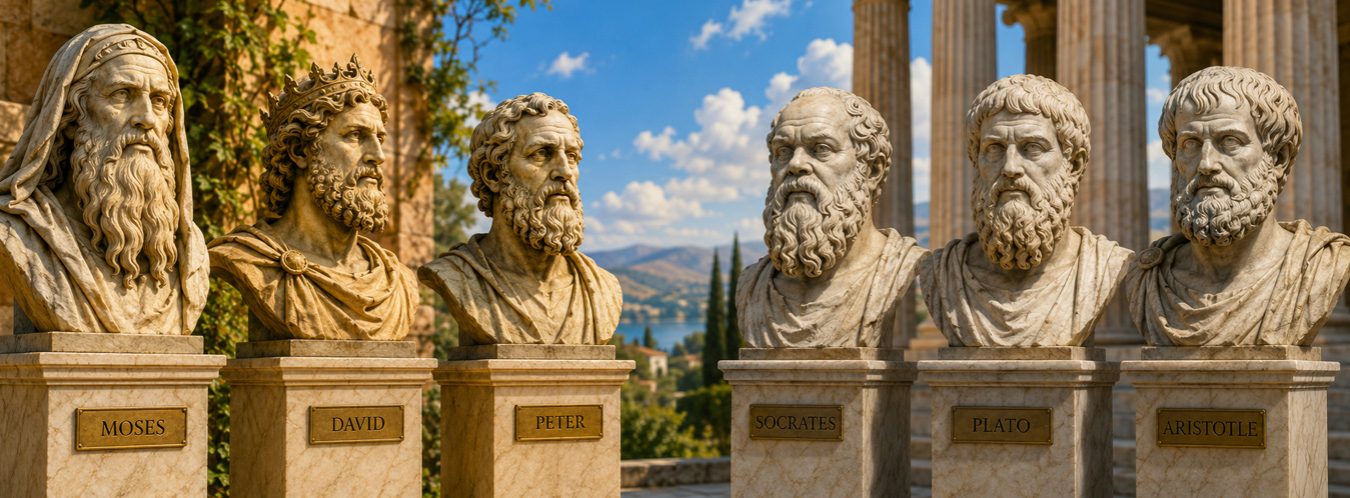
the Prophets and the Apostles. There stood Isaiah, Jeremiah, Ezekiel
and all the rest–one knew the usual portraits of them. And up in the
dome, at the very top of the church, was a large and striking image of
the Savior. Now, what struck me about the church was this–that the
images of those Prophets and Apostles who stood there had their fingers
all pointed upwards, so that, when I went in, I could not help looking
up to the top to see what they were pointing at! All round the church
there were the words, in Latin, "Moses and the Prophets spoke
concerning Him." And there stood Moses and the Prophets, carved in
stone, and all pointing to Him! Isaiah had a little scroll in his hand
on which was written, "The Lord has made to meet on Him the iniquity of
us all." Jeremiah had a scroll in his hand, on which was written,
"Behold, and see if there is any sorrow like unto My sorrow, which is
done unto Me." I think the church just represented the Truth in that
case. It is even so. All the Prophets stand as a complete circle of
distinct testifiers and, with uplifted fingers, they all concur with
John the Baptist when he said, "Behold the Lamb of God, which takes
away the sin of the world." They all point to Christ. If you read the
life of Christ and then read what they said of Him, you will be
persuaded that this is He which was to come!
II. But to pass on, we may look upon the spear-thrust in the side of
Christ as THE ESCUTCHEON OF SHAME.
While our Lord lived, He was the subject of every form of scorn. He was
scourged as none but a felon might be according to the Roman Law. He
was spat upon and mocked, as even a felon ought not to have been. That
crown of thorns, that reed scepter and that old scarlet cloak–who
could have invented a more shameful insignia for One who was greater
than all the kings on the earth but who was brought exceedingly low?
And our Lord's death, itself, was a great portion of His shame. It was
a shame for Him to die–and ignominy for Him to die the death of
hanging on the Cross. Heraldry has so emblazoned the symbol that we do
not ordinarily apprehend the real shame to which Christ was exposed.
Were I to preach to you tonight that a certain man who was hanged was
very God, people would begin to say, "Why do you preach of one who died
on the gallows as a felon?" Literally and truly, that is just how Jesus
Christ died, according to the customs of His times. Crucifixion was to
the Romans what hanging is to us, only it was worse. It was more
shameful, for crucifixion was reserved for the very worst of crimes.
Not all murderers were so punished, but only the worst and vilest
crimes with murder to aggravate them received this opprobrious doom.
People hang crosses round their necks and wear them as ornaments–I
wonder whether they would make ornaments of gallows? Yet it means that.
It is just the same thing and this is the shame of Christ. This is the
very shame in which Paul rejoiced and gloried, that Jesus Christ was
not ashamed to be ashamed! That He was willing to be made ashamed and a
curse for us! That He was content to be treated with all the scorn that
human malignity and inhuman cruelty could heap upon Him!
But, Beloved, when Christ was dead, they might certainly have ceased
from their scorn. But no, the brutal Roman soldiers were not very nice
as to what they did with living bodies. They would not, therefore, be
particular as to what they did with dead bodies! Therefore this
soldier, in a mere freak of wanton brutality, thrust his lance into the
Savior's heart. It was the last kick of the old enemy. It was, as it
were, the last of the spit from the foul mouth of human slander and
hatred. It was the last thrust that human malice could give to the Lord
of Life and Glory! I see in this the mark, the crowning emblem of the
shame which He endured.
Well, and what then? Why, it should teach us, dear Friends, what a
shameful thing sin must be! For, though Christ was no sinner, yet when
our sins were laid upon Him, look how God treated Him and permitted Him
to be treated as an outcast–to be covered with the utmost shame! Ah
Sin, what a shameful thing you must be! Blush, Christian, that you
should be guilty of it. Blush again, that you do not blush more often!
Be ashamed that you are not ashamed of sin, and be offended that your
heart should be so stolid over a thing so detestable.
Another thought springs up, namely, that if Christ was put to so much
shame for us, how glad we ought to be if we are sometimes allowed to be
put to shame for Him! Oh, there are some people who cannot bear
shame–they can endure anything else but ridicule and laughter! As John
Bunyan says, "of all villains, Shame is the most shameless for he will
go and make sport and fun of the Christian's virtues and mock at that
which he ought to admire." Well, child of God, supposing today you have
your face spat upon for Christ? 'Twere scarcely worthwhile to wipe it
off! Ah, if you had to live a dying life, to be thrown in a dungeon, or
to live upon the rack–as long as it was done for Him who bore all this
for you–the thought might sweeten the wormwood and turn the gall into
honey, that you were thus honored to have fellowship with Him in His
sufferings! I leave that view of this wound of Christ with you, praying
that it may nerve your hearts with a glorious courage as you see Jesus
thus shamefully wounded for you.
III. This lance wound was THE SEAL OF DEATH UPON OUR LORD JESUS CHRIST.
His enemies were so determined to put Him to death that they dragged
His life out of its principal organ and then they pierced it, namely,
the heart. It was not possible that Jesus Christ could have lived
another moment longer, even had He been alive at that time–but when
the heart was touched, death must come. Those who understand anatomy
tell us that the pericardium around the heart was pierced and they say
that from that there flowed the blood and the water. But I am extremely
doubtful whether the pericardium in any state whatever could have
yielded a sufficient quantity of lymph, for though there is water
there, there is only a small quantity. In the state in which our Savior
was, blood and water might have been found naturally in His heart, but
only in a very small and infinitesimal quantity. The fountain that
flowed from there was miraculous, not natural but supernatural–or if
natural, yet so exalted and so increased in quantity as to become in
itself supernatural.
Certainly, however, the piercing of His heart was the indication to all
mankind that "He was dead already." Now, little as that may seem in the
eyes of those of you who do not love Him, it is a most important thing
to those who trust Him, for remember, if Jesus Christ had not died, you
and I would have perished! It was of no use for our expiation that He
sweat great drops of blood unless He had perfected the Sacrifice. The
Law required if– if Christ had not laid down His life, the Law would
have required ours. In due time, our souls would have been cast into
the Second Death on account of sin if Jesus had not died, actually and
truly died. But we are quite sure about it now, for His heart was
pierced. Indeed, I may say that this is the one keystone of the whole
Gospel system, for if Jesus did not die then, we have no Resurrection.
If He died not then, He did not rise–and if we have no evidence of
Resurrection, the whole of our religion becomes a lie! But, Brothers
and Sisters, He did die. His soul left His body. That corpse that was
taken by Joseph of Arima-thaea was as lifeless as any that was ever
committed to the sepulcher! And He did rise again, in proof to us that
we who die and those we have parted with on the confines of this mortal
life who are, alas, all truly dead, shall certainly rise again and in
their flesh shall see God! This is a simple Truth of God for you to
hear, perhaps, but never did angel have such weighty news to tell as I
have told you tonight–that God was made flesh–the very God that made
Heaven and earth took upon Himself our nature and as such He died,
literally died for us! The God-Man, the Mediator, Jesus of Na-
zareth, the Son of God and the Son of Mary, died, was crucified and had
His heart pierced for us! And if we depend upon this, we may rest
secure. If He died, then we need not die! If He died for us, then we
cannot die the Second Death. If Jesus was punished in our place, the
sting of death is taken away, the Law is satisfied and every soul that
believes in Him shall have eternal life!
IV. But I cannot tarry longer upon that and, therefore, I come to the
fourth point. This heart wound of Christ is also to be called THE
SOURCE OF PURITY. The text tells us that there issued from it a double
flood of blood and water. We are not at a loss to explain this because
the Apostle John, in his Epistle, has told us that our Lord "came by
water and blood; not by water only, but by water and blood," and he
explains it by the connection that Christ came into the world by blood
to take away the guilt of sin, and by water to take away the power of
sin–by blood to remove the punishment,
by water to remove the filth. [See Sermon #3252, Volume 57–"BY WATER
AND BLOOD."]
Now, dear Friends, let us say that there is no blood and no water that
can wash away sin anywhere but in Christ. All the blood of bulls could
not take away sin, though offered by Aaron, himself, the father of the
Levitical priesthood! And all the water in the world, though
consecrated by bishops, cardinals and popes, cannot take away a single
spot of iniquity! The only blood that can cleanse us from God's wrath
is the blood of Jesus Christ, Himself, and the only water that can wash
out of us the damning stain of sin is the water which came from Jesus
Christ's heart! If you want to be thus doubly washed, go to the Son of
God for the washing! Go nowhere else, I pray you, for every other trust
is but a delusion and a lie. Jesus Christ can put away the guilt of
every sin. Though you have been a drunk, an adulterer, a whoremonger, a
thief, a murderer, yet the blood of Jesus Christ can wash you from the
accumulated filth of years–and the water from Christ's side can take
away your propensities to sin, change your nature and make you holy
instead of filthy–can make you pure in heart instead of polluted in
spirit! Nothing else can do it. No lie was ever more extraordinary than
the lie that baptismal water can regenerate the soul! I marvel more and
more that I should find myself living in an age of such idiots and have
almost come to think that Carlyle was right when he spoke of our nation
as "Consisting of twenty million people, mostly fools." So it seems to
be, or else such a dogma as this would have been kicked out of the
universe years since–and banished once and forever to the limbo of
lunacy as an outrage on common sense! Is God the Holy Spirit confined
to water, as that the priest's dropping it on the child's brow can work
regeneration in the child's soul? Believe it not, it is a foul lie! But
hold you to this–that which alone can work regeneration is the water
from the side of Christ–and when faith can get that, and trust that,
the matter is done! Faith relies upon the sacred double flood! Then the
heart is renewed, the man is changed, the soul is saved by Jesus
Christ!
Remember, too, that the water and the blood flowed from the same place
and flowed together And, therefore, if a man would be saved, He must
have the two. Tens of thousands would like to escape from Hell, but
they have no wish to escape from sin. Are there not multitudes who are
very anxious to get rid of the punishment, but are not at all concerned
to be delivered from the habit of iniquity? Oh, yes, the drunk would
gladly be forgiven, but he would like to keep to his tippling. Yes, the
lecherous man would gladly have his constitution restored and his
iniquity blotted out, but he must go to his dens of infamy again! Such
is not the religion of Christ The religion of Christ demands of us that
if we take Christ, we should take Him for the double purpose–pardon
for past sins and to deliver from sins to come. I think it was Celsus,
the ancient philosopher, who jeered at the great Christian advocates,
saying, "Your Master, Christ, receives all the filth of the universe
into His Church! He tells you to go about to find out thieves, drunks,
harlots and such like, and to tell them to come to Him! Your religion
is nothing better than a hospital into which you thrust lepers." "Yes,"
said he who argued with him, "you have spoken well. We do receive them
as into a hospital, but we heal them, Sir, we heal them! And while into
the one door the spiritually and morally blind, cripples, and maimed
come in as they are, the Great Physician touches them with His Grace
and cleanses them with the water and the blood–and they are not what
they were any longer."
Now, am I addressing one man who feels that he is saved by faith, and
yet he is sinning as he used to do? Give up that belief, Sir, or it
will ruin you! I pray you do not indulge in it, for it is a delusion of
Satan! Do I address one man who has a hope that perhaps he can so trust
Christ as to be saved, and yet continue to live in his own wicked way?
If anyone has told you that, he has told you a lie! Rest assured that
you are mistaken! Christ never came to be the minister of sin. He came
to save us, not in our sins, but from our sins. He will forgive us all
manner of iniquities, but not if we love the iniq-
uity and continue in it! If you hug sin to your bosom, the viper will
sting you–and no power, either human or Divine– can extract the
poison unless the viper, itself, is taken away. You must have both the
water and the blood–and I pray that you may have both.
Now, Christians, I have done when I have put to you one question.
Answer it and answer it truthfully. It is this– Beloved Friends, have
you got such a hold of Christ as you should have in His double capacity
as your Pardoner and your Sanctifier? I know you plead the blood for
your remission. I know that is all your hope. I know that the blood of
Christ is your comfort and your hope, but have you got the water quite
as fully? You have a bad temper, perhaps. Well, it is a pitiable
circumstance, but surely, if Christ can forgive a bad temper, He can
remove a bad temper, too! Did you ever bring your bad temper to Christ
to have it washed away with the water? You should have done so, for He
can do it. Perhaps you have got an envious spirit–a murmuring spirit?
Naturally so, you are generally depressed and downhearted. Did you ever
believe in the power of Christ to kill envy and to lift you up above
murmuring? You should do so. You believe that Christ can forgive this
sin. Well, that is through the power of the blood–but do you think
that the water is less potent than the blood–that Christ can forgive
what He cannot subdue? Oh, think not so! Think as well of the Spirit
and His sanctifying power as of Christ and His justifying
righteousness!
"Well," says one, "I have a besetting sin which I do not think I shall
ever quite overcome," My dear Brother, why not? It strikes me that the
Christian ought to get his greatest victories from his weakest
points–and if you have a besetting sin, I think you ought to be
distinguished by its opposite virtue! I do not know that it was so, but
I always have a notion that Moses was, by his natural constitution, a
thoroughly quick-tempered man. I think so from the fact that when he
saw the Egyptian smiting the Israelite, he did not stop a minute, but
he slew him at once and hid him in the sand. That looks to me to be the
breaking out of the real Moses. But what did he become by the Grace of
God? Why, after his spirit was subdued, he became the meekest of men
and often was quiet where you and I would have spoken! Now, why should
it not be so with us? It strikes me that the worst-tempered man who
becomes a Christian ought to make this a strong point and to strive to
become the best-tempered. There are some Christians who naturally have
a little weakness in their hand and cannot open it well. If they get a
little money in it, they are very apt to get their joints tied together
very tightly! But, when Divine Grace comes in, I think they should try
to defeat the devil by being more than ordinarily generous–so that,
whereas other Christians might be content to give less, they say to
Satan–"O my enemy, you have held me in bondage in this way, but in
wherever else you may get the upper hand of me, you never shall in
this, for I will take care that whenever you tell me not to give a
shilling, I will give two in order to let you see that you are no
master of mine and that I have got rid of the foul sin of stinginess!"
Do let us, each one, act upon this great Truth of God, that as Christ
has the power to forgive us our sin, so He also has the power to
cleanse it away!
And, my dear Brothers and Sisters, let us get closer to Christ! Let us
be bedewed more often than we have been before with the water and with
the blood! Let us live in the spirit of this double purification and be
it ours to find this blessed stream lead us right up to the heart of
Christ, from which it flowed, that we may understand the everlasting
love which dwells there deep in its eternal fountains–and may rejoice
and be glad in it all our days!
EXPOSITION BY C. H. SPURGEON: JOHN19:23-37.
Verse 23. Then the soldiers, when they had crucified Jesus, took His
garments. They had already stripped Him, no element of shame was
lacking in His substitution for us. He stooped as low as our sins could
have thrust us that He might bring us up from the very depths of
degradation and shame!
23, 24. Andmade four parts, to every soldier a part, andalso His coat:
now the coat was without seam, woven from the top throughout They said
therefore among themselves, Let us not ear it, but cast lots for it,
whose it shall be: that the Scripture might be fulfilled, which says,
They parted My raiment among them, and for My vesture they did cast
lots. These things therefore the soldiers did. Quite unaware of the
ancient prophecy, yet in complete accord with Divine Predestination,
these soldiers did exactly according to the eternal purposes of God! It
is very amazing how, in practice, the free agency of man tallies
exactly with the Predestination of God. We need not enquire how it is,
but we may admire that it is so. "These things therefore the soldiers
did," yet the motive which swayed them was not the fulfillment of the
Divine
Will, but simply the common sense thought that it would be a pity to
spoil such a garment by tearing it and partly, also, by that innate
love of gambling which is found everywhere, in every age, so that often
men would sooner run the hazard of winning all than take the safe one
fourth which might fall to their lot! Let us reverently adore the whole
scheme of Providence by which God's determinate purpose is carried out
in every jot and tittle, while the free agency of man is left
unfettered.
25. Now there stood by the Cross of Jesus, His mother, and His mother's
sister, Mary the wife of Cleophas, and Mary Magdalene. These gracious
women stood by the Cross. We call them the feebler sex, but we must
grant that they are the stronger of the two in anything which has to do
with pure disinterested love. Yield the first place to them.
26. When Jesus therefore saw His mother.Here was another pang for
Him–He could not be spared anywhere. He must recollect in His death
everything that would cause Him grief–"When Jesus therefore saw His
mother"–
26, 27. And the disciple standing by, whom He loved, He said unto His
mother. Woman, behold your son! Then said He to the disciple, Behold
your mother! And from that hour that disciple took her unto his own
home. There was no specific direction given to John to entertain Mary.
It was quite enough for the Lord to call his attention to her by saying
"Behold your mother." How I wish we were always in such a state of
heart that we did not need specific precepts, but a hint would suffice.
Dear Friends, do not need pressing or driving to holy duty! Be not as
bulls that must be goaded, but rather have within you such a spring of
love that it shall be a delight to do anything that may give joy to the
heart of the Well-Beloved! When you see Him on the Cross, is there
anything you can deny Him? Will you not think spontaneously of what you
can do to please Him?
28. After this, Jesus knowing that all things were now accomplished,
that the Scripture might be fulfilled, said, I thirst.There was yet a
little more to be done–all the great things were accomplished, but He
would keep even the least particles of prophecy, so He cried, "I
thirst."
29. 30. Now there was set a vessel full of vinegar: and they filled a
sponge with vinegar, andput it upon hyssop, and put it to His mouth.
When Jesus therefore had received the vinegar–He did receive that. He
had refused the drugged draught which they had first offered to Him to
lull His pain, but He accepted this, which was simply weak wine, no
doubt a little sour, possibly bitter. When He "had received the
vinegar"–
30. He said, It is finished: andHe bowedHis head, and gave up the ghost
[See Sermon #421, Volume 7–it is finished and #2344,
Volume 40–CHRIST'S DYING WORD FOR HIS CHURCH.] Incarnate Love has
fulfilled its self-imposed task! Jesus, as the Substitute for sinners,
was condemned to die and He died that He might finish the work of our
Redemption–
"'It is Finished.'
Hear the dying Savior cry."
31. The Jews therefore, because it was the preparation, that the bodies
should not remain upon the cross on the Sabbath day, (for that Sabbath
day was an high day,) besought Pilate that their legs might be broken,
and that they might be taken away.To prevent a ceremonial error, they
are willing to commit brutal cruelty! Indeed, they had already
committed the more brutal cruelty of putting Christ to death. How
particular some men are about some merely human rubric–yet the Divine
precepts of the Law they violate with impunity! God save us from a
conscience which will stick at some minute point which is of no
consequence, but will allow us to commit great sin! We have heard of a
Spanish bandit who confessed to his priest, after having murdered a
great many persons, not his robberies and his murders, but the fact
that a drop of blood had spurted on his lips on a Friday, and thus he
had defiled the feast day by taking animal food! Ah me, conscience is a
strange thing, yet some call it "the vicegerent of God." I believe it
is no such thing, but that it very soon becomes as depraved as any
other power of the human mind! We have need of far more than conscience
to keep us right.
32. Then came the soldiers, and broke the legs of the first, and of the
other which was crucified with Him.With a huge iron bar smashing the
great bones of their legs.
33. 34. But when they came to Jesus, andsaw that He was deadalready,
they broke not His legs: but one of the soldiers with a spear pierced
His side and forthwith there came out blood and water. See how, even
after death, His heart its tribute poured out for us. We have not only
the love of Christ's heart blessing us while He lives, but after He
died there was the stream of blood and water to cleanse us from sin's
guilt and power!
35-37. And hie that saw it bares record, and his record is true: and he
knows that he is telling the truth, that you might believe. For these
things were done that the Scripture should be fulfilled, a bone of Him
shall not be broken. And again another Scripture says, They shall look
on Him whom they pierced. [See Sermon #1956, Volume 33–on the cross
after
DEATH.]