

Christianity
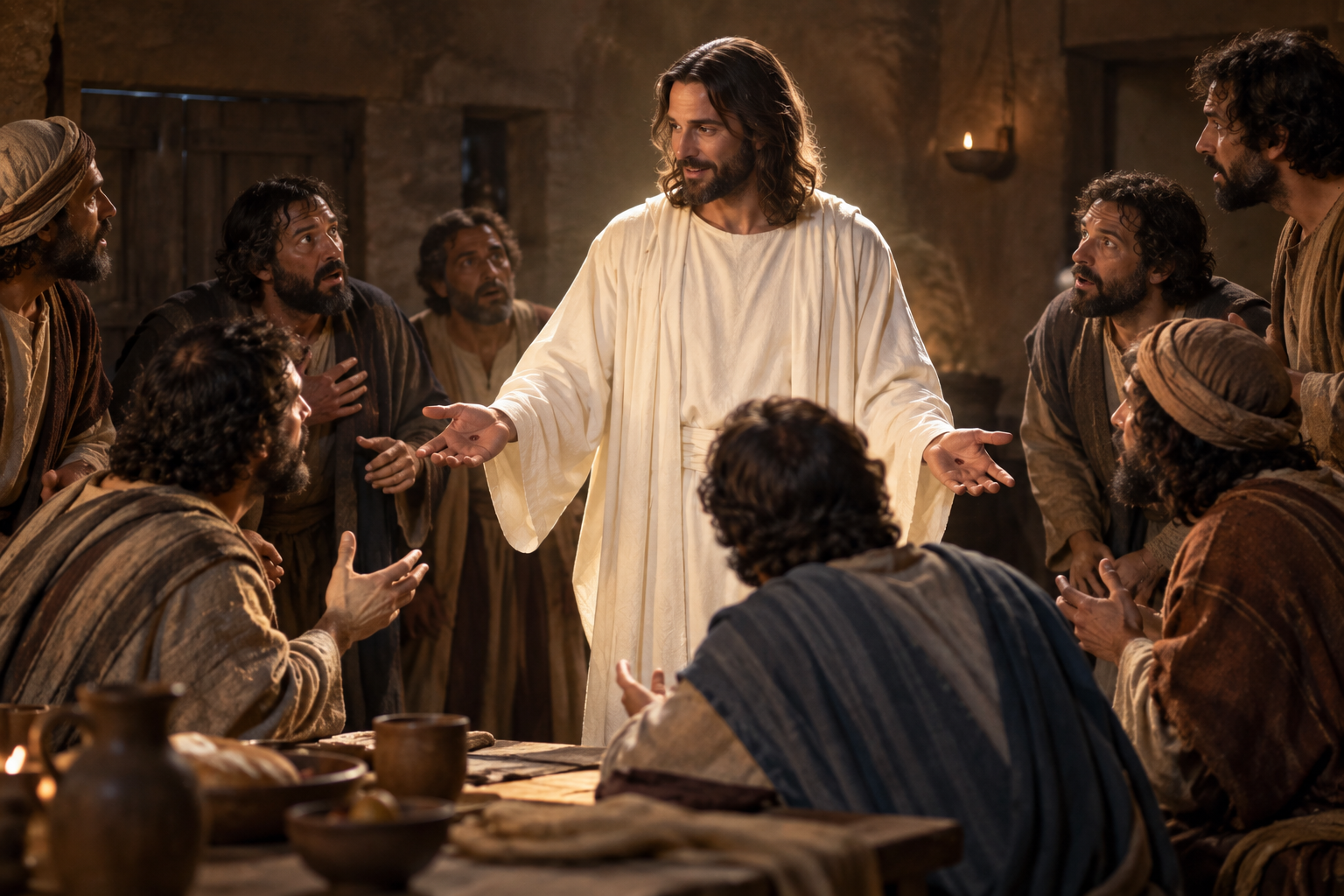
Christianity is centered on Jesus Christ—who He is, what He taught, what happened in His death and resurrection, and what those events mean for humanity.
Christians believe that Jesus of Nazareth is the promised Messiah and the Son of God, that He became truly human while remaining truly divine, that He was crucified and died, and that He rose bodily from the dead. Through Him, Christians believe that God offers forgiveness, reconciliation, and eternal life.
Christianity did not appear in a vacuum. Jesus and His first disciples were Jews, and the Christian faith grew out of the history, promises, and expectations recorded in the Hebrew Scriptures. The earliest Christians believed that Jesus was the fulfillment of those promises and that His resurrection demonstrated that He was the Messiah they had been waiting for.
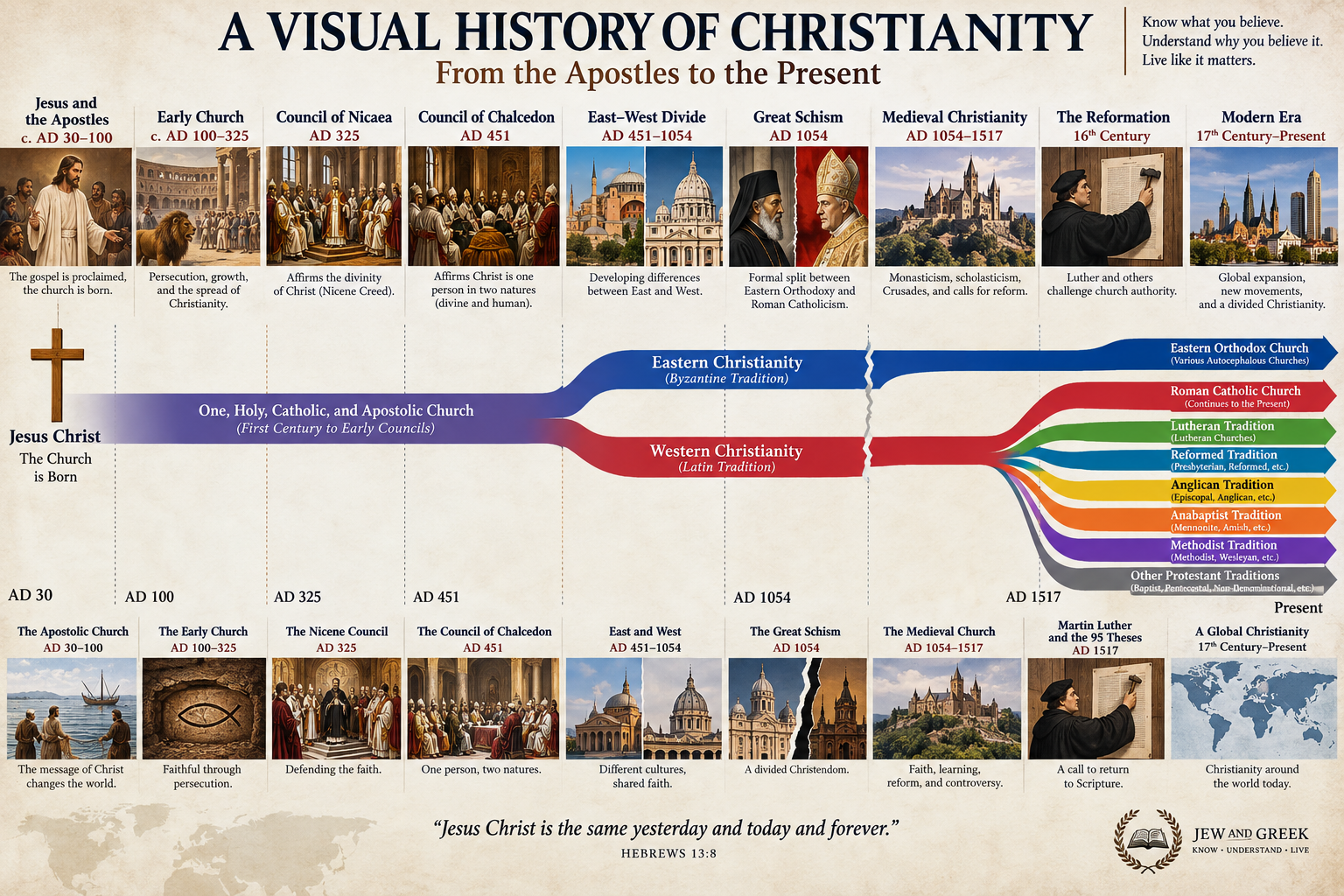
From Jerusalem, the message spread throughout the Roman world and eventually far beyond it. Along the way, Christianity developed into a number of traditions that today can look remarkably different from one another. Walk into a Roman Catholic Mass, a Greek Orthodox Divine Liturgy, a Baptist worship service, and a Pentecostal revival meeting, and you might reasonably wonder whether you’ve entered four different religions.
You haven’t—but you have walked into nearly two thousand years of Christian history.
What Christians Believe
Christians disagree about a great deal, but historic Christianity has generally been defined by a recognizable core of beliefs.
Christians believe in one God, understood as Father, Son, and Holy Spirit. They believe that God created the world and that human beings were created in His image but became alienated from Him through sin. They believe that Jesus Christ is both divine and human, that He died for our sins, rose from the dead, and offers salvation to those who believe in Him.
Christians also believe in the Holy Spirit, the church, the resurrection of the dead, and eternal life.
Exactly how all of that works is where things begin to get interesting.
Christians have disagreed over the nature of salvation, baptism, Communion, church government, the authority of bishops and popes, predestination and free will, spiritual gifts, the role of tradition, the relationship between faith and works, and quite a few other things. Some of those disagreements produced denominations. Others produced divisions that have lasted for more than a thousand years.
To understand why Christianity looks the way it does today, it helps to see how it got here.
Christianity Through the Centuries
Jesus and the Apostolic Church — c. AD 30–100
Christianity began as a Jewish movement centered on Jesus of Nazareth. Jesus preached the kingdom of God, gathered disciples, was crucified under the Roman governor Pontius Pilate, and—according to His followers—rose from the dead.
The resurrection became the central proclamation of the earliest Christians. At Pentecost, the disciples began publicly proclaiming Jesus as the Messiah, and the movement spread from Jerusalem into Judea and Samaria and then throughout the Roman world.
The first Christians were Jewish, but Gentiles soon began entering the church in substantial numbers. That created one of Christianity’s earliest controversies: Did Gentiles have to become Jews in order to become Christians?
The answer reached by the apostles was essentially no. Gentile believers did not have to convert to Judaism and observe the entire Mosaic Law in order to follow Christ. That decision helped transform what had begun as a Jewish messianic movement into a faith capable of crossing ethnic and cultural boundaries.
During this period, apostles and other Christian leaders established congregations throughout the Roman Empire. The writings that would eventually comprise the New Testament were also produced during the first century.
Why It Mattered: By the end of the apostolic period, Christianity had moved well beyond Jerusalem. The basic message about Jesus had crossed into the Gentile world, churches had been established across a large geographical area, and the documents that would become Christianity’s New Testament were in circulation.
Key Figures: Jesus • Peter • Paul • James • John • the Apostles
The Early Church — c. AD 100–325
By the beginning of the second century, the generation that had personally known the apostles was disappearing. Christianity now faced a new problem: How do you preserve apostolic teaching when the apostles are no longer around to settle the argument?
And there were plenty of arguments.
Christians debated the identity of Jesus, the nature of God, which writings carried apostolic authority, how churches should be governed, and how Christianity related to both Judaism and the surrounding Greco-Roman culture.
At the same time, Christianity continued spreading despite periods of Roman persecution. Writers such as Ignatius of Antioch, Justin Martyr, Irenaeus, Tertullian, Origen, and others defended Christianity, argued against teachings they considered heretical, and helped shape the theological vocabulary Christians would use for centuries.
Church organization also became more defined. Bishops, presbyters, and deacons increasingly occupied recognizable roles, although historians and Christian traditions disagree over exactly how early church government developed and what those offices imply for later forms of church organization.
The boundaries of the New Testament canon also became increasingly clear during these centuries. Christians had been reading apostolic writings long before anyone assembled a leather-bound New Testament with a table of contents, but determining which writings belonged among the authoritative books of the church took time.
Why It Mattered: During these centuries Christianity survived the loss of the apostles, spread across the Roman world, defended itself against competing interpretations of the faith, and increasingly clarified its Scriptures, theology, and church structures.
Key Figures: Ignatius • Justin Martyr • Irenaeus • Tertullian • Origen • Cyprian
Councils and Creeds — AD 325–451
The year 325 marks an important turning point in Christian history. Christianity had survived periods of Roman persecution, but the political situation changed dramatically under Emperor Constantine. In 313, Constantine and Licinius issued the Edict of Milan, establishing religious toleration within the empire. A little more than a decade later, Constantine called bishops from throughout the empire to meet at Nicaea.
The immediate controversy concerned the relationship between Jesus Christ and God the Father.
A presbyter named Arius taught that the Son, although exalted above creation, was not eternal in the same sense as the Father. His opponents insisted that if Christ were truly divine, He could not be a created being. The disagreement became serious enough to threaten the unity of the church.
The Council of Nicaea in 325 rejected Arius’s teaching and affirmed that the Son is homoousios—“of the same substance” or “of the same essence”—with the Father.
That settled the matter.
Well, not exactly.
The controversy continued for decades. Bishops were removed and restored, emperors supported different theological factions, terminology continued to be debated, and the church spent much of the fourth century working through what the Nicene confession actually required.
The Council of Constantinople in 381 reaffirmed the Nicene position and further clarified Christian teaching concerning the Holy Spirit. The creed associated with these councils became what is commonly known today as the Nicene Creed, one of the most widely accepted statements of Christian belief in church history.
But another question remained: if Jesus is truly God and truly human, how are His divinity and humanity related?
That controversy contributed to the councils of Ephesus in 431 and Chalcedon in 451. Chalcedon affirmed that Jesus Christ is one person in two natures, truly divine and truly human, “without confusion, without change, without division, without separation.”
The language was technical because the questions were difficult. Christians were trying to say two things at once without sacrificing either one: Jesus really is God, and Jesus really became human.
Why It Mattered
The fourth and fifth centuries gave Christianity much of the theological vocabulary still used to describe the Trinity and the person of Christ. Nicaea, Constantinople, Ephesus, and Chalcedon did not invent those questions, but their answers became standards of orthodoxy for most subsequent Christian traditions.
The councils also contributed to divisions. Not every Christian community accepted every council or understood its terminology in the same way. Those disagreements help explain the emergence of several ancient Christian traditions that remain distinct today.
Key Figures: Constantine • Arius • Athanasius • the Cappadocian Fathers • Cyril of Alexandria • Nestorius • Leo the Great
Medieval Christianity — AD 1054–1517
Following the division between Eastern and Western Christianity, the two traditions continued developing along increasingly separate paths. In the East, the Orthodox churches remained closely connected with the Byzantine Empire until the fall of Constantinople in 1453. In Western Europe, the Roman Catholic Church became one of the most powerful religious and political institutions of the medieval world.
The period saw the growth of monasteries and religious orders, the Crusades, the rise of universities, and the development of scholastic theology, which attempted to examine Christian doctrine through careful philosophical reasoning. Thinkers such as Anselm of Canterbury and Thomas Aquinas became enormously influential in Western Christian theology.
But the medieval church also experienced repeated calls for reform. Questions about the wealth and political power of the church, the authority of the pope, corruption among clergy, and certain church practices produced criticism both inside and outside the established hierarchy.
Figures such as John Wycliffe in England and Jan Hus in Bohemia challenged aspects of church authority and teaching well before Martin Luther appeared. Hus was condemned and executed in 1415, but the movement associated with him survived.
By the beginning of the sixteenth century, demands for reform were hardly new.
What happened next, however, would divide Western Christianity permanently.
Why It Mattered
The medieval period shaped the institutions and theology of both Roman Catholicism and Eastern Orthodoxy, while developments in Western Europe created many of the conditions that would eventually contribute to the Protestant Reformation.
Key Figures: Anselm • Thomas Aquinas • John Wycliffe • Jan Hus
Key Developments: Monasticism • Scholasticism • Crusades • Papal Authority • Medieval Reform Movements • Fall of Constantinople
The Protestant Reformation — 16th Century
By the beginning of the sixteenth century, calls for reform had been circulating within Western Christianity for generations. But in 1517, a German monk and professor named Martin Luther challenged the sale of indulgences by publishing his Ninety-Five Theses. What began as a dispute over one church practice soon developed into a much larger controversy over salvation, biblical authority, the sacraments, and the authority of the pope.
Luther increasingly argued that sinners are justified before God through faith rather than through human merit and that Scripture, rather than the pope or church councils, is the final authority for Christian doctrine. His refusal to retract his teachings eventually resulted in his excommunication from the Roman Catholic Church.
Luther, however, was only one part of the Reformation.
In Switzerland, Huldrych Zwingli led a reform movement in Zurich that agreed with Luther on many issues but differed with him sharply over the Lord’s Supper. John Calvin, a generation younger, became the most influential theologian of the Reformed tradition, particularly through his work in Geneva and his Institutes of the Christian Religion.
The Reformation in England followed a different course. Henry VIII’s break with Rome initially had as much to do with royal authority and his marriage as Protestant theology. Nevertheless, the Church of England gradually developed a distinctly Protestant identity while retaining many features of historic Catholic worship and church organization.
Still another movement, usually called the Radical Reformation, argued that the major Protestant reformers had not gone far enough. The Anabaptists rejected infant baptism in favor of the baptism of professing believers and generally advocated a more radical separation between church and state. From these movements would eventually come traditions including the Mennonites and, later, the Amish.
The Roman Catholic Church responded to the Protestant challenge with reforms of its own. The Council of Trent (1545–1563) clarified Catholic teaching on Scripture and tradition, justification, the sacraments, and other disputed doctrines while also addressing abuses within the church. New and renewed religious orders, particularly the Jesuits, became important forces in Catholic education, missions, and reform.
By the end of the sixteenth century, the religious landscape of Western Europe had been permanently altered. Western Christianity was no longer united under Rome. It now contained several major Protestant traditions alongside a reformed and revitalized Roman Catholic Church.
Why It Mattered
The Reformation changed much more than the denominational map. It brought fundamental questions about authority and salvation to the center of Christian debate.
Who has the final authority to define Christian doctrine? Scripture alone? Scripture interpreted within the historic tradition of the church? What role does the church itself play? How is a sinner justified before God? What happens in baptism and Communion?
Christians are still arguing about those questions five hundred years later, which is usually a good indication that the Reformation isn’t quite over.
It also produced the major streams from which much of later Protestant Christianity would develop. Lutheran, Reformed, Anglican, and Anabaptist Christianity now become important branches on our timeline.
Key Figures: Martin Luther • Huldrych Zwingli • John Calvin • Thomas Cranmer • Menno Simons • Ignatius of Loyola
Key Developments: Ninety-Five Theses • Lutheran Reformation • Swiss/Reformed Reformation • English Reformation • Radical Reformation • Anabaptism • Council of Trent • Catholic Reform
Expansion, Revival, and New Movements — 17th–19th Centuries
The Protestant Reformation did not produce a single Protestant church. Once Christians began challenging the authority of Rome, they also began disagreeing with one another about what should take its place. During the next three centuries, new movements appeared, older traditions divided, and Christianity expanded far beyond its European base.
In the early seventeenth century, Baptist churches emerged from the English Separatist environment. Baptists rejected infant baptism and taught that baptism should follow a personal profession of faith. They also became important advocates of religious liberty and the separation of church and civil authority.
A few decades later, George Fox and others gave rise to the movement known as the Society of Friends, or Quakers. Quakers emphasized direct experience of God, the inward work of the Spirit, simplicity of worship, and—eventually quite prominently—pacifism and religious liberty.
Meanwhile, another movement was developing within European Lutheranism. Pietism emphasized personal conversion, practical Christian living, Bible study, and an active faith rather than merely formal adherence to Christian doctrine. Through groups such as the Moravians, these ideas would influence evangelical Christianity far beyond their original setting.
One person profoundly affected by the Moravians was an Anglican minister named John Wesley.
Wesley and his brother Charles became leaders of an eighteenth-century revival movement that emphasized conversion, disciplined Christian living, personal holiness, and the possibility of a deeply experienced relationship with God. Their followers became known as Methodists—a name that originally referred somewhat mockingly to their methodical approach to Christian devotion.
At roughly the same time, evangelical revivals swept through Britain and the American colonies. Preachers such as George Whitefield and Jonathan Edwards became associated with what is now called the First Great Awakening. Further waves of revival followed during the late eighteenth and nineteenth centuries.
The nineteenth century also became an extraordinary period of missionary expansion. Protestant missionary societies sent missionaries throughout Africa, Asia, the Pacific, and other parts of the world. Roman Catholic missionary activity continued as well. Christianity was increasingly becoming a global religion rather than primarily a European one.
The United States became particularly fertile ground for new Christian movements. During the Second Great Awakening, revivalism flourished, and a number of groups attempted to recover what they believed to be the simplicity of New Testament Christianity.
Among them were Barton W. Stone, Thomas Campbell, and Alexander Campbell. Their movements eventually joined forces and became known collectively as the Restoration Movement or Stone-Campbell Movement. From it would eventually develop the Churches of Christ, Christian Churches/Churches of Christ, and the Christian Church (Disciples of Christ).
Methodism also produced new branches. During the nineteenth century, the Holiness movement placed particular emphasis on sanctification and the possibility of a deeper work of grace in the Christian life. From this environment would eventually emerge denominations such as the Church of the Nazarene and other Holiness churches.
And near the end of the century, some Holiness Christians began asking whether the supernatural experiences described in the book of Acts—including divine healing and the gifts of the Holy Spirit—should be expected in the modern church.
That question would help set the stage for one of the most significant developments in twentieth-century Christianity.
Why It Mattered
Between the Reformation and the beginning of the twentieth century, Protestant Christianity became enormously diverse. Baptists, Quakers, Methodists, Restorationists, Holiness churches, and numerous other movements joined the Lutheran, Reformed, Anglican, and Anabaptist traditions that had emerged during the Reformation.
At the same time, revivalism and missionary expansion carried Christianity into new cultures and created movements that no longer fit comfortably within the older European denominational categories.
By 1900, many of the ingredients were already present for the emergence of Pentecostal Christianity.
Key Figures: John Smyth • George Fox • Philipp Jakob Spener • John Wesley • Charles Wesley • George Whitefield • Jonathan Edwards • Barton W. Stone • Thomas Campbell • Alexander Campbell
Key Developments: Baptists • Quakers • Pietism • Moravians • Methodism • Great Awakenings • Modern Missions • Restoration Movement • Holiness Movement
Pentecostalism and Modern Christianity — 20th Century
At the beginning of the twentieth century, Christianity entered another period of rapid change. New movements appeared, older denominations spread around the world, and theological developments that had begun in the nineteenth century took forms that would eventually affect hundreds of millions of Christians.
One of the most important was Pentecostalism.
Pentecostalism grew partly from the nineteenth-century Holiness movement, with its emphasis on sanctification and a deeper experience of the Christian life. Some believers began paying particular attention to the accounts of the Holy Spirit in the book of Acts and asking whether experiences such as speaking in tongues, prophecy, divine healing, and other spiritual gifts should still occur in the church.
In 1901, students at Charles Parham’s Bible school in Topeka, Kansas, reported experiences of speaking in tongues that they associated with the baptism in the Holy Spirit. A few years later, the Azusa Street Revival, led by William J. Seymour in Los Angeles beginning in 1906, became an important center of the emerging Pentecostal movement.
Azusa was particularly significant because people from different racial and social backgrounds participated in the revival at a time when American society was deeply segregated. Visitors carried Pentecostal beliefs and practices to churches and missions throughout the United States and overseas.
Pentecostalism soon developed into numerous denominations, including the Assemblies of God, Church of God (Cleveland, Tennessee), Church of God in Christ, and International Church of the Foursquare Gospel, along with many independent Pentecostal churches.
But Pentecostal experience did not remain confined to Pentecostal denominations.
Beginning especially in the 1950s and 1960s, similar beliefs about spiritual gifts began appearing among Christians who remained within Roman Catholic, Anglican, Lutheran, Presbyterian, and other historic churches. This became known as the Charismatic movement.
By the late twentieth century, another large category of independent and nondenominational churches had developed. Some were Pentecostal or charismatic; others were evangelical without identifying strongly with either movement. As a result, the older denominational family tree became increasingly difficult to use as a complete description of Christianity.
Pentecostalism was not the only major development of the period. Evangelicalism became an influential transdenominational movement, particularly within Protestant Christianity, emphasizing personal conversion, the authority of Scripture, evangelism, and the central importance of Christ’s saving work.
The twentieth century also saw the rise of the modern ecumenical movement, which sought greater cooperation—and in some cases greater institutional unity—among historically divided Christian traditions. The Second Vatican Council (1962–1965) introduced significant changes within Roman Catholicism and reshaped Catholic relationships with other Christians and with the modern world.
Meanwhile, Christianity’s demographic center was shifting. Churches grew rapidly in parts of Africa, Latin America, and Asia, while Christianity’s cultural dominance declined in much of Western Europe. A religion that many Westerners still thought of primarily in European and North American terms was becoming increasingly centered elsewhere.
Why It Mattered
The twentieth century changed the shape of Christianity in ways that the traditional Catholic-Orthodox-Protestant division does not fully capture.
Pentecostal and charismatic Christianity crossed denominational boundaries. Evangelicalism connected Christians belonging to many different Protestant traditions. Independent and nondenominational churches multiplied. At the same time, Christianity expanded dramatically outside its traditional European centers.
The family tree still matters. It just stopped being quite as tidy.
Key Figures: Charles Parham • William J. Seymour • Aimee Semple McPherson • Billy Graham
Key Developments: Pentecostalism • Azusa Street Revival • Evangelicalism • Ecumenical Movement • Second Vatican Council • Charismatic Movement • Independent and Nondenominational Churches • Growth of Global Christianity
Global Christianity — 21st Century
Christianity entered the twenty-first century as the world’s largest religion, but its geographic and institutional landscape looks very different from the Christianity of previous centuries.
Roman Catholicism remains the largest single Christian tradition, while Eastern Orthodox, Oriental Orthodox, Protestant, Pentecostal, charismatic, evangelical, and independent churches represent an enormous variety of Christian communities. In many places, Christians increasingly identify with networks and local churches that do not fit neatly into the older denominational family tree.
Perhaps the most important change is geographic.
For centuries, the story of Christianity was often told primarily as a European story. That is increasingly difficult to justify. By 2020, sub-Saharan Africa had surpassed Europe as the region containing the largest number of Christians. About 31 percent of the world’s Christians lived in sub-Saharan Africa, compared with 22 percent in Europe.
Christianity is also substantial throughout Latin America and continues growing numerically in parts of Africa and other regions. Pentecostal and charismatic forms of Christianity have become especially visible across the Global South, further weakening the usefulness of older European denominational categories as the only way of describing the Christian world.
At the same time, Christianity has been declining as a share of the population in many traditionally Christian Western countries. Between 2010 and 2020, the Christian population declined both numerically and proportionally in Europe and North America, largely as increasing numbers of people identified with no religion. Globally, the number of Christians still increased—from about 2.1 billion to 2.3 billion—but Christianity’s share of the world’s population declined from about 31 percent to 29 percent.
Another development is the continued growth of independent and nondenominational Christianity. A congregation may be evangelical, charismatic, Reformed, Wesleyan, or some combination of influences without belonging formally to the denomination from which those ideas historically developed.
That makes the modern Christian landscape somewhat harder to put on a family tree.
The old branches haven’t disappeared. Roman Catholicism, Eastern Orthodoxy, the ancient Eastern churches, Lutheranism, Anglicanism, the Reformed tradition, Anabaptism, Methodism, Baptists, Restoration churches, Holiness churches, Pentecostals, and many others remain identifiable traditions.
But increasingly, the lines between some of those branches are crossed by movements and influences that don’t respect denominational boundaries.
Christianity Today
Nearly two thousand years after a small group of disciples began proclaiming the resurrection of Jesus in Jerusalem, Christianity has become a global faith encompassing an extraordinary variety of cultures, traditions, worship practices, and theological perspectives.
Those differences are real, and sometimes substantial. Understanding Christianity therefore requires more than asking what Christians believe today. It also requires understanding how they got here.
The pages that follow explore those traditions, movements, people, councils, controversies, and ideas in greater detail.
Explore Christianity
Explore the traditions, people, movements, ideas, and writings that have shaped Christianity through nearly two thousand years of history.
Christian Traditions
Catholic • Orthodox
Protestant • Pentecostal
Church History
Apostles • Early Church
Reformation • Modern Church
People
Fathers • Reformers
Revivalists • Theologians
Councils & Creeds
Nicaea • Constantinople
Ephesus • Chalcedon
Movements
Pietism • Methodism •
Restoration • Holiness • Pentecostalism
Christian Theology
God • Christ • Salvation
Holy Spirit • Church
Christian Writings
Early Church • Reformation
Post-Reformation
Christian Resources
Bible • Commentaries
Glossary • Questions