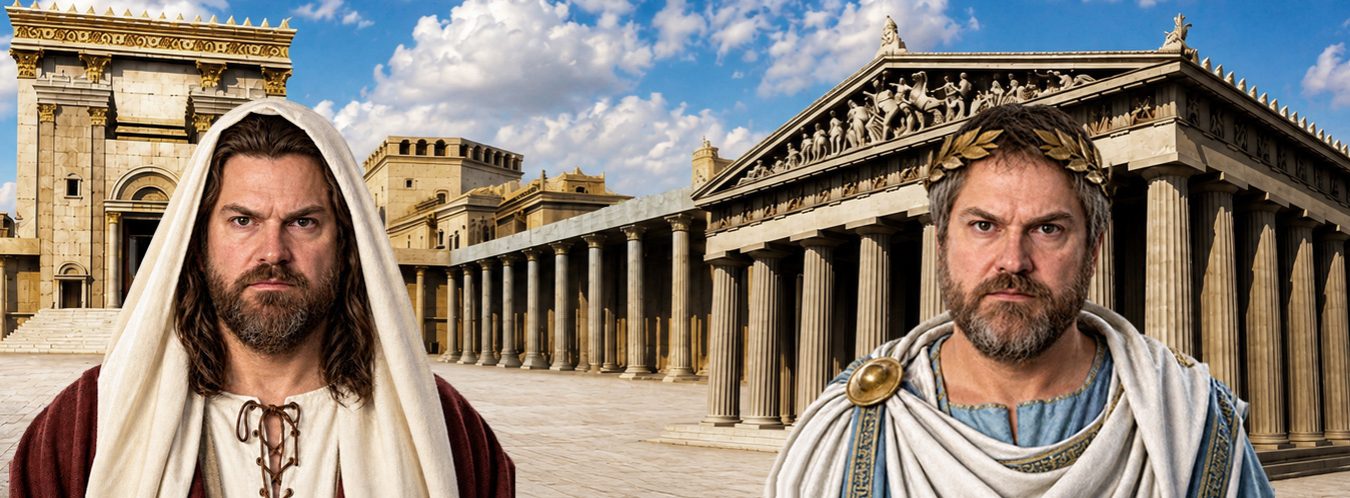

Christ and His Hearers
(No. 3410)
A SERMON PUBLISHED ON THURSDAY, JUNE 11, 1914.
DELIVERED BY C. H. SPURGEON
AT THE METROPOLITAN TABERNACLE, NEWINGTON.
"Then drew near unto Him all the publicans and sinners to hear Him, and
the Pharisees and Scribes murmured, saying, This Man receives sinners
and eats with them." Luke 15:1,2.
SELF-RIGHTEOUSNESS always seeks to blame others and to whitewash
itself. The group that stood nearest to Christ in preaching was
composed of two classes of persons–the publicans, or tax-gatherers and
the open sinners. Now the Pharisee, when he came to speak of these two
classes, called them by one name, lumping them all under one
description and calling them all sinners. Now, although the publicans,
or tax-gatherers, were very generally taken from the lowest class of
Jews, and their calling of tax-gathering, never in itself, too popular,
was in their particular case very objectionable, yet we have no reason
to believe that all tax-gatherers were necessarily profane, or
licentious, or dishonest. There were bad and good among those Jewish
tax-gatherers, as well as among all other classes of mankind! Yet,
because they were looked upon as being of the lowest class, the
Pharisee spoke of them as if they were all "sinners." This is a common
habit, I am afraid, with the Too-Goods–with those who have never felt
their own sinfulness, to always use the worst names they can and to put
as bad a color as they can upon the characters of other men. I wish we
had learned to do the very reverse, namely, to try to see all the good
we can in our fellow creatures, which were far more like Christ, rather
than to condemn them wholesale, and impute the faults of some to a
whole class. The Holy Spirit here speaks of "publicans andsinners"–the
evil spirit in the Pharisee calls them all sinners. Let us imitate the
Spirit of God and not the spirit ofpride.
But I said that self-righteousness tries to whitewash itself, for did
not these Pharisees, when they murmured that Christ received sinners,
intend to say that as He did receive them, they were not sinners? No,
they would not have blushed, for they were rather honest in their
self-righteousness–perhaps more honest than we are–they would not
have blushed to have said, "We have thanked God that we are not as the
publicans, and not as the sinners." They did not reckon themselves as
belonging to the class of offenders and breakers of the Law of God.
They were holy! They were the separated ones! They were a peculiar
people, zealous for good works after their own estimation, though not
in the sight of God. Alas, how easy it is for us to try to make
ourselves appear to be better than we really are! We are full of
sin–our nature is deceitful and vile, and yet we try to draw up a good
balance sheet, if we can, of our spiritual trading! We represent that
to be sound which is rotten, and that to be accepted which is
dishonored. Oh that we could but see ourselves as God sees us! We would
never again, then, dare even to thinka good thought of ourselves out of
Christ, but abhorring ourselves in dust and ashes, we would wrap His
righteousness about us! We would plunge into the crimson fountain of
His blood and never hope to be accepted except in the Beloved! May God
grant us Grace to beware of the least touch of self-righteousness, for
it is evil, only evil and that continually! May we always be as timid
as the publican who stood afar off and dared not even lift up his eyes
to Heaven, rather than be as censorious and presumptuous as the
Pharisee, whose sole prayer consisted in flattering himself that he was
better than others.
Having thus introduced to you the Pharisees, the publicans and the
sinners, let us now come to the text, itself, and observe that
publicans and sinners were attracted to the ministry of Christ. The
first question at this time shall be–what attracted them? Then
secondly, what in the Gospel should attract us? And thirdly, what came
of their being attracted, and what comes to us, also, of our being
attracted by the Gospel?
First, then, it seems that when Christ preached, He was surrounded by a
number of persons of very loose character, and others of the lowest
calling who pressed to Him to hear Him.
I. WHY DID CHRIST'S HEARERS COME?
They were genuine hearers–it was a bona fide audience. I mean by that,
that they were not like the crowds who followed Christ up the
mountain–who followed not to hear Him, but to eat of the loaves and
the fishes. These publicans and sinners were not thinking of the loaves
and fishes. They were none of those who, like the old people in some
parishes,go to Church in order to get the loaf of bread on the Sunday
morning. They were real, bona fide hearers, who really went to hear.
They were a genuine, earnest, and honest audience–and they pressed
around Him to listen to Him. Why did they do this?
I will tell you why they did not. They certainly were not attracted to
Christ by any ceremonialism which Christ used, or any kind of pomp or
show of priestcraft in His dress. It is said that the working classes
do not attend places of worship because we do not dress ourselves in
white, and blue, and green, and I do not know what other colors
besides–in fine because we do not make fools of ourselves! It is said
that people will not come to hear us because of this, but our Lord
Jesus Christ never put on anything like a priestly vestment in His
life! The common dress in which He robed Himself was "a garment without
seam, woven from the top throughout," or rather, the usual dress of the
East. There was nothing whatever in His garb that was distinctive. John
the Baptist, it is true, put on prophetic robes–the rough robe of
hair-skin and some have used that same rough garment to deceive, but
Christ was perfectly a Man among men. I may venture to say that whoever
else was a clergyman, Jesus Christ was not, and whoever else was a
priest, as one of a priestly caste set apart from the people, He was
none. He was just a Man among men. He ate as they ate, and drank as
they drank. He toiled as other carpenters have done in the carpenter's
shop, and when He came to speak in public, He spoke like one of the
people. His authority was not derived from His robes! He had not to
step into the vestry and put on His garments to get His dignity. His
dignity was in the Man, Himself, in the Spirit that filled the Man.
That which attracted people to Him was certainly nothing external and
had nothing to do with milliner's shops, but was something far other
than that.
Again, the publicans and sinners certainly did not come to Christ to
hear Him because of His laborious reasoning. The working classes of
London, we are told, if they are ever to be brought to places of
worship, need that we should argue with them, and prove to them the
existence of God, the Divinity of Christ, the truth of the Bible and
all such things–and they are not led by our dogmatism! That is the
statement that is made. I believe it to be as false as those who say it
is impertinent. I do not find our Savior ever trying to prove that
there is a God. I do not find Him standing up and continually
apologizing! His mode of address is, in the strongest sense, and I
grant you in a sense far above what you and I could claim to adopt,
dogmatic! "Verily, verily, I say unto you." That is His argument. "I
testify what I do know, and what I have seen of the Father," and He
bears witness to the Truths of God with a full, down-right certainty
which does not admit of a doubt! True, He has an answer for the
Sadducees, but it is curt, sharp and decisive. And He goes on His way
to preach His own Gospel, which is evidently His delight and His forte.
No, if publicans and sinners came to Christ, they did not come to Him
to be amazed with the display of intellect or to be dazzled with the
remarkably judicious manner in which He would handle a debate! They
came for some other reason than that.
Again, if they came to Jesus Christ, they certainly did not come
because of His trimming Doctrines. He was not one who excused sin, or
who made it out to be a weakness, incidental to human nature. No, He
denounced sin in the most burning terms! They did not come to Him
because He was one who preached smooth things with regard to the
punishment of sin. No, my Brothers and Sisters, of all the preachers
that ever lived, none ever preached on the wrath of God in such
terrible terms as Jesus Christ, Himself! Though He was full of
tenderness and full of love, yet you hear Him speak of the worm that
never dies, and of the fire that never shall be quenched! He loved
men's souls too well to make them think that sin was a trifle! He loved
them too well to let them run the risk of everlasting woe without
warning them of it in the plainest terms. No, if any sat at Jesus' feet
to learn of Him, it was not because their conscience remained
unmolested and they were lulled by siren strains into a deadly sleep!
His spirit-stirring words must often have sent bolts right through and
through their consciences! They did not, therefore, go because He used
fair speech and so amused the people, and lulled them to sleep in sin!
Once more, if the publicans and sinners listened to Christ in crowds,
it was not because of His vehement gesticulation or His declamation. He
was not a preacher who was at all given to the stamping of the foot.
"He shall not strive, nor cry, nor His voice be heard in the streets."
The bruised reed He shall not break, and the smoking flax He shall not
quench. He opened His mouth and spoke, and He spoke with matchless
oratory, for "never man spoke like that Man." But it was all simple and
plain. You see no traces of logic. There are no signs of rhetoric. You
do not catch Him for a moment, as it were, seeking so to awaken the
emotions as to ignore the intellect, and so to stir the passions as if
men were only children to the frightened or to be cajoled. He speaks to
them as men! He appeals to their entire nature and while the Truths He
utters are full of pathos that stir the very depths of the soul, yet
are they gentle and quiet, and His speech distils as the dew and drops
as the rain. Let none think that they can win a congregation by the
mere force of gesticulation. Jesus did not so.
What then, was it that attracted these people? They were not generally
sermon-hearers. Look at that fellow, there with his ink bottle. He will
look up the Jew that has forgotten to pay his tribute to Caesar. He is
very quick about that,but he is not a man who is at all likely to
attend theological discussions. Do you see that villain, there, with
the low forehead? Why, I do believe he is the very man who was tried
and who only escaped with his life upon a doubtful point at the last
Passover! And there is that woman–oh, yes, there can be no doubt about
her character! You know her, and what she is. Do you see them there?
They are all listening, not with their ears, only, but with their very
eyes and mouths they are drinking in every word that Man is saying as
He talks to them about the lost sheep and the lost son. What is it that
enthralls them? What are the golden chains that come from His mouth and
hold these by their ears? What can the secret be? I think it lay partly
in this, that He was a Man awfully in earnest. As they looked up to
Him, they all felt that He was a real Man. The Pharisees were starched
with decorum and full of affectation. These people were too
simpleminded, though wicked, to believe in the Scribes and
Pharisees–and so they went their way to their own haunts and never
regarded their teaching. But with half an eye, they could see standing
there a Man unaffected, sincere and in earnest, who was speaking of
something which He, Himself, believed, and speaking it with power and
force because He felt it in His soul! Oh, never was there such an
earnest preacher as the Master! No idle word has He to give account of!
No words to recollect that lack results because they came not fresh
from the Speaker's heart! All He speaks is to the point and all of it
came deep from His heart's inmost self. This drew the people to Him.
They were attracted, too, no doubt, because He honestly touched their
consciences. It would be supposed, my Brothers and Sisters, that the
very intelligent, wise, rational and seemly Doctrine of Unitarianism,
as we are commonly told it is, would everywhere be attended by
crowds–but there are scarcely any places in which that Doctrine is
preached in which you might not catch any number of spiders, and study
the whole science of entomology as far as these interesting creatures
are concerned! How is this? Why, as one said, once, "The people know in
their hearts somehow or other, I cannot tell how, that this that you
preach is not true. Although it looks so well and so rational, and
seems to flatter them so much, yet they do not come to hear it, for in
their hearts they know it is not true." It is a strange thing that if
the old evangelical Doctrines should appear for one moment to be beaten
in a debate, they always conquer in results. I shall defy any man to
maintain a Church prosperously, or to keep up a denomination which is
built upon unsound Doctrine with anything like prosperity during a term
of years. The bubble shines and glitters, but it is too thin to last,
and it goes. Now, after all, the worst men like to hear a preacher who
will dash at their consciences, who will tell them what they, in their
inner selves, know to be true! And as Jesus Christ never flinched from
this, but told them just what was fact, the people delighted to gather
round Him and to listen to His speech.
Moreover, and I doubt not that this was the great charm they
perceived–that He intensely loved them, that He did not preach the
Truths of God merely that it might cause philosophic speculation and
because He was highly pleased to teach it, but because He wanted that
Truth to raise, to bless, to comfort, to save them and to make them
happy. The Pharisee, if he ever spoke to a publican or a sinner, would
do it with a long space between them, gathering up his robes for fear
of contagion, looking down upon the sinner as though the teacher were
so much above the taught. But Christ came right among them, and was one
of them–and He looked as if He would do anything for them if He might
but deliver them from their sins. They knew this, and it was this
mighty charm that embraced them and made them linger till the voice had
done, and then carry away the echoes of those loving tones in their
memories for many a day afterwards.
Besides that, I doubt not that another charm of Christ's preaching lay
in this, that He always preached Doctrine that was hopeful to them.
While He said, "Woe unto you, Scribes and Pharisees," He had loving
words for weary and heavy-laden ones. While He denounced
self-righteousness, He would turn round and say, "I came not to call
the righteous, but sinners to repentance." If He ever had a frown upon
His brow, it was for the hypocrite and the proud man, but He had tears
for sinners, He had loving invitations for penitent ones. Like a good
physician, He sought out morally sick folk and sought to restore them
to spiritual health. This it was, also, that helped to attract them to
Christ.
Now, my dear Hearers, I believe that if you would tell me your
characters, I could tell you whether, if Jesus Christ were here now,
you would be likely, habitually, to hear Him or not. If you are a very
excellent person who never did anything wrong. If you feel yourself a
deal above most people. If you have a proper sense of your own dignity,
and if you are much impressed with your own importance, I believe that
you would have murmured at Christ. And I am quite sure that you would
not have been in the throng that drew near to hear Him. But if you are
sensible that you have been guilty. If you confess that you have broken
God's Law. If you are anxious to be forgiven, or if you are conscious
that you are forgiven, but still need to be daily washed, to be daily
kept, to be daily dealt with in tenderness and love–oh, you are the
men and women who would have made a bodyguard about that Prince of
Preachers, for as surely as His Doctrine was meant for you as the rain
comes down upon the mown grass, so was your state of mind meant for the
Gospel! And you and the Savior would be quite sure to stand in near and
proper relationship to one another!
But we cannot linger, and must pass on, now, to the second point–
II. WHAT IS THERE IN THE GOSPEL OF CHRIST THAT DOES NOT ATTRACT SOME OF
US, BUT OUGHT TO ATTRACT US ALL?
Very briefly, there is this in the Gospel that attracts my soul and I
will speak for others. Ever since we fell out with God through sin, the
thought of God has been dreadful to us. We have been afraid of Him. But
Jesus Christ is God and He has taken upon Himself our manhood. And now
He tells us that we may come to God through Him–in fact, that if we
come to Him, when we have seen Him, we have seen the Father! Now, as I
want to be one with God, and yet shudder at the thought of coming to
Him, my soul burns with fervent affection towards Christ! And when I
see that I can come to God so safely and so sweetly by coming through
Him, that attracts me.
Next, ever since we were awakened to a sense of what sin is, sin has
been a great burden to us. We have offended against God, and we know
it. Oh, that this offense could be blotted out! Now, Jesus Christ comes
and shows that, altogether without a violation of justice, God can put
away all our sins as if they had never been! The Gospel tells us that
Christ becomes a Substitute for us, that He was punished instead of all
those who believe in Him, so that the Law takes effect, Justice is
satisfied and yet God is gracious. I know when I first learned that
Truth of God, my heart was ravished with it. I have read books,
sometimes, that have kept me up at night to read them, or I have got
hold of ideas that have almost made me dance when I have got them–but
that old idea of Substitution–oh, Sirs, it was the brightest day I
ever lived when I learned that–that the Lord has laid on Him the
iniquity of us all! You know, an awakened conscience cannot play with
sin as some of you do and imagine that God can easily forgive sin–but
when the conscience is awakened, it feels that God cannot forgive sin
without exacting the punishment that is due to sin! Then there comes in
to meet this difficulty the fact that Christ is punished in the place
of the Believer–that God is just, and yet the Justifier of him that
believes. Here is another precious Truth that has attracted many of us
to Christ. I pray God that it may attract many others to Him. Here is
the way of pardoned sin and here is the way of access to God!
Brothers and Sisters, we feel in ourselves so many inabilities, we
cannot do anything right! We feel that we cannot pray. There are times
when, if we gave a world for it, we cannot shed a tear, when we cannot
make our hard hearts melt, cannot get repentance out of these dry
souls! Oh, but then this attracts me to Christ, to find that He can
give me all Grace–that in Him all fullness dwells, that His Spirit
helps our infirmities and that just as I am–wounded, broken, sin-sick,
hard, cold and dead– Christ comes and meets my case! Oh, how this
ought to attract us to Christ!
And then oftentimes the fear comes up to every awakened man–"Shall I
hold on? If I begin to be a Christian, shall I hold out to the end?
Will not temptation yet lead me astray?" Then Christ comes in and says,
"Because I live, you shall live also. I give unto My sheep, eternal
life, and they shall never perish, neither shall any pluck them out of
My hands." Oh, Savior, this is a silken bond to draw us to Yourself!
Was there ever a greater attraction than this–all safe in Christ! The
lambs of the flock, the weakest ones, all safe! The man of imperious
passions, the man with once imperious lusts–all safe when once they
put themselves in the hands of Christ! Then can we all say, "I know
whom I have believed, and am persuaded that He is able to keep that
which I have committed to Him until that day." But the thought comes
over us sometimes, "Ah, but what will it be to die?" That hour of
death–how grim it looks! And, indeed, it never is child's play to
die–to pass into the unknown and the invisible! The naked spirit–to
leave the body behind–it to become food for worms. The bravest man may
well turn pale here! But oh, the attraction of Christ is, "He that
believes in Me shall never die. Though he were dead, yet shall he
live." Oh, the thought of resurrection! The thought that death is
changed, no longer to be a penal sentence, but to be merely an entrance
into Heaven! The thought that–
"Jesus will make a dying bed Feel soft as downy pillows are, While on
His breast we lean our head And breathe our life out sweetly there."
The thought that He will come and meet us, and that our spirits, side
by side with His, shall pass through the iron gate with a song upon our
lips, and fear no terror as we pass by the gates of the grave! My
Brothers and Sisters, this woos us to Christ! This holds us to Christ!
This charms and fascinates us! This is a faith that well sustains us,
that blots out the past, that brightens the present and lights up the
future with the expectation of the glory to be revealed!
My Hearer, if you have never had Christ, do you not desire Him? Man, if
Christ is yours, Heaven is yours. Man, if you believes in Christ, this
night, your transgressions shall be forgiven you! You shall become a
child of God, an heir of immorality! Do you not need a Savior? Will you
not ask for one? Oh, yield you, yield you now to Him who was given for
you, who round you now, the cords of His love would cast, binding you
fast to His altar! God grant in His Infinite Mercy that the attractions
of the Gospel may be known to us all! And now, in the last place–
III. WHAT CAME OF IT?
Those who were attracted first to hear were, according to the second
verse, still further blessed. The Pharisees said, not–"This Man
preaches to sinners," but, "This Man receives sinners and eats with
them." It is a great blessing when the Gospel is preached to sinners,
but oh, it is a far greater blessing when sinners are received, when
sinners come to eat with Christ. The Pharisees left out what they ought
to have mentioned, that when Christ received sinners, He did not leave
them sinners. It is no disgrace to say of a certain doctor in London,
"Why, it is said that that doctor has had some of the most horrible
cases in London. I saw one man, there, with a dreadful cancer. Another
was taken in that was subject to epilepsy. I saw one with a leprosy
taken into that physician's house." Is that any disgrace to the
physician? Why, Sir, the thing is how did they come out? What were they
after his skill had been exerted upon them? What they were when they
went into the hospital is no disgrace to the hospital–it may even
reflect honor upon the wisdom of those who exercised their skill within
it. So that Christ receives sinners is true, but He first makes them
penitent sinners! He makes them believing sinners! He changes their
nature! He turns the lion into a lamb, the raven into a dove–and then
when He has done this, when He has washed away their sins and changed
their natures–He receives them to be His friends! None are so near to
Christ as blood-washed sinners! He receives them to be His disciples!
None could sit at His feet but those who first have been washed in His
blood. Then He receives them as His servants. None can serve Him who
have not first been served by Him. Then He receives these sinners to be
His advocates. He sends them out to preach His Gospel, but He never
sends any out to preach the Gospel unless, first of all, they have
received Him into their hearts as the Gospel of their salvation. "This
Man receives sinners."
Oh, I wish that tonight the Lord would find the biggest sinner in the
Tabernacle! I might say, if there were such a person present, one
commonly known to be the biggest blackguard in the parish, I wish the
Lord would light on just such an one, for the raw material for a great
saint is often a great sinner! When the devil wanted to make the
biggest sinner that ever lived, he took an Apostle to be the raw
material, namely, Judas, and made him the son of perdition. But when
Christ wanted the greatest of preachers, and the best of all the
Apostles, He went right into the devil's camp and laid hold of Saul of
Tarsus–and made him become Paul, the mighty winner of souls! "This Man
receives sinners." The thief, the drunkard, the harlot–He still
receives them! He washes them, changes them, takes them into His
society, lifts them up–takes the beggar from the dunghill and makes
him sit among princes. Oh, mighty Master, do this deed of Grace again
and though the Pharisees will murmur and the proud may still slander
Your name, we who are sinners, too, will clap our hands for very joy
and bless Your love and adore Your Grace, world without end! "This Man
receives sinners."
And then they said, "And eats with them." Yes, in a mystical sense you
will see that done again tonight, for here is the TABLE, the Lord's
Table, peculiarly so, and to that Table let no man come who has never
been a sinner, for he will not be welcome! Let no man come who has not
felt himself to be a sinner, for he will not be welcome. If there is a
man that is rich in good things and that is full of good things, let
him not come, for, "He has filled the hungry with good things, but the
rich He has sent away empty." If there is a handmaiden here of low
estate and humble mind, let her come, for He has remembered the low
estate of His handmaiden. But if there are any that are great and
mighty, and exalted in their own estimation, let them stand aside and
hear Him say, "He has put down the mighty from their seat, and He has
exalted them of low degree." Here is a Table spread for sinners,
sinners blood-washed, but still sinners. I often feel, my Brothers and
Sisters, as if I could not come to the Cross anyway but as a sinner. I
think I told you this parable once. Once there was a great king who
used to have a table spread every day, and there were two sorts of
persons who had a right to come there. All round the king, on his right
and left, sat the princes of the blood and the nobles of the highest
rank. They came in their robes of state and there they sat, and they
were welcome. At the other end of the table, the king in his bounty had
bidden his chamberlain every day spread many dainty dishes for beggars,
and if there were any in the city at any time who were foot sore, who
were houseless and homeless, ragged and hungry, the notice was given
that anyone who could plead abject poverty might come to the king's
table. Now, it so happened once on a time that a prince of the blood
had lost, as he thought, the deeds of his estate. Moreover, he had lost
the register of his birth and he was afraid that all that he had ever
possessed had never been rightly his own. Perhaps he was some
changeling child, he said, for such things had been. Perhaps his
estates were not his own, and as the time came round for the feast, he
felt as if he did not dare put on his robes lest he should be shown to
be an impostor. But then it flashed across his mind, "If I have been an
impostor up till now, and I am not the son of my reputed father. If the
estates and the rich gems I have, are not mine, then I am a poor beggar
and I have not anything." So he took off his fine garments and found
some common dress that had been laid aside. "I must sit at the king's
table somewhere," he said, "and if I cannot go as a prince, I will go
as a beggar and so, one way or the other I will eat of his banquet."
Brothers and Sisters, I have often had to do that, and I would advise
you to do it whenever your doubts and fears come across you. If Jesus
Christ cannot receive you and you cannot come to Him asa saint or as a
child of God, remember, that "This Man receives sinners and eats with
them." Come with all your sins! Come, I say, and you cannot be cast
out!
Many years ago the shaft of a mine was blocked up by some falling
earth, and there was no chance of the miners' escape. They gathered
themselves together and held a Prayer Meeting in expectation of a
speedy death, for it did not seem probable that they would ever be able
to get out by the shaft, which was so thoroughly destroyed. While they
were in prayer, a happy thought struck one of the older miners. He had
heard that there was an old shaft which led into another mine, which
had been given up, and he said he would go first and perhaps they might
be able, by going through some old passages, to come out into the old
mine. He knew from what he had heard his father say, that much of it
was very low, and water dripped into it, and that in some places they
would have to keep on all fours. But for all that, he said, it would
not matter so long as they could but get to the daylight again. They
could not go up the regular shaft, but away they went, creeping down
the back ways, all through the mire, mud, and filth, and dirt and
darkness–but they came to the light at last and all came up safe to
their homes again.
Now, sometimes when I can look straight up to my Lord, I know that I am
His child. I do tonight, and I can rejoice to go up and down the shaft
straight ahead. But, Brothers and Sisters, if ever you cannot do that,
there is an old working, there is an old way, the way that all the
saints have gone. You will have to go on your hands and knees. You will
have to go on all fours. You will find it flooded with tears of
repentance, but never mind, the devil himself cannot block up that way.
If you cannot come as a saint, come as a sinner! If you have got no
Grace, you can get Grace. If you cannot come with a tender heart, come
fora tender heart. If you cannot come with faith, come to get faith,
for "this Man receives sinners and eats with them." May this Blessed
Man come and eat with us tonight!
EXPOSITION BY C. H. SPURGEON: LUKE 15:11-32.
Verses 11-13. And He said, A certain man had two sons: And the younger
of them said to his father, Father, give me theportion of goods that
falls to me. And he divided unto them his living. And not many days
after, the younger son gathered all together and took his journey into
a far country, and there wasted his substance with riotous living. It
was an act of ingratitude to leave his father at all–an act of extreme
folly to turn his father's goods to ill-account.
14. And when he had spent all, there arose a mighty famine in that land
and he began to be in need.And the sinner's greatest all will be spent
one day! The pleasures of sin are but for a season. The strongest sinew
in an arm of flesh will one day crack. The flowers that grow in man's
garden will one day fade–man may think he has an eternity of pleasure
before him, but if he is looking to the flesh for it, it shall be but
for an hour.
15. And he went and joined himself to a citizen of that country. And he
sent him into his fields to feed swine. At the very best, the comforts
of this world are ignominious to a man. They degrade him–as it was a
very degrading employment for a Jew to feed swine–so the comfort the
world can give to a man does but degrade his noble spirit.
16. And he would gladly have filled his belly with the husks that the
swine did eat, but no man gave unto him.The prodigal cannot be brought
any lower! He is made to herd with the swine, and he envies even them
because they are satisfied with the husks! He cannot eat of the same
and, therefore, he envies even the brutes! Surely, when a sinner
becomes fully convinced of sin, he may well envy even the sparrows or
the serpents because they have not sinned!
17-20. And when he came to himself, he said, How many hired servants of
my father's have bread enough and to spare, and I perish with hunger! I
will arise and go to my father, and will say unto him, Father, I have
sinned against Heaven and before you, and am no more worthy to be
called your son. Make me as one of your hired servants. And he arose,
and went to his father. But when he was yet a great way off, his father
saw him.Remember Matthew Henry's pa-raphrase?–Here were eyes of mercy.
20. And had compassion–Here was a heart of mercy. 20. And ran Here
were legs of mercy. 20. And fell on his neck Here were deeds of mercy.
20. And kissed him And here were lips of mercy.
21- 22. And the son said unto him, Father, I have sinned against Heaven
and in your sight and am no more worthy to be called your son. But the
father said to his servants Here were words of mercy, wonders of mercy
and, indeed, it is all mercy throughout!
22- 25. Bring forth the best robe andput it on him; andput a ring on
his hand, and shoes on his feet. And bring here the fatted calf and
kill it; and let us eat and be merry: For this, my son, was dead, and
is alive again; he was lost, and isfound. And they began to be merry.
Now his elder son was in the field. That is where these over-good elder
sons always are–they are out at work–they are not at home in
communion with God! They are in the field! Do not ask who the elder
brother was–he is here tonight–there is many an envious
moralist–yes, and an envious professor, too, who feels it hard that
profligate offenders should be pardoned!
25-27. And as he came and drew near to the house, he heard music and
dancing. And he called one of the servants, and asked what these things
meant. And he said unto him, Your brother is come; and your father has
killed the fatted calf because he has received him safe and sound. And
he was angry. He did not want the fatted calf killed! If this reprobate
brother were allowed to come in at the back door and to eat with the
servants, he thought that quite good enough, but for this rebel to be
put upon an equality with himself–he could not bear that!
28. And would not go in: therefore came his father out and entreated
him. See the tenderness of this father? The same arms which embraced
the sinning one, were also ready to clasp the self-righteous one! I
always feel great pity and great admiration for this dear, dear father.
What with a bad son and a good son, he had two bad sons, for this good
son, you see, had got in a pet just as I have seen some real Christians
get into a very un-Christian frame of mind! Well, they do not like,
somehow, receiving into their company the women who have gone
astray–the men who have lost their reputation. He was angry and would
not go in–and now his father crowned his love. He ran to meet one son
and now he comes out to reason with another who is unnaturally and
ungraciously angry with him.
29. Andhe, answering, said to his father, Lo, these many years do
Iserve you, neither transgressed I at any time your commandment: and
yet you never gave me a kid, that I might make merry with my friends. I
know the brother. He says, "I have been a consistent Christian. I have
been diligent in the service of God. I have abounded in prayer and yet
all the daylong have I been plagued and chastened every morning. I do
not get much joy–I have such a sight and sense of temptation and sin
that I am generally low spirited. I seldom get a drop of full
assurance. I never get a kid given me, that I might make merry with my
friends." Those who are under the Law never do make merry. You never
knew a man yet that was trying to save himself by keeping the
Commandments of God that could dare to make merry. No, they have to
draw long faces, and well they may, for they have a long task before
them! They put on a garb of sadness, being of a sad countenance, as the
hypocrites are!
31, 32 But as soon as this, your son, was come, who has devoured your
living with harlots, you have killed for him the fatted calf And he
said, to him, Son, you are always with me, and all that I have is
yours. It was right that we should make merry and be glad, for this,
your brother, was dead and is alive again! He was lost and is found.
And so, dear Friends, there is more joy over the prodigal when he
returns, than over the man who thinks he never has been astray!