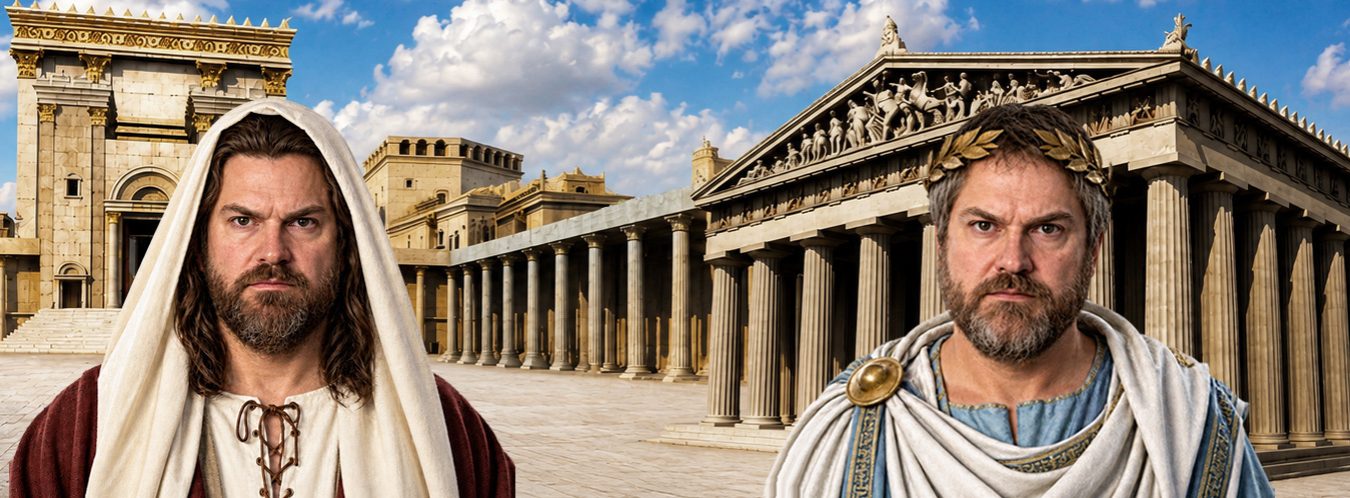

Christ the Cause of Division
(No. 2710)
A SERMON INTENDED FOR READING ON LORD'S-DAY, JANUARY 20, 1901.
DELIVERED BY C. H. SPURGEON,
AT THE METROPOLITAN TABERNACLE, NEWINGTON, ON LORD'S-DAY EVENING, MARCH
21, 1880.
"So there was a division among the people because of Him." John 7:43.
IT seems, then, that even when Christ was the Preacher, there was a
division among the hearers, so we must not be surprised if the same
result follows from ourpreaching. No doubt strife has sometimes been
caused by a preacher's harshness of expression, or unwise utterances.
He may have spoken unadvisedly, or provokingly, but if he did not, all
would not be pleased, for even when Jesus spoke as never man spoke, all
His hearers were not pleased. We truly say, "Many men, many minds" and,
therefore, even when Christ spoke, "there was a division among the
people because of Him."
Nor was the division to be traced to the subject upon which Jesus was
speaking at that time. There are some deep, mysterious subjects which
seem calculated to stir up controversy, and you might say, "Whoever
shall speak upon such a topic, even if the wise Solomon were to speak,
he must create a division in any audience, if that should be his
theme." But, in this case, with Christ for a Speaker, the subject was
Himself. It was concerning Him that the schisma–the schism occurred.
There was a schism among the people, not concerning predestination or
free will–not concerning forms of church government–not concerning
the modes of observing the ordinances, but,"because of Him."
So, then, we may not expect unanimity among mankind, whoever shall be
the speaker, or whatever may be the subject of address. And I am not
quite sure that this is a result that is altogether to be regretted. I
have heard of a whole parish in which there were no religious bickering
because there was no religion! There were no religious strifes because
nobody had anything worth striving for! And that is not a state of
things over which I can rejoice. I dread the peace of the sepulcher far
more than the battles of life. Life naturally makes a stir–it seems
inevitable that it should do so–and it is better that men should
think, even though they think amiss, than that they should not think at
all! I am not aware that the cattle in the fields have any diversity of
judgment–it is no cause for wonder that there should be agreement
where mind is absent. But it seems all but inevitable that where there
is mind, where there is thought, where weighty subjects are considered
and discussed, there should be differences of opinion. And it is better
that there should be those differences than that there should be the
apathy, the indifference, the smell of death!
And yet, my Brothers and Sisters, I am sorry that there should be any
division among the people about the Lord Jesus Christ, because if there
is a point in which all mankind ought to have been agreed, it is
concerning Him who came to save men–the Unselfish One who laid aside
His robes of Glory that He might take upon Himself our nature, our
suffering and our sin, so that He might redeem us from all our
iniquities. There ought to have been only one opinion upon this
subject–"This is the Son of God! Let us adore Him. This is the Christ
of God! Let us trust Him. This is our God! We have waited for Him–let
us rejoice and be glad in Him." But it was not so–"There was a
division among the people because of Him." And, to this day, the
greatest division in the world is "because ofHim."
I. I ask you to notice, first, that THERE WAS A DIVISION AMONG
NON-BELIEVERS CONCERNING CHRIST. A large proportion of those who
listened to Christ did not accept Him as their Savior and, although
they all agreed upon thatpoint, there was a division among them
concerning Him.
First, there were some who rejected His claims altogether, and who even
said, "He deceives the people." They went so far as to wish to lay
violent hands upon Him and, more than once we read that they took up
stones to stone Him. And
we know that they did, at last, compass His death. In like manner, even
to this day, there are some who utterly reject the claims of Jesus
Christ. They seem as if they could not say anything too bitter and
cruel concerning Him. They will not have Him to reign over them–in
downright, terrible earnest, they reject Him!
But all unbelievers are not so extreme in their opposition to Christ.
We noticed, in reading the chapter, that there are some who admit a
portion of Christ's claims. Some said, "He is a good Man." Many said,
"Of a truth, this is the Prophet"–the promised Messiah. They would not
shut their eyes–they were too candid to do so–to the goodness of His
personal Character and to a certain grandeur about Him which betokened
that He was a Prophet sent from God. They went as far as that, but they
would go no further. And there are many in the present day who act in
the same fashion.
There was a third class of persons who went still further. They
admitted Christ's claims, but neglected to follow out the legitimate
consequences of them. They said, "When Christ comes, will He do more
miracles than these, which this Man has done?" Others said, "This is
the Christ." They were quite certain that He was the Messiah and yet,
when they had said that, they coolly went their way and took no more
notice of Him. They had made a truthful statement, but it did not in
the least affect their conduct! Though they believed Jesus to be
anointed of God, they did not enroll themselves beneath His banner, or
become obedient to His commands, or ask to be instructed in His
doctrine. And, alas, we have a good many persons of that sort still in
our midst! I suppose that most of the unconverted people here are
persons of that character. You do not deny the Scriptures–you believe
in them. You do not doubt the Deity of Christ–you believe it. You do
not question His Atonement–you believe it. Some of you would not like
to hear anything contrary to the doctrine which has been taught to you
concerning Him. If anyone were to preach error, you would at once say,
"This is not the Gospel, but another gospel, and we will not listen to
it." Yet you have never accepted Christ to be your very own Savior! You
have never committed yourselves to His dear keeping. You have orthodox
heads, but heterodox hearts!
It is still true, as it was in our Lord's day, that there is a division
among the people because of Him. And I ask you, who love the Savior, as
you look upon those who do not love Him, to make a distinction between
the one and the other of them. As for those who utterly reject Him,
pray for them. Do not expect them to love you if they do not love your
Lord. And when they speak harshly concerning you, do not be astonished,
for Jesus said to His disciples, "The servant is not greater than his
master. If they have persecuted Me, they will also persecute you; if
they have kept My saying, they will keep yours also." Do not get angry
with them because they do not receive the Savior, but pray for them,
pity them and love them with a love that will not give them up.
Remember that the greatest force in the world is love–it is
invincible. You can love a man to Christ, but you cannot bully him into
salvation. I never heard of a soul that was scolded to the Savior, but
I have known many drawn to Him by love. So love them, dear
Friends–keep on loving them more and more until they shall be brought
to feel that the love of God shed abroad in your heart has also reached
their hearts.
As for those who are prepared to go part of the way with Christ, aid
them all you can. If they have not all the Light of God you wish them
to have, be thankful that they have any, and tell them that no man who
acts honestly up to the light he has, will be left in the dark. If a
man has a dozen errors beclouding the truth which he sincerely
believes, if he is only a true man, he will come out right. I have
often conversed with persons who have been as wrong as wrong can be,
but they did not mean to be wrong. They had an earnest desire to know
the Truth of God if they could find it, and they had an earnest wish to
live that Truth, too. I am always hopeful about such persons. You
remember that our Lord Jesus said, concerning His Father, "If any man
will do His will, he shall know of the doctrine, whether it is of God,
or whether I speak of Myself." It is the same now–if anyone is
desirous to act according to the mind of God, the Light of God will
come to him sooner or later, and he shall discover the true Doctrine of
Christ. Try and help him discover it. Quietly, lovingly, point him to
the Son of God, and rest not content till he finds his Savior.
As for those who believe everything about Christ, but yet do not
savingly rely upon Christ, Himself, O my Friends, what shall we say
concerning these people? We have brought them to the Water of Life, but
we cannot make them drink! We put the Bread of Life before them, but we
cannot make them eat it! It behooves us to weep in secret concerning
our fellow seat holders and those who come here constantly, or who go
to other places of worship where Christ is preached, and who say of
what they hear, "It is all true," yet they do not receive it in their
hearts. O my Hearer, out of your own mouth you will be condemned at the
last because you will not be able to say, "I did not know the way of
salvation," for you do know it! You will not be able to say, "I did not
accept the Bible as true," for you knowit is true, and yet you do
not take the practical step that ought to follow as the result of that
knowledge! May the Lord, in His infinite mercy, lead you to take it
this very hour! If you do not take it, you will be
convicted–self-convicted at the bar of God! I must not spend more
time, however, on this part of the subject–but you can all see that
there was a division among the unbelievers concerning Christ.
II. But now, secondly, THERE WAS ALSO A DIVISION OF BELIEVERS FROM
NON-BELIEVERS.
There were some who did really and savingly take Christ to be theirs
and, "there was a division among the people" on that account, and what
a division that always is! How deep it is! How wide it is! Between the
poorest saint and the brightest moralist, there is a great gulf. We may
not be able to perceive it in the outward character, but there is as
deep a gulf as there is between the feeblest form of life and death–a
gulf which only Omnipotent Grace can cause any man to pass over. The
radical difference between the true Believer and the unbeliever lies in
their relation to Christ. That is the point of divergence–"There was a
division among the people because of Him."
For, first, to the unbeliever, Christ is nothing. But to the Believer,
Christ is everything. To the unbeliever, a mere opinion about Christ is
everything. To the true Believer, the saving knowledge of Christ has
covered up all mere opinions concerning Him. He knows Christ, and lives
in Him, and Christ also lives in him.
Look at the difference between the Believer and the unbeliever in the
matter of trusting Christ. The unbeliever trusts in himself, or in his
own works, or in his priest if he is a Romanist or Ritualist. But the
true Christian trusts in Christ wholly and alone. There is one thing
concerning myself about which I am perfectly sure. When I pass myself
through many forms of self-examination, I tremble as I do it, lest I
should deceive myself. But about this one matter I know that I am not
deceived–I have not the shadow of a shade of a ghost of a confidence
as to my ultimate salvation except in Jesus Christ alone! And one
reason why I dare not have any confidence except in Him is that I do
not know anything I ever did, or ever thought, or ever was in which I
could confide–so I am driven to trust in Him, and in Him alone. I lie
at the foot of His Cross because I cannot stand upright. I must do
that, for, like Luther, I can do no other. If I search myself and my
whole life over and over again, I cannot see anything but what I call a
filthy rag, and I fling it all away–good works and bad works–so far
as mine are concerned, are not worth the trouble of sorting out. So I
tie them all up in one bundle and pitch them overboard, and just cling
to the ever-blessed lifebuoy of the merits of Jesus Christ, my Lord and
Savior. That is what a Believer does–he trusts Christ, and the
unbeliever does not–and that difference between them makes a division
among the people.
The same difference is apparent in the matter of love to Christ. The
true Believer loves his Lord. He is no fiction to us–no mere historic
personage about whom we read, but of whom we think little or nothing.
We love Him! The very sound of His name has music in it to us. Some
seek their pleasure in the world, but the Christian does not. If he is
obliged to go into the world, he is glad to get out of it as quickly as
possible. While he is with worldlings, he says, "There is nothing here
to suit me." But let him have his Master's company for half an hour
alone, no matter where, and he says, "This is to me a foretaste of the
bliss of Heaven!" Rest assured, dear Friends, that where your pleasure
is, there your heart is. If you find your pleasure in the world, your
heart is in the world and you are to be reckoned among the worldly. But
if Christ is your joy, your pleasure, your delight, your very
Heaven–then there is a difference between you and worldlings.
Further, those who know Christ and trust Him, and love Him, differ in
character from worldlings, for those who truly know Christ seek to be
like He. They take Him to be their copy, and try to imitate every line,
each down-stroke and up-stroke. But he who knows not Christ takes any
model that he pleases and aims not at copying the excellence of Jesus,
and thus, again, there is "a division among the people because of Him."
This division is also shown in the gradual development of different
characters. You may be at a railway station–an important junction, it
may be–there are two lines of rails that run parallel to each other.
There is a point, a little distance off, where they begin to diverge,
one going to the East, and the other to the West. They will be many
miles apart before long, but, at first, how slight is the division! So
is it with those who begin life side by side. Two young men may be very
much alike and for years you may scarcely see any difference between
them. But, after a while, the ungodly man develops in his ways, and the
lover of Christ develops in his. You see them when they have reached
middle life. You see them, perhaps, on their dying bed–what a vast
distance they are from one another! What a difference there is between
them with respect to Christ! One knows Him as his Savior and
All-in-All. The other knows nothing of Him. One rejoices
in Him–the other despises Him. One is triumphing in the thought that
he will wake up in his Lord's likeness. The other lies down to die
moaning that he is "without hope." In such cases, there is truly a
difference among the people because of Christ!
But what a difference there will be among the people in their eternal
destiny! By-and-by they will awake, and arise! The Judgment Seat will
be occupied and Christ, the Judge, will sit upon His Throne. He is the
Man upon whom wicked men once spat, but His Countenance shall be bright
as the sun in that day! He is the Man whom they scourged–but then He
will sway the scepter of universal Sovereignty and the unnumbered
myriads of our race will all stand before Him! What an assembly that
will be when before Him are gathered all nations! They will crowd the
land and throng the very mountain tops–and stand upon the ocean as
upon a sea of glass. What a multitude! But there will be one thing that
will divide them, and that will be "a division among the people because
of Him."
Do you hear the songs and shouts of the ransomed? Louder than ten
thousand thunders! Do you hear them? They are clapping their hands!
They are shouting, "Welcome, welcome, Son of God!" The archangel's
trumpet seems to them, as they wake up from the dead, to be the morning
summons that calls them up from beds of dust and silent clay to joy and
eternal peace! And every note, as it peals out, is one to which they
can sing, and they chant in harmony with it the great anthem, "Worthy
is the Lamb that was slain to receive power, and riches, and wisdom,
and strength, and honor, and glory, and blessing."
But what other sounds do I hear amidst those thunders of applause, and
that mighty chorus of the redeemed? Listen! Sharp and shrill, there
come up cries that pierce the very firmament–terrible sounds that even
the glad music of that grand morning hymn cannot wholly drown. I can
hear it, though the archangel's trumpet waxes exceedingly loud and
long, for myriads of lost souls have risen from the tomb, and they are
wailing, wailing, wailing, "because of Him" whom they rejected! And
above all other sounds there comes up the awful cry to the mountains
and rocks, "Fall on us, and hide us from the face of Him that sits on
the Throne, and from the wrath of the Lamb: for the great day of His
wrath is come; and who shall be able to stand?"
There will, indeed, be a division among the people because of Him in
that tremendous day! On which side of the King will you be, then, my
dear Hearer? I pray you to answer that question in the quietude of your
chamber this very night. Where will you be when Christ shall make the
final division between all the vast masses of the human race? "And He
shall separate them, one from another, as a shepherd divides his sheep
from the goats." Will you be driven to the left hand, among the goats,
with the King's curse thundering in your ears? Or will you be gathered
with those upon His right hand, and join with them in singing the hymns
of angels and of men redeemed, to whom Christ will say, "Come, you
blessed of My Father, inherit the kingdom prepared for you from the
foundation of the world"?
III. I cannot give more time to that solemn theme, for I must close my
discourse with a brief reference to one other topic which arises out of
the text. We have considered the division among the unbelievers
"because of Him," and the division between Believers and unbelievers.
Now, in the last place, I want to show you that, WHEN FAITH COMES,
UNITY IS PRODUCED.
Is there any division among Believers because of Christ? Is there "a
division among the people"–the people of the Lord–because of Him? No,
Beloved. Christ is the cause of the greatest division, but He is also
the medium of the greatest union. No force in the world splits as does
Christ's battle-axe. He Himself said, "I am come to set a man at
variance against his father, and the daughter against her mother, and
the daughter-in-law against her mother-in-law. And a man's foes shall
be they of his own household." And it is amazing how families have been
divided, and how communities and even nations have been divided by the
coming of Christ! Those who loved and served Him would follow Him at
all costs, and those who would not have Him rejected Him with the
utmost fury! There are some people in this world who are like the chip
in the porridge–there is no flavor in them, they are of little or no
account–but my Master, the Lord Jesus Christ, is not one of that sort!
You must either love Him or hate Him! You must give a verdict for Him
or against Him! You cannot be indifferent. He Himself puts the matter
thus–"He that is not with Me is against Me; and he that gathers not
with Me scatters abroad." You are, at this moment, either Christ's
friend or His foe. You cannot be neutral.
Yet, while Christ is the great cause of division, it is also true that
He is the great means of union. There is nothing that welds men
together as the love of Christ does–it is the most potent force in the
universe for gathering together those who are scattered abroad, and
making them truly one. In Christ, nationalities are blended. Think of
the division
between the Jew and the Gentile–what can make them one, but Christ? He
breaks down the middle wall of partition, and unites them. Look at
Peter, that stiff, unbending Jew. He never ate of an unclean animal and
he never means to do so. He is on the top of the house, praying at
noonday, and is very hungry. He hears the command, "Rise, Peter. Kill
and eat." And there is let down before him a great sheet full of all
manner of strange creatures! But Peter has never touched anything of
the kind. He does not like such fare, but, by-and-by, he learns the
meaning of the vision. There were certain Gentiles on the way to him
and he was to go with them, and to preach Christ to all who were
assembled in the house of Cornelius. And he must eat and drink with the
uncircumcised! And, taught of the Spirit, Peter does it, and Paul does
it. Never, I pray you, speak disrespectfully of a Jew. The greatest man
who ever lived was a Jew! Christ our Lord was, Himself, of the house of
David, of the tribe of Judah, of the seed of Abraham. Glory be to God,
the Jews shall be brought in with the Gentiles, but they are the old
original branches of the good olive tree, and they shall be grafted in
again. It is unbelief that has caused them to be cast out–but I am
sure that every man who truly loves Christ, feels that to him there now
is neither Jew nor Gentile–that feud is ended once and for all, for
all Believers are one in Christ.
So, too, wherever Christ comes, there are no foreigners. Paul wrote to
the Ephesians, "Now, therefore, you are no more strangers and
foreigners, but fellow citizens with the saints, and of the household
of God." Tell me that a man is a Christian–I do not care to what
nationality he belongs–he may be a Dutchman, he may come from
Zululand, he may be an Afghan, he may be a Hindu–it does not matter
what he is, as long as he loves Christ. What more do I need than that?
He is my Brother, whatever is the color of his skin. He is near akin to
me if he is akin to Christ–and all genuine Christians feel that it is
so. May there be more and more of this fellow feeling among Believers,
for Christ Jesus our Lord has no division among His people as to blacks
and whites, race and caste–that is ended once and for all.
And, truly, wherever Christ is known in His saving power, there is a
wonderful uniting force among all genuine Christians. Look at
Pentecost–"All that believed were together, and had all things
common." They loved each other so much that if one was poor, his rich
Brothers and Sisters helped him. They felt as if they were all fused
into one body by the intense heat of love to Christ! And there are
many, many, many similar cases now, (I speak what I know,) in which
Believers have received help and succor which they never would have had
if it had not been for the name and love of Christ. Many of you here
know that there is much true Christian love in the world–and you could
speak of it if it were the time to do so–but these things are not to
be blazed abroad.
In Christ, personal peculiarities cease to divide. We love each
other–let us love one another more and more, "for love is of God and
everyone that loves is born of God, and knows God." Did you ever notice
how true Christian workers love each other? When there is little doing
for Christ, a man tries to get all the fish he can into his own net. He
says, "We must get the people inside our Chapel–try and make Baptists
of them, or Wesleyans." But if ever the Spirit of God comes with mighty
power, they begin to beckon to their neighbors, who are in the other
ship, to come and help them because their boat will not hold all the
fish! And they forget all their little differences in the one grand
point of unity, for all are agreed about Christ!
Notice what happens in a real, earnest Prayer Meeting. Christians do
not agree about everything. Perhaps we never shall. Possibly it is well
that we never should, or else we might make a great big church and have
a pope over it, and do nobody knows how much harm! We are sometimes
best apart. Some people love one another all the better because they do
not all live in the same house. Sometimes it is a cause of disagreement
when two or three sets of husbands and wives, who are related to each
other, come to live under the same roof. But you get together a number
of people who love Christ and set them praying. What was that Brother
who prayed just now? He was a Wesleyan. How do you know that? Why,
because he prayed a Calvinistic prayer! Who was that last Brother that
prayed? He was a Strict Baptist. How do you know that? Why, because he
prayed a prayer that was full of generosity and Christian love! Here is
another–who is he? He is an Independent, I should say. How do I know
that? Why, because his prayer was so full of dependence on Christ, and
trust in Him. We can sometimes even fight with one another for what we
believe to be the Truth of God and rebuke each other to the face if we
think there is an error–but when it comes to Christ and His dear
Cross, give me your hand, Brother! You are washed in the blood, and so
am I. You are resting in Christ, and so am I. You have put all your
hope in Jesus and that is where all my hope is, and, therefore, we are
one! Yes, there is no real division among the true people of God
because of Christ.
Let us try, moreover, to make the world see that it is so by everyone
endeavoring to magnify Jesus more than his neighbor does. Let there be
no strife except to see who can deny himself most for Jesus, who can
labor most for Jesus, who can lift the Grace of Jesus higher than
others!
And, oh, what unity there will be in Heaven, where Christ will be the
center of the redeemed, where all shall sing of Him and where all shall
equally behold Him! All of us who believe in Jesus will be with Him
where He is, and so we shall behold His Glory, the Glory which His
Father gave Him. Certain brethren think that they will have a place all
to themselves. Well, they have not been very amiable down here and,
therefore I should not be sorry if they were going to have a place to
themselves! But, at the same time, I pray the Lord to have mercy upon
them and to enable them to give up all idea of having a place for
themselves, and all thought of having anything different from the rest
of the Lord's family, for I believe that there will be no division
among the people of God because of Christ, or concerning the Glory that
Christ will give them. But they shall all forevermore behold Him and
forevermore call Him theirs, and rejoice in Him world without end. I am
quite satisfied to share the lot of the poorest of His people. And if
there is a saint in Heaven who has to sit by the door, I will sit with
him forever. And if I shall have a right–as I am sure I shall not–to
a higher and a better place than he has, I will ask my Master to let me
sit among the lowliest of His servants, and I am sure that you,
Brothers and Sisters, will add, "And so say all of us!" Let others say
what they like, I feel certain that there will be no division among the
people of God in Heaven because of Christ–to whom be praise forever
and ever! Amen.
EXPOSITION BY C. H. SPURGEON: JOHN 7:14-53.
Verse 14. Now about the midst of the feast Jesus went up into the
temple and taught He was no coward, so He boldly showed Himself in the
midst of the throng in the temple.
15. And the Jews marveled, saying, How knows this Man letters, having
never learned. Or, "How knows He the Scriptures? How has He come to be
an instructed Man, having never learned of the Rabbis? He has never
passed through our schools of learning, so what can He know?"
16. Jesus answered them, and said, My doctrine is not Mine, but His
that sent Me. "I am not the inventor of what I say. I am but a
messenger, delivering the message of Him that sent Me."
17. If any man will do His will, he shall know of the doctrine, whether
it is of God, or whether I speak of Myself Any man who is seeking after
that which is right, and laboring to do that which is right, is a good
judge of the Truth of God. A practical life of godliness makes a man a
far better critic as to what Truth is than all the learning of the
schools can do.
18. He that speaks of himself seeks his own glory: but He that seeks
His glory that sent Him, the same is true, and no unrighteousness is in
Him. If you ever hear a man speaking about the priesthood, meaning
himself and his brethren, and about the Church, again meaning himself
and his brethren–and about the sacraments, meaning certain
performances by himself and his brethren–you may know at once that God
did not send him! But he who speaks to the Glory of God, and does not
say, "Behold me," but, "Behold the Lamb of God," he it is whom God has
sent!
19. Did not Moses give you the Law, and yet none of you keeps the Law?
Why go you about to kill Me? "Did not Moses say, 'You shall not kill'?
Then you do not keep his Law, though you profess such reverence for
him, for, if you did, you would not go about to kill Me."
20. 21. The people answered and said, You have a devil: who goes about
to kill You? Jesus answered and said unto them, I have done one work,
and you all marvel "I did it on the Sabbath and you are all stumbling
at that."
22, 23. Moses therefore gave unto you circumcision; (not because it is
of Moses, but of the fathers) and you on the Sabbath circumcise a man.
If a man on the Sabbath receive circumcision, that the Law of Moses
should not be broken; are you angry at Me because I have made a man
every whit whole on the Sabbath?Surely, there was never a more
triumphant answer than that!
24, 25. Judge not according to the appearance, but judge righteous
judgment Then said some of them of Jerusalem, Is not this He whom they
seek to kill? Perhaps some of the same people who had asked Christ,
"Who goes about to kill You?" now enquired, "Is not this He, whom they
seek to kill?"
26, 27. But, lo, Hie speaks boldly, and they say nothing unto Him. Do
the rulers know indeed that this is the very Christ?However, we know
where this Man is from, but when the Christ comes, no man knows where
He comes from. They had a notion–perhaps derived from that passage in
Isaiah, "who shall declare His generation?"–that the birth of Christ
would be hidden in mystery. At any rate, there was some cloudy idea
floating about that it would be concealed.
28. Then cried Jesus in the temple as He taught, saying, You both
knowMe, andyou know from where Icome. "And yet you do not know Me."
28-30. And I am not come of Myself, but He that sent Me is true, whom
you know not But I know Him: for I am from Him, and He has sent Me.
Then they sought to take Him: but no man laid hands on Him because His
hour was not yet come. Something seemed to hold them back. Enraged as
they were against Him, a mysterious and mighty awe was upon them so
that they dared not touch Him.
31-33. And many of the people believed on Him, and said, When Christ
comes, will He do more miracles than these which this Man has done? The
Pharisees heard that the people murmured such things concerning Him;
and the Pharisees and the chief priests sent officers to take Him. Then
said Jesus unto them–As they came to take Him–perhaps to the very
officers sent by the Pharisees, Jesus said–
33. Yet a little while am I with you, and then Igo unto Him that sent
Me. "You may well let me alone now, for it will only be a little while
and then I shall be delivered into your hands, and you will no more be
troubled with Me."
34, 35. You shallseekMe, andshallnot findMe: and where Iam, there you
cannot come. Then said the Jews among themselves, Where will He go,
that we shall not find Him? Will He go unto the dispersed among the
Gentiles, and teach the Gentiles? That was always their fear. "Is He
going to the Greeks? Will He be a teacher to them? Will He try to
introduce them into the mysteries of our faith?"
36, 37. What manner of saying is this that He said, You shall seek Me,
and shall not findMe: and where Iam, there you cannot come? In the last
day, that great day of the feast, Jesus stood and cried–I think I see
Him standing up in the midst of the great throng. That congregation
would soon be scattered, never to come together again, so He stood up
in the most prominent place He could find, and, notwithstanding all
their anger, and their desire to kill Him, He cried–
37, 38. Saying, If any man thirsts, let Him come unto Me, and drink. He
that believes on Me, as the Scripture has said, out of his belly– Or,
"out of the very midst of him"
38, Shall flow rivers of living water What a glorious Gospel sermon
that was! It comes to us down through the ages, and is as true, now, as
when Jesus spoke it! Ho, thirsty ones, come to Him, and drink! And He
will slake your thirst, and create in you a well of living water which
shall bubble up forever and ever.
39, 40. (But this spoke He of the Spirit, which they that believe on
Him should receive: for the Holy Spirit was not yet given; because that
Jesus was not yet glorified). Many of the people, therefore, when they
heard this saying, said, Of a truth this is the Prophet. The Prophet
about whom Moses spoke.
41. Others said, This is the Christ. The Messiah.
41, 42. But some said, Shall Christ come out of Galilee?Has not the
Scripture said, That Christ comes of the seed of David, and out of the
town of Bethlehem, where David was?This was blessed testimony even out
of the mouth of Christ's enemies! They objected against Christ what
was, indeed, the fact, for He did come of the seed of David, and from
the town of Bethlehem. He was born there and though they called Him the
Nazarene–and He refused not the title–though over His head Pilate
wrote, "Jesus of Nazareth, the King of the Jews," yet is He the Son of
David and His birthplace was at Bethlehem, though some of them knew it
not.
43, 44. So there was a division among the people because of Him. And
some of them would have taken Him; but no man laid hands on Him. He was
immortal till His work was done! The hour for His death had not yet
struck and He must live on till the appointed time.
45, 46. Then came the officers to the chief priests and Pharisees; and
they said unto them, Why have you not brought Him? The officers
answered, Never man spoke like this Man. The charm of His eloquence,
the dignity of His Person, His awe-inspiring demeanor and a singular
something–they knew not what–that Divinity that hedges about such a
King as He was–restrained their hands. They said, "Never man spoke
like this Man."
47. Then answered them the Pharisees, Are you also deceived? " 'You
sheriffs' officers are generally hard-hearted enough–are you, also,
deceived?"
48. Have any of the rulers or of the Pharisees believed on Him? This
was as much as to say, "If we have not believed on Him–we who are the
great dons of the nation–the rulers and the Pharisees–why, then,
there cannot be anything in His claims! Just as some people seem to
think that unless there is a lord in a Society, unless there is an
honorable somebody or other in the chair, there is nothing in it.
49. But this people who knows not the law are cursed. They regarded the
poor, common people as ignorant and accursed, whereas they, probably,
knew as much about the Law and the real spirit of it as these learned
teachers did.
50. Nicodemus said unto them, (he that came to Jesus by night, being
one of them). Being a member of the council–
51. Does our Law judge any man before it hears him and knows what he
does? He only asked a question, that was all, and, timid Christian, if
you are placed where you cannot say much for Christ–if you have too
great a fear upon you to vindicate your Master at any considerable
length–yet say what you can! And, perhaps, the simple asking of a
question may suffice to defend Him. Nicodemus did but rise and ask,
"Does our Law judge any man before it hears him, and knows what he
does?"
52. They answered and said unto him, Are you also of Galilee? Search,
and look: for out of Galilee arises no Prophet. Which was a lie, for
prophets had come out of Galilee. Still, they denied it and they were
indignant at having such a question put to them by Nicodemus.
53. And every man went unto his own house. I t was like a bombshell
exploding in the midst of them! And often, a few brave words dropped
into the midst of an assembly of bad men will explode among them and
scatter them here and there. Nicodemus had accomplished what, perhaps,
he thought he would never do. He was, indeed, like his name, on that
occasion–one of the conquering people–for "every man went unto his
own house." Nicodemus had scattered them all by his startling question.
May each of us witness as bravely for Christ as we have opportunity!