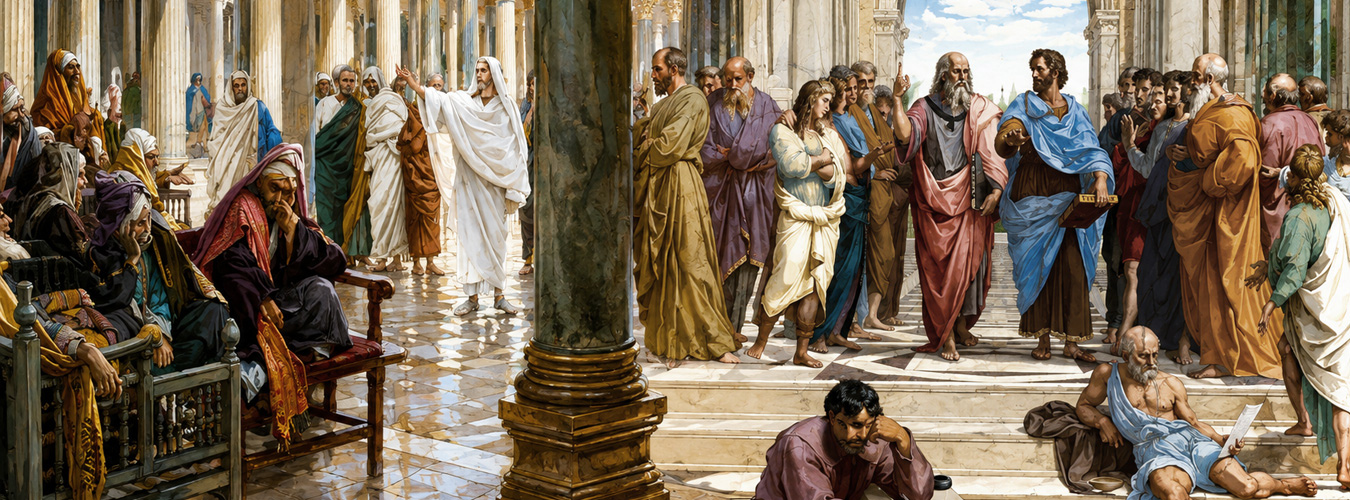

Jesus Putting Away Sin
A sermon
(No. 759)
Delivered on Lord's-day Morning, JULY 7, 1867, by
C.H.SPURGEON,
At the Metropolitan Tabernacle, Newington
"…now once in the end of the age has He appeared to put away sin by
the sacrifice of Himself."- Hebrews 9:26.
WHEN the conscience is unenlightened and the heart is rebellious, man
is divided from his God by a false sense of personal righteousness. He
imagines that God deals harshly with him, that He looks upon his sin in
too severe a light, and that although He may be offended, yet, in some
other respects, he has a claim upon the consideration of his Maker. As
soon, however, as the Spirit of God illuminates the understanding, this
self-righteousness disappears! It is a flimsy cobweb which the broom of
the Law soon sweeps away. It is no more substantial than the mist of
the morning, and it is at once dissipated by the rising sun of Divine
Grace.
Then man feels himself divided from his God by another and more real
barrier–he has given up his self-righteousness, but now he is
painfully conscious of his sinfulness, which appears to him to be an
impassable gulf– separating him forever from the just and holy God.
The more the conscience becomes quickened and the more fully the
understanding is enlightened, the more desponding does the man become
as to any hope of his ever becoming acceptable to the Most High. He
puts himself into God's position–his enlightened understanding enables
him to look upon sin in some degree as God would regard it–and he is
horrified to think that he should have been so ungrateful to so kind a
Father!
He is ashamed that he should have broken laws so perfectly just, and he
is altogether out of heart with himself for having done despite to a
government every way so generous and righteous as the moral government
of God. The awakened sinner says within himself, "I can never make
recompense for the injury which I have done to God's honor. It is not
possible that anything I do or suffer may compensate for my continued
rebellion and obstinacy. Even if I could cease from sin in the future,
yet I cannot hope to meet my God with peaceful mind when I remember the
unhallowed and disgraceful past."
And thus the very enlightenment of conscience, which is one of the best
signs of hope in quickened sinners, causes in him a consciousness of
sin which becomes to him the ground of self-despair. I have no doubt I
have some such in this congregation. Even among you who have believed
in Jesus there may be some such. Every now and then we must go back to
first principles and get, again, a distressingly vivid sight of sin. We
need, once more, to understand how God can be just and yet the
justifier of him that believes.
Brethren, if you are now desirous to be at one with God. If your spirit
longs for His embrace–and yet you feel as if you could not come to God
by reason of the sin which troubles you–it will be a great joy to you
to know that eternal wisdom has devised a plan, and carried it out,
too, for the effectually putting away of sin! This is a wonder of
wonders which will create, forever, enthusiastic gratitude among
celestial spirits. Eternity shall not diminish the amazement of our
minds at the thought that the impenetrable partition wall of our sin
has been broken down, and the awful veil of thick darkness which shut
us out from the Mercy Seat has been forever removed.
Belshazzar's knees knocked together and the joints of his loins were
loosened when he saw the handwriting on the wall which declared his
condemnation. What joy would have filled his despairing spirit if
suddenly that writing had been blotted out, and another hand had
written "I have loved you with an everlasting love"! Can you conceive
the joy of that astonished monarch–the transport of that frightened
throng?
Yet this morning I have as good news to tell to the penitent as though
such were their position, and such the act of pardoning mercy! Jesus
has blotted out the handwriting which was against us, and written words
of love concerning us! The Angel of Wrath once stood over Jerusalem,
having a drawn sword in his hand, but Jehovah has put away the sin of
His people and now the avenging sword is returned to the scabbard and
God regards His Zion with everlasting love! I have said that this is a
wonder, and so it is, when you recollect that the angels fell.
The sons of the morning kept not their first estate, but for fallen
angels there is no putting away of sin. Shut up forever, chained with
adamantine bands, their sufferings shall know no pause, their anguish
shall find no end. And yet we, creatures of inferior mold, we have
enlisted the sympathy of the Ever Blessed who undertook to make
atonement for our sin, and has achieved the purpose of His Grace.
Brethren, it might have been easy enough for God to have put away human
sin itself by the destruction of our race. It would no more need an
effort of power on God's part to destroy us than for us to tread upon a
moth–no, His mere will could have done it–and I do not know that one
of the crowns of His glory would have lost a jewel.
He might instantly have created another race superior to ourselves if
so it had pleased Him, and every gap which the destruction of mankind
might have caused in the universe might have been at once filled up.
But, wonder of wonders, He spares us at a vast expense–He spared not
His own Son, but freely delivered Him up for us all! It has sometimes
been asked why God did not pardon sin without an atonement. That is a
question which we must leave those to answer who propound it. We do not
doubt but what God might have done so if so He had willed–we doubt
whether He ever would have willed to do so, for our view of the
constitution of His glorious Character seems to require that sin should
be punished.
But that is not a question for us–we know that the Lord has not willed
to let sin escape. He has been pleased to make the display of His Grace
to sinners an opportunity for the revelation of all His other
attributes, that–
"God, in the Person of His Son,
Has all His mightiest works outdone." Without raising questions which
would minister no profit to us, it is ours to behold the great love
which the Lord has loved us–that He sent His Son to redeem us from our
iniquities by the shedding of His own most precious blood–
"Oh, fathomless abyss!
Where hidden mysteries lie!
The seraph finds his bliss
Within the same to pry.
Lord, whatis man, Your desperate foe,
That You should bless and love him so?" I propose, this morning, as God
may help me, to comfort those who are longing for reconciliation with
God by showing them that no difficulties exist, since Jesus Christ has
forever put away the sin which would have separated a penitent soul
from its God. We shall look at the text carefully, and I think we shall
notice in it several things which minister comfort to seeking sinners.
Jesus Christ has appeared once, in the end of the age, to put away sin
by the sacrifice of Himself.
I. Let us consider, first, THE TIME OF THIS GREAT PUTTING AWAY OF SIN,
in the end of the world, or the age–"in these last days"–as one of
the Apostles words it. Why was that time selected? Was it not in order
to exercise the faith of ancient saints, who, like Abraham, saw
Christ's day in vision–saw Him and were glad? They were denied the
great privilege which we possess. Prophets and kings desired it long,
but died without the sight. Nevertheless, above the mausoleum of
ancient saints we read this inscription, "These all died in faith."
They rested in confidence in the Messiah that was to come, and their
faith received its reward. Did not God place the putting away of sin at
the close of the age in order to glorify His Son by letting us see that
the very anticipation of His death was sufficient for the salvation of
men? Before Peter touched the sick, we find that his shadow had a
healing efficacy, and so, before Jesus literally took upon Himself our
flesh, we find that the shadow of His Advent saved the chosen sons of
men!
Long before the sun has risen in these summer mornings, the twilight
begins. Before his wheel has touched the horizon, his refracted light
banishes the darkness. And so, before the Savior actually came there
was a blessed twilight of Gospel Grace, in the light of which
Patriarchs found their way to Jerusalem the golden. Let us glorify the
blood of Jesus, which in God's decree was shed from before the
foundations of the world! Let us magnify the Divine Sacrifice which,
before it was led to the slaughter was capable of redeeming from death
and Hell unnumbered thousands of God's elect!
Was not this Sacrifice placed at the end of the world to be, as it
were, the crown of all Jehovah's works? I see before me a stupendous
pyramid, the base of it is exceedingly broad. It is the inanimate
creation. Stars unnumbered lie close to-
gether at its base like the sands of the Libyan desert. Ponderous
masses of matter underlie the whole amazing structure, all radiant with
the glory of God with a light like a stone most precious, even like a
jasper stone, clear as crystal.
Measureless fields of space and all but infinite leagues of matter form
the grosser basis of the pyramid which now rises before my astonished
vision. Overlying this, as though it were a layer of malachite or
emerald veined with blue, and scarlet, and vermillion, I see the
vegetable creation with all its beauty of form and splendor of
color–cedar and hyssop, olive and lily, oak and bramble. No art of man
or polished jewels of the mine can rival its magnificence. Over these,
sparkling like the stone which was full of eyes, I see the animal
kingdom with its mingled varieties of symmetry and strength, energy and
vitality.
Here on high the pyramid is narrower, but its light is far more
excellent, for the likeness of the living creatures sparkle and flash
like burning coals of fire, with an energy unseen in the broader
foundations which are placed beneath. Beasts and all cattle, creeping
things and flying fowl all magnify the master Builder who has ordained
for them their place in the pyramid of His manifested glory. Higher
still I see man, who is made to have dominion over all the lower works
of God–man, of whom it is written, "You have been in Eden the garden
of God. Every precious stone was your covering, the sardius, topaz, and
the diamond, the beryl, the onyx, and the jasper, the sapphire, the
emerald, and the carbuncle, and gold."
Above these I see men twice made–the regenerated men, the precious
sons of Zion–comparable to fine gold, the peculiar portion and crown
jewels of Jehovah. But can my eyes endure to gaze upon the glowing
brightness which forms the apex of the glittering pyramid? I look, and
lo, above the firmament, higher than the Heaven of Heaven, I see the
likeness of a throne, as the appearance of a sapphire stone, and upon
the throne there sits the Son of Man in all the brightness of His
Father's glory, encircled with a rainbow like unto an emerald, and
hymned by innumerable spirits in strains like these: "You are worthy, O
Lord, to receive glory and honor and power: for You have created all
things, and for Your pleasure they are and were created."
O my Soul, are you not overwhelmed with the vision of Man upon the
Throne of God? Man most true and manlike, born of a virgin, the woman's
promised Seed and yet God over all, blessed forever! When that pyramid
was crowned with such a matchless Topstone well might the morning stars
sing together, and all the sons of God shout for joy! Well might there
be from men and angels joyous shouts of "Grace! Grace unto it." The
great Master of the feast has kept the best wine until now! Richest and
rarest of the wines on the lees, well refined is that which was shed on
Calvary by the soldier's spear! Rich was the store which the glorious
Monarch of the ages placed upon the table of His benevolence!
But in these last days He brings out the choicest of His dainties, the
Bread of Heaven, the wine which makes glad the heart of God and man.
"Thanks be unto God for His unspeakable gift." The practical point I
drive at in referring to the period of our Lord's Sacrifice is just
this–you and I live in a period when the putting away of sin has been
perfectly accomplished. Beloved, sin is put away! We have not to
exercise the faith of a Noah, or an Isaac, or a David in looking
forward to the expiation as a blessing yet to come, but the testimony
of the Holy Spirit is that Jesus has once and for all finished
transgression, and made an end of sin, and brought in everlasting
righteousness!
Jesus has been led like a lamb to the slaughter. The Passover is slain,
the Propitiation is made. It is a recorded fact. It is a fact that
never can be blotted from the annals of time, that redemption is
finished! Sin is put away by the one great Sacrifice, and we may come
to God who is reconciled through the death of His Son. May I press this
upon those of you who would come to God, but are afraid? Come back,
poor Prodigal! The heart of God towards you is that of a loving Father!
You need not fear! Come back, you Wanderer, however far you may have
gone–
"Sprinkled now with blood the Throne, Why beneath your burdens groan?
On My pierced body laid, Justice owns the ransom paid. Bow the knee,
and kiss the Son; Come and welcome, Sinner, come."
If, in the earliest ages you had come in faith that this atonement
would be offered, you would have been accepted. But how can you linger
when the atonement is already presented? Once, in the end of the ages,
the work of Divine Grace has been done. You have not to wait until the
bridge spans the gulf. You have not to enquire who shall roll away the
stone,
for, behold, One greater than an angel has descended and rolled away
the stone from Heaven's gate and opened the kingdom of Heaven to all
Believers!
There are no barriers now between a seeking soul and God except such as
unbelief shall set up. I pray you, build no barricades to exclude
yourself from happiness! Christ has dashed down all the partition walls
that your sin had erected and there is a straight path from your
present position right up to God's greatest glory! Come now, even now,
unto the Lord, believing in the Atonement which is achieved.
II. Secondly, let us meditate upon THE PERSON ACCOMPLISHING THE WORK.
Once, in the end of the world, has HE appeared. Remember who it was
that came to take away sin that you may find solid and substantial
ground for comfort, and may the Holy Spirit help you to stand upon it.
He who came to take away sin did not come unsent. He was appointed and
delegated by God. As Toplady has put it in his hymn–
"The God for your unrighteousness Deputed to atone."
He was not only so appointed and elected, but He was also qualified by
God. The Spirit of the Lord was upon Him. He came in His Father's name,
clothed with His Father's authority: "I do not My own will," He said,
"but the will of Him that sent Me." He continually calls it His
Father's work and business which He came to do. This ought to give us
richest consolation. Jesus is no amateur Savior who has no right to
appear as our Representative–He comes in a legal and proper manner.
The King of kings has appointed Him, and what He does He does in the
name and by the authority
of God.
God has sent His Son into the world. His death, though voluntary on His
own part, was not without the consent and will of His Father. It
pleased the Father to bruise Him–He has put Him to grief. Should we
not, when God has set Him forth as a Propitiation for sin–should we
not cheerfully accept whom God appoints?
Attentively observe the constitution of His Person. He who came to save
men is no other than God! Therefore is He capable of viewing sin from
God's point of view and capable of understanding what was due God. By
bracing His Godhead to His Manhood He was capable, in his twofold
Nature, of sustaining pangs which humanity could not have endured apart
from Godhead, and of receiving into His infinite mind a sight of sin
and a horror concerning it such as no finite mind ever could have
endured.
You think you comprehend sin? My Brothers and Sisters, you cannot! It
is an evil too monstrous for the human mind fully to know its heights
and depths, its lengths and breadths. But Christ, who is God Incarnate,
knew what sin meant. He plumbed it to the very bottom and knew how deep
it was. He gazed upon it and felt all the horror of its
unrighteousness, ingratitude, and turpitude. Its sinfulness struck His
mind with all its force and overwhelmed His holy soul with a horror
which none but He could bear. He was a perfect Man and therefore had no
need to die, else His death were for Himself.
It behooved Him to suffer, not because He was the Son of God, or the
Son of Man, but because He was the Redeemer, the Sponsor and the Surety
of men! Can you trust Him? When I have felt the burden of my sin, I do
confess I have at times felt as if it were too great to be taken away
by any conceivable power. But, on the other hand, when I have seen the
excellence of my Master's Person, the perfection of His Manhood, the
glory of His Godhead, the wondrous degree of His anguish, the solid
value of His obedience, I have felt as if my sin were too little a
thing to need so vast a Sacrifice!
I have felt like John Hyatt who, when dying, said he could not only
trust Christ with one soul, but he could trust him with a million souls
if he had them. Were my sins greater than they are, and God forbid they
should be. Were my sense of them 10,000 times more vivid than that
sense is now–and I could wish I had a more clear and humbling view of
my own iniquity–yet even then I know my Lord and Master is a greater
Savior than I am a sinner.
From the constitution of His Person as God and Man I am certain that if
I had heaped up my iniquities till they assailed the skies, and though,
like the giants in the ancient mythology I had piled Pelion upon Ossa,
mountain of sin upon mountain of rebellion, and had thought to scale
the very Throne of God in my impious rebellion–yet the precious blood
of Jesus Christ could cleanse me from all sin! My dear Hearer, if you
are trembling because of your guilt, do not try to be rid of a sense of
the guilt of sin but study much and devoutly the Person of God, the
Sin-Bearer. Let your thoughts dwell upon the great Savior and His work,
and so shall you be able to say, "I will, even I will believe that
Jesus Christ is
able to save to the uttermost them that come unto Him, and I will cast
myself upon Him. I will rest in His Atonement now."
I feel as if I must pause to say to some here how anxiously do I wish
that they would, this morning, have done with seeking rest where no
rest is to be found! Have done with reliance upon anything within or
anything without, except the Son of God! God Himself puts away sin.
What more do you want? You have a God to be your Savior, and will you
link your pitiful weakness with His Omnipotence? Would you yoke an ant
with a cherubim? Will you join your rags to the fair white linen of the
righteousness of Christ? Your nothingness–shall that contribute to His
fullness?
Your strength? It is perfect weakness and your merit is a lie! Will you
bring these to put them side by side with Jesus? No, Sinner, may the
Holy Spirit constrain you now to rest on Him who, in such a glorious
manner, has put away sin in the end of the ages by the sacrifice of
Himself! If those two points do not yield you comfort, I will gladly
hope and pray that a third consideration drawn from the text may do so.
III. Note in the text THE APPEARANCE MENTIONED. "Now once in the end of
the ages has He appeared to put away sin." Dwell on this. The way by
which God has put away sin is one which is not obscure, concealed,
recondite, inexplicable, but one which is eminently plain and manifest!
You will remember that when the High Priest made atonement for sin, he
took the basin filled with blood and passed within the veil. No one saw
him there. And while he stood before the Mercy Seat and sprinkled
blood, no human eye beheld it–his typical work was a thing of mystery.
But, my Brothers and Sisters, the great High Priest and Prophet of our
profession has torn the veil and appeared openly, and the putting away
of sin by Him is a manifest thing which can be seen by the
understanding! No, in some respects it was even seen by human eyes and
heard by mortal ears! Christ appeared, that is to say, when He came
down among men He lived for no less than 32 years under daily human
inspection. He was seen as a Child in the manger by shepherds and by
Eastern wise men. He was not concealed and put away like Moses, hidden
from the Egyptian murderers, but He was the Observed of all observers.
As a Child, no doubt, His bringing-up was well known, so that they
said, "His sisters and His brothers, are they not all with us?" "As for
this man, we know where He is." That short portion of His life which
was allotted to public ministry was public in the highest degree. "In
secret," said He, "I did nothing." "I taught openly in your streets."
For "the Word was made flesh, and dwelt among us," says John, "and we
beheld His glory, the glory as of the only-begotten of the Father, full
of Grace and truth." No, more not only was His Manhood apparent, but
His Godhead, too. Did He not raise the dead with His voice?
When He walked on the sea, when He healed the leper, when He opened the
blind eyes, when He unstopped the deaf ears–were not all these gleams
and glimpses of His eternal power and Godhead? These things were not
seen by a few priests set apart to enter into the sacred circle, and
then to bear witness, but throughout all Galilee and Judea it was
openly heard abroad that the Messiah had come, and "these things were
not done in a corner."
And further, Brethren, the great act by which our Lord redeemed us was
an open act. True, there were inward depths into which the human mind
cannot dive. God knows, and God alone, all that His Beloved suffered.
But still, the scourging and the mocking, the spitting and the crowning
with thorns, the nailing and the Crucifixion and the death– these were
open and manifest things. Did not all Jerusalem ring with the news that
Jesus of Nazareth, a Man sent of God, had been put to death? And I will
proceed a step further.
Not only were the Incarnation of Christ and His Deity, and His death
manifest things, but the way in which these things relate to the
forgiveness of sin is also clearly revealed to us. We do not come to
you this morning, and say, "Believe in Jesus Christ–it is a great
mystery, you cannot understand it, but if you trust in Jesus Christ,
God will save you." No, we tell you that there is a ground for your
trust which your reason may apprehend–it is this, that Jesus Christ
stood in the place and stead of sinners–that God visited Him with the
stripes which were due to us. That, to use the words of our hymn–
"He bore, that we might never bear His Father's righteous ire."
Now, this is a clear explanation of the plan of salvation. Not thus is
it with the mummeries of superstition. The priests of Baal tell us that
when they take an infant in their arms, and put water on its face,
using a certain ritual, that the
unconscious babe becomes then and there a member of Christ, a child of
God, and an inheritor of the kingdom of Heaven! Can they tell us how
this marvelous change is worked upon a dormant intellect, a slumbering
soul?
No, they can only mutter that it is by some occult influence! Occult,
indeed! For the child grows up to live as others live, and perhaps to
die in unbelief. Such mummeries, with their base pretensions to occult
influences, are worthy to be ranked with the whispers and incantations
of the witch of Endor, or the dealings of Balaam, the son of Peor. But
we can tell you how it is that sin is put away by the Sacrifice of
Christ. There is nothing occult in the Cross.
The doctrine of the Atonement appeals to the understanding and the
judgment. Christ pays the debt–then, of course, the Believer is free.
Christ suffers for me. Then how can two suffer for the one offense?
Here is something for men in their wits to think of–something for the
most profound intellect to ponder over. As for the shams of confession,
priestly absolution, etc., which Baal's priests are continually
thrusting in your way instead of our blessed Lord and Master–such
shams that my soul boils at the very thought of them–regard them not,
neither endure them!
With their vestments, their genuflections, and their ceremonies they
are as wizards that peep and mutter and forge a lie to deceive. They
would use an unknown language if they dared, like Babylon's priests. As
it is, their intoning makes plain words hard to be understood. Their
religion is not a revelation, but an rejection–not a manifestation of
God– but a veiling of His face. Like the children of the old Covenant
of Bondage, they have a veil over their faces and they see not the
Truth of God! But we who preach Jesus Christ in the fullness of His
Gospel use great plainness of speech, for we tell you good news which
you can comprehend.
We tell you that Truth of God which appeals to your understanding and
intellect–for once in the end of the ages Jesus Christ has made a
disclosure of Himself. He has brought life and immortality to light and
has revealed to you how God can be just, and yet the Justifier of the
ungodly. Surely there is no one here who does not understand the plan
of Substitution. If there were, I would try to elucidate it still
further. Jesus Christ, the Son of Man, stood in the place of men–in
your place, dear Hearer, if you trust Him! He suffered for you.
You can understand how God is just in taking this Sacrifice, offered
voluntarily, instead of your sacrifice– punishing Christ instead of
you, and then saying to you–"I have vindicated the honor of My
government. I have magnified My Law and shown that it must not be
trifled with, and now I forgive you–freely do I pardon you, for Jesus
died." I pray you receive with your heart what you have accepted with
your understanding.
My dear Hearer, kick not against a Gospel so simple, so just to God, so
safe to you! Yield to it, I pray you, yield now, and remember, if you
believe in the appointed Savior you are saved! If you will trust
yourself now with Jesus Christ, He will not fail you. He will cover you
with His righteousness, cleanse you with His blood, protect you by His
power, and, by-and-by enshrine you in His glory, world without end. But
we must pass on.
IV. A fourth matter which should yield us consolation is THE SACRIFICE
ITSELF. "Once in the end of the ages has He appeared to put away
sin"–how? "By the sacrifice of Himself." Observe, Brothers and
Sisters, Christ did not come into the world merely to put away sin by
His example–His example is most blessed–and if we follow it, it
becomes a potent means of promoting virtue. Jesus did not come into the
world merely to put away sin by His teaching–although His teaching
does do that wherever it is received, since in the strength of His
doctrine men become mighty through His Spirit to overthrow their inbred
sin.
But we are told in the text that He came to put away sin by sacrifice.
Oh, how some people writhe and rage at this! Those Socinians who sat at
the foot of the Cross when Jesus Christ died, and said, "Let Him come
down from the Cross and we will believe in Him," held the same beliefs
as their successors who will admire Jesus everywhere but as a sacrifice
for sin. Many men kick the Crucified Son of God. "No," they say, "the
doctrine of the Atonement, the doctrine of suffering for sin–sin being
put away by blood–it is that which we cannot endure."
Know, then, you proud objectors, that this is the Gospel–the sum and
substance, and essence of Mercy's message– this is the Good News from
Heaven, that Jesus Christ has put away sin not by His teaching, nor by
His example alone, but by making a bloody sacrifice of Himself! I fear
that this doctrine is covertly assailed by a school of men who mingle
with the orthodox, and are much admired for their intellect and boasted
liberality. In some way or other they try to get rid of this sacrifice
by blood.
Substitution, Atonement by suffering they cannot believe in, but I pray
you, dear Friends, as you would be saved, hold this Truth of God. No,
do more! Build your soul's only hope upon it, for no other foundation
can man lay than
this–the foundation of salvation through faith in Jesus' blood. "The
blood of Jesus Christ, His Son, cleanses us from all sin." And nothing
but the blood! Take the blood of Jesus away and you have removed the
only effectual consolation from a troubled conscience.
Note that the text affirms that our Lord took away sin by the
sacrifice, not of His honor, though He left that and forsook the courts
and courtiers of Heaven. Not by the sacrifice of His wealth, for though
He was rich, yet for our sake He became poor. It does not say that He
took away sin by the sacrifice of His reputation though He did make a
sacrifice of that, and made Himself of no reputation, and took upon
Himself the form of a servant–but it was the sacrifice of HIMSELF–His
body and His soul.
It was that sacrifice, my Brothers and Sisters, which commenced in
Gethsemane when the bloody sweat bedewed Him from head to foot–when
every portion of His body and every power of His soul was full of
anguish and dismay. It was that sacrifice which was carried on in the
halls of Pilate, before the judgment seat of Caiaphas, at the bar of
blustering Herod–a sacrifice which He offered when they scourged Him.
When they plaited a crown of thorns. When they spat upon Him. When they
struck Him with their fists and mocked Him–a sacrifice which
culminated when He hung upon the Cross in the extreme of thirst, and
shrieked, "My God, My God, why have You forsaken Me?"
O Sinner, I would that you would stand at the foot of the Cross and
think of Jesus till you could find comfort! I believe the shortest way
to faith is to consider well the Object of faith. The true way to get
comfort is not to try and comfort yourself away from the Cross, but
think of Christ dying for you till you are comforted. Say to your soul,
"I will never depart from the Cross until I am washed in His precious
blood!–
'Blest Savior, at Your feet I lie, Here to receive a cure or die. But
Grace forbids that painful fear, Almighty Grace, which triumphs here.'"
You know the healing came to the sin-bitten by looking at the
serpent–not by looking at their own wounds, nor yet by hearing about
the cure of others! And, even so, healing will come to you–not by
looking at sin, nor hearing about Christ–so much as by fixing your
mind's eye upon the Cross and meditating upon Him who died there, till,
as by considering His merits you believe on Him and so are saved!
Beloved, put these two or three thoughts together. God comes into the
world as Man–the Mediator dies. Easily said, but what a weight of
meaning in it! Now, what merit there must be in the suffering and death
of the dying Mediator! What power there must be in the blood of Him
who, while He is Man, is nevertheless God! Come, guilty Sinner! Plunge
into this Fountain filled with blood, and you shall be made clean, or
else God speaks not the truth. Come, you blackest, foulest, filthiest,
most defiled of all the human race! Come now and look to Jesus, dying,
bleeding, and you must be saved, for God's Word is pledged to it! He
cannot cast into Hell the soul that rests upon the sacrifice of Christ.
Only let us be well persuaded that sin is put away by nothing but by
the Lord Jesus making himself a Sacrifice.
V. Still, if this should not yield comfort, though I pray it may, for
one moment I ask you to think, in the fifth place,
of THE THOROUGHNESS OF THE WORK WHICH WAS CONTEMPLATED. In the end of
the ages Christ was revealed to put away sin. He did not come into the
world to palliate it merely, or to cover it up, but He came to put it
away. Observe, He not only came to put away some of the attributes of
sin, such as the filth of it, the guilt of it, the penalty of it, the
degradation of it–He came to put away sin itself, for sin, you see, is
the fountain of all the mischief.
He did not come to empty out the streams but to clear away the fatal
source of the pollution. He appeared to put away sin itself, sin in its
essence and being. Do not forget that He did take away the filth of
sin, the guilt of sin, the punishment of sin, the power of sin, the
dominion of sin–and that one day He will kill in us the very being and
existence of sin–but remember that He aimed His stroke at sin itself.
My Master seemed to say, as the king of Syria did of old, "Fight
neither with small nor great, save only with the king." He aimed His
shafts at the monster's head, smote his vital parts, and laid him low.
He put Hell itself to flight, and captivity was led captive. What a
glorious word–our Lord put away sin! We read in the Word of God,
sometimes, that He cast it into the depths of the sea. That is
glorious, nobody can ever find it again–in the shoreless depths of the
sea Jesus drowned our sins!
Again, we find He removed it as far as the east is from the west. Who
can measure that distance? Infinite leagues divide the utmost bounds of
space–so far has He removed our transgressions from us. We read again
that He has made an
end of sin. You know what we mean by making an end of a thing–it is
done with, annihilated, utterly destroyed and abolished. Jesus, we here
read, has put sin away, He has divorced it from us. Sin and my soul are
no more married! Christ has put sin away–He has borne it away as the
scapegoat carried the iniquity of the people in type and shadow. He has
literally taken upon Himself the sins of all His people, and, stronger
than Atlas, has borne the load and carried it away and hurled it into
His sepulcher where it lies buried forever.
"Who shall lay anything to the charge or God's elect? It is God that
justifies. Who is he that condemns? It is Christ that died, yes,
rather, that is risen again, who is even at the right hand of God, who
also makes intercession for us." Sin is clean gone. If you believe in
Christ, there is nothing that can be laid to your charge! The past, the
present, the future– every sin was laid on Christ! Sins of tongue, and
brain, and heart, and hand, and thought were all laid on Him. Sins
against men, sins against God, adultery, murder,
blasphemy–everything–all were laid on Jesus!
He became, as it were, the common reservoir for all the sin of His
people to meet, and then He emptied it all out by His atoning
Sacrifice, so that the filth of His people is removed. He has crossed
the Kedron and put away the filth of sin. You and I may sing concerning
sin as Israel sang concerning Egypt when the ransomed nation stood upon
the shore of the Red Sea. "The depths have covered them: there is not
one of them left."
O for a sweeter voice than Miriam's! O for virgins more joyful and more
tuneful than the daughters of Israel! O for high-sounding cymbals and
lofty timbrels to resound with our exulting song! "Sing unto Jehovah
Jesus, for He has gotten unto Himself the victory! He has appeared and
put away sin by the sacrifice of Himself! And now, as for our
iniquities, the depths have covered them–there is not one, not one,
not one of them left! They sank unto the bottom like a stone! They sank
like lead in the mighty waters! Sing you unto the Lord, for He has
triumphed gloriously!"
VI. O that some soul may get a ray of light from the last
consideration, if all others shall have failed! THE EVIDENT COMPLETION
of this work, upon which we have already touched, demands a word
because of its being rendered conspicuous by the word, "once." "Once in
the end of the ages He has appeared to put away sin."
If He had not put away sin, He would have come again to do it, for
Jesus Christ never leaves His work unfinished. What He undertakes He
achieves. The pleasure of the Lord shall prosper in His hands. My
Brothers and Sisters, Christ's one offering put away all sin forever.
Away! Away with those priests of Baal with their "unbloody sacrifice,"
as they call it, offered daily for the propitiation of sin! Traitors to
God's truth! Traitors to the souls of men! May they never dominate in
this land, but may their barefaced impertinencies be cast forth as dung
upon the face of the earth, and may they themselves be rejected as salt
which has lost its savor!
What right have they to eat the bread of a Protestant people while
doing the Pope's work? Our Lord has once and for all made an Atonement,
and all attempts to tamper with His finished work is treason such as
shall be answered for in the court of Heaven! And terrible shall be the
doom of those who have dishonored Christ in the point where He is most
jealous of His honor.
Brethren, Christ's being in Heaven today is a proof that there is
nothing to divide a sinner from God on God's part–
"If Jesus had not paid the debt,
He never had been at freedom set." He would have been imprisoned in the
prison of the tomb at the present moment if He had not discharged all
the debts and liabilities of His people. And His exaltation in Heaven
is the evidence that He has completed His work. There He takes His seat
because the work is done. If the work had not been accomplished, He
would be suffering, suffering often, until at the last He could say,
"It is finished."
But His redemption is complete! Sin is put away and Believers are
saved. What I have to say, in conclusion, is this. Will you not come,
poor, guilty, empty, needy Sinners? Will you not come and partake of
the glorious fullness of Christ's merit this morning? O why do you
stand back? You need no fitness. Wait not for it. No goodness is asked
of you. Do not look for it. All goodness dwells in Him. Come with your
hard hearts, He will soften them! Come with the stone that is within,
He will take it away and give you a heart of flesh. Come to Jesus now
for all–
"True belief and true repentance, every Grace that brings us near,
Without money, come to Jesus Christ and buy."
Oh, if I knew how to preach my Master to you plainly, I would! If the
words would be called vulgar, I should not care for that so long as I
could make men see what is the mystery of Christ Jesus, which was hid
in the ages past, but now is made manifest in Him. O trust Him, Souls,
trust Him, and you shall be saved!
I heard the day before yesterday what greatly cheered me. I heard that
at the late meeting of Believers at Chicago, one came from the far West
who asked for a missionary to preach in a newly-formed district, and
the reason he gave for wishing for the missionary was this–that they
had read my sermons on Sunday, and that no less than 200 souls had been
converted to God by the reading of those sermons. When I read that
report I did exceedingly rejoice, but then I thought, "Alas, there are
many who have those sermons first hand, and get no blessing from them."
And I thought of some of you who had heard me these many years, and I
have been faithful to you–I trust I have–God knows I desire to
be–and yet you are in the gall of bitterness and in the bonds of
iniquity!
While across the blue Atlantic, the echo of our words has called men
from the grave of sin to life in Christ, you, though you love to listen
to us, have not heard our voice in the depths of your soul! Shall it
always be so? It will be, I fear, with some of you, for I foresee your
ruin. You will go down to Hell with the Gospel sounding in your ears
and wake up in the pit with this to aggravate your woe, that you knew
the Gospel and refused it! How shall you escape if you neglect so great
a salvation, so great that angels cannot tell its greatness, and human
tongues are dumb, at best, when they attempt to speak of the excellent
glory of it? Why will you reject it when it is in your hands, when, if
you with your hearts believe and with your mouths confess Christ, you
shall be saved? Why those hard hearts? Why those silent mouths? May the
Eternal Spirit bring you to Jesus, and His shall be the praise, world
without end. Amen.
__________________________________________________________________
The Sweet Harp of Consolation
A sermon