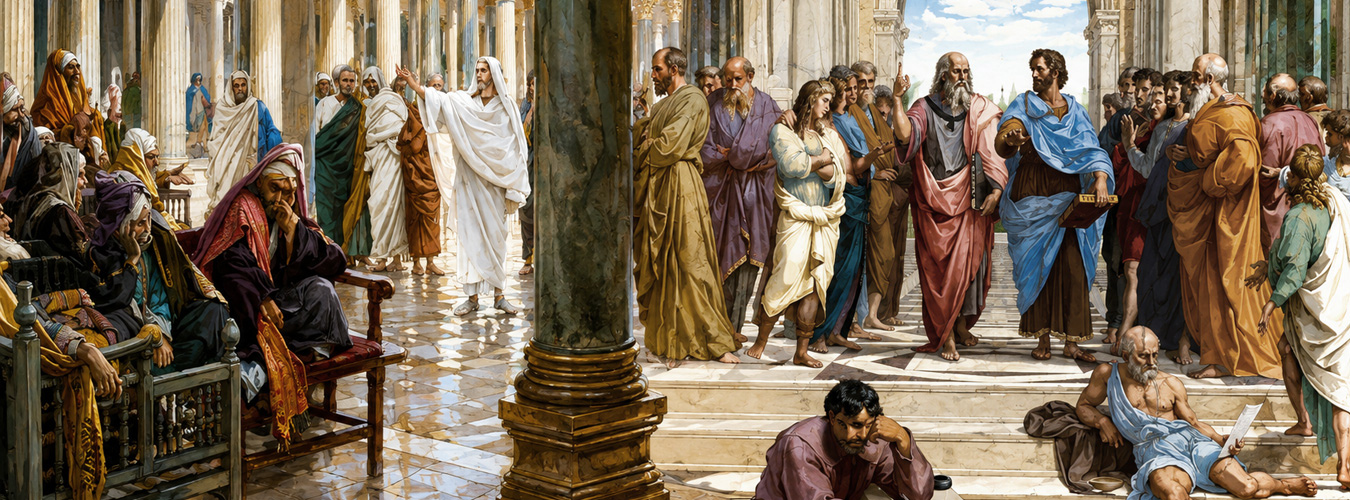

The Centurion–Or An Exhortation To The Virtuous
A SERMON DELIVERED BY C. H. SPURGEON, AT THE METROPOLITAN TABERNACLE,
NEWINGTON.
"And when they came to Jesus, they besought Him instantly, saying, That
he was worthy for whom He should do this: for he loves our nation and
he has built us a synagogue. Then Jesus went with them. And when He was
now not far from the house, the centurion sent friends to Him, saying
unto Him, Lord, trouble not Yourself: for I am not worthy that You
should enter under my roof: why neither thought I myself worthy to come
unto You: but say in a word and my servant shall be healed. For I also
am a man set under authority, having under me soldiers and I say unto
one, Go and he goes. And to another, Come and he comes. And to my
servant, Do this and he does it. When Jesus heard these things, He
marveled at him and turned Him about and said unto the people that
followed Him, I say unto you, I have not found so great faith, no, not
in Israel." Luke 7:4-9.
THIS Centurion certainly had a high reputation. Two features of
character blend in him which do not often meet in such graceful
harmony. He won the high opinion of others and yet he held a low
estimation of himself. There are some who think little of themselves.
And they are quite correct in their feelings as all the world would
endorse the estimate of their littleness. Others there are who think
great things of themselves–but the more they are known the less they
are praised–and the higher they carry their heads the more the world
laughs them to scorn!
Nor is it unusual for men to think great things of themselves because
the world commends or flatters them. They robe themselves with pride
and cloak themselves with vanity because they have by some means,
either rightly or wrongly, won the good opinion of others. There are
very few who have the happy combination of the text. The elders say of
the centurion that he is worthy. But he says of himself, "Lord, I am
not worthy!" They commend him for building God a house. But he thinks
that he is not worthy that Christ should come under the roof of his
house. They plead his merit. But he pleads his demerit.
Thus he appeals to the power of Christ apart from anything that he felt
in himself or thought of himself. O that you and I might have this
blessed combination in ourselves! To win the high opinion of others, so
far as it can be gained by integrity, by uprightness and by decision of
character and yet at the same time to walk humbly with our God! Now
there are three things I shall speak about tonight and may God make
them profitable. First, here is a high character. Secondly, here is
deep humility. And, thirdly, here is, notwithstanding that deep
humility, a very mighty faith.
I. To begin, then, dear Friends, here is A HIGH CHARACTER. Let us
thoroughly appreciate it and give it a full measure of commendation.
When preaching Jesus Christ to the chief of sinners, we have sometimes
half dreamed that some who are moral and upright might think themselves
excluded–they ought not to think so, nor is it fair for them to draw
such an inference. We have heard the whisper of some who have said they
could almost wish that they had been more abandoned and dissolute in
the days of their unregeneracy so they might have a deeper repentance
and be witnesses of a more palpable and thorough change and that they
might never have cause to doubt of the triumph of Grace in their
experience!
We have even heard some say, "I could have wished that I had groveled
in the very mire of sin–not that I love it– on the contrary, I loathe
it. But because had I then to be rescued from such a course of life,
the change would be so manifest and apparent that I should never dare
to ask myself whether I was a changed man or not. I should feel it and
see it in my daily course and conversation." Dear Friends, if anything
we have ever said should have led you into this mistake we are sorry
for it–it was never our intention. While we would open the gates of
mercy so wide that the greatest blas- phemer, the most unchaste and the
most debauched may not be without hope–yet we never want to shut those
gates in the face of such as have been brought up in a godly
manner–those who through the Providence of God and the checks of
education have been kept from the grosser vices.
On the contrary, we thought that when we opened it for the worst there
would be room for the best! And if Noah's ark took in the unclean,
certainly the clean would not be afraid to enter. If Jesus Christ was
able to cure those who were far gone in sickness, you might infer that
He would certainly be able to heal those who, though they were sick,
might not be so far advanced in disease! Besides, a little reflection
may suggest to you that the penitence of contrite Believers is not
regulated by the extent of their crimes against what you call the moral
code. It is one thing to estimate sin by its apparent turpitude and
another and an infinitely better thing to have the eyes of the
understanding enlightened–to see sin in its infinite malignity as it
appears in the light of heavenly purity and perfection which proceeds
from the Throne of God, or as it is reflected from Mount Calvary where
the amazing Sacrifice of Christ was offered.
What? Do you think the whitewashed sepulcher of a Pharisee's heart is
less loathsome to the Almighty than the open pollution of a Magdalene's
life? Or, in the matter of experience, could the recollection of a
thousand debaucheries give such a melting sense of contrition as a
sight of the Crucified One? O Friends, let me remind you of the words
of Jesus, "When He"–the Spirit of Truth–"is come, He will reprove the
world of sin and of righteousness and of judgment: of sin, because they
believe not on Me."
That one sin of unbelief is such a concentration of all wickedness that
it could outweigh the crimes of Sodom and Gomorrah and make them more
excusable in the Day of Judgment than the men of Capernaum who saw the
mighty works of Christ and did not repent! That one sin of unbelief is
so heinous that the groans of the whole creation were but pitiful sighs
to deplore it! And rivers of tears were but a weak tribute to lament
it. However, as mistakes do arise and misapprehensions will take place,
let us have a few words concerning a high character in the sight of
men. Such a character among your fellow creatures may be gained in any
situation.
The centurion was a soldier–a profession of life not altogether the
most favorable for moral excellence–though there have been in the army
some of the brightest saints that ever lived. He was a soldier,
moreover, in a foreign country–not the place where he was likely to
win esteem. He was there as one of the representatives of a power which
had conquered Judea and had treated it with great cruelty. Yet,
notwithstanding the prejudices of race and nationality, this man's
kindness of disposition and goodness of conduct had won for him the
esteem of others.
Moreover, being a commander of soldiers, he, naturally, would be blamed
for every act of violence committed by his soldiers. Whatever might be
done by his hundred men would be laid to the captain, so that his was a
condition of peculiar difficulty and yet, notwithstanding this, the
elders said, "He is worthy." Let none of you despair! Wherever you may
be placed, a noble character may be earned. You may serve God in the
most menial capacity but you may compel your very foes to admit your
excellence! You may stand without blame before men and you may walk so
uprightly before God that those who watch for your stumbling may bite
their lips with disappointment–while they shall not have a single word
to say against you except it is about the religion of your God and
King.
Let no man, wherever he may be thrown–though he is surrounded by those
who tempt him–despair, especially if the Grace of God is in him. Let
him pray like Joab that he may have favor in the eyes of his Master and
expect to win it. This centurion must have been a man of sterling
worth. He was not merely quiet and inoffensive like some men who are as
dull as they are harmless. Though a high character may be won, it
cannot be won without being earned. Men do not get character among
their fellows by indolence and listlessness, or by pretensions and
talk. Action! Action!–this is what the world wants!
And there is more truth than we have dreamed of in Nelson's
opinion–"England expects every man to do his duty." Certainly men will
not speak well of you unless you do well. This centurion did so, for
you will observe that they said he was worthy–which must have
signified that he was just in his dealings and generous in his
habits–or they would not have thought him worthy. It would appear,
too, that his private temperament as well as his public spirit
contributed to the estimation in which he was held. You will notice in
the circumstances which bring him before us, how his tender feelings
and his intense anxiety were drawn out on behalf, not of a child, but
of a servant–perhaps of a slave!
And then we might have thought it had been enough to have said that the
man was highly valued by his master–but the expression is one of
fondness–he was, "dear unto him." The fidelity of the servant may be
implied, but it is the amiability of the master which is most prominent
and chiefly arrests our attention. Nor need we overlook the fact that
Matthew lays an emphasis upon the servant being, "at home," under his
master's roof. We know that the Romans were not remarkable for the
kindness they showed to their dependants–often they were merely looked
upon as slaves.
Why, in our own days and in the midst of our boasted civilization, when
Christianity has exerted a salutary influence upon all our social
relations, I suppose it is not uncommon for a domestic servant to go
home to her parents' house in the case of sickness. It is not every
good man among us, I fear, whose gentleness would equal that of the
centurion in the love which he bears to his servant and the comfort he
provided for him in his own house!
Next to this you will observe his generosity. It is not, my dear
Friends, by occasional deeds of showy luster but by the habitual
practice of lovely virtues that a worthy character is built up. A
thousand kindnesses may be nestling beneath the soil like the
many-fibred root of a gigantic tree, when it is said, "He loves our
nation," and then the conspicuous fruit appears in its season–"He has
built us a synagogue." This example of liberality is spoken of as a
mere supplement. The Jewish elders do not say, "He loves our nation"
for–but they say, "he loves our nation and he has built us a
synagogue." This last was a visible token of innumerable good offices
which had already won their secret esteem before it bloomed in an open
reputation.
I have heard all sorts of men praised and I have noted the qualities
which win the plaudits of the crowd. Even the high and haughty have
some to praise them. But I think I never heard a niggardly man praised,
or one who was perpetually guilty of meanness. Let him have whatever
virtues he may, if he lack liberality, few, if any, will speak well of
him. Let me commend liberality to the Christian–in all his actions and
benevolence–in all his thoughts. This may sound commonplace, but I am
persuaded that the little tricks in trade–those little savings of the
pence, those sharp dealings–are just the things which bring religion
into disrepute. It were infinitely better that the Christian should pay
too much than too little. He had better be blamed for an excess of
generosity than take credit to himself for a rigid stinginess.
Rather let him become, now and then, the dupe of an imposter than shut
up the heart of his compassion against his fellow man. I would seek,
Christian man, to win a noble character. I cannot see how you can do so
except you should put generosity into the scale and enroll it in the
list of your virtues. A high character, when earned, is very useful. I
am saying this because some might imagine that in the preaching of the
Gospel we put the base and the wicked before those who have walked
uprightly. A good character, a good reputation in the esteem of men,
when earned, may win for us as it did for this centurion, kind
thoughts, kind words, kind acts, kind prayers.
There is many a man who will pray for you if he sees you walk
uprightly. Yes, and your very adversary who would otherwise have cursed
you, will find the curse trembling on his tongue. Though he would
gladly scorn, yet does he bate his breath, abashed at your
excellencies. Let the Christian labor so to live that he shall not lack
a friend. "Make to yourselves friends of the mammon of
unrighteousness," is one of Christ's own precepts. If to stoop, to
cringe, to lie, wins you friends, do not do it! But if with uprightness
before God you can still mingle such affection and such generosity
towards men that you shall win their support, do it, I pray you. The
time may come when their sympathy shall befriend you.
But remember, and here I close this point, however good your character
or however excellent your reputation, not one word of this is ever to
be mentioned before the Throne of the Most High. Job could say when he
was talking with his adversaries, "I am not wicked." He could boast in
his excellencies, as he did. But in the Presence of God how he changed
his note–"Now my eyes see You: why I abhor myself and repent in dust
and ashes." Coming before the Lord, we must all come as sinners. When
on your knees you have nothing to boast of more than the worst rogue or
the man who has sinned against his country's laws. There, at the foot
of the Cross, one needs the cleansing blood as much as the other. At
mercy's gate we must alike knock and we must be fed by the same
generous hand. There are no degrees here–we enter by the same door. We
come to the same Savior.
And we shall ultimately–Glory be to His name!–sit together in the
same Heaven whether we have earned a good reputation or not! Whether we
have crept into Heaven, as the thief did at the eleventh hour, or
through forty and five years of public service earned the applause of
men, as did Caleb the son of Jephunneh–
"Nothing in my hand I bring, Simply to Your Cross I cling," must be the
common footing and the like confession of both before the God of Mercy.
Thus much by way of tribute to the high character of the centurion and
the high motives to emulate it.
II. Secondly, in the centurion we see coupled with this high and noble
repute, DEEP HUMILIATION OF SOUL. "I am not worthy that You should
enter under my roof." Humility, then, it appears, may exist in any
condition. There are some men who are too mean to be humble. Do you
understand me? They are too crouching, crawling, sneaky and abject to
be humble. When they use humble words, they disgrace the words they
use! You perceive at once that it is rather a rise than a stoop for
them to be humble.
How could it be otherwise? It certainly is not for the least vermin
that creep the earth to talk about humility. They must be low–it is
their proper place. Such the creatures who cringe and fawn–"Whatever
you please, Sir," "Yes," "No," in the same breath. They have not a soul
within them that would be worth the notice of a sparrow hawk. They are
too little to be worthy of observation yet they say they are humble! A
man, to be humble, needs to have a soul–to stoop, you must have some
elevation to stoop from. You must have some real excellence within you
before you can really understand what it is to renounce merit.
Had the centurion been unworthy, had he been ungenerous and an
oppressor, he would have spoken the truth when he said, "I am not
worthy that You should enter under my roof." But there would have been
no true humility in what he said. It was because of his excellence, as
acknowledged by others, that he could be humble in the modesty of his
opinion of himself. We have heard of a certain monk who, professing to
be humble, said he had broken all God's Commandments. He said he was
the greatest sinner in the world–he was as bad as Judas. Somebody
said, "Why tell us that? We have all of us thought that a long time!"
Straightway the holy man grew red in the face and struck the accuser
and asked him what he had ever done to deserve such an accusation!
We know some of that kind–they will use the words of humility, appear
very contrite and perhaps even at Prayer Meetings you would think them
the meekest and most broken-hearted of men–but if you were to take
them at their word, straightway they would tell you they use the
language as some ecclesiastical personages do, in a non-natural sense!
They do not quite mean what they were supposed to mean, but something
very different. That is not humility–it is a kind of mock-modesty
which hankers after applause and holds out specious words as a bait for
the trap of approbation.
Our centurion was truly humble. This a man may be, though possessing
the highest excellence and standing in the most eminent position. I
believe, in my soul, that no man had truer humility in him than John
Knox and yet John Knox never cringed and never bowed. When Luther dared
the thunders of the Vatican, no doubt many said how self-conceited,
egotistical and proud he was. But for all that, God knew how humbly
Martin Luther walked with Him. When Athana-sius stood up and said, "I,
Athanasius, against the world," it had the ring of pride about it–but
there was true and sound humility before God in it–because he seemed
to say, "What am I? Not worthy of taking care of. And therefore I do
not use the deceptions of cowardice for my own personal safety. Let the
world do what it will to me, God's Truth is infinitely more precious
than I am and so I give myself up as an offering upon its altar."
True humility will agree with the highest chivalry in maintaining
Divine Truth and with the boldest assertion of what one knows in his
own conscience to be true. Though it may be the lot of Christians to be
thought proud, let it never be true or capable of being substantiated
concerning them. The centurion, though worthy, was still humble. His
friends and neighbors gauged him by what he said and what he did. He
asked them to go for him, seeing he was not worthy. Then, finding that
they asked too great a gift, he comes to stop them–"I am not worthy
that You should enter under my roof."
You need not tell people that you are humble. You have no occasion to
advertise that you have genuine humility– let it discover itself as
spice does, by its perfume–or as fire, by its burning. If you live
near to God and if your humility is of the right kind it will tell its
own tale before long. But the place where humility does speak out is at
the Throne of Grace. Beloved, there are some things we would confess of
ourselves before God which we would not confess before men. There is an
attitude of prostration at the Throne of the Most High which will never
be so gracefully or graciously taken as by that man who would spurn to
prostrate himself before his fellows.
That is not true humility which bends the knee at the tyrant's
throne–that is true humility which, having bearded the tyrant to his
face, goes down on its knees before the God of Heaven–bold as a lion
before men, but meek as a lamb before Jehovah! The true man, whom God
approves, will not–dares not–turn aside the love he bears his
sovereign Lord when he faces men. But when he is alone with his Maker
he veils his face with something better than the wings of angels!
Wrapped all over with the blood and righteousness of Jesus Christ, he
rejoices with fear and trembling that he is justified from all things.
Yet, conscious of the total defilement of his nature, with deep
prostration of soul he uses the leper's cry, "Unclean! Unclean!
Unclean!" Thus does he fix all his hope upon that cleansing blood and
depends alone on that meritorious obedience of Jesus upon which every
sanctified Believer exclusively relies. Seek, then, as much as lies in
you, that high character which the Christian should maintain among men.
But with it always blend that true humility which comes of the Spirit
of God and ever behooves us in the Presence of the Lord.
III. The main thing I am aiming at, because, after all, the most
practical, lies in my third point. However deep our humility, however
conscious we may be of our own undeservedness, WE SHOULD NEVER DIMINISH
OUR FAITH IN GOD. Observe the confession–"I am not worthy that You
should enter under my roof." What then will be the inference? "I fear,
therefore, my servant will not be healed"? No, no! But–"Say in a Word
and my servant shall be healed"!
It is all a mistake that great faith implies pride. Beloved, the
greater the faith, the deeper the humility. These are brothers, not
foes. The more the Glories of God strike your eyes, the humbler you
will lie in conscious abasement but the higher you will rise in
importunate prayer! Let us take this principle and endeavor to apply it
to a few cases. I say that a deep sense of our own nothingness is not
to prevent our having strong faith. We will take a few instances. There
is a minister here who has been preaching the Word of God–he has so
proclaimed it that God has been pleased to own it in some degree.
But, it may be, he has stirred up strife. He has caused, I know not
what amount of turmoil and of noise, as the faithful servant of God
will in his measure. And now, coming before God, he is asking that a
greater blessing than ever may rest upon his labors. But something
checks his tongue. He remembers his many infirmities. He remembers,
perhaps, how slack he is in his private devotions and how cold he is in
his pleading with the sons of men. He has before Him the promise, "My
Word shall not return unto Me void." But for all that, he is so
conscious that he does not deserve the honor of being useful that he is
half afraid to pray as he should pray and to believe as he should
believe.
Dear Brother, may I press upon you the case of the centurion? It is
right for you–it is right for me, to say, "Lord, I am not worthy to be
made the spiritual parent of one immortal soul." It is right for me to
feel that it is too great an honor to be permitted to preach the Truth
of God at all and almost too high a thing for such a sinner to have any
jewels to present to the Redeemer to fix in His crown! But, oh, we must
not from this infer that He will not fulfill His promise to us and hear
our prayers! "Lord, speak in a Word and, feeble though the instrument
may be, the congregation shall be blessed! Say but the Word and the
marvelous testimony, though marred with a thousand imperfections, shall
yet be 'quick and powerful and sharper than any two-edged sword.' "
Let this comfort and cheer any desponding pastor–let him take heart
from this and learn that it is not himself to whom he is look to, but
that he is to look to God. And that it is not his own arm upon which he
is to depend, but the promise of God and the strong arm of the Most
High. Or, am I addressing some Brother or Sister in a somewhat similar
perplexity of mind? In your private life, dear Friend, you have laid
upon your heart some of your relatives and neighbors who are very dear
to you.
Or perhaps, you teach a class in the Sunday school, or possibly you
have a larger class of adults and sometimes Satan will be very busy
with you. The more useful you are, the more busy he will be. And he
will say to you, "What are you, that you should ever hope to see
conversions? Other men and women have had them, but they were better
than you are– they had more talent. They had more ability. They served
God better. And God gave them a greater reward. You must not hope to
see your children saved! You cannot expect it. How should such teaching
as yours ever be useful?"
Friend, you are right in saying, "Lord, I am not worthy that you should
enter under my roof." The more you can feel that, the more hopeful
shall I be of your success! You are right in feeling that David is not
fit to meet the giant and that the stones out of the brook are scarcely
fit weapons for such a warfare. But, oh, do not push the right into a
wrong! Do not, therefore, mistrust your God! No matter what a fool you
may be–God has confused wise things by the foolish long before now. No
matter how weak you are–God has brought down the mighty by weak
instrumentalities often enough before this time!
Have hope in Him and tonight in your prayers, when you have made your
confessions, do not let your faith fail you, but say, "Lord, say in a
Word and my class shall be blessed! Say in a Word and those stubborn
boys and girls, those to whom I have talked so often, who seem to be
none the better–shall be saved." Have faith in God, beloved fellow
work- ers! The result of all, under God, must rest with your faith! If
you believe for little success, you shall have little success. But if
you can believe for great things and expect great things, you shall
certainly find your Master's Words fulfilling your desire!
Do I now also address parents here who have been praying for their
children? Or a husband who has been pleading for his wife? Or a wife
who has been making intercession for her husband? God only knows what
heart-rending prayers are often heard in families where only a part is
saved! Ah, what grief is it to a truly godly father to see his sons and
daughters still heirs of wrath! And what a pang to know that the
partner of your bosom must be separated from you forever by the stroke
of death! I marvel not that you pray for your friends! Should I not
marvel at you if you did not? And now, when you have been praying
lately, a sense of your unworthiness has almost stopped you. And
though, perhaps, there has been no public sin about you–before others
you could have defended yourself–you have said in private, "Lord, I am
not worthy of this blessing."
You have said, "Lord, my children are not saved because my example is
not as good as it should be. My conversation is not as upright as it
should be." You have felt, as I have sometimes, that there was no
creature in the whole world so little and no man loved of God in all
the world that was so great a wonder of ingratitude as you are. I say
it is right that you should feel this–but do not let this stop your
prayers! Offer your request! Depend upon the blood of Christ for its
plea and upon the intercession of Christ for its prevalence! Do not be
afraid!
An evil hand drops a letter into the post office, but the blackness of
that hand will not hinder the dispatch of it. There is a stamp upon it
and it will go. And your black hand drops a prayer before Christ's
feet, but that black hand will not stop its being heard, for there is a
stamp upon it–Jehovah Jesus' blood! It may be blotted and misspelled
and there may be many blurs all over it, but do not be afraid, for God
knows His Son's signature and that will give a worth to your prayers.
It is the bloody signature of Him whose hand was nailed to the Cross
that will carry the day with God. Therefore do not, I pray you, give
place to fear–your prayers shall return into your bosom with an answer
of peace.
"Well, but," says one, "I have prayed so long." Ah, Brother, do not,
"limit the Holy One of Israel." Sister, do not let your doubts prevail.
Renew your appeal to Jesus, "Say in a Word–only say one Word." It is
all done if He shall speak! Darkness fled before Him in the primeval
chaos and order followed confusion. Do you think, if He shall say, "Let
there be light" in a dark heart, that there shall not be light there?
Angels fly at His bidding–at His Presence the rocks melt and the hills
dissolve–Sinai is altogether on a smoke. And when He comes forth,
dressed in the robes of salvation, there are no impossibilities with
Him. He can win and conquer to your heart's best desire. Therefore be
humble, but be not unbelieving.
By your leave, I shall now turn the principle of my text to an account
in another way. Concerning yourselves, Friends, what are the mercies
which you want? If every man could write down his own peculiar prayer,
what a variety we should have upon the paper as it just went round the
front row of that gallery. If it went round to all, it would not be
like Jeremiah's roll, written within and without with lamentations, but
it would be filled within and without with many petitions! But now just
imagine what your own case is and the case of others and let us apply
this principle to it–we are utterly unworthy to obtain the temporal or
spiritual mercy which, it may be, we are now seeking–we may feel this,
but in asking anything for ourselves we must still ask in faith in
God–in His promise and in His Grace–and we shall prevail.
This blessed principle may be turned to all sorts of uses. Whatever
your desire may be, only believe and it shall be granted unto you if it
is a desire in accordance with His will and in accordance with the
promises of His Word–or else God's Word is not true. Be humble about
it, but do not be doubtful about it. The case I have in my mind's eye
is this– there is an unsaved soul here tonight. It happens to be one
whose character has been morally admirable. Nobody finds any fault with
you, and, as I said before, you almost wish they could! You cannot
feel, as some do, the terrors of the Lord. Your heart is not broken
with conviction as the hearts of some are, but there is this desire in
it, "Lord, save me, or I perish!"
Now, dear Friend, it is well that you should feel that there is nothing
in you to commend you to Christ. I am glad that you feel this. Though
before the eyes of men and even of your own parents there is nothing
which can cause you a blush, I am glad that you feel that before God
you have nothing whatever to boast of. I think I see you now–you are
saying, "My Church goings, my Chapel goings, I do not trust in them–I
would not give up attendance at the means of
Grace, but, Sir, I have no reliance upon all this. As for my Baptism,
or my confirmation, or my taking the sacrament, I know that all this
has nothing whatever in it which can save my soul. And though I love
God's ordinances, yet I cannot trust in them. Sir, I have fed the poor.
I have taught the ignorant. In my measure I would do anything to assist
those who need my aid. But I do solemnly renounce all this as a ground
of trust. I have nothing of which to glory."
Well now, dear Friend, there remains only one thing to give you perfect
peace tonight! And may the Master give you that one thing! Lift up this
prayer to Him, "Say in a Word and I shall be made whole." Christ can do
it! The offering is made. The precious blood is spilt. There is an
almighty efficacy in it–He can put away your sin. Christ lives to
intercede before the Throne and "is able also to save them to the
uttermost that come unto God by Him." Doubt not, then, but now,
trusting yourself with Jesus Christ, remember you are saved!
I am not now looking for the vilest of the vile. How many times have we
said from this place that none are excluded? None but those who exclude
themselves. No mountains of sin nor height of vileness can shut a man
out of Heaven if he believes in Jesus–but just now we are after you. I
know you are a numerous class. You are, in some respects, our dear
Friends. And though not of us, you hover round us. If there is anything
to be done for the cause of God, you are, perhaps, first in it. And yet
you, yourselves, are not saved! I cannot bear the thought of your being
cast away–to be so near the gates of Heaven and yet to be shut out
after all! Why should it be? The voice speaks to you now–the Spirit of
the living God speaks through that voice.
There is life in a look for you as well as for the chief of sinners!
Without the strong convictions, without the terrors of conscience,
without a sense of any aggravated crimes–if you rest on Jesus, you are
saved! There is no amount of sin specified there. You are lost in the
Fall–wholly lost–even if you had no sin of your own. But your own
actual sin has irretrievably ruined you apart from the Grace of Christ.
You know this and to an extent you feel it. You will feel it all the
more when you have believed in Jesus. But now the one message of mercy
is, "Believe and you shall live." I feel as if I cannot get at you. My
soul will not go out as I desire and yet you know that I am talking
about you and about your case.
When we are firing our shots at sin we hardly ever strike you. You have
become so used to our appeals that there seems no likelihood of our
getting at you. Oh, there are some of you whom I would not find fault
with if I could. You make your mother glad with your industry. You make
your sister's heart rejoice at your many virtues. But yet there is one
thing which you lack! Remember that when the strength of a chain is to
be measured, it is measured at its one weakest link. If you have that
one weak link, the vital union is snapped.
You may have anything and everything else, but you will be only a child
of nature and not a living son! I am only telling you over and over
Truths of God which you have known for many years. You will not dispute
these things. And sometimes you feel an earnestness about your eternal
portion, though, like so many others, you are putting off and putting
off. But death will not put off! The Judgment Day will not be postponed
for you. O may you be brought in now! What a happy Church we should be
if such as you should be brought in. We rejoice over the chief of
sinners–we make the place ring when the prodigals come in. But elder
Brother, why will you not come in?
You who have not been standing all the day in the market idle, but only
the first hour–say not, no man has hired you. O come in, that the
house of mercy may be filled! God grant the desire of our hearts and to
His name shall be the praise. Amen and Amen.