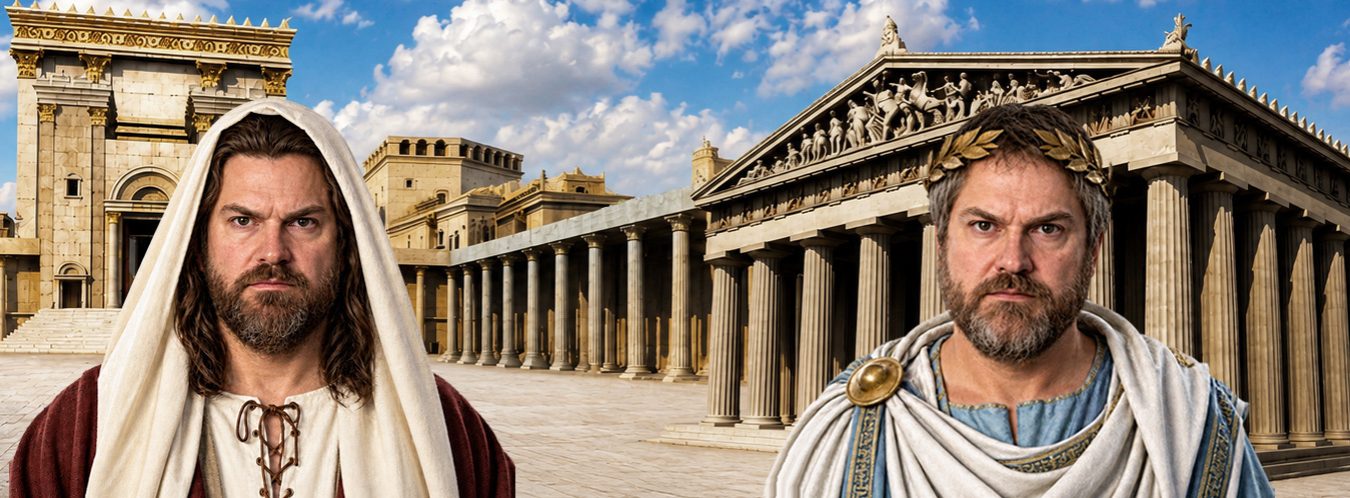

The Cripple at Lystra
A Sermon
(No. 559)
by the
Rev. C. H. SPURGEON,
At the Metropolitan Tabernacle, Newington
"The same heard Paul speak: who stedfastly beholding him, and
perceiving that he had faith to be healed, said with a loud voice,
Stand upright on thy feet. And he leaped and walked."–Acts 14:9-10.
I HAVE READ in your hearing the story of the preaching of Paul and
Barnabas in the town of Lystra. The name of Christ was there totally
unknown. They were a sort of country people, partly pastoral and partly
agricultural, who seem to have been deeply sunken in superstition. At
the gates of their city there stood a great temple dedicated to
Jupiter, and they appear to have been his zealous votaries. Coming down
from the mountainside Paul and Barnabas enter the town, and when a
fitting time has come, they stand up in the marketplace, or the street,
and begin to talk concerning Jesus, the Son of God, who had come down
from heaven, had suffered and died, and had again ascended up on high.
The people gather round them. Among the rest a cripple listens with
very marked attention. They preach again. The crowds are still greater,
and on one occasion, while Paul is in the middle of a sermon, using his
eyes to watch the audience as all preachers should do, and not looking
up at the ceiling, or at the gallery-front as some preachers are wont
to do, he marks this cripple, fixes his eyes upon him, and looks
earnestly in his face. Either by the exercise of his judgment, or by
the promptings of revelation, the apostle gathers that this man has
faith–faith to be healed. In order to attract the attention of the
people, to glorify the name of Christ, to publish more widely his
glorious fame, and to make the miracle well known, Paul stops the
sermon, and with a loud voice cries, "Stand upright on thy feet." The
cripple leaps and praises God. The population are all amazed, and
knowing that there was a tradition that Jupiter and Mercury had once
appeared in that very town, a tradition preserved in the Metamorphoses
of Ovid to the present day, they at once conclude that surely Jupiter
and Mercury must be come again. They fix upon Barnabas, who was
probably the elder and the nobler looking man, for Jupiter; and as
Jupiter was always attended by Mercurins, as a messenger, and Mercury
was the god of eloquence, they conclude that Paul must be Mercury. They
rush to the temple, they tell the priests that the gods have come down.
The priests, only too ready to foster popular credulity, and pander to
it, bring forth the sacred bullocks and the garlands, and are about to
offer sacrifice before Paul and Barnabas. Such homage these men of God
indignantly refuse; they rend their clothes; they beseech them to do no
such thing, for they are nothing but men; yet hardly with earnest words
can they stay the people. But the next day certain Jews came thither
and produced a counter irritation in the simple minds of the people. No
very difficult task where a rude fanaticism rouses the wild passions of
the mob. Such an assembly must rage, whether it he with redundant
applause or with derisive jeers. Accordingly, Paul finds himself
exposed to peril; he is stoned through the streets, dragged forth as
dead, and left by the very men who worshipped him but yesterday as a
god, left to die as a villain outside the city gates. But Paul's
preaching had not been in vain. There were some few disciples who
remained faithful. His ministry was rewarded and owned of God.
There are two or three points in this narrative to which I shall call
your attention to-night, making, however, the lame man the center of
the picture. We shall notice, first of all, what preceded this lame
man's faith; secondly, wherein lay his faith to be healed; and thirdly,
what is the teaching of the miracle itself, and the blessing which the
lame man obtained through faith.
I. WHAT WAS IT WHICH PRECEDED HIS FAITH?
That "Faith cometh by hearing, and hearing by the word of God," is a
great and universal rule; but the hearing of what? Doubtless the
hearing of the gospel is intended. On turning to your Bibles you will
find it is written–"And there they preached the gospel." What, Paul,
dost thou not change thy voice? Thou hast preached the gospel in the
cities of Iconium and Antioch, where there were enlightened and
intelligent hearers; if the gospel suited them, surely it will not do
for these wolfish boors! Why go and preach to these poor, ignorant,
superstitious fanatics the very same truths which you spoke to your
enlightened Jewish brethren? But he does do so, my friends. The very
gospel which he preached at Damascus in the synagogue he preaches here
at Lystra in the market-place. He makes no difference between the
education of his hearers in different places; he has the same gospel to
preach to them both. You recollect that Paul went to Ephesus, and
Ephesus, as a city, was besotted with a belief in sorcery. The people
had given themselves up to practice magical arts. What is the right way
to begin to preach at Ephesus? Deliver a course of lectures upon the
impossibility and absurdity of such superstition? No, sir, nothing of
the kind. Preach Christ, preach the gospel; and as Jesus Christ is
lifted up they bring their magical books and make a bonfire of them in
the open forum. But here is a polished governor, Sergius Paulus,
sitting upon the judgment-seat. What shall be preached to him? Would it
not be well to begin with a dissertation on politics, and to show that
the Christian religion does not interfere with proper government, that
it does not stir up the people to anarchy? No, sir, nothing of the
kind. There is nothing for Sergius Paulus any more than there is for
Elymas the sorcerer, but the preaching of the gospel of Jesus Christ.
Paul goes to Athens. Now the Athenians are the most learned and
philosophical of the whole race of men. What will Paul preach there?
The gospel, the whole gospel, and nothing but the gospel. He may change
his tones, but never his matter. It is the same remedy for the same
disease, he the men what they may. He comes to Corinth, and here you
have not only polished manners, but the very refinement of vice. It is
a city, an emporium of trade, and a sort of central depot of sin. What
then? Will he now, to please the trader, assume a different dialect?
Not he! The Christ for Athens is the Christ for Corinth too. And now
see him. He has come to Lycaonia, and is preaching at Lystra. Here is
an ignorant set of people who worship an image. Why does he not begin
by preaching of the deity? Why does he not talk to them of the Trinity
in unity? Why does he not try and confute their notions about their
gods? No, my dear sir, he will do nothing of the kind; that may be done
incidentally, but the first and the last thing that Paul will do at
Lystra is, there he will preach the gospel. O glorious gospel of the
blessed God! Wherever we take thee thou art suited to the wants of men.
Take thee to Persia with all its gems and jewels, and thou dost suit
the monarch on his throne; or take thee to the naked savage with all
his poverty and squalid filth, and thou dost suit him too. Thou mayst
he preached, thrice glorious wisdom of God, to the wisest of men; but
thou are not too great a mystery to be understood and believed even by
the fools and the babes; the things which are not can receive thee as
well as the things which are. Never, I pray you brethren, lose heart in
the power of the gospel. Do not believe that there exists any man, much
less any race of men, for whom the gospel is not fitted. Wherever you
go, do not cut, and trim, and shape, and alter; hut just bring out the
whole truth as God has taught it to you, and rest assured that you will
be unto God a sweet savor of Christ in every place, both in them who
are saved and in them who perish.
What then, was this gospel which the apostle Paul did preach
everywhere? Well, it was a gospel which had in it three things, certain
facts, certain doctrines, and certain commands.
It was a gospel of facts. Every time Paul stood up to preach he told
the following unvarnished tale: God, looking upon the race of men,
beheld them lost and ruined. Out of love to them he sent his only
begotten Son, the Lord Jesus Christ, who was born of the virgin Mary,
lived some thirty-two or thirty-three years a life of spotless
innocence and perfect obedience to God. He was God: he was man. In due
time he was delivered up by the traitor Judas. He was crucified, and
actually put to death. Though he was the Lord of life and glory, who
only hath immortality, yet he bowed his head and gave up the ghost.
After three days he rose again, and showed himself to many of his
disciples, so that they were well assured he was the same person who
had been put into the grave; and when the forty days were finished he
ascended up to heaven in the sight of them all, where he sitteth at the
right hand of God, and shall also come ere long a second time to judge
both the quick and the dead. These were the facts which Paul would
state. God was made flesh and dwelt amongst us, and we beheld his
glory, the glory as of the only-begotten of the father, full of grace
and truth. "This is a faithful saying, and worthy of all acceptation,
that Christ Jesus came into the world to save sinners; of whom I am
chief." Briefly, these were the facts which Paul would preach, and if
any one of these facts he preached doubtfully, or he left out of any
ministry, then the gospel is not preached; for the foundations upon
which the gospel rests have been removed, and then what can the
righteous do?
Following upon these facts, Paul preached certain doctrines, the
doctrines flowing out of the facts. To wit, he preached that Jesus
Christ had offered a full atonement to divine wrath for the sin of his
people, so that whosoever would believe on him, and trust him, should
be saved. The doctrine of the atonement would form the most prominent
feature in the gospel of the apostle Paul, Christ also hath suffered
for us, the just for the unjust, to bring us to God. "God commendeth
his love towards us, in that, while we were yet sinners, Christ died
for the ungodly." Then would come the doctrine of pardon. Paul with
glowing tongue would tell how God could be just, and yet the justifier
of him who believeth; how all manner of sin and iniquity shall be
forgiven unto men, the simple condition being that the man believes in
Christ, and this not so much the man's own work, as a gift of the Holy
Ghost. Everywhere Paul would he unmistakable in this–"Ye chief of
sinners, look to the wounds of Jesus, and your sins shall he forgiven
you." Equally clear would he be upon the doctrine of justification.
"Christ," he would say, "will wash you; nay, more, he will clothe you;
the perfect holiness of his character shall he imputed unto you, and
being justified, you shall have peace with God, and there shall be no
condemnation, because you are in Christ Jesus." I think I see the
flashing eye of the apostle; methinks I listen to his earnest voice,
while he pleads with men to lay hold upon eternal life, to look to
Jesus Christ, to forsake the deeds of the law, to put their trust in
nothing which cometh from man, but to look to Jesus, and to Jesus only.
These great truths, atonement, pardon, and justification, with all the
other truths connected with them, of which we cannot now speak
particularly, were just the gospel which the apostle Paul preached.
And out of these we said their sprung certain commands. The commands
were these–"Believe in the Lord Jesus Christ and thou shalt be saved."
Nor do I suppose that the apostle for a moment stammered to preach that
other command–"Arise, and he baptized." He would not preach half the
gospel, but the whole of it–"He that believeth and is baptized shall
he saved; but he that believeth not shall he damned;" and often after
his hearers had cried, "What must we do to he saved," and they had
believed in Christ, they would say to him–"See, here is water, what
doth hinder me to he baptized?"
The apostle then preached a gospel which was made up of certain
authenticated facts, out of which there flowed certain most gracious
evangelical doctrines, which were enforced and driven home with divine
authority, by Christ's own commands. "Well," says one, "do you think
the world will be turned upside down by this?" Sirs, it has been, and
it will he again. In vain do those who seek after human learning, and
who aim at dreamy sentiment or spurious science in preference to the
standard teaching which is from above, attempt to find a nobler
instrument. This is the great battering-ram which shall yet shake the
bastions of error. This is the sword, the true Escalabar, which, if any
man knoweth how to wield it, shall cut through joints and marrow, and
make him more than a conqueror. He who getteth a hold of the gospel of
Christ, and knoweth how to use it, hath that before which the devils
tremble, and in the presence of which angels adore, which cherubs long
to look into, and which God himself smiles upon as his noblest work.
The truth we proclaim is not that which is discovered by us, but that
which has been delivered to us. Do ye ask, then, where this man's faith
came from? It came from Paul's preaching of the gospel.
II. Now WHEREIN LAY THIS MAN'S FAITH?
Paul looked at the man, we are told, and perceived "that he had faith
to be healed." What meaneth this "faith to be healed?" In this man's
case I think it was something like this. Poor fellow! As he listened to
Paul's preaching, he thought perhaps–"Well, that looks like true; that
seems to be the truth; it is the truth; I am sure it is true; and, if
it is true that Jesus Christ is so great a Savior, perhaps I may be
healed; these lame legs of mine, which never would carry me anywhere,
may yet come straight; I–I–I think they may; I hope they may; I
believe they may; I know it can be done if Christ wills it; I believe
that, and from what Paul says of Christ's character, I think he must be
willing to do it; I will ask the apostle; the first convenient season
that I have I will lift up my cry, for I believe it can be done, and I
think there is a perfect willingness, both in the mind of the apostle
and of the Master that it should be done; I believe it will be done,
and that I shall yet stand upright." Then Paul said to him, "Stand
upright on thy feet," and he did so in a moment, for "he had faith to
he healed."
Do you think I am overstraining the probabilities of the case? You will
perhaps say, "It does not appear that Paul had any communication with
the poor cripple before the miracle was performed." Now I venture to
draw quite an opposite inference. I know from my own experience that it
is no uncommon thing for some one individual to arrest the preacher's
attention. The group of countenances which lay before him in a large
assembly like the present, might to the first glance of a stranger look
confused and inexplicable, as a Chinese grammar does to those who know
not the language. But you need not doubt that a practiced eye can learn
to read the one as well as the other. The languor and indifference of
some; the curious enquiring look of others; the cold, critical
attention of a considerable number, and the countenances of those who
are rather absorbed in a train of thought just awakened in their own
minds–these have all a peculiar impressiveness, and form a picture
which often reacts upon us, and kindles a vehement desire in our
breasts to reach the souls of those who, for a brief hour, hang upon
our lips. But there will sometimes be one who has faith dazzling in his
very eyes, as they are fixed with an intentness, of which it were vain
for me to attempt a description, seeming to drink in every word and
every syllable of a word, till the preacher becomes as absorbed in that
man as the man had been in the preacher. And while he pursues the
discourse, gaining liberty at every step, till he forgets the formality
of the pulpit in the freedom of conversation with the people, he
perceives that at last this man has heard the very truth which meets
his case. There is no concealing it. His features have suddenly
relaxed. He listens still, but it is no longer with painful anxiety; a
calm satisfaction is palpable on his face now. That soul of communion
which is in the eye has unravelled the secret. Preacher and hearer,
unknown to all the rest of the audience, have secretly saluted ench
other, and met on the common ground of a vital faith. The anxious one
feels that it can be done. And I can readily conclude that the apostle
perceived that feeling with greater certainty than he would have done
had the man whispered it in his ears. So have I sometimes known that
the exhortation to believe has become from these lips a positive
command to the struggling conscience of some one, who has been brought
to a point where the remedy is instantly applied, and the cure
instantly effected.
Most unquestionably there is such a thing as faith to be saved. I do
not know how many here may possess it; but, thank God, there are
hundreds of you here who have faith that you are saved. That is better;
that is the ripest faith, the faith which knows you are saved and
rejoices in hope of the glory of God. Alas! there are others who have
no faith at all. But it is with those who have faith, and that only
faith to be saved, not faith that you are saved, I am more particularly
concerned at this moment.
Shall I describe this "faith to he saved?" for I believe that there may
be some here who may just now stand upright on their feet; some who may
at this time leap for joy of heart because they are saved and did not
know it. You have "faith," but you have not fully exercised it. Now,
you believe that Jesus Christ is God's Son? "Yes." That he has made a
full atonement for his people? "Yes." You believe that they are his
people who trust him? "Yes." You believe he is worthy to be trusted?
"Yes." You have nothing else to trust to? "No, sir." You depend on
nothing which you have ever felt, or thought, or done? "No, sir, I
depend on nothing but Christ." And you do, after a sort of fashion,
trust Christ. You hope that one of these days he will save you, and you
think, and sometimes you almost know, he will. You are ready to trust
him. You do believe he is able, you do not think he is unwilling; you
have got faith in his ability, and you have almost got faith in his
willingness; sometimes you half think to yourself, "I am a child of
God." But then, there is some ugly "but" comes in. Those lame legs
again; those lame legs again. You are still afraid. You have "faith to
he saved," but you have not the full assurance of faith which can utter
forth this joyous psalm, "Behold, God is my salvation; I will trust,
and not he afraid: for the Lord Jehovah is my strength and my song; he
also is become my salvation."
Well now, I do not know whether I have picked you out, whether I have
given a right description of you or not. I recollect the time when I
was in that state. I can honestly say I did not doubt Christ. I then
partly believed that he would save me. I knew he was worthy of my
trust, and I did trust him as far as this, that I resolved, if I did
perish, I would perish crying to him, and that if I was east away, it
should be clinging to the cross. I believe I had "faith to be saved,"
and was for months in bondage, when there was no necessity that I
should have been in bondage at all, for, when there is "faith to he
saved," then the man only needs that gracious command–"Stand upright
on thy feet," and forthwith he leaps out of his infirmity, and walks
freely in the integrity of his heart.
III. I shall not enlarge further upon this, because I want to go to THE
SPIRITUAL TEACHING OF THE MIRACLE, AND OF THE BLESSING CONFERRED.
Are there not many, who though they have "faith to be saved," are still
entirely lame or painfully limping? The reasons may be different in
different cases. Some have been so stunned by the grief which they have
suffered on account of sin, and the frightful convictions through which
they have passed, that while they do believe that Christ is able and
willing to save, they cannot get a hold of the fact that they are
saved; such is the faintness of spirit and the languishing of soul
brought on by long despair. "Stand upright on thy feet," thou trembling
sinner. If thou believest in Jesus, whatever thy fears may be, there is
no cause for them. As for thy sins, they were laid on him, every one of
them, and though thou hast been sore broken in the land of dragons,
thus saith the Lord unto thee, "I have put away thy sin; thou shalt not
die; I have blotted out like a cloud thy transgressions, and like a
thick cloud thy sins." Rejoice, then, and he glad. If you do trust
Christ, you are saved; though as yet it only looketh like faith which
heralds the tidings of a salvation which has not yet arrived. Still, it
is the grace of God which bringeth salvation which has enabled thee to
believe; and he who believeth on the Son bath everlasting life. O
receive the welcome message; spring up at the sound of the words; stand
upright on thy feet and rejoice.
Some are still lame, though they have faith, through ignorance. They do
not know what being saved is. They entertain wrong expectations. They
are trusting in Christ, but they do not feel any surprising emotions;
they have not had any remarkable dreams, or visions, or striking
ebullitions of excited joy, and therefore, though they have "faith to
be saved," they have not the faith of a present salvation. They are
waiting for something, they hardly know what, to embellish their faith,
or to fortify it with signs and wonders. Now, poor soul, wherefore do
you wait? These things are not necessary to salvation. In fact, the
fewer you have of them, methinks, the better, especially of things
which are visionary. I rather tremble for those who talk much about
sensible evidences; they are too often the frivolities of unstable
hearts. Beloved, though you may have never had any ecstatic joys, or
suffered any deep depression of your spirits, if you are resting on
Christ, it does not matter one whit what your feelings have been or
have not been. Do you expect to have an electric shock, or to go
through some mysterious operation? The operation is mysterious, too
mysterious for you to discern it; but all that you have to do with is
this–"Do I believe in Jesus? Am I simply depending upon him for
everything?" If you do you are saved, and I pray you to believe this.
Stand upright on your feet, and leap for joy; for whether you believe
it or not, if you are now depending upon Christ, your sins are forgiven
you; you are a child of God; you are an heir of heaven.
How many, too, are kept lame because of a fear of self-deception. "I do
trust Christ, but I am afraid lest I should deceive myself; suppose I
were to get confidence, and it should he presumption! suppose I should
think myself saved, and I am not!" Now, sir, if thou wert dealing with
thyself there would be reason to be afraid of presumption, but thy
faith hath to deal with God, who cannot deceive thee, and with Christ
who will never tempt thee to be a deceiver. Doth not the Lord Jesus
Christ himself tell thee that if thou believest in him thou art saved?
Thou believest that, dost thou not? Then, soul, if thou believest on
him, it is not presumption to say, "I am saved." Away with all that
affectation of modesty, which some good people think to he so
pretty–saying, "I hope;" "I trust;" but "I feel such doubts, such
fears, and such gloomy misgivings." My dear sir, that is not humility:
that is a vain unseemly questioning of God. The God and Father of our
Lord Jesus Christ tells you, and he gives his own unequivocal word for
it, that if you rest upon Christ you rest upon a rock; that if you
believe in him you are not condemned. Is it an evidence of the
lowliness of your heart that you suspect the veracity of God, or the
faithfulness of his promise? Surely this were no fruit of the meekness
of wisdom. No, beloved; it may seem too good to he true, but it is not
too good for my God to give, though it is too good for you to receive.
You have his word for it, that if you trust his Son to save you, and
simply trust him, and him alone, even if the pillars of the heavens
should shake, yet you would be saved. If the foundations of the earth
should reel, and the whole earth should like a vision pass away, yet
this eternal promise and oath of God must stand fast.
Others again, cannot stand upright on their feet, because they are
afraid that if they did begin they would go back again, and so bring
dishonor to Christ. This would be a very proper fear if you had
anything to do with keeping yourselves. If you had to carry yourselves
to heaven, it would he reasonable enough for you to despair of doing
it. Of your own impotence it is impossible you can be too deeply
convinced. You cannot do anything whatever, but Christ gives you his
promise to preserve you even to the end. If you believe on him you
shall be saved. He does not say you shall he saved for a year, or for
twenty years, and then, perhaps, he lost at last. No; but "he that
believeth and is baptized, shall he saved." If one man who believes in
Christ is cast away, that promise of Christ is not true. Brethren, it
is true, and it must he true, and let its glorious truth be sweetly
familiar with you now–if you give your soul to Christ, putting simple
faith in his person as the Son of God, and in his work as the Mediator
between God and man, you shall as surely see his face within the pearly
gates of heaven as your eyes see me to-night. There may he a question
about your seeing me, but there can be no question about Christ
fulfilling his promise and keeping his word. Now sit down in the dust
no longer, thou doubting, mourning, trembling sinner. With a loud voice
I say unto thee, as Paul did, "Stand upright on thy feet." Wherefore
dost thou mourn? There is nothing to mourn about. Thy sin is forgiven;
thine eternal salvation is secure; a crown in heaven is provided for
thee, and a harp of gold awaits thee. If thou believest in Jesus none
can lay anything to thy charge. Not even the principalities of darkness
shall be able to prevail against thee. Eternal love secures thee
against the malice of hell. Stand upright, then, on thy feet, for if
thou believest thou art saved, completely saved, saved in time, and for
eternal days, saved in the Lord with an everlasting salvation.
Then possibly there is one here who cannot stand upright because of his
many sins. Ah! while I have been talking about Christ it may be
something has been saying in your heart, "Ah! ah! what is it? Christ
taking men's sins, suffering in their stead? That suits me. Is God
doing this? Ah! then he must be able to save, and I am told that
whosoever trusteth in him shall never perish; is it so? Why, here I am;
I who have not been in a place of worship for months, for years, I have
strayed in here to-night, and if what this man says be true, well then
I will even venture my soul upon it; I have got nothing, I know, but he
says there is nothing wanted; I am not prepared to trust Christ, but he
says there is no preparation required, and if I trust Jesus Christ just
as I am, Christ will save me; why, I will do it; by the grace of God I
will do it; can he save me?" Then comes in the bitter reflection–"Look
what a sinner I have been! why, I should be ashamed to say how foully I
have sinned; he must shut me out; I have been too great a villain, too
gross an offender; I have cursed and sworn at such a rate; he cannot
mean that if I trust Christ I shall be saved; 1 believe he can save me;
I see the fitness of the plan, and the excellency of it; I believe it,
but see what a sinner I am!" Sinner, stand upright on thy feet, for
"all manner of sin and blasphemy shall be forgiven unto men." Return,
thou wanderer, return to thy Father's house! He comes to meet thee. On
thy neck he will fall, and thou shalt be his child for ever. Only
believe thou in his Son Jesus Christ, and though this he the first time
thou hast ever heard his Word, I would settle mine eyes upon thee
earnestly, and say, "Stand upright on thy feet."
Oh! how often I do wish that somebody had come to me when I was under
depression of mind, and had told me about the simple gospel of Jesus
Christ. I think I should have stood upright on my feet long before I
did, but, alas! I kept hearing about what people felt before they
believed in Christ–very proper preaching–and I was afraid I did not
feel it, though now I know I did. I heard a great deal about what
Christians ought to be, and a great deal more about God's elect, what
they are in his esteem, but I did not know whether I was one of God's
elect, and I knew I was not what I ought to be. O for the trumpet of
the archangel, to sound the words, "Believe and live," as loud as the
voice which shall wake the dead in their graves! and O for the
quickening Spirit to go with voice, as it shall go with the ringing of
the archangel's trump, when the graves shall open, and the dead shall
arise! Go, you who know it, and tell it everywhere, for there are
multitudes, I doubt not, who are really seeking Christ, and who have
his Spirit in them, but it is like as the prophet hath it, "The
children have come to the birth and there is no strength to bring
forth." They have come to the very edge of light, and they only want
one helping hand to bring them into noonday. They are slipping about in
the Slough of Despond, and they are almost out of it, but they want
just a helping hand to pull them out. This hand of help is stretched
out by thus telling them, telling them plainly, it is in Jesus their
help is found, and that trusting him, relying upon him, they shall
never perish. neither shall any pluck them out of his hand.
I would to God that some of you, who have been long hearing me, might
be found in this class. I have been bowed down in spirit at some sad
things which have been brought to my hearing of late. I know that there
are some here, and there always have been some few attending my
ministry, who have a personal affection for me, and who listen to the
Word with very great attention, and who, moreover, are very greatly
moved by it, but who have some besetting sin which they either cannot
or will not give up. They do renounce it for a time, but either bad
associates, or else the strength of their passions, take them away
again. O sirs! I would ye would take warning. There was one of whom we
had some sort of hope, who listened to our ministry. There came a
turning point with him; it was this, either that he must give up sin,
or else give up coming to the Tabernacle; and what–oh! what became of
him? I could indicate the place where he sat. He died of delirium
tremens! And I do not wonder. When you have heard the gospel preached
Sabbath after Sabbath, when your response to the solemn appeals you
have earnestly listened to has only been that you reject Christ and
refuse eternal life–is it any marvel that in making the choice of your
own damnation reason should resign its seat as director of your
actions, and cease to curb your headstrong will, leaving the maddened
passions to dash on with reckless fury, and precipitate your
destruction. Am I clear of their blood? I have asked myself the
question. I may not be in some things, but I know I am as far as my
ministry is concerned. I have not shunned to declare unto any of you
the whole counsel of God. When I have known any vice, or any
folly–which of you have I been afraid of, or before whom of you all
have I trembled? God is my witness; him have I served in the spirit;
and if these turn aside unto their crooked ways, they have not done it
without well knowing the consequences; nay, they have not done it
without being warned and entreated, and persuaded to look unto Jesus
Christ. And I do conjure some of you–you know to whom I refer–I do
conjure those of you who have a conscience which is not seared, but
who, nevertheless, persevere in your sins–I conjure you by the love of
God, do me this one favor at the last: if you choose your own ruin,
bear witness for me that I have not hesitated to warn you of it. I had
infinitely rather, however, that you would do yourselves this great
favor, to love your own souls. If you have anything to throw into the
fire, throw it in, but let it not be your soul. If you have anything to
lose, go and lose it, but do not lose your soul. Sirs, if you must play
the fool, indulge your sport at a cheaper rate than this. If sin be
worth having, then I pray you pay a cheaper price than your own souls
for it, for it does seem to me so pitiful, so sorrowful a thing, that
you who have been so short a time among us and are passing away before
my very eyes, should still prefer the fleeting joy of the moment to the
eternal joy, and risk everlasting torment for temporary mirth. By the
tears of Jesus when he wept over Jerusalem, by the blood of Jesus which
he shed for guilty men, by the heart of the eternal Father who willeth
not the death of a sinner but had rather that he should turn unto him
and live, I pray you he wise and consider your ways. Choose ye this day
whom ye will serve, and may the Lord guide your choice. May you fall
into the arms of divine mercy and say, "If thou wilt help me, Jesus,
here I am; I give myself to thee." May my Master teach me how to
address you if I do not know how to gasp the words of simplicity,
tenderness, of terrible apprehension, but of persuasive power. If there
were any words in any language that would melt you, this tongue is at
your service to utter them. If there is any form of speech, though it
should make me to be called vulgar, and subject me to the shame and
hissing which once I endured, if the furnace could be heated seven
times hotter than that, I would but laugh at it if I might but win your
souls. Tell me, sirs, how shall I put the case? Would you have
argument? I wish that I could reason with you. Would you have tears?
There, let them flow! Ye dry eyes, why do ye not weep more for these
perishing souls? Would you have God's Word without my word? Sirs, I
would read it, and let my tongue he dumb if that would teach you. Would
my death save you? That God who seeth in secret knoweth that to-night
it were a joy to me to enter into my rest, and so it were little for me
to talk of being willing to give a life for you, and it were, indeed,
but a trifle to me. Oh! why will ye perish? Why should I plead with
you, and you not care for yourselves? What is it that besets you? Poor
moths! Are ye dazzled with the flames? Are ye not content to have
singed your wings? Must they also consume body and soul? How can ye
make your bed in hell? How can ye abide with eternal burnings? In the
name of Jesus of Nazareth, I command you–for I can do no less–I
command you to turn unto him and live. Believe on him and you shall he
saved. But remember, at your hazard you reject the message to-night. It
may he the last message that shall ever come to your soul with power,
if ye cast this away–
"What chains of vengeance must they feel,
Who slight the bonds of love?"
I would have you saved just now. I cannot talk about to-morrow. I would
have you decide it at once. Oh! you have come as far as this twenty
times, and have you gone back again? You have been aroused, you have
made vows and you have broken them, resolutions and you have belied
them. O sirs, for God's sake do not lie to the Almighty again. Now be
true this time. May the Spirit of God make you speak the truth, even
though you should he compelled to say, through your wickedness, "I will
not submit myself unto the Son of God." Do speak the truth.
Procrastinate not. As Elijah said, "How long halt ye between two
opinions?" so say I. If God he God serve him, but if Baal he God serve
him. But do not keep on coming here and then going to the pot-house. Do
not come and take your seat here and then go to the brothel. Sirs, do
not this foul scandal for God's sake, and for your own sake. If you
will serve the devil serve him, and he a true servant to him. If you
mean to go to hell, go there; but if you seek eternal life and joys to
come, give up these things. Renounce them. Why drink poison and drink
medicine too? Have done with one or the other and be honest. Be honest
to your own souls. May the Lord grant that tonight some may have given
to them, not only "faith to be saved," but the faith which saves, for
his name's sake. Amen.