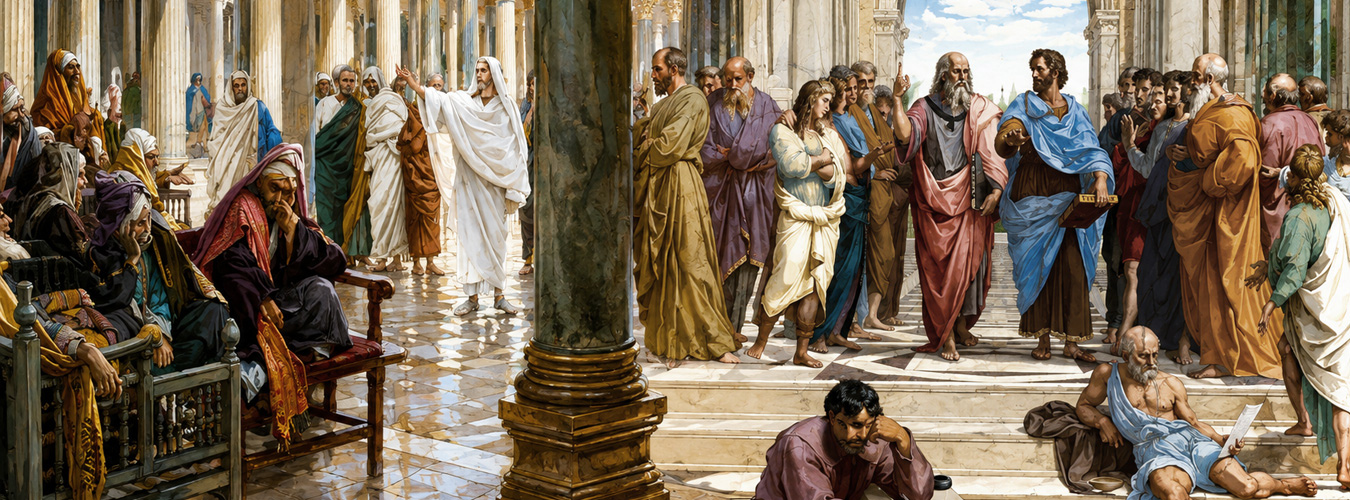

To Those Who Are "Almost Persuaded"
A sermon
(No. 871)
Delivered on Lord's-day Morning, MAY 16, 1869, by
C.H.SPURGEON,
At the Metropolitan Tabernacle, Newington
"Then Agrippa said unto Paul, You almost persuade me to be a
Christian."- Acts 26:28.
NOTWITHSTANDING his bonds, Paul is to be envied that he had an
opportunity of addressing himself to kings and rulers and that once, at
least, in his life he stood before the great master of the Roman world,
the Emperor himself. To reach the ignorant who sit on thrones is no
mean feat for benevolence. Alas, the Gospel seldom climbs the high
places of rank and dignity. It is a great act of mercy towards nobles
and princes, when they have the opportunity of hearing a faithful
Gospel discourse. Highly favored was Edward VI to have such a preacher
as Hugh Latimer, to tell him to his face the Truth of God as it is in
Jesus!
And much favored was Agrippa, though he scarcely appreciated the
privilege, to listen to so earnest an advocate of the Gospel of Jesus
as Paul the Apostle. We ought to pray much more than we do for men in
high places, because they have many bewitching temptations and less
gracious opportunities than even the humblest paupers. There is less
likelihood of the Gospel ever affecting their hearts than of its
converting the poor and needy. We should make them, therefore,
especially the subjects of supplication and then we might hope to see
consecrated coronets far more frequently. Should a preacher be called
to address himself to kings, he could not follow a better model than
the Apostle Paul whom we may fitly call the king of preachers and the
preacher to kings.
His speech is extremely forcible and yet exceedingly courteous. It is
powerful in matter, but graceful in manner. It is bold, but remarkably
unobtrusive–never cringing, but never impertinent. The Apostle speaks
much of himself, for so his argument required, but still, nothing for
himself, nor by way of self-commendation. The whole address is so
adroitly shaped with such a sacred art and yet with such a holy
naturalness, that if any human persuasion could have converted Agrippa
to the faith, the address of the Lord's prisoner was most likely to
have done so. The line of argument was so suited to the prejudices and
tastes of Agrippa as to be another instance of Paul's power to become
"all things to all men."
Now, it may be, this morning, while we are speaking upon the Apostle's
teaching and the results of it, that a great blessing may rest upon us
so that many of you may be persuaded to be Christians by the very
arguments which failed with the Herodian king. Not many great men after
the flesh, not many mighty are called–but this assembly is of another
order and, O may the Lord extend His Sovereign Grace along our ranks,
through Jesus Christ our Lord!
I. This morning I shall ask you to spend a little time in considering
THE GREAT OBJECT OF THE CHRISTIAN MINISTER'S PERSUASIONS. Agrippa said,
"You almost persuade me to be a Christian.''" I do not recollect a
single sermon from this text that is fairly upon the words as they
stand. They are all discourses upon being almost Christians, which,
begging the pardon of the venerable divines, has nothing to do with the
text, for the Apostle never persuaded Agrippa to be an
"almost-Christian"–but he almost persuaded him to be a Christian!
Agrippa certainly never was an almost-Christian! His life and character
displayed a spirit very far removed from that condition. He was not
like the young man in the Gospel to whom the name "almost-Christian" is
far more applicable, although I gravely question its propriety in any
case. There is a great difference between being almost a Christian and
being almost persuaded to be a Christian. A man may be almost a
Calvinist and so may hold most of the Doctrines of Grace, but another
who has been on a certain occasion almost persuaded to be a Calvinist,
may be, as a matter of fact, a complete Arminian. A man who is almost
an artist knows something of painting, but a man almost persuaded to be
an artist may not even know the names of the colors.
Now the great drift of Paul's preaching, according to Agrippa's
confession, was to persuade him to be a Christian. And the Apostle
himself acknowledges the same design in his concluding sentence, "I
would to God, that not only you, but also all that hear me this day,
were both almost and altogether such as I am." In that parting word of
goodwill he
unveiled the desire of his heart–he sought not release from his
chains, but the deliverance of the souls of his hearers from the
bondage of sin.
My Brethren, the preaching of the Gospel minister should always have
soul-winning for its object. Never should we seek that the audience
should admire our excellency of speech. I have in my soul a thousand
times cursed oratory and wished that the arts of elocution had never
been devised, or at least had never profaned the sanctuary of God.
Often, as I have listened with wonder to speech right well conceived
and sentences aptly arranged, I have yet felt as though I could weep
tears of blood that the time of the congregation on the Sabbath should
be wasted by listening to wordy rhetoric, when what was needed was a
plain, urgent pleading with men's hearts and consciences. It is never
worth a minister's while to go up his pulpit stairs to show his
audience that he is adept in elocution.
High-sounding words and flowery periods, are a mockery of man's
spiritual needs. If a man desires to display his oratory, let him study
for the bar, or enter Parliament, but let him not degrade the Cross of
Christ into a peg to hang his tawdry rags of speech. The Cross is only
lifted up aright when we can say, "Not with enticing words of man's
wisdom, but in demonstration of the Spirit and of power." Every
minister should be able to say with Paul, "Seeing, then, that we have
such hope, we use great plainness of speech." No, my dear Hearers, may
it never be in any measure or degree an object of ours to flash and
dazzle and astonish–but may we keep this one aim in view–to persuade
you to be Christians!
Neither would the Apostle have been content if he could have persuaded
Agrippa to take the name of a Christian, or to be baptized as a
Christian. His object was that he might in very deed be a Christian. To
seem is nothing, but to be is everything. I grant you that the Apostle
would have been glad enough to see Agrippa avowedly a Christian. Why
should he not take the name if he had received the essential Grace? He
would have rejoiced to have baptized him! Why should he not, if he
believed in Jesus? But the Apostle was not anxious to confer misleading
names. Nominal Christians he had no desire to create. To be or not to
be was his great question–names and rites were secondary matters.
It would not be worth the snap of a finger to Christianize a nation
after the manner in which the zealous Francis Xavier made converts by
sprinkling their heathen foreheads with a brush of holy water! It were
scarcely worth rising from one's bed to persuade an avowed son of
Belial to put on the cloak of a religious profession and practice his
vices in decorous secrecy. No, the persuasion of the Apostle aims at
Agrippa being a Christian, indeed, and of a truth! Thus should we labor
in seeking converts–the adoption of a certain dress or mode of speech
is little. Union with our denomination is almost as unimportant–the
true embracing of Jesus as the Savior of men is the vital matter. To
bring men to be Christians, "this is the work, this the labor."
The Apostle does not appear to have aimed at merely making the man a
convert as to his judgment, or a trembler as to his feelings, or an
enthusiast as to his passions. Is it not sometimes evidently the drift
of Christian ministers to make men weep for weeping's sake? Funeral
rites are paraded and sepulchers unveiled–mournful memories are
awakened and half-healed wounds ruthlessly torn open–and this
laceration of the natural feelings is supposed to be a process
peculiarly conducive to conversion! I have no faith in such appeals! I
want men's tears for other sorrows than those connected with the dead!
I beg their heart's regard to a far more important occupation than
garlanding the memories of the departed.
Is it not very possible to work up a congregation to the highest
possible state of excitement upon their bereavements, and yet, after
all, have gained no step in advance in the direction of their eternal
salvation? The deaths of the Herod family might have been worked into a
touching appeal to Agrippa, but Paul was too manly to attempt the
sentimentalist's effeminate discoursing. Neither did the Apostle excite
Agrippa's patriotic sensibilities by rehearsing the glorious deeds of
ancient Jewish valor with which the world had rung! No glowing stanzas
of heroic verse or thrilling legend of chivalry were embossed upon his
address–but in all simplicity the Apostle aimed at this one thing–to
convince the monarch's judgment as to change his heart. He wished to
affect Agrippa's passions as by the power of the Holy Spirit to make a
new man of him! This, this only, would content the Apostolic
orator–that his hearer might be a Christian! That he might be such a
one as Paul also was, the Lord's servant, relying upon Christ's
righteousness and living for Christ's Glory.
Now, it is well for the preacher to know what he is at and it is well
for the hearers to know what the preacher desires to have them do or
be. Why, Brothers and Sisters, I trust my heart's desire is precisely
that which ruled the Apostle. I
long that every one of you may be a Christian! Ah, my Lord, I pray You
bear me witness that the one thing I strive after is that this people
may know Your Truth and trust Your Son and be saved by Your Holy
Spirit–saved in their outward lives and eternally saved in the day of
Your appearing!
Brothers and Sisters, whatever else shall come out of my preaching,
though your liberality should be superabundant, though your morality
should be untarnished, though your assembling together should never
decrease in numbers, though your enthusiasm should never abate in
intensity, yet if you are not altogether Christians, made so by the new
birth and by the power of the Holy Spirit, I shall regard my ministry
as a miserable failure–a failure full of grief to me and of confusion
to you! O may God grant that many here may be altogether and at once
persuaded to be Christians, for nothing but this will content me!
If you desire a definition of a Christian, the Apostle has given it to
you in the 18th verse of the chapter from which the text is selected.
He there gives a fivefold description of the true Christian. He is one
whose eyes are opened, who has been turned from darkness to light–that
is to say, he knows the Truth of God and perceives it in quite a
different manner from any knowledge of it which he possessed in the
past. He sees his sins and feels their heinousness. He knows the plan
of salvation and rejoices in its all-sufficiency. His knowledge is not
superficial and a thing of the head, but internal and a matter of the
heart. He knows now truly what he only knew theoretically before.
Knowledge is essential to a Christian. Romanism, that owl of night, may
delight in ignorance, but true Christianity prays evermore for light.
"The Lord is my light and my salvation"–light, first, and salvation
afterwards. May you all have the opened eye, which is the Spirit's
early gift. But the next point of the Christian is conversion, "To turn
them from darkness to light and from the power of Satan unto God." The
Christian is emancipated from the tyranny of evil and is free to follow
after holiness and to delight in the commands of God. He is a citizen
of a new world, alienated from his former loves and desires, made a
fellow citizen of a city with which he had no acquaintance before. He
owes no more service to the flesh and the lusts thereof, but the Lord
is his Lawgiver and his King.
Thirdly, he has received forgiveness of sin. He is pardoned through the
precious blood of Christ and rejoices in the full remission of his
sins. Faith has brought him to the foot of the Cross. Faith has led him
to the fountain filled with blood. The Holy Spirit has applied the
Atonement, his conscience is clear–he has received redemption, to wit,
the forgiveness of sins. The next and, indeed, the essential point in a
Christian is faith–"By faith that is in Me," says the Lord. Faith in
the crucified and risen Savior. From this root will spring all the
other characteristics of the genuine Christian.
Once again, the Christian is a man who is sanctified–that is, set
apart, a separated man, a holy man, a sin-hating man–one who loves the
commandments of God and counts it his pleasure to be obedient to them.
Such a man has salvation. He has already a part of the inheritance of
saints and he is on his way to that blessed place where he shall
receive its full fruition. It is after this that the Christian minister
is always striving, that his hearers may be Christians– be
enlightened, be converted, have real and true faith–be sanctified by
the Spirit, be forgiven all their sins and made heirs of immortality.
Has the ministry which you have attended effected, under God, this for
you? If not, is this great failure the fault of the ministry or your
own? O dear Hearers, if the blame lies in the ministry, if it is not
such preaching as God will really bless, forsake it and attend some
other! But if you are conscious that it is a Gospel ministry to which
you have listened, because it has been blessed to others by the Holy
Spirit, then I ask you, how will you answer for it at the bar of God,
that so great a blessing of Heaven has been slighted and how will you
excuse yourself for resisting cogent, earnest, affectionate
persuasions, all intended to lead you to be a Christian?
O confess your sin, that you still halt between two opinions and remain
in the gall of bitterness and in the bonds of iniquity despite the
pleadings of the Word and the rebukes of your conscience! God grant
that such enquiries may have the practical result of humbling and
arousing you.
II. Secondly, let us spend two or three minutes in considering THE
APOSTOLIC MANNER OF PERSUADING. Read carefully the notes of Paul's
sermon as given in the chapter before us. In what way did he endeavor
to persuade the king? I reply it is noteworthy that Paul made constant
appeals to Scripture. We say not that he quoted one or more passages,
but he insisted from first to last that he spoke no other things than
Moses and the Prophets wrote and nothing but what the 12 tribes were
looking for.
My dear Hearers, this ought always to be a powerful argument with you.
You are as yet unconverted, you are not yet persuaded to be Christians,
but yet you believe the Bible to be true. From your childhood you have
accepted with reverence the Book of God as being inspired. Now, if this
Book is of God, it is your highest wisdom to be a follower of Christ!
And as you dare not reject the Book–you have not yet come to that–I
ask you how you make it consistent with reason, how you reconcile it
with conscience and with sound sense that you remain disobedient to its
high behests? That Book declares that no foundation can be laid for our
eternal hopes but in Christ Jesus and yet you have not built on that
foundation!
This Book testifies that those who reject the Lord Jesus and His
Atonement must perish without mercy! Are you prepared to so perish? It
also invites you to build on the foundation of Christ's sacrificial
work and it promises you infinite security in so doing. Are you willing
to reject so great a blessing? If you did not believe the Bible, no
argument drawn from it could have any force with you, and therefore the
Apostle did not quote Scripture to the philosophers on Mars' Hill. But
granted that you accept the Scriptures as God's Word, as Agrippa did,
the Apostolic form of reasoning from that Word ought not merely to
convince your judgments, but to persuade your hearts! And it would do
so, if there were not something radically wrong in your
hearts–something to be repented of, something to be removed by the
power of God's Holy Spirit!
Observe next, the Apostle's persuasion of Agrippa lay mainly in his
personal testimony to the power of Divine Grace in his own soul. We
need not repeat the story of Paul on the road to Damascus and the
bright light and the sacred voice and the sinner rising up converted to
go forth to bear witness to others of Jesus and of His Grace. Personal
testimony ought always to weigh with men. Convince me that a man is
honest and then, if he bears witness to facts which are matters of his
own personal consciousness, not merely the gleanings of hearsay, but
things which he has tasted and handled, I am bound to believe him. And
especially if his testimony is backed up by others, I dare not deny
it–I could not be so unjust.
A great part of the preaching of every Christian minister should lie in
his bearing his personal testimony to what Christ has done for him. It
was my privilege only last Thursday night to tell you over again for
perhaps the thousandth time, how the Grace of God has converted,
consoled, supported and benefited me. I did not hesitate to tell how
the Holy Spirit led me to the foot of the Cross and by one look at the
crucified Redeemer, banished all my guilty fears. I know I speak the
truth! My conscience witnesses that I lie not when I declare that trust
in Jesus Christ has changed me so totally that I scarcely know my
former self! It has unbound my sackcloth and girded me with gladness!
It has taken the ashes of sorrow from my head and anointed me with the
oil of joy!
Moreover, my testimony does not stand alone, but there are hundreds and
thousands who consistently and without hesitation declare that faith in
Christ has blessed and saved them. Such testimony ought to weigh with
you and it would convince you, were you not desperately set against the
Lord's Truth and so fond of sin. Our testimony to the joy, peace,
comfort and strength, which faith in Jesus brings, ought to be
accepted, being corroborated by the witness of thousands of men of
undoubted truth and unblemished character. O that men were wise and
would not resist the counsel of God against themselves!
The Apostle added to this twofold reasoning, a clear statement of the
facts of the Gospel. Notice how he piles precious Truths of God
together and compresses them as with an hydraulic press, in the 23rd
verse–"That Christ should suffer and that He should be the first to
rise from the dead and should show light unto the people and to the
Gentiles." He was about to complete this summary of Christian divinity
when Festus interrupted him. In that verse you have most of the grand
Truths of the Gospel. It is a ready way to convince men, so far as
instrumentality can do it, to tell them clearly that God became
Incarnate in Christ Jesus–that the Incarnate God bore the sin of
Believers and suffered in man's place that justice might be vindicated.
That Jesus rose again and ascended into Heaven to plead the cause of
Believers before the Throne of God and that pardon, free and full, is
proclaimed to every sinner who will simply come and trust in the
sufferings of Jesus.
Where the Gospel statement is clearly given, even if no reasoning is
used, it will, under God, frequently convince, for it is so marvelously
self-evident, indeed, it would convince men universally were not the
human heart harder than the nether millstone and carnal reason deaf as
the adder that will not hear the wisest charmer! The Apostle did not
close his sermon until he had made a home appeal to Agrippa. "King
Agrippa," said he (in something like the style of Nathan when he said,
"You are the man!") "King Agrippa, do you believe the Prophets? I know
that you believe." He looked him
through and through, and read his heart–and to escape that glance the
king suddenly complimented him–and to avoid such close applications of
unpalatable Truth withdrew from the place of hearing.
Oh, but this is the way to preach! We must not only argue from the
Scriptures, relate our experience, and give clear statements of Gospel
Truth, but we must also carry the war into the heart! The minister of
Christ must know how to take the scaling ladder and fix it against the
wall of the conscience and climb it, sword in hand, to meet the man
face to face in sacred duel–for the capture of his heart he must not
flinch to tell the faults he knows, or deal with the errors he
perceives. There must be a consecrated self-denial about the preacher,
so that it matters not to him, even though he should draw down the
wrath of his hearer upon his head. One thing he must aim at, that he
may persuade him to be a Christian and for this he must strike home,
coming to close quarters, if perhaps by God's Grace, he may prick the
man in his heart, slay his enmity and bring him into captivity to
Jesus!
Thus have I shown you the modes of persuasion which the Apostle used,
and the object for which he used them. O that such pleadings would
persuade you!
III. Thirdly, consider THE DIFFERING DEGREES OF SUCCESS ATTENDING SUCH
PERSUASIONS. How
did Paul succeed? We can hardly expect to persuade more successfully
than he, for we have neither his ability nor his Apostolic authority.
Note, then, that he failed with Festus, a rough soldier, an officer of
decent character–one of the most respectable of the Roman governors
who ruled Judea (as a whole a wretched band). He was an administrator
of stern, ready justice–very apt, according to Josephus–in the art of
hunting down robbers and generally a shrewd, vigorous, independent, but
severe ruler of the province entrusted to him.
He was the type of those commonsense, business people who are very
practical, very just, very fond of facts, but who consider nothing to
be worth their thoughts that has anything like sentiment in it or that
deals with abstract truth. "You are beside yourself," is the way in
which Festus puts Paul down. And as if he noticed in Agrippa's face
some little sympathy with the captive Jew, for the monarch's sake he
tones down the roughness of his remark, by adding, "Much learning has
made you mad."
The rough legionary neither knew nor cared much about learning himself,
but he felt it a nuisance to be worried with Jewish trivia concerning
rites and dogmas, and questions about one Jesus that was dead, whom
Paul affirmed to be alive. He put such speculations all aside, saying
to himself, "People who attach importance to such romantic speculations
must assuredly be crazed or imbecile." Wherever the Gospel is preached
there are people of that kind. "By all means," say they,
"toleration–by all means, and if people like to believe this, or that,
or the other, well–let them believe it. Of course, you know, we men of
the world do not care a button about such matters! We know too much to
commit ourselves to any set of dogmas–we have more practical and
rational business to attend to."
As to investigating the claims of the Truth of God–as to asking what
is Divinely revealed, as to giving themselves the trouble to study–no,
no, no! Everlasting matters are by them, (so wise are they), thought to
be trifles. Time is everything! Eternity is nothing! This transient
life is all–the life everlasting is a thing to be sniffed at! Well, if
such men bring grief to the preacher nowadays, he must not marvel, for
such was Paul's burden in his day.
Now let us turn our gaze upon the young scion of the house of Herod, a
man of very different mold. He listened attentively. He had always
taken an interest in religious questions. He was sprung of a family
that, with all their frightful vices, had trembled before the voice of
prophecy and Scripture and like the Herod who heard John gladly, he
listened with great attention and interest to Paul. As he weighed the
arguments in his mind, he felt that there was a great deal to be said
for Paul's view of the question. He did not half-know but what Paul
might be right. Still he had an "if." He would rather not think that
the prisoner before him was better informed than he, or that such stern
teaching demanded obedience from him and, therefore, he closed the
discourse with a remark intended to be pleasing to the orator and he
went his way.
Oh, but these Agrippas! These Agrippas! I would almost sooner deal with
Festus, for I know what Festus means and I am not disappointed! And one
of these days it may be the Lord will direct an arrow between the
joints of Festus's harness. But this Agrippa utterly deceives me! He is
a fair blossom that never knits and so turns not to fruit! He is almost
persuaded. Yes, and therefore he takes a sitting at our chapel and he
attends the ministry and look, he even drops a tear–but then he would
do the same if he sat in a smoke-filled room! He will remember what is
said, too, and when he
hears a pungent remark he will repeat it at the dinner table and
commend the speaker–but then he would have done the same if he had
been gratified by an actor at the theater.
We are told that he is a good fellow and well inclined! It may be so,
but alas, he is almost persuaded and not quite and so he is no
Christian. He is not in any measure a Christian, although he listens to
Christian preaching. He is almost persuaded, yet nothing more. I wonder
whether in Paul's congregation there was a third sort of hearer! I hope
there was–for there were present not only Festus and Bernice and
Agrippa, but doubtless many of the attendants and certainly, according
to the 23rd verse of the 25th chapter, the chief captains and principal
men of the city were there. Perhaps–though we are not so
informed–while Paul was failing with Festus and disappointed with
Agrippa, there sat somewhere in the back seats a centurion, or a
private soldier, or a Jewish ruler upon whom the Truth of God was
falling like soft dew, and into whose heart it was being received as
the ocean absorbs the falling shower!
Surely he was not left without witness! The seed he was casting on the
waters was found again–and though he came up from his dungeon to
preach on that occasion bearing precious seed with many tears,
doubtless in Heaven he rejoices over sheaves which sprang up from that
morning's preaching! Blessed be God, our labor is not in vain in the
Lord!
IV. We will now enquire WHY THE HALF-CONVINCED HEARER WAS ONLY "ALMOST
PERSUADED"! Look at Agrippa again. Fix your attention fully upon him,
for with some of you he is a photograph of yourselves. The arguments
which Paul drew from Scripture and his own personal experience were
very appealing to the intellect. His way of putting these arguments was
exceedingly forcible and therefore, if Agrippa were not altogether
persuaded, it was not the fault of the preacher's matter or manner.
Nothing could have been more powerful in either case.
Where, then, did the fault lie? I stand now in the court and I look
around and I ask myself, "What is the reason why Agrippa is not
persuaded?" The argument seemed feasible to me, why not to him? As I
look around I notice on the right hand of Agrippa a very excellent
reason why he is not convinced, for there sat Bernice, of whom there
were very unsavory stories afloat in Josephus's day. She was Agrippa's
sister and is accused of having lived in incestuous communion with him.
If so, with such a woman at his right hand, I marvel not that Paul's
arguments did not fully persuade. The reason why sinners are not
persuaded is, in 99 cases out of a 100, their sin–their love of sin!
They see, but they will not see–for if they did see, they would have
to tear out that right eye sin or cut off that right arm lust–and they
cannot consent to that. Most of the arguments against the Gospel are
bred in the filth of a corrupt life. He makes the best reasoner as an
infidel who is most unholy, because the devil and his soul together
will never keep him short of the fiery arrows of Hell. If it were true
that Agrippa lived in such degrading sin, it is no wonder that when
Paul reasoned so soberly and so truthfully, Agrippa was almost, but not
altogether, persuaded! If the charge brought against Bernice as to her
brother was not altogether true, yet she was beyond all question a
shameless woman. She had been originally married to her own uncle,
Herod, and was therefore both his niece and his wife. And her second
marriage was soon broken by her unfaithfulness.
Now Agrippa's public and ostentatious associating with her, proved at
least that he was in evil company. This is quite sufficient to account
for his never being altogether persuaded to be a Christian. Evil
company is one of Satan's great nets in which he holds his birds until
the time shall come for their destruction. How many would gladly
escape, but they are afraid of those around them whom they count to be
good fellows, and whose society has become necessary to their mirth!
Oh, you know it, some of you! You know it! You have often trembled
while I have told you of your sins and of the wrath to come–but you
have met your bad companion at the door, or you have gone home and
attended parties of gaiety–and every godly thought has been quenched
and you have gone back like a dog to his vomit and like a sow that was
washed to her wallowing in the mire. Ah, you Agrippas, your Bernices
will lead you down to Hell!
But if Agrippa has his Bernice, Bernice has her Agrippa! And so men and
women become mutual destroyers. The daughters of Eve and the sons of
Adam assist each other in choosing their own delusions. Now that I am
in the court, I look around again and think I notice that Agrippa is
easily influenced by Festus. Festus is a commonsense rough-and-ready
governor and such men always have power and influence over gentlemen of
taste like Agrippa, for somehow the greater the diversity of character
the more influence a man will have upon another.
The rough Festus appears to the gentle Agrippa to be his superior and
if he sneers and calls Paul mad–well, Agrippa must not go the length
of being persuaded, although he may demonstrate his expertness in
Jewish questions by giving a favorable opinion on the case, which may,
a little, put Festus down–yet how could he go and dine with the
governor if he became quite convinced? What would Festus say? "Ah, two
madmen! Is Agrippa, also, beside himself?" The king can hardly put up
with the sarcasms which he foresees. Some people's sneers he could
bear, but Festus is a man of shrewdness and common sense and is so
prominent a ruler that a sneer from him would cut him to the quick.
Alas, how many are influenced by fear of men! Oh, you Cowards, will you
be damned out of fear? Will you sooner let your souls perish than show
your manhood by telling a poor mortal that you defy his scorn? Dare you
not follow the right though all men in the world should call you to do
the wrong? Oh, you cowards! You cowards! How you deserve to perish who
have not soul enough to call your souls your own, but cower down before
the sneers of fools! Play the man, I pray you, and ask God's Grace to
help you to do the right as soon as you are convinced, let Festus scoff
as he will.
Do you not think, too, that Paul himself had something to do with
Agrippa's not being convinced? I do not mean that Paul had one grain of
blame in the case, but he wore decorations during his preaching which
probably were not of a pleasing and convincing character to a man of
Agrippa's taste for pomp and ease. Though better than golden ornaments
were his chains, Paul seems to have perceived that Agrippa was shocked
at Christianity in that peculiar garb, for Paul said, "Except these
bonds." It often happens that looking abroad upon the sorrows of God's
people, ungodly men refuse to take their portion with them. They find
that righteous men are frequently sneered at and called names. Their
self-love can hardly run the risk of such inconvenience.
Be a Methodist? No! Presbyterian? No! Truth is all very well, but gold,
they say, can be bought too dearly. Men are so moved by the fear of
contempt and poverty that they turn aside from the narrow path and no
reasoning can convince them to follow it, for they are unwilling to
encounter the dangers of the heavenly pilgrimage. O that men were wise
enough to see that suffering for Christ is honor! That loss for the
Truth of God is gain! That the truest dignity rests in wearing the
chain upon the arm rather than endure the chain upon the soul!
The great reason why Agrippa was not convinced lay in his own
heart–partly in the love of pomp, partly in the dread of his master
Nero at Rome, partly in his superficial and artificial character–but
mainly in his love of sin and in the struggling of his passions against
the Divine restraints of the Gospel. The main reason why men are not
persuaded to be Christians lies in their own hearts. It is not a flaw
in the preacher's logic. It is a flaw in the hearer's nature. It is no
mistake in the logic–it is an error in the hearer's will. It is not
that the reasonings are not powerful–it is that the man does not wish
to feel their power and so endeavors to elude them. I ask your
consciences, you who are not convinced, whether I have not fairly
stated some of the causes which create and prolong your halting between
two opinions and, if I have, may God's Grace help you to confess them,
and then may it deliver you from their power.
V. Lastly, I have to show THE EVIL THAT WILL FOLLOW UPON BEING ONLY
ALMOST PERSUADED. The first evil is that if a man is only almost
convinced, he misses altogether the blessing which being fully
persuaded to be a Christian would have brought him. A leaky ship went
out to sea and a passenger was almost persuaded not to trust his life
in it, but he did so and he perished. A bubble speculation was started
in the city and a merchant was almost persuaded not to have shares in
it, but he bought the scrip and his estate went down in the general
shipwreck. A person exceedingly ill heard of a remedy reputed to be
most effectual and he was almost persuaded to take it, but he did not
and therefore the disease grew worse and worse. A man who proposed to
go into a subterranean vault in the dark was almost persuaded to take a
candle, but he did not and therefore he stumbled and fell.
You cannot have the blessing by being almost persuaded to have it! Your
hunger cannot be appeased by almost eating, nor your thirst quenched by
almost drinking. A culprit was almost saved from being hanged, for a
reprieve came five minutes after he was hung, but alas, he was
altogether dead despite the almost escape. A man who has been almost
persuaded to be saved, will at the last be altogether damned! His being
almost convinced will be of no conceivable service to him. This seems
so grievous, that the life of God and the light of God and the Heaven
of God should glide by some of you and you should be almost persuaded
and yet should miss them through not being Christians.
Worse still, in addition to the loss of the blessing, there certainly
comes an additional guilt to the man who, being almost persuaded, yet
continues in his sin. A person has rebelled against the government–in
hot haste he has taken side with the rioters. But he is afterwards very
sorry for it and he asks that he may be forgiven–let mercy have free
course. But another offender has been reasoned with. He has been shown
the impolicy of treason. He has seen clearly the evil of taking up arms
against the commonwealth and he has been almost persuaded to be loyal.
I say when he becomes a rebel, he is a traitor with a vengeance to whom
no mercy can be shown! The man who is almost persuaded to be honest and
yet deliberately becomes a thief, is a rogue ingrain. The murderer who
almost saves his victim's life in the moment of passion, pausing
because almost persuaded to forego revenge and, after all, deliberately
kills his enemy, deserves death beyond all others. The man who is
deliberately an enemy to Christ. Who presumptuously rejects the offer
of peace. Who in calm moments puts from him the precious blood. Who is
almost persuaded, but yet by desperate effort overcomes his
conscience–such a man shall go down to the Pit with a millstone about
his neck that shall sink him to the lowest Hell! You almost persuaded
ones, I pray you look at this and tremble!
Once more. To have been almost persuaded and yet not to be a Christian
will lead to endless regrets for will not this thought bubble up in the
seething soul amidst its torments forever–"I was almost persuaded to
repent. Why did I go on in my sin? I was almost persuaded to put my
trust in Jesus. Why did I cling, still, to my self-righteousness and
vain ceremonies? I was almost persuaded to forsake my evil companions
and to become a servant of God–but I am now cast away forever–where
no more persuasions can melt my heart. Oh, my cursed sin! Alas, that I
should have been fascinated by its temporary sweetness and for the sake
of it should have incurred this never-ending bitterness! Oh, my
madness! Oh, my insanity, that I should have chosen the lies which did
but mock me and suffered my Savior and His salvation to pass
me by!"
I dare not attempt to picture the remorse of spirits shut up in the
cells of despair. Suffice it to say the dread truth is clear–a man
cannot come so near to the verge of persuasion and yet with desperate
obstinacy start back from the great salvation without incurring the hot
displeasure of the God of Mercy–without bringing upon himself, also,
the doom of a suicide in having destroyed his own soul and put from him
the mercy of Jesus Christ! How I wish I knew how to plead with you this
morning! How earnestly I would persuade those of you who are halting
between two opinions! Some of you have but a little time to be
halting–your wavering will soon be over–for your death warrants are
signed and the Angel of Death has spread his wings to the blast, to
bring the fatal summons down!
The grave is appointed for some of you within a few weeks or months.
You shall not trifle with God long. O, I pray you, I beseech you! If
you have any concern for yourselves and have any sound reason left,
seek that your peace may be made with God through the precious blood of
Christ! Seek that you may be ready to stand before your Maker's bar,
for stand there you must and will, before many days are past. If you
should live another 30 or 40 years, how short that time is and how soon
will it pass!
Consider your ways now. Today is the accepted time, today is the day of
salvation! The Lord persuade you. I have done my best. He can do it.
The Lord the Holy Spirit create you anew and make you Christians and
His shall be the Glory forever. Amen and Amen.
PORTION OF SCRIPTURE READ BEFORE SERMON–Acts 26.