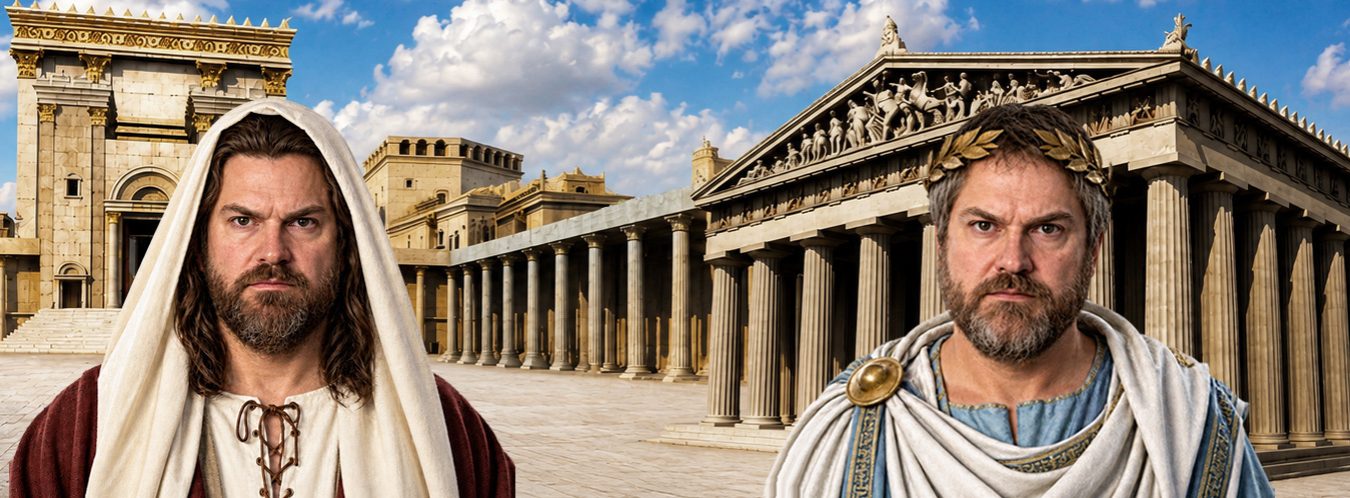

Unbelievers Stumbling–Believers Rejoicing
DELIVERED ON SUNDAY MORNING, MAY 22, 1864, BY THE REV. C, H. SPURGEON,
AT THE METROPOLITAN TABERNACLE, NEWINGTON.
"As it is written, Behold I lay in Zion a stumbling stone and rock of
offense: and whoever believes on Him shall not be ashamed." Romans
9:33.
OUR Apostle was inspired of God and yet he was moved to quote passages
out of the Old Testament. The Spirit of God might have dictated new
words to him. He might have shown him how to confirm the Truth by other
arguments, but He is not pleased to do so. He moves His servant to
establish the present Truth by Truths formerly revealed and thus He
sets us an example of searching the Scriptures and prizing the ancient
Oracles of God. The passage before us appears to be composed of two
Scriptures woven into one, a method not very infrequent with the
Apostles. A part of the text before us is found in Isaiah 28:16.
The Apostle does not quote verbatim, but gives us rather the sense than
the words–"Behold, I lay in Zion for a foundation a stone, a tried
stone, a precious cornerstone, a sure foundation: he that believes
shall not make haste." But the Apostle inlays this word of Prophecy
with another, selecting this time from Isaiah 8:14–"And He shall be
for a sanctuary. But for a stone of stumbling and for a rock of offense
to both the houses of Israel." I cannot help making an observation or
two upon these passages before I come to the text before us.
In Isaiah 8:14 you will perceive a striking proof of Christ's Divinity.
Observe the thirteenth verse–"Sanctify the Lord of Hosts Himself. And
let Him be your fear and let Him be your dread. And He," that is the
Lord of Hosts, "shall be for a sanctuary" to Believers, "but a stone of
stumbling and for a rock of offense to both the houses of Israel."
Isaiah utters a prophecy of the Lord of hosts. Paul quotes it in
reference to the Lord Jesus Christ, plainly intending us to infer that
the Lord Jesus Christ is no other than Jehovah Himself!
We learn from the other passage another Truth of God which serves more
closely to illustrate our text. In Isaiah 28:16, we read, "Behold, I
lay in Zion for a foundation a stone." The Apostle has omitted the
words "for a foundation," and has inserted the words of the other
passage, "a stumbling stone, a rock of offense." But the original
prophecy in Isaiah serves to show us that God's real object in laying
Christ in Zion was not that men might stumble at Him, but that He might
be a foundation for their hopes. The real object of God was that Christ
might be the cornerstone of human confidence.
But the result has been that to one set of men, renewed by Almighty
Grace, Christ has become a sanctuary of refuge and a stone of
dependence. And to others left to their own depravity He has become a
rock of offense and a stumbling stone–thus the remarks upon the
primitive Scriptures which Paul quotes. And now let us come to the
verse itself. Our text tells us that many persons stumble at Christ.
And, then, secondly, it assures us that those who receive Christ and
believe in Him, shall have no cause to be ashamed.
I. The first declaration needs no proof, for observation itself teaches
us that MANY STUMBLE AT CHRIST. No sooner was God manifest in the
flesh, than mortals began to stumble at Him. "Is not this the
carpenter's son?" was the question of those who looked for worldly pomp
and imperial grandeur. "His father and His mother we know, and His
brothers and His sisters, are they not all with us?" was the whispered
objection of His own townsmen. In His own country the greatest of all
Prophets had no honor. Our Lord was rejected by all sorts of men. They
looked at Him from different quarters, but all with the same scornful
eye.
The Pharisee stumbled at Him because He was not superstitions and
ostentatious. Indeed, He did not wash His hands before He ate! Nor did
He pray at the corner of the streets! Why, He entered into the company
of publicans and sinners! He did not make broad His phylactery. He
healed the sick upon the Sunday! He had no respect for traditions and
therefore every righteous Pharisee abhorred Him. The Sadducee, on the
other hand, much as He hated Pharisaic superstition, despised Christ
equally as much. His objections were shot from quite another quarter.
To him Christ was too superstitious, for the Sadducee would not believe
in angels or spirits, or the resurrection of the dead–all which
beliefs the Prophet of Nazareth openly avowed.
Philosophical skepticism detested Jesus because His teaching had in it
very much of the supernatural element. All His life long, in the high
courts of Herod or of Pilate, or in the lowest rank of the mob of
Judea, Christ was despised and rejected of men. They had long ago
persecuted all the Prophets whom the Lord had sent and it was little
marvel that they now assailed the Master Himself. "We have piped unto
you and you have not danced. We have mourned unto you and you have not
lamented," might all the Prophets of God say, for Israel received
neither the lonely man, whose meat was locusts and wild honey, nor the
more genial Spirit who came eating and drinking.
They put all God's Prophets away and would have none of their rebukes.
And when the Son Himself had come, they said, "This is the Heir, let us
kill Him, that the inheritance may be ours." The Jews, with one voice
rejected Him, save only the remnant, according to the election of
Grace. But the Jew is not alone in his offense at the Cross. We know
that when the Gospel was carried afterwards to the Gentiles, Christ
Crucified was a stumbling stone to them. The polished Greeks, with
their various systems of philosophy, expected in the Messiah deep
thinking and classic taste. But when they heard Paul preach the
resurrection of the dead, they saw nothing flattering to their
philosophy and therefore they openly mocked him.
While the Jew gathered up his broad-bordered garment and called Christ
a stumbling block, the Greek marched off to his classic temple or to
his scientific academe and cried, "Foolishness! The men who talk thus
must be mad!" In every age, even to the present time, wherever Jesus
Christ is preached, the human heart at once has been stirred with wrath
against Him. God's ambassador has found men unwilling to receive the
peace which he proclaims. God's dear Son, who came with no words but
those of mercy and of tenderness, has been abhorred and rejected by the
very men whom He came to bless. "He came unto His own and His own
received Him not."
However, we have very little to do with these past ages–we have far
more to do with the present and with ourselves. And it is a sad thing
to know that among this assembly, though I suppose we all call
ourselves Christians, there are many who still find Christ Jesus to be
a stumbling stone to them and a rock of offense. It is a lamentable
fact that there are hundreds of thousands in London to whom the Gospel
of Christ is as little known as to Hindus or Tartars. Christ is not a
stumbling block to these–they are unaware of Him and therefore they
have not the guilt which some of you have–of having heard of Him and
having rejected Him.
Among the present assembly there are some who stumble at Christ because
of His holiness. He is too strict for them. They would be Christians
but they cannot renounce their sensual pleasures. They would be washed
in His blood, but they desire still to roll in the mire of sin. Willing
enough, the mass of men would be to receive Christ, if, after receiving
Him, they might continue in their drunkenness, their wantonness and
self-indulgence. But Christ lays the axe at the root of the tree–He
tells them that these things must be given up–"because of these things
comes the wrath of God upon the children of disobedience," and,
"without holiness no man can see the Lord."
Human nature kicks at this. "What? May I not enjoy one darling lust?
May I not indulge myself at least now and then in these things? Must I
altogether forsake my old habits and my old ways? Must I be made a new
creature in Christ Jesus?" These are terms too hard, conditions too
severe, and so the human heart goes back to the flesh pots of Egypt and
clings to the garlic and the onions of the old estate of bondage and
will not be set free even though a greater than Moses lifts up the rod
to part the sea and promises to give to them a Canaan flowing with milk
and honey. Christ offends men because His Gospel is intolerant of sin.
Others stumble at our blessed Lord because they do not like the plan of
being saved altogether and alone through faith. Have I any such here? I
suppose I have. They say, "What? Are our good works to go for nothing?
Is there nothing that we can do to assist in our salvation? You tell us
that it is trusting in Christ alone without anything else which
justifies the soul. Then we do not understand it, or if we understand
it we do not like it." This is too humbling, too simple, too easy.
"Why," says the man who has always been to his parish Church or to his
Meeting House, who owes nobody anything and is kind to the poor–"Why,
then I am no better off than the harlot who walks the pavement at
midnight! Or the thief who is spending his month at the treadmill."
You are no better off, my Hearer, as to your eternal salvation if you
refuse to believe in Christ! The damnation of the openly ungodly is
sure, but so is yours, if, after having heard the plan of salvation you
turn upon your heels and despise it because you prefer your own
righteousness to the righteousness of God! Ah, how many are shipwrecked
upon this rock, swallowed up in this quicksand? They would be saved but
they will not bow the knee. They are not content to take God's
salvation by faith in Christ Jesus and so they perish through their
willful pride.
I have known others who stumble at Christ because of the doctrine which
He preaches, more especially the Doctrines of Grace. There will come
into this House, some who, if we preach a sermon upon Christian virtue,
will say, "I enjoyed that discourse." But if we preach Christ and begin
to talk about the deep doctrines which lie underneath the Gospel, such
as election, effectual calling, and eternal and immutable love,
straightway they are angry almost to the gnashing of their teeth. They
would have Christ, they say, but they cannot accept these doctrines.
"What? God saves whom He wills and not so much as ask the creature's
permission? Shall He do just as He pleases with us as a potter does
with lumps of clay? Are we to be told to our face that it is not of him
that wills, nor of him that runs, but of God that shows mercy? We
cannot endure this–we will betake ourselves to some place where man is
made more of and where God is not set so high above our heads!"
Ah, but my Friend, Jesus Christ will not shape His doctrine to please
you, nor tone down the Truth of Scripture to suit your carnal taste.
Mark you, it is in the ninth of Romans that my text is found, and in
that ninth of Romans you have the most plain and bold declaration
anywhere on record concerning the Sovereignty of Divine Grace and if
you choose to make that Sovereignty a reason for not believing in
Christ you will perish for your pains. And, perish deservedly, too,
because you will quarrel with God's Word and damn your own soul to be
avenged on God's Sovereignty.
But indeed, my dear Friends, when sinners are resolved to object to
Christ, it is the easiest thing in the world to find something to
object to. I have met with some who stumble at Christ's people. They
will say, "Well, I would believe in Christ, but look at professors! See
how inconsistent they are! See many Church members, in what an unholy
way they walk and even some ministers," and then they will begin to
quote various faults of some of God's eminent servants and they think
this is an excuse for going to Hell themselves, because others do not
walk straight in the way to Heaven!
O, will you send your soul to Hell because another man is not all he
should be? What if David falls and David is restored, is this any
reason why you should fall and never be restored? What if some pilgrims
to Heaven do turn into Bypath Meadow and have to come limping back into
the road–is this a reason why you should follow the road to the City
of Destruction? I think, Man, that this should only make you the more
diligent to make your calling and election sure! The shipwrecks of
others should make you sail more carefully. The bankruptcies of other
men should make you trade with greater diligence and humility. To quote
the defects of others as a reason why you should continue in the error
of your ways is a fool's method of reasoning! Take heed, lest you find
out your folly in the flames of Hell!
The real objection of the natural man is not, however, to God's people,
nor to the plan of salvation itself, so much as to Christ. The rock of
offense is Christ–to the Person of Christ. You will not have this Man
to reign over you! You are not willing that He should wear the crown
and have all the honor of your salvation. You had rather perish in your
sin than that Jesus Christ should be magnified in your salvation. This
is a severe charge, you will tell me. If it is not true, I pray you
prove it false by believing in Jesus! If you have no objection to
Christ, accept Him! Sinner, I charge you, if you say you do not stumble
at Christ, then lay hold upon Him! If He is not obnoxious to you, clasp
Him in your arms now!
Why, Man, if you are in your senses, since Christ can save you with an
eternal salvation, you will certainly grasp Him, unless there is some
objection in the way. And because you do not lay hold of Him, I tell
you there is some hindrance in your sinful heart–an offense at Christ
which will be your ruin unless God delivers you from it. Now may God
help me to reason a few minutes with those who are not believers in
Christ, who have made Him a stumbling stone and a rock of offense.
Dear Friend, let me come close to you and take your hand and talk with
you. Have you ever considered how much you insult God the Father by
rejecting Christ? If you were invited to a man's feast and you should
come to the table and dash down every dish and throw them on the ground
and trample on them, would not this be an insult? If you were a poor
beggar at the door and a rich man had bid you into his feast out of
pure charity, what do you think you would deserve if you had treated
his provisions in this way? And yet this is just your case. God owes
you nothing. You are a poor sinner without any claim upon Him and yet
He has been pleased to prepare a table for you. His oxen and His
fatlings have been killed and now you will not come!
No! You do worse! You raise objections to the feast! You despise the
pleasant land and the goodly provision of God! Just think at what an
expense the provision of salvation has been made! The eternal Father
gave His Son. Hark you–His Well-Beloved, the Darling of His heart, His
only Son–He gave Him to DIE, and do you despise such a Gift as this?
What do you think? Would it not bring the blood into your face if you
should give your only son to fight for your country and they to whom he
was given should despise you and your gift? If out of some superhuman
patriotism for your country's good you should even slay your son, would
it not cut you to the quick if men should laugh at you and scoff the
deed?
And yet such you do to the eternal Father, who for the love of men has
rent His Darling from His bosom, nailed Him to the tree and filled Him
with unutterable pains. You despise the unspeakable gift, the richest
deed of bounty which even the infinite heart of God could have
imagined, or the infinite hand of God could have performed! You despise
all this! You touch God, let me tell you, in the apple of His eye. You
do now wound Him in the most tender part! You might better have run
upon the edge of His sword or dashed yourself upon the bosses of His
buckler than to despise and reject His Only-Begotten Son, slaughtered
for human guilt!
Think again, what a proof is here of your sinfulness and how readily
will you be condemned at the last when this sin is written on your
forehead. Why, Man, there will be no reason to bring up any other sins
against you! The book in which your faults have been recorded scarcely
need be opened, for this, alone, will be enough! You have made Christ a
stumbling block, you have objected to God's dear Son–why need we any
other witness? Out of this one mouth you shall be condemned–"You did
abhor the Prince of Glory. You did refuse Him your heart"–take him
back to the place from where he came. What if he has never been an
adulterer or a whoremonger, yet is not this enough? Does not this show
the blackness of the traitor's heart and the vileness of his character?
He would not have Christ! He made the foundation which God laid in
Zion, "a stone of stumbling and a rock of offense." What do you think
of this, my Hearer?
Moreover, as this will be a swift witness to condemn you, how will this
increase your misery? Do you think God will be tender over you when you
have not been tender with His Son? When He shall cast you into Hell,
will He make the flames less hot? Do you think His vengeance will be
cool towards the man who stumbled at His Son? No! But this shall whet
the edge of His sword. "This traitor did do despite unto the blood of
Christ." He will pour oil upon the flames. "This man made My
Only-Begotten Son to be a stumbling stone. And now will I prove to him
that whoever stumbles upon this stone shall be broken and upon whomever
it shall fall, it shall grind him to powder."
Do you think that a king would be any the more inclined to be merciful
towards a traitor if he knew that that traitor had despised his son?
No. I think the sentence would be the more severe. Ah, Sinner! If all
other sinners escape, you who have heard the Gospel shall not. If God's
arrows miss other sinners, they shall strike you! You shall be the
special object of almighty vengeance because you were disobedient,
stumbling at this stumbling stone. Think again, Man, will not this seat
the eternity of your woe? How can you escape if you neglect so great a
salvation? You have broken down the only bridge which could have led
you into safety! You have pulled down the only refuge which could have
protected you from Divine wrath–"There remains no more sacrifice for
sin."
How can there be? Do you think when you are in Hell that Christ will
come a second time to die for you? Will He pour out His blood again to
bring you from the place of torment? Man, do you have so vain an
imagination as to dream that there will be a second ransom offered for
those who have not escaped the wrath to come, and that God the Holy
Spirit will again come and strive with sinners who aforetime willfully
rejected Him? No, inasmuch as even your Savior is objected to and you
put eternal life from you and the foundation itself is a stumbling
stone, there can remain nothing for you but a fearful looking for of
judgment and of fiery indignation.
And now one other word with you. Does not this view of the case make
your heart tremble? Is it not enough to have broken God's Law? Why do
you go the length of despising His Son? O my eyes! If you could weep
forever you could never weep tears enough, because once you refused to
look to Him who is now your daily joy. Is not this one of the worst
sins we shall have to confess? And O Sinner, will not you confess it
now? Will not this thought break your heart–that you have up to now
despised the altogether lovely and loving One? May the Spirit of God
drive that home as a nail in a sure place, and I think you will turn to
the Redeemer and say, "My Lord and my God, forgive me that I have dealt
so un- kindly with You. Accept me, receive me to Your bosom. Wash me in
Your blood. Take me to be Your servant and save me with a great
salvation."
Happy is the man who has been brought by Divine Grace thus to confess
his fault and stumble no longer. After all, what is there to stumble
at? O my Hearer, why should you reject Christ? He is not a hard
taskmaster–"His yoke is easy and His burden is light." Why should you
refuse your own mercy? To be saved–is that a misfortune? To be
cleansed from sin–is this a calamity? To be made a child of God–is
that a disadvantage? To escape from Hell and fly to Heaven–is not this
the most desirable of all mercies? Why, then, despise Christ? It is
unreasonable! God deliver you from this unreasonable sin and bring you
now to accept Christ with a perfect heart and He shall be praised for
it forever.
II. I shall now try, by the help of God's Spirit, to explain the second
part–the more comforting part of the text, "WHOEVER BELIEVES ON HIM
SHALL NOT BE ASHAMED." He shall be ashamed to think he did not believe
be-fore–he shall be ashamed to think he does not believe more firmly
now–he shall often feel shame and confusion of face on account of his
ingratitude and his sinfulness and his wandering of heart. But the text
means he shall not be ashamed of having trusted Christ. He that
believes on Christ shall never have any cause to be ashamed of so
doing.
1. In handling this I shall first of all notice when those who trust
Christ might be ashamed of having trusted Him. Well might they be
ashamed if Christ should ever leave them. If it should ever come to
this, that He who is the husband of my heart, should desert me and
leave me a lone widow in the world. If, after having said, "I will
never leave you nor forsake you," He should after all take Himself away
and never indulge His servant with one smile from His face, I should
then, indeed, have reason to be ashamed of having put my trust in such
a fickle Savior.
The Arminian's christ is one whom they have good reason to be ashamed
of because he redeems men with his precious blood and yet they go to
Hell. The Arminian's christ loves today but hates tomorrow. He saves by
grace, but that grace is dependent upon man's use of grace. He does
bring men out of a state of condemnation and he does justify them–but,
after all, he lets them go back into a state of condemnation and they
still perish! But the Christian's Christ is a very different Person,
whom once He loves He never leaves, but loves them to the end. Where He
has begun a good work He carries it on and perfects it.
The Christian's Christ can say, "I give unto My sheep eternal life and
they shall never perish, neither shall any pluck them out of My hands."
Until the Christian finds that the Grace of God is clean gone, that
Christ's love has ceased, he shall never have any cause to be ashamed.
Again, the Christian would have cause to doubt if Christ were to fail
him, either as to Providence or Grace, in his times of trial and
temptation. When in the midst of the rivers, if the Lord does not
sustain me, I shall have cause to blush for my hope. If, walking
through the fires the flames do kindle upon me and I do not find the
Lord to be my present help in the time of trouble, then I am put to
shame.
O Beloved, when will this happen? In six troubles He has been with you
and in seven no evil has touched you. You have been brought very low!
You could not have been much lower unless you had been in your grave.
You have been very poor, scarcely having bread to eat, or raiment to
put on! Everything in which you trusted has been cut from under you.
You are left orphans in the world, with the exception of your Father
which is in Heaven. But still, for all that, has not your bread been
given you? Have not your waters been sure? And today must not your
testimony be concerning God that He has been a Friend who sticks closer
than a brother? Well, then, you never need be ashamed, because there
never shall come a time when He shall leave you to perish through
stress of trials or suffer you to be destroyed by the force of
temptations.
Again, a Christian would have cause to be ashamed if Christ's promises
were not fulfilled. They are very rich and very full and there are very
many of them–and if I take these promises and act upon God's Word and
then, after all, find the promise to be mere waste paper–if the Lord
breaks His own Oath, then I should be ashamed to have believed in an
unfaithful God! But when will that be? Christian, has the time come
with you yet? You have had promises applied with power to your heart
and you have taken them to God in prayer. Let me appeal to your
experience! Have they not been fulfilled beyond your expectation or
your faith? Has not God done for you exceedingly abundantly above what
you can ask or think?
And yet this morning, perhaps, you are afraid His promise will not be
kept! You have come here in lowness of spirit, you have had so many
troubles during the week that you really begin to be ashamed of having
trusted in God. Be ashamed of yourself for being ashamed! And depend on
it, your confidence is not a thing to blush over. But O my Broth- ers
and Sisters, how ashamed would the Christian be if when he came to die
he should find no support, no kind angels near his bed, no Savior to
bear his head up amidst the billows! But have you ever heard of a
Christian who was ashamed in his dying hour? Is it not rather the sure
witness of all the departed that their last moments have been gilded
with the sunlight of Heaven?
Have not they snug on their dying beds, with David, "Yes, though I pass
through the valley of the shadow of death, I will fear no evil: for You
are with me. Your rod and Your staff they comfort me"? If, indeed, we
could wake up in the resurrection and find ourselves without a Savior.
If we could stand at the judgment bar of God and find that Christ's
blood had not made us clean. If, after all our faith in Him, we should
hear Him say, "Depart, you cursed, into everlasting fire," then might
we be ashamed! But our text assures us that we never shall have to
suffer this. Let us then roll ourselves upon this sweet comfort–having
believed in Christ we shall never in this life, nor in the life to
come–need to be ashamed of our hope.
2. Having noticed when the Christian might be ashamed, let us notice
why he might be ashamed if such things were to come. I have sometimes
thought, dear Friends, that in some respects, if the Bible were proven
to be false, I should never be ashamed of having believed it. If there
should be no Savior, I think that when I stand before God's Throne I
shall not be ashamed of having believed the Gospel because, I think, I
could dare to say even to the eternal God, "Great God, I believed of
You that which reflected the highest honor upon Your Character. I
believed You capable of a great deed of kindness, the giving of Your
own Son. I believed You to be so just that You would not forgive
without a punishment and yet so gracious that You would sooner give
Your Son than not have mercy upon men.
"I believed of You higher things than either Jew, or Mahommedan, or
Heathen–and my soul did love You for it. I did preach what I thought
would honor Your name and now that it turns out to be a mistake, I am
not ashamed of having believed it, for it was such a thing as should
have been true–Your Nature and your Character made it likely to be
true and I mourn to think it is not, but I am not ashamed! I wish it
had been. It would make You, great God, even more glorious than You
are."
Beloved, we are under no apprehension that it shall turn out to be so,
for we know whom we have believed and we are persuaded that He is able
to keep that which we have committed to Him. Why would a Christian be
ashamed if the Gospel were untrue? We should be ashamed, first of all,
because we have ventured our all upon its Truth. We have ventured our
all upon Christ. The world says you should never put all your eggs in
one basket. And when a man speculates in some one thing and it all
comes down, wise people hold up their hands and say, "Ah, very
imprudent, very imprudent! Better have three or four strings to your
bow! You must not be depending on any one thing."
The world is quite right in human things. But here are we–we are
depending everything upon one Man–my soul has not a shadow of a hope
anywhere else but in Christ and I know that your spirits have not even
the ghost of a shadow of dependence anywhere but in the blood and
righteousness of that Divine Redeemer who has completed our salvation
and ascended up on high. If He can fail us, then all our hopes are
gone! We are, of all men, most miserable. If our hope should turn out
to be a delusion, we should be foolish, indeed, and have reason to be
ashamed of our hope.
We should be ashamed, again, because we have given up this life for the
next–believing in the world to come, we have said, "This is not our
rest, we have no abiding city here." The world's proverb is, "A bird in
the hand is worth two in the bush." But we, on the other hand, have
said that the bird in the hand is nothing at all–that the bird in the
bush is everything. Our soul says, "Joy! We do not expect it here, it
is there that joy is to be found." "Wealth? No man is rich on earth,
riches are in Heaven, the true treasure is in Glory." "Love does not
find a fit object here–our affection is set upon things above, where
Christ dwells at the right hand of God."
Now if things should turn out wrong and we have believed in vain, then
we shall be ashamed of our hope, but not till then! Not till then,
Beloved! And that shall be never! We know whom we have believed and we
are confident that in giving up this earth we have only given up a
handful of ashes that we may enjoy riches and Glory forever. Again, if
Christ should fail us, we should be ashamed because we began boasting
before we had ended the battle. "My soul shall make her boast in the
Lord."
I hope you can say, dear Friends, that though you have not entered
Heaven and have not yet seen Christ face to face, yet you have learned
to bask in the Cross of Christ and no man has been able to stop you in
your glory. You have boasted in Christ! You have said that He is a sure
Foundation, that He is a precious Husband, that He is All in All to you
and worthy of your best love! But if He should fail you, why then, you
would be in the position of a man who boasted before the time. But we
shall never be ashamed! We do right to boast with a full mouth! Let us
glory in the Lord. But oh, if He should fail us–which He never
can–then were we ashamed, indeed!
Besides, we have done more than boast! You and I have actually divided
the spoil! And oh, if the battle should be lost, then we should be
ashamed! We are told that in one of the great battles on the continent
in the olden times, the French, before the battle began, commenced
selling the English captives to one another and calculated how much
each man would have of the spoil. But then, fortunately, they never
gained the victory. But you and I have already entered into our
rest–we have had the earnest of our inheritance–we have begun, even
on earth, to eat the clusters of Eshcol. And if it should be a delusion
we should be ashamed, but not till then. Courage, dear Friends! We may
go boldly on dividing the spoil! For while Christ is true and God is
faithful, there shall be no reason for being ashamed.
I have known some ashamed when they have made a bad speculation because
they have induced others to enter into it. They have been more ashamed
to face their friends who have lost money than they have been to
acknowledge that they lost themselves. You and I have been inducing
others to embark in this great venture. We have taught others to
believe in Christ. And some of us scarcely spend a day without winning
some souls to confidence in Christ. Oh, sweet Assurance! We have not
preached cunningly devised fables and shall never be ashamed!
3. I must crave your patience just a moment while I now pass on to
notice who are they who shall never be ashamed? The answer is general
and special. The text says, "Whoever believes"–that is, any man who
ever lived, or ever shall live, who believes in Christ shall never be
ashamed. Whether he has been a gross sinner or a moralist. Whether he
is learned or illiterate. Whether he is a prince or a beggar, it
matters not–"Whoever believes in Christ shall never be ashamed." You,
Man, over yonder, though you may very seldom come to the House of God,
yet if you believe in Christ today you shall never be ashamed of Him.
You who have sat in God's House for years and feel yourselves guilty of
having rejected Christ, yet if now you trust Him you shall not be
ashamed.
But there is a specialty, it is "Whoever believes." Others shall be
ashamed. There must be a real and hearty believing. There must be a
simple confidence in the Person and work of Jesus–wherever this is
there shall be no shame. "Ah," says one, "but I have such a little
faith. I am afraid I shall be confounded." No, you come in under the
"Whoever"– "Whoever believes," though his faith is ever so little,
shall never be ashamed. "Ah," says another, "but I have so many
doubts." Still, dear Heart, since you believe you shall not be ashamed.
All your doubts and your fears shall never damn you, for your faith
will prevail.
"Oh, but," says another, "my corruption is so strong! I have come this
morning lamenting because of my imperfections. They have obtained the
mastery of my faith and I have fallen during the week." Yes, Soul, all
fallen as you are, yet if you believe you shall never be ashamed. Does
sin stare you in the face? Do you feel very heavy under a sense of your
own unworthiness? Dare to believe in Christ just as you are–sins and
all–venture on Him without any other confidence. When frames are dark
and graces dead, when evidences are black, when everything gives you a
frown and a curse, yet dare to believe in Him!
Now take Him to be your Friend when you have no other! Now flee to this
Refuge when every other door is shut! Now that winter has frozen every
brook, now come and drink of this Brook which flows on forever! This
Well of Bethlehem which is within the gate can never fail you! And you
need not to put your life in jeopardy to get it, it is free to you this
moment! Stoop and drink confidently! Stoop and drink and you shall
thirst no more, for, "Whoever believes in Him shall never be ashamed."
4. To conclude, the text means more than it says, for whereas it says
they shall not be ashamed, it means that they shall be glorified and
full of honor! If you trust Christ today, it will bring you shame from
men, it will ensure you trials and troubles–but it will also ensure
you honor in the sight of God's holy angels and Glory at the last in
the sight of the assembled universe! Where is the man who trusts Christ
today? There he stands in the pillory and men say, "Aha! Aha! The fool!
The fool! The fool! He trusts a God whom he cannot see! He believes in
a Christ whom we have heard of but whom we never heard! He trusts in
the blood of a crucified Galilean!
The worldling cries, "We are too wise for that! We will believe
geological theories, spiritualism, or metaphysics! We will believe the
devil himself sooner than we will believe in Christ!" So they scoff at
the man who trusts Christ. The scene is changed, the generation of the
living has passed away and the world has become one great burial field.
There they lay.
Innumerable hillocks mark where the bodies of men are sleeping. The
trumpet sounds, it rings clear through earth and Heaven and up from the
graves rise bodies which have once been worm's meat and souls come back
into those frames– and now where is the man who trusted Christ?
The trumpet has startled them all from their tombs and they awake
together–"Where is the man who trusted in Christ?" Who is it that
inquires for him? The King Himself upon the Throne has asked the
question! King Jesus, sitting on His judgment seat, searches for His
friends–"Where is the man who trusted in Me? Bring him here." See the
change, no hooting and yelling and laughter and slander now! A
triumphant squadron of bright spirits carry up the Believer to the
right hand of Jesus and there he sits enthroned like Christ, sitting
with Him to judge men and angels, reigning upon Christ's Throne in all
Christ's splendor!
"Thus shall it be done unto the man whom the King delights to honor,"
thus shall it be done to the man who puts his trust in Christ! Come,
Christian, whatever may be your state today, however the world's
mockery may ring in your ears, think of that unwilling honor which the
crowd of sinners will have to give you at the Last Great Day! Think of
how your fame and reputation shall rise with your bones! And as worms
cannot devour your body to prevent your rising, so shall not slander
and rebuke devour your character to prevent its rising, too! Glory
shall be yours–everlasting Glory–while your enemies shall be clothed
with shame and eternal contempt!
Well, what do you say, dear Hearers? On which side are you this
morning? Is Christ a stumbling block to you? Will you go on stumbling
at Him and objecting to Him? Do you say rather, "No, we will have
Christ and trust Him." Oh, if the Lord has brought you to this, I will
clap my hands for joy! And you, you Angels, strike your harps! You
Seraphs! Tune your lyres anew, for there is joy in Heaven as there is
joy on earth when a soul comes to put its trust in Christ! The Lord
bring every one of us, for His name's sake. Amen. Amen.