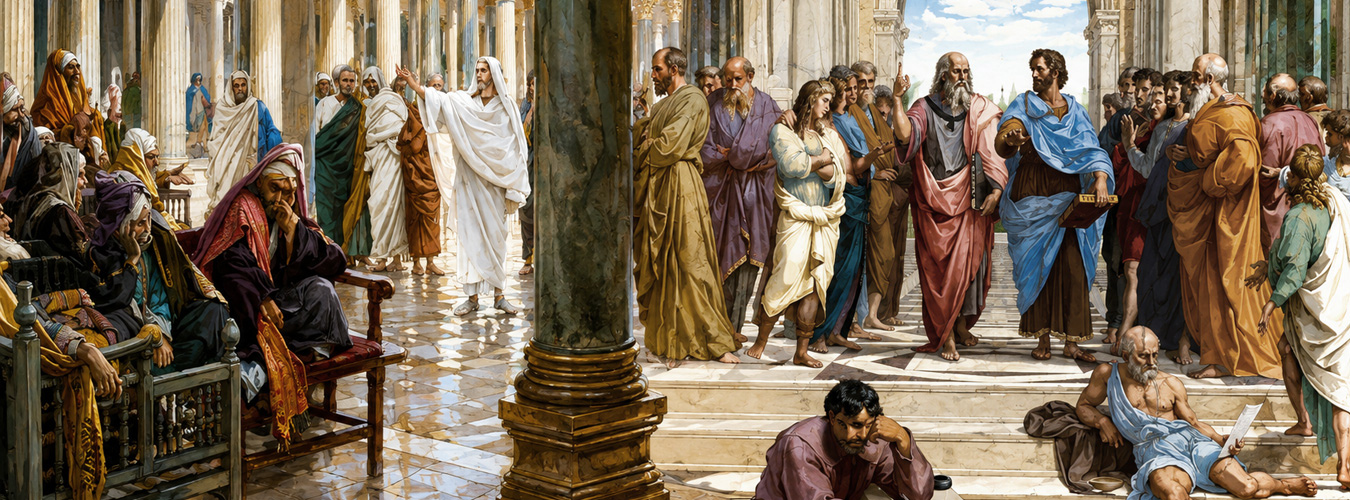

Young Man, Is This For You?
DELIVERED ON LORD'S DAY MORNING, JANUARY 15, 1888,
BY C. H. SPURGEON,
AT THE METROPOLITAN TABERNACLE, NEWINGTON.
"And it came to pass the day after, that He went into a city called
Nain; and many of His disciples went with Him and much people. Now when
He came near to the gate of the city, behold, there was a dead man
carried out, the only son of his mother and she was a widow: and much
people of the city was with her. And when the Lord saw her, He had
compassion on her and said unto her, Weep not. And He came and touched
the bier: and they that bare him stood stiil. And He said, Young man I
say unto you, Arise. And he that was dead sat up and began to speak.
And He delivered him to his mother. And there came a fear on all: and
they glorified God, saying, That a great prophet is risen up among us;
and, That God has visited His people. And this rumor of Him went forth
throughout all Judea and throughout all the region round about." Luke
7:11-17.
BEHOLD, dear Brethren, the overflowing, ever-flowing power of our Lord
Jesus Christ! He had worked a great work upon the centurion's servant,
and now, only a day after, he raises the dead. "It came to pass the day
after, that He went into a city called Nain." Day unto day utters
speech concerning His deeds of goodness. Did He save your friend
yesterday? His fullness is the same. If you seek Him, His love and
grace will flow to you today. He blesses this day and He blesses the
day after. Never is our Divine Lord compelled to pause until He has
recruited His resources. Virtue goes out of Him forever. These
thousands of years have not diminished the greatness of His power to
bless.
Behold, also, the readiness and naturalness of the outgoings of His
life-giving power. Our Savior was journeying and He works miracles
while on the road–"He went into a city called Nain." It was
incidentally, (some would say accidentally), that He met the funeral
procession. But at once He restored to life this dead young man. Our
blessed Lord was not standing still, as one professionally called
in–He does not seem to have come to Nain at anyone's request for the
display of His love. But He was passing through the gate into the city
for some reason which is not recorded.
See, my Brethren, how the Lord Jesus is always ready to save! He healed
the woman who touched him in the throng when He was on the road to
quite another person's house. The mere spilling and droppings of the
Lord's cup of grace are marvelous. Here He gives life to the dead when
He is en route. He scatters His mercy by the roadside and anywhere and
everywhere His paths drop fatness. No time, no place can find Jesus
unwilling or unable. When Baal is on a journey, or sleeps, his deluded
worshippers cannot hope for his help. But when Jesus journeys or
sleeps, a word will find Him ready to conquer death, or quell the
tempest.
It was a remarkable incident, this meeting of the two processions at
the gates of Nain. If someone with a fine imagination could picture it,
what an opportunity he would have for developing his poetical genius! I
venture on no such effort. Yonder a procession descends from the city.
Our spiritual eyes see death upon the pale horse coming forth from the
city gate with great exultation. He has taken another captive. Upon
that bier behold the spoils of the dread conqueror! Mourners, by their
tears, confess the victory of death. Like a general riding in triumph
to the Roman capitol, death bears his spoils to the tomb. What shall
hinder him?
Suddenly the procession is arrested by another–a company of disciples
and much people are coming up the hill. We need not look at the company
but we may fix our eyes upon One who stands in the center, a Man in
whom lowliness was always evident and yet majesty was never wanting. It
is the living Lord, even He who only has immortality and in Him death
has now met his destroyer. The battle is short and decisive–no blows
are struck–for death has already done his
utmost. With a linger the chariot of death is arrested–with a word the
spoil is taken from the mighty and the lawful captive is delivered.
Death flies defeated from the gates of the city, while Tabor and
Hermon, which both looked down upon the scene, rejoice in the name of
the Lord. This was a rehearsal upon a small scale of that which shall
happen by-and-by, when those who are in their graves shall hear the
voice of the Son of God and live–then shall the last enemy be
destroyed. Only let death come into contact with Him who is our life
and it is compelled to relax its hold. Whatever may be the spoil which
it has captured, soon shall our Lord come in His glory and then before
the gates of the New Jerusalem we shall see the miracle at the gates of
Nain multiplied a myriad times.
Thus, you see, our subject would naturally conduct us to the doctrine
of the resurrection of the dead, which is one of the foundation stones
of our most holy faith. That grand Truth of God I have often declared
to you and will do so again and again. But at this time I have selected
my text for a very practical purpose. It concerns the souls of some for
whom I am greatly anxious. The narrative before us records a fact, a
literal fact–but the record may be used for spiritual instruction. All
our Lord's miracles were intended to be parables–they were intended to
instruct as well as to impress– they are sermons to the eyes, just as
His spoken discourses were sermons to the ears. We see here how Jesus
can deal with spiritual death. And how He can impart spiritual life at
His pleasure. Oh, that we may see this done this morning in the midst
of this great assembly!
I. I shall ask you first, dear Friends, to reflect that THE SPIRITUALLY
DEAD CAUSE GREAT GRIEF TO THEIR GRACIOUS FRIENDS. If an ungodly man is
favored to have Christian relatives, he causes them much anxiety. As a
natural fact, this dead young man, who was being carried out to his
burial, caused his mother's heart to burst with grief. She showed by
her tears that her heart was overflowing with sorrow. The Savior said
to her, "Weep not," because He saw how deeply she was troubled. Many of
my dear young friends may be deeply thankful that they have friends who
are grieving over them. It is a sad thing that your conduct should
grieve them–but it is a hopeful circumstance for you that you have
those around you who do thus grieve.
If all approved of your evil ways, you would, no doubt, continue in
them and go speedily to destruction. But it is a blessing that
arresting voices do at least a little hinder you. Besides, it may yet
be that our Lord will listen to the silent oratory of your mother's
tears and that this morning He may bless you for her sake. See how the
Evangelist puts it– "When the Lord saw her, He had compassion on her
and said unto her, Weep not." And then He said to the young man,
"Arise."
Many young persons who are in some respects amiable and hopeful,
nevertheless, being spiritually dead, are causing great sorrow to those
who love them most. It would perhaps be honest to say that they do not
intend to inflict all this sorrow. Indeed, they think it quite
unnecessary. Yet they are a daily burden to those whom they love. Their
conduct is such that when it is thought over in the silence of their
mother's chamber, she cannot help but weep. Her son went with her to
the House of God when he was a boy, but now he finds his pleasure in a
very different quarter.
Being beyond all control now, the young man does not choose to go with
his mother. She would not wish to deprive him of his liberty, but she
laments that he exercises that liberty so unwisely. She mourns that he
has not the inclination to hear the Word of the Lord and become a
servant of his mother's God. She had hoped that he would follow in his
father's footsteps and unite with the people of God. But he takes quite
the opposite course. She has seen a good deal about him lately which
has deepened her anxiety–he is forming companionships and other
connections which are sadly harmful to him. He has a distaste for the
quietude of home and he has been exhibiting to his mother a spirit
which wounds her.
It may be that what he has said and done is not meant to be unkind. But
it is very grievous to the heart which watches over him so tenderly.
She sees a growing indifference to everything that is good and an
unconcealed intention to see the vicious side of life. She knows a
little and fears more as to his present state and she dreads that he
will go from one sin to another till he ruins himself for this life and
the next. O Friends, it is to a gracious heart a very great grief to
have an unconverted child. And yet more so if that child is a mother's
boy, her only boy, and she a desolate woman, from whom her husband has
been snatched away.
To see spiritual death rampant in one so dear is a sore sorrow which
causes many a mother to mourn in secret and pour out her soul before
God. Many a Hannah has become a woman of a sorrowful spirit through her
own child. How sad that he who should have made her the most glad among
women has filled her life with bitterness! Many a mother has
had to grieve over her son as almost to cry, "Would God he had never
been born!" It is so in thousands of cases. If it is so in your case,
dear Friend, take home my words to yourself and reflect upon them.
The cause of grief lies here–we mourn that they should be in such a
case. In the story before us the mother wept because her son was dead.
And we sorrow because our young friends are spiritually dead. There is
a life infinitely higher than the life which quickens our material
bodies. And oh, that all of you knew it! You who are unrenewed do not
know anything about this true life. Oh, how we wish you did! It seems
to us a dreadful thing that you should be dead to God, dead to Christ,
dead to the Holy Spirit. It is sad, indeed, that you should be dead to
those Divine Truths which are the delight and strength of our
souls–dead to those holy motives which keep us back from evil and spur
us on to virtue.
Dead to those sacred joys which often bring us very near the gates of
Heaven. We cannot look at a dead man and feel joy in him, whoever he
may be–a corpse, however delicately dressed, is a sad sight. We cannot
look upon you, you poor dead souls, without crying out, "O God, shall
it always be so? Shall not these dry bones live? Will You not quicken
them?" The Apostle speaks of one who lived in pleasure and he said of
her, "She is dead while she lives." Numbers of persons are dead in
reference to all that is true and noble and most Divine. And yet in
other respects they are full of life and activity. Oh, to think that
they should be dead to God and yet so full of happiness and energy!
Marvel not that we grieve about them.
We also mourn because we lose the help and comfort which they ought to
bring us. This widowed mother no doubt mourned her boy not only because
he was dead but because in him she had lost her earthly stay. She must
have regarded him as the staff of her age and the comfort of her
loneliness. "She was a widow"–I question if anybody but a widow
understands the full sorrow of that word. We may put ourselves by
sympathy into the position of one who has lost her other self, the
partner of her life. But the most tender sympathy cannot fully realize
the actual cleavage of bereavement and the desolation of love's loss.
"She was a widow"–the sentence sounds like a knell.
Still, if the sun of her life was gone, there was a star shining. She
had a boy, a dear boy, who promised her great comfort. He would, no
doubt, supply her necessities and cheer her loneliness and in him her
husband would live again and his name would remain among the living in
Israel. She could lean on him as she went to the synagogue. She would
have him to come home from his work at evening and keep the little home
together and cheer her hearth. Alas, that star is swallowed up in the
darkness. He is dead and today he is carried to the cemetery.
It is the same spiritually with us in reference to our unconverted
friends. With regard to you that are dead in sin we feel that we miss
the aid and comfort which we ought to receive from you in our service
of the living God. We want fresh laborers in all sorts of places–in
our Sunday school work, our mission among the masses and in all manner
of service for the Lord we love! Ours is a gigantic burden and we long
for our sons to put their shoulders to it. We looked forward to seeing
you grow up in the fear of God and stand side by side with us in the
great warfare against evil and in holy labor for the Lord Jesus.
But you cannot help us, for you are yourselves on the wrong side. Alas,
alas, you hinder us by causing the world to say, "See how those young
men are acting!" We have to spend thought and prayer and effort over
you which might usefully have gone forth for others. Our care for
yonder great dark world which lies all around us is very pressing but
you do not share it with us–men are perishing from lack of knowledge
and you do not help us in endeavoring to enlighten them.
A further grief is that we can have no fellowship with them. The mother
at Nain could have no communion with her dear son now that he was dead,
for the dead know not anything. He can never speak to her, nor she to
him, for he is on the bier, "a dead man carried out." O my Friends,
certain of you have dear ones whom you love and they love you. But they
cannot hold any spiritual communion with you, nor you with them. You
never bow the knee together in private prayer, nor mingle heart with
heart in the appeal of faith to God as to the cares which prowl around
your home. O young man, when your mother's heart leaps for joy because
of the love of Christ shed abroad in her soul, you cannot understand
her joy. Her feelings are a mystery to you.
If you are a dutiful son, you do not say anything disrespectful about
her religion. But yet you cannot sympathize in its sorrows or its joys.
Between your mother and you there is upon the best things a gulf as
wide as if you were actually dead on the bier and she stood weeping
over your corpse. I remember, in the hour of overwhelming anguish when
I feared that my beloved wife was about to be taken from me, how I was
comforted by the loving prayers of my two dear sons–we had commun-
ion not only in our grief but in our confidence in the living God. We
knelt together and poured out our hearts unto God and we were
comforted.
How I blessed God that I had in my children such sweet support! But
suppose they had been ungodly young men? I should have looked in vain
for holy fellowship and for aid at the Throne of Grace. Alas, in many a
household the mother cannot have communion with her own son or daughter
on that point which is most vital and enduring because they are
spiritually dead– while she has been quickened into newness of life by
the Holy Spirit.
Moreover, spiritual death soon produces manifest causes for sorrow. In
the narrative before us the time had come when her son's body must be
buried. She could not wish to have that dead form longer in the home
with her. It is a token to us of the terrible power of death that it
conquers love with regard to the body. Abraham loved his Sarah. But
after a while he had to say to the sons of Heth, "Give me a possession
of a burying place with you, that I may bury my dead out of my sight."
It happens in some mournful cases that character becomes so bad that no
comfort in life can be enjoyed while the erring one is within the home
circle.
We have known parents who have felt that they could not have their son
at home so drunken, so debauched had he become. Not always wisely, yet
sometimes almost of necessity, the plan has been tried of sending the
incorrigible youth to a distant colony in the hope that when removed
from pernicious influences he might do better. How seldom so deplorable
an experiment succeeds! I have known mothers who could not think of
their sons without feeling pangs far more bitter than those they
endured at their birth. Woe, woe to him who causes such heartbreak!
What an awful thing it is when love's best hopes gradually die down
into despair and loving desires at last put on mourning and turn from
prayers of hope to tears of regret!
Words of admonition call forth such passion and blasphemy that prudence
almost silences them. Then have we before us the dead young man carried
out to his grave. A sorrowful voice sobs out, "He is given unto idols,
let him alone." Am I addressing one whose life is now preying upon the
tender heart of her that brought him forth? Do I speak to one whose
outward conduct has at last become so avowedly wicked that he is a
daily death to those who gave him life? O young man, can you bear to
think of this? Are you turned to stone? I cannot yet believe that you
contemplate your parents' heartbreak without bitter feelings. God
forbid that you should!
We also mourn because of the future of men dead in sin. This mother,
whose son had already gone so far in death that he must be buried out
of sight, had the further knowledge that something worse would befall
him in the sepulcher to which he was being carried. It was impossible
for her to think calmly of the corruption which surely follows at the
heels of death. When we think of what will become of you who refuse the
Lord Christ we are appalled. "After death the judgment." We could more
readily go into details as to a putrid corpse than we could survey the
state of a soul lost forever. We dare not linger at the mouth of Hell.
But we are forced to remind you that there is a place, "where their
worm dies not and the fire is not quenched."
There is a place where those must abide who are driven from the
presence of the Lord and from the glory of His power. It is an
unendurable thought that you should be, "cast into the lake of fire,
which is the second death." I do not wonder that those who are not
honest with you are afraid to tell you so and that you try yourself to
doubt it. But with the Bible in your hand and a conscience in your
bosom you cannot but fear the worst if you remain apart from Jesus and
the life He freely gives. If you continue as you are and persevere in
your sin and unbelief to the end of life, there is no help for you but
that you must be condemned in the Day of Judgment.
The most solemn declarations of the Word of God assure you that, "he
that believes not shall be damned." It is heartbreaking work to think
that this should be the case with any of you. You prattled at your
mother's knee and kissed her cheek with rapturous love–why, then, will
you be divided from her forever? Your father hoped that you would take
his place in the Church of God–how is it that you do not even care to
follow him to Heaven? Remember, the day comes when, "one shall be
taken, and the other left." Do you renounce all hope of being with your
wife, your sister, your mother at the right hand of God? You cannot
wish them to go down to Hell with you–have you no desire to go to
Heaven with them?
"Come, you blessed," will be the voice of Jesus to those who imitated
their gracious Savior. And "Depart from Me, you cursed, into
everlasting fire, prepared for the devil and his angels," must be the
sentence upon all who refuse to be made like the Lord. Why will you
take your part and lot with accursed ones? I do not know whether you
find it easy to hear me this morning. I find it very hard to speak to
you because my lips are not able to express my heart's feelings. Oh
that I had the forceful utterance of an Isaiah, or the passionate
lamentations of a Jeremiah with which to arouse your affections and
your fears! Still, the Holy Spirit can use even me, and I beseech Him
so to do. But I have said enough on this point. I am sure you see that
the spiritually dead cause great grief to those of their family who are
spiritually alive.
II. Now let me cheer you while I introduce the second head of my
discourse, which is this–FOR SUCH GRIEF THERE IS ONLY ONE HELPER–BUT
THERE IS A HELPER.
This young man is taken out to be buried. But our Lord Jesus Christ met
the funeral procession. Carefully note the "coincidences," as skeptics
call them but as we call them–"Providences"–of Scripture. This is a
fine subject for another time. Take this one case. How came it that the
young man died just then? How came it that this exact hour was selected
for his burial? Perhaps because it was evening. But even that might not
fix the precise moment. Why did the Savior that day arrange to travel
five-and-twenty miles, so as to arrive at Nain in the evening? How came
it to pass that He happened just then to be coming from a quarter which
naturally led Him to enter at that particular gate from which the dead
would be carried?
See, He ascends the hill to the little city at the same moment when the
head of the procession is coming out of the gate! He meets the dead man
before the place of sepulture is reached. A little later and he would
have been buried. A little earlier and he would have been at home lying
in the darkened room and no one might have called the Lord's attention
to him. The Lord knows how to arrange all things–His forecasts are
true to the tick of the clock. I hope some great purpose is to be
fulfilled this morning. I do not know why you, my Friend, came in here
on a day when I am discoursing on this particular subject. You did not
think to come, perhaps, but here you are. And Jesus has come here, too.
He has come here on purpose to meet you and quicken you to newness of
life. There is no chance about it–eternal decrees have arranged it all
and we shall soon see that it is so. You spiritually dead are being met
by Him in whom is life eternal.
The blessed Savior saw all at a glance. Out of that procession He
singled out the chief mourner and read her inmost heart. He was always
tender to mothers. He fixed His eye on that widow. For He knew that she
was such, without being informed of the fact. The dead man is her only
son–He perceives all the details and nothing is hid from His infinite
mind. O young man, Jesus knows all about you. Jesus, who is invisibly
present this morning, fixes His eyes on you at this moment. He has seen
the tears of those who have wept for you. He sees that some of them
despair of you, and are in their great grief acting like mourners at
your funeral.
Jesus saw it all and, what was more, entered into it all. Oh, how we
ought to love our Lord that He takes such notice of our griefs and
especially our spiritual griefs about the souls of others! You, dear
Teacher, want your class saved–Jesus sympathizes with you. You, dear
Friend, have been very earnest to win souls, Know that in all this you
are workers together with God. Jesus knows all about our travail of
soul and He is at one with us therein. Our travail is only His own
travail rehearsed in us, according to our humble measure. When Jesus
enters into our work it cannot fail. Enter, O Lord, into my work at
this hour, I pray You, and bless this feeble word to my hearers! I know
that hundreds of Believers are saying, "Amen." How this cheers me!
Our Lord proved how He entered into the sorrowful state of things by
first saying to the widow, "Weep not." At this moment He says to you
who are praying and agonizing for souls, "Do not despair! Sorrow not as
those who are without hope! I mean to bless you. You shall yet rejoice
over life given to the dead." Let us take heart and dismiss all
unbelieving fear. Our Lord then went to the bier and just laid His
finger upon it and they that carried it stood still of their own
accord. Our Lord has a way of making bearers stand still without a
word. Perhaps, today, yonder young man is being carried further into
sin by the four bearers of his natural passions, his infidelity, his
bad company, and his love of strong drink. It may be that pleasure and
pride, willfulness and wickedness are bearing the four corners of the
bier. But our Lord can, by His mysterious power, make the bearers stand
still. Evil influences have become powerless, the man knows not how.
When they stood quite still, there was a hush. The disciples stood
around the Lord, the mourners surrounded the widow and the two crowds
faced each other. There was a little space and Jesus and the dead man
were in the center. The widow pushed away her veil and gazing through
her tears wondered what was going on. The Jews who came out of the city
halted as the bearers had done. Hush! Hush! What will HE do? In that
deep silence the Lord heard the unspoken prayers of that widow woman. I
doubt not that her soul began to whisper, half in hope and half in
fear–"Oh, that He would raise my son!"
At any rate, Jesus heard the flutter of the wings of desire if not of
faith. Surely her eyes were speaking as she gazed on Jesus, who had so
suddenly appeared. Here let us be as quiet as the scene before us. Let
us be hushed for a minute and pray God to raise dead souls at this
time. [Here followed a pause, much silent prayer and many tears.]
III. That hush was not long, for speedily the Great Quickener entered
upon His gracious work. This is our third point– JESUS IS ABLE TO WORK
THE MIRACLE OF LIFE-GIVING.
Jesus Christ has life in Himself and He quickens whom He will (John
5:21). Such life is there in Him that "he that lives and believes in
Him, though he were dead, yet shall he live." Our blessed Lord
immediately went up to the bier. What lay before Him? It was a corpse.
He could derive no aid from that lifeless form. The spectators were
sure that he was dead, for they were
carrying him out to bury him. No deception was possible, for his own
mother believed him dead and you may be sure that if there had been a
spark of life in him she would not have given him up to the jaws of the
grave. There was then no hope–no hope from the dead man, no hope from
anyone in the crowd either of bearers or of disciples. They were all
powerless alike.
Even so, you, O Sinner, cannot save yourself–neither can any of us–or
can any of us save you. There is no help for you, dead Sinner, beneath
yon skies. No help in yourself or in those who love you most. But, lo,
the Lord has laid help on One that is mighty. If Jesus wants the least
help, you cannot render it, for you are dead in sins. There you lie,
dead on the bier and nothing but the sovereign power of Divine
omnipotence can put heavenly life into you. Your help must come from
above.
While the bier stood still, Jesus spoke to the dead young man, spoke to
him personally–"Young man, I say unto you, Arise." O Master,
personally speak to some young man this morning. Or, if You will, speak
to the old, or speak to a woman. But speak the Word home to them. We
mind not where the Lord's voice may fall. Oh that it would now call
those around me, for I feel that there are dead ones all over the
building! I stand with biers all about me and dead ones on them. Lord
Jesus, are You not here? What is wanted is Your personal call. Speak,
Lord, we beseech You!
"Young man," said He, "Arise." And He spoke as if the man had been
alive. This is the Gospel way. He did not wait till He saw signs of
life before He bade him rise. But to the dead man He said, "Arise."
This is the model of Gospel preaching–in the name of the Lord Jesus,
His commissioned servants speak to the dead as if they were alive. Some
of my Brethren laugh at this and say that it is inconsistent and
foolish. But all through the New Testament it is even so. There we
read, "Arise from the dead and Christ shall give you light." I do not
attempt to justify it. It is more than enough for me that so I read the
Word of God. We are to bid men believe on the Lord Jesus Christ, even
though we know that they are dead in sin and that faith is the work of
the Spirit of God.
Our faith enables us, in God's name, to command dead men to live and
they do live. We bid unbelieving man believe in Jesus and power goes
with the Word and God's elect do believe. It is by this Word of faith
which we preach that the voice of Jesus sounds out to men. The young
man who could not rise, for he was dead, nevertheless did rise when
Jesus bade him. Even so, when the Lord speaks by His servants the
Gospel command, "Believe and live," it is obeyed and men live.
But the Savior, you observe, spoke with His own authority–"Young man,
I say unto you, Arise." Neither Elijah nor El-isha could thus have
spoken. But He who spoke thus was very God of very God. Though veiled
in human flesh and clothed in lowliness, He was that same God who said,
"Let there be light" and there was light. If any of us are able by
faith to say, "Young man, Arise," we can only say it in His name–we
have no authority but what we derive from Him. Young man, the voice of
Jesus can do what your mother cannot. How often has her sweet voice
wooed you to come to Jesus but wooed in vain? Oh, that the Lord Jesus
would inwardly speak to you! Oh, that He would say, "Young man, Arise."
I trust that while I am speaking, the Lord is silently speaking in your
hearts by His Holy Spirit. I feel sure that it is even so. If so,
within you a gentle movement of the Spirit is inclining you to repent
and yield your heart to Jesus. This shall be a blessed day to the
spiritually dead young man, if now he accepts his Savior, and yields
himself up to be renewed by Divine Grace! No, my poor Brother, they
shall not bury you! I know you have been very bad and they may well
despair of you. But while Jesus lives we cannot give you up.
The miracle was worked straightway–for this young man, to the
astonishment of all about him, sat up. His was a desperate case but
death was conquered, for he sat up. He had been called back from the
innermost dungeon of death, even from the grave's mouth. But he sat up
when Jesus called him. It did not take a month, nor a week, nor an
hour–no, not even five minutes. Jesus said, "Young man, Arise. And he
that was dead sat up, and began to speak." In an instant the Lord can
save a sinner. Before the words I speak can have more than entered your
ear, the Divine flash which gives you eternal life can have penetrated
your breast and you shall be a new creature in Jesus Christ, beginning
to live in newness of life from this hour–no more to feel spiritually
dead–or to return to your old corruption.
New life, new feeling, new love, new hopes, new company shall be yours,
because you have passed from death unto life. Pray God that it may be
so, for He will hear us.
IV. Our time has gone and although we have a wide subject we may not
linger. I must close by noticing that THIS WILL PRODUCE VERY GREAT
RESULTS. To give life to the dead is no little matter.
The great result was manifest, first, in the young man. Would you like
to see him as he was? Might I venture to draw back the sheet from his
face? See there what death has done? He was a fine young man. To his
mother's eye he was the mirror of manhood! What a pallor is on that
face! How sunken are the eyes! You are feeling sad. I see you cannot
bear the sight. Come, look into this grave where corruption has gone
further in its work. Cover him up! We cannot bear to look at the
decaying body! But when Jesus Christ has said, "Arise," what a change
takes place!
Now you may look at him. His blue eyes have the light of Heaven in
them. His lips are coral red with life. His brow is fair and full of
thought. Look at his healthy complexion, in which the rose and the lily
sweetly contend for mastery! What a fresh look there is about him, as
of the dew of the morning! He has been dead but he lives, and no trace
of death is on him. While you are looking at him he begins to speak.
What music for his mother's ear! What did he say? Why, that I cannot
tell you. Speak yourself as a newly-quickened one and then I shall hear
what you say.
I know what I said. I think the first word I said when I was quickened
was, "Hallelujah." Afterwards, I went home to my mother and told her
that the Lord had met with me. No words are given here. It does not
quite matter what those words are, for any words proved him to be
alive. If you know the Lord, I believe you will speak of heavenly
things. I do not believe that our Lord Jesus has a dumb child in His
house–they all speak to Him and most of them speak of Him. The new
birth reveals itself in confession of Christ and praise of Christ. I
warrant you that his mother, when she heard him speak, did not
criticize what he said. She did not say, "That sentence is
ungrammatical."
She was too glad to hear him speak at all, that she did not examine all
the expressions which he used. Newly-saved souls often talk in a way
which after years and experience will not justify. You often hear it
said of a revival meeting that there was a good deal of excitement and
certain young converts talked absurdly. That is very likely–but if
genuine grace was in their souls and they bore witness to the Lord
Jesus, I, for one, would not criticize them very severely. Be glad if
you can see any proof that they are born again and mark well their
future lives. To the young man himself a new life had begun–life from
among the dead.
A new life also had begun in reference to his mother. What a great
result for her was the raising of her dead son! Henceforth he would be
doubly dear. Jesus helped him down from the bier and delivered him to
his mother. We have not the words He used. But we are sure that He made
the presentation most gracefully, giving back the son to the mother as
one presents a choice gift. With a majestic delight which always goes
with His condescending benevolence, He looked on that happy woman and
His glance was brighter to her than the light of the morning, as He
said to her, "Receive your son."
The thrill of her heart was such as she would never forget. Observe
carefully that our Lord, when He puts the new life into young men, does
not want to take them away with Him from the home where their first
duty lies. Here and there one is called away to be an Apostle or a
missionary–but usually He wants them to go home to their friends and
bless their parents and make their families happy and holy. He does not
present the young man to the priest but He delivers him to his mother.
Do not say, "I am converted and therefore I cannot go to business any
more, or try to support my mother by my trade." That would prove that
you were not converted at all.
You may go for a missionary in a year or two's time if you are fitted
for it. But you must not make a dash at a matter for which you are not
prepared. For the present, go home to your mother and make your home
happy and charm your father's heart and be a blessing to your brothers
and sisters and let them rejoice because, "he was dead and is alive
again. He was lost and is found."
What was the next result? Well, all the neighbors feared and glorified
God. If yonder young man who last night was at the music-hall and a few
nights ago came home very nearly drunk. If that young man is born
again, all around him will wonder at it. If that young man who has got
himself out of a situation by gambling, or some other wrong-doing, is
saved, we shall all feel that God is very near us. If that young man
who has begun to associate with evil women and to fall into other
evils, is brought to be pure-minded and gracious, it will strike awe
into those round about him. He has led many others astray and if the
Lord now leads him back it will make a great hubbub and men will
enquire as to the reason of the change and will see that there is a
power in religion alter all.
Conversions are miracles which never cease. These prodigies of power in
the moral world are quite as remarkable as prodigies in the material
world. We want conversion, so practical, so real, so Divine–that those
who doubt will not be able to doubt–because they see in them the hand
of God.
Finally, note that it not only surprised the neighbors and impressed
them but the rumor of it went everywhere. Who can tell? If a convert is
made this morning, the result of that conversion may be felt for
thousands of years, if the world stands so long. Yes, it shall be felt
when a thousand, thousand years have passed away, even throughout
eternity. Tremblingly have I dropped a smooth stone into the lake this
morning. It has fallen from a feeble hand and from an earnest heart.
Your tears have shown that the waters are stirred. I perceive the first
circlet upon the surface.
Other and wider circles will follow as the sermon is spoken of and
read. When you go home and tell what God has done for your soul, there
will be a wider ring. And if it should happen that the Lord should open
the mouth of one of this morning's converts to preach His Word, then no
one can tell how wide the circle will become. Ring upon ring will the
Word spread itself,
until the shoreless ocean of eternity shall feel the influence of this
morning's Word. No, I am not dreaming. According to our faith so shall
it be. Grace this day bestowed by the Lord upon one single soul may
affect the whole mass of humanity.
God grant His blessing, even life forevermore. Pray much for a
Blessing, my dear Friends, I beseech you, for Jesus Christ's sake. And
pray much for me. Amen.