

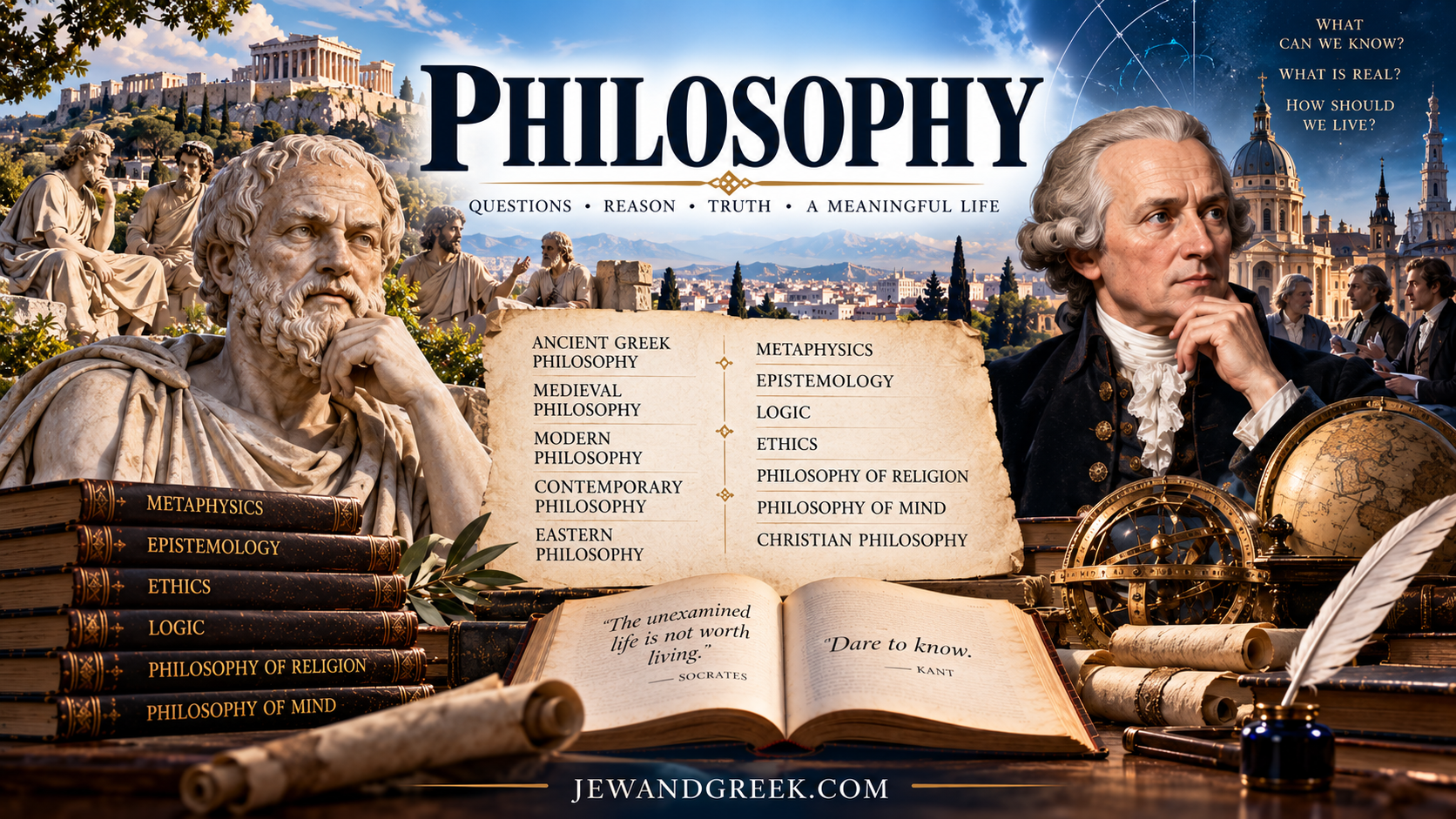
Philosophy begins with questions. What is ultimately real? How can we know whether something is true? What makes an action right or wrong? Are human beings genuinely free? What is the relationship between the mind and the body? Does God exist? What makes a belief reasonable? These questions have occupied thinkers across cultures for thousands of years, and the attempts to answer them have profoundly influenced religion, science, politics, ethics, education, and Western civilization itself.
The word philosophy comes from the Greek philosophia, commonly translated as “love of wisdom.” Philosophy, however, is more than the accumulation of wisdom or the expression of personal opinions. It is the disciplined examination of fundamental questions through reasoning, argument, analysis, and reflection. Philosophers do not merely ask what people believe. They ask whether those beliefs are coherent, what evidence supports them, what assumptions lie behind them, and what conclusions logically follow from them.
For Christians, philosophy has had a complicated but enormously important relationship with theology. Christian thinkers have sometimes warned against philosophical systems that conflict with biblical revelation, while at other times they have employed philosophical concepts and methods to explain and defend Christian beliefs. Questions concerning God, creation, human nature, morality, knowledge, freedom, evil, and the soul inevitably bring theology and philosophy into conversation. Understanding that conversation requires understanding philosophy on its own terms as well as examining it from a Christian perspective.
What Is Philosophy?
Unlike disciplines that concentrate on a relatively defined subject matter, philosophy investigates the assumptions underlying many different areas of human thought. A physicist may investigate the laws governing matter and energy, while a philosopher can ask what a law of nature actually is, whether causation exists independently of human observation, and what qualifies a scientific explanation as knowledge. A historian studies events in the past, while a philosopher may ask how historical claims can be known and what constitutes adequate evidence for believing them.
Philosophy therefore often begins where ordinary assumptions end. We normally assume that an external world exists, that other people have minds, that logical reasoning can lead us toward truth, and that some actions really are better or worse than others. Philosophers ask what justifies those assumptions and what happens when they are challenged.
This does not mean that philosophy consists primarily of doubting everything. Skepticism is one philosophical approach, but philosophy also attempts to construct positive accounts of reality, knowledge, morality, and human existence. Aristotle developed an extensive account of reality, causation, ethics, politics, and logic. Thomas Aquinas attempted to explain how reason and Christian revelation relate to one another. René Descartes searched for a foundation for knowledge that could survive radical doubt. Immanuel Kant investigated the limits and structure of human reason. Contemporary philosophers continue debating many of the same fundamental questions while applying philosophical analysis to developments in science, technology, medicine, artificial intelligence, politics, and culture.
The Major Questions of Philosophy
Several fundamental questions recur throughout the history of philosophy.
What is real? This is the concern of metaphysics. Philosophers investigate existence, identity, causation, time, possibility, necessity, freedom, and the fundamental structure of reality. Questions about whether God exists, whether human beings possess souls, and whether free will is compatible with causation all involve metaphysical issues.
What can we know? Epistemology examines knowledge and justified belief. How do we know that our senses accurately represent the world? What is the relationship between reason and experience? Can testimony provide genuine knowledge? How much evidence is necessary before a belief becomes rational? Skepticism challenges philosophers to explain why we are justified in claiming to know anything at all.
How should we reason? Logic studies the principles of valid reasoning. It examines the structure of arguments and distinguishes conclusions that genuinely follow from their premises from conclusions that do not. Logic also provides tools for identifying ambiguity, contradiction, invalid inference, and common fallacies.
How should we live? Ethics investigates morality, virtue, obligation, justice, and the good life. Philosophers have proposed very different answers. Some emphasize the development of virtuous character, others moral duties and universal principles, and still others the consequences produced by our actions. Behind these disagreements lies an even deeper question: whether moral truths exist objectively or are ultimately products of individuals, societies, or cultures.
What are human beings? Philosophy of mind explores consciousness, thought, personal identity, emotion, memory, and the relationship between mind and body. Ancient discussions of the soul have developed into contemporary debates over materialism, dualism, consciousness, neuroscience, and artificial intelligence.
Does God exist, and what follows if He does? Philosophy of religion uses philosophical reasoning to examine religious claims. It includes arguments concerning God’s existence and attributes as well as questions about miracles, religious experience, faith and reason, divine action, evil, suffering, and whether religious belief can be rationally justified.
These branches overlap constantly. A discussion of human freedom can involve metaphysics, ethics, philosophy of mind, and theology simultaneously. A debate about miracles can involve metaphysics, epistemology, philosophy of science, and philosophy of religion. Philosophy is therefore best understood not as a collection of isolated compartments but as an interconnected investigation into reality and our understanding of it.
Philosophy Before Christianity
Christianity entered a world in which philosophical traditions were already centuries old. Greek thinkers before Socrates attempted to explain nature and reality without relying exclusively upon traditional mythology. Socrates redirected attention toward questions of virtue, knowledge, and the examined life. Plato developed an influential account of knowledge, reality, morality, politics, and the soul, while Aristotle constructed systems of logic, metaphysics, ethics, natural philosophy, and political thought whose influence would extend for more than two millennia.
Other ancient schools offered competing visions of human flourishing. Epicureans emphasized tranquility and freedom from unnecessary fear and desire. Stoics emphasized virtue, reason, self-control, and living according to nature. Skeptical traditions questioned whether human beings could attain the certainty claimed by competing philosophical schools.
The New Testament itself emerged within this intellectual environment. Acts 17 describes Paul encountering Epicurean and Stoic philosophers in Athens and speaking at the Areopagus. Early Christians therefore did not encounter philosophy as a later addition to Christianity. Christianity arose in a world already engaged in sophisticated philosophical debate.
Christianity and Philosophy
The relationship between Christianity and philosophy has never been entirely simple. Some Christians regarded pagan philosophy with deep suspicion, particularly when philosophical speculation appeared to challenge biblical revelation. Others believed that truths discovered through reason could be used in the service of Christian theology.
Augustine interacted extensively with Platonist and Neoplatonist thought while fundamentally reshaping those ideas within a Christian understanding of God, creation, sin, grace, and history. Medieval Christian scholars later encountered the works of Aristotle through a complicated process involving Greek, Islamic, Jewish, and Latin intellectual traditions. Thomas Aquinas became especially important for his attempt to demonstrate that properly understood reason and revelation cannot ultimately contradict one another because both truth and the capacity for reason originate with God.
The Reformation changed the theological landscape without ending Christian engagement with philosophy. The rise of modern science, rationalism, empiricism, Enlightenment skepticism, and later secular philosophies forced Christian thinkers to confront new questions about revelation, evidence, miracles, morality, and religious knowledge. That conversation continues today.
Philosophy Beyond the Western Tradition
Philosophical reflection was never confined to Greece or Europe. Indian philosophical traditions developed sophisticated discussions of reality, consciousness, knowledge, suffering, moral action, and liberation. Hindu philosophical schools offered competing understandings of the self, ultimate reality, knowledge, and the relationship between the individual and the divine. Buddhist philosophy examined impermanence, suffering, desire, consciousness, and the nature of personal identity.
Chinese philosophy developed along different trajectories. Confucian traditions concentrated heavily on virtue, moral formation, family relationships, social order, education, and good government. Daoist thinkers explored nature, simplicity, human striving, and living in harmony with the Dao. These traditions contain significant internal diversity and should not be reduced to a single category called “Eastern thought.”
Studying Eastern philosophy also provides an important corrective to the assumption that philosophical questions must always be framed according to categories inherited from Greece and Europe. Different traditions sometimes ask remarkably similar questions while beginning with very different assumptions.
From Ancient to Contemporary Philosophy
The history of philosophy is partly a history of arguments being inherited, criticized, reformulated, and sometimes revived. Ancient Greek philosophy profoundly influenced medieval Christian, Jewish, and Islamic thinkers. Medieval debates contributed concepts that continued into early modern philosophy. The scientific revolution and Enlightenment generated new disputes concerning reason, experience, knowledge, religion, political authority, and human freedom.
Modern philosophers such as Descartes, Locke, Hume, and Kant transformed discussions of knowledge and reality. Later thinkers challenged many assumptions of the Enlightenment itself. The nineteenth and twentieth centuries saw the emergence or development of movements such as idealism, existentialism, pragmatism, phenomenology, analytic philosophy, logical positivism, and various forms of continental philosophy.
Contemporary philosophy is consequently not a single school. Philosophers today investigate everything from traditional problems of knowledge and morality to consciousness, language, scientific explanation, bioethics, technology, artificial intelligence, political justice, religious belief, and the implications of modern physics and neuroscience.
Faith and Reason
For Jew & Greek, one of the most important philosophical questions is the relationship between faith and reason. Christianity makes claims about reality: that God exists, that the universe is created, that human beings possess particular moral significance, that certain historical events occurred, and that truth can be known. Such claims naturally invite philosophical examination.
Christian philosophy should not simply attach Bible verses to philosophical arguments, nor should philosophy be permitted to determine in advance what Scripture is allowed to say. The more productive task is to examine the assumptions, arguments, evidence, and consequences involved in both philosophical and theological claims.
That means Christians need not fear difficult questions. If an argument against a Christian belief is strong, it deserves serious consideration rather than dismissal. If an argument offered in defense of Christianity is weak, calling it Christian does not make it sound. Intellectual integrity requires applying careful reasoning to arguments we want to accept as well as those we want to reject.
Exploring Philosophy
The study of philosophy is therefore both historical and topical. Understanding how philosophical ideas developed helps explain why contemporary debates take the forms they do, while studying the major branches of philosophy allows individual questions to be examined in greater depth.
Ancient Greek Philosophy
Socrates • Plato • Aristotle • Stoics
Medieval Philosophy
Augustine • Anselm • Aquinas • Scholasticism
Modern Philosophy
Descartes • Locke • Hume • Kant
Contemporary Philosophy
Analytic • Continental • Existentialism • Postmodernism
Eastern Philosophy
Hindu • Buddhist • Confucian • Daoist
Metaphysics
Being • Reality • Causation • Free Will
Epistemology
Knowledge • Reason • Evidence • Skepticism
Logic
Arguments • Deduction • Induction • Fallacies
Ethics
Virtue • Duty • Consequences • Moral Truth
Philosophy of Religion
God • Faith • Reason • Miracles
Philosophy of Mind
Mind • Consciousness • Soul • Personhood
Christian Philosophy
Faith • Reason • Natural Theology • Worldview